


Opinion: ARC Raiders Says Actors Would “Go Crazy” Reading Every Line. Have They Met a Voice Actor?
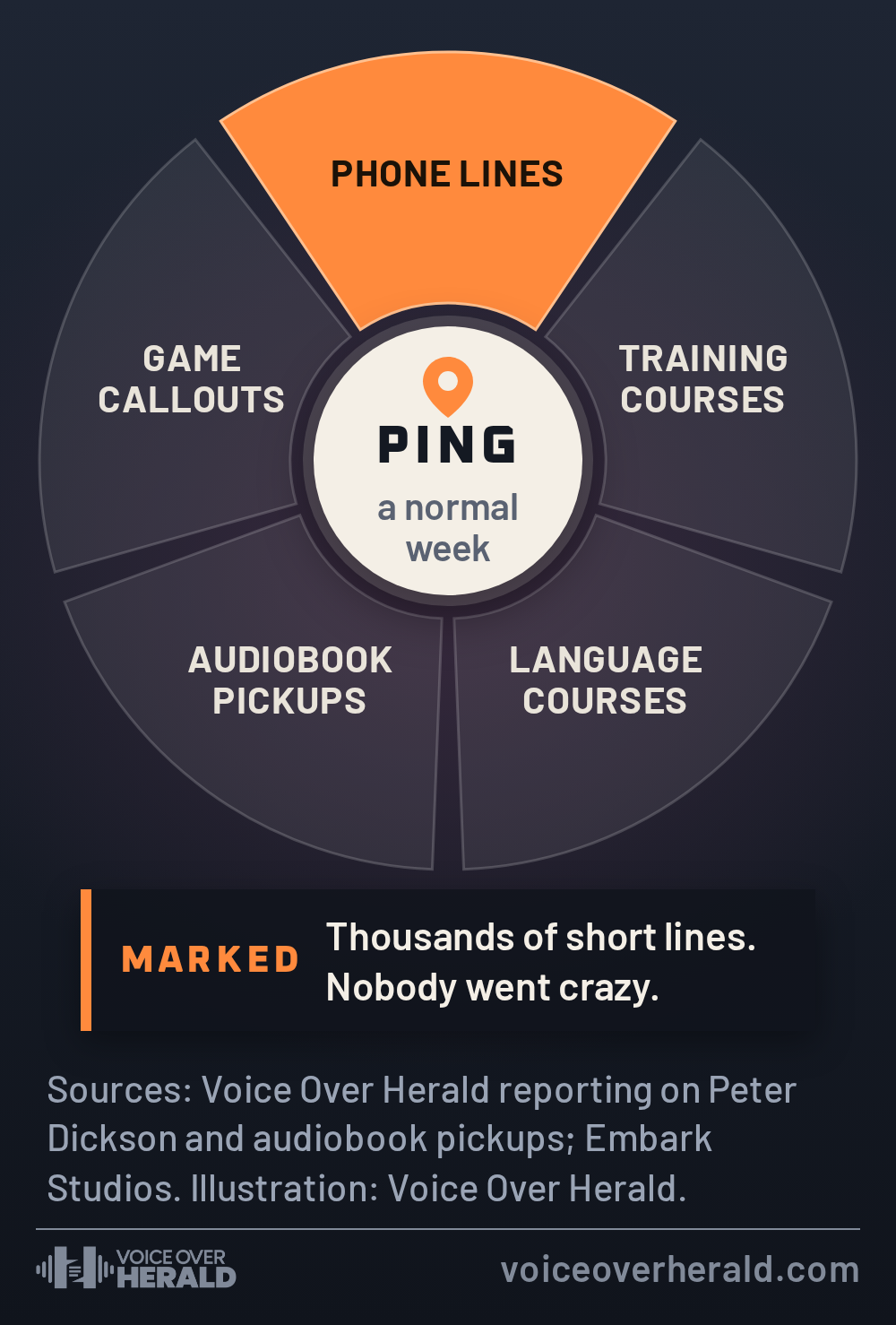
ARC Raiders’ audio director says recording every ping line with real actors would drive them “crazy.” Voice actors read thousands of tiny lines for phone menus, courses and audiobook pickups every week, and stay sane. The hard part was never the reading. It’s the booking, the budget and the contract.
Somewhere right now a voice actor is reading “Press two for billing” for the fourth time, in a slightly warmer way, because the client felt the third one sounded “a bit billing-ish.” Nobody has gone crazy yet. Give it till lunch.
So it was hard not to smile at the week’s most quotable line about our trade. In Embark Studios’ own behind-the-scenes series, The Evolution of ARC Raiders, audio director Bence Pajor explained why the game’s ping system, the bit where your character calls out an item or a place when you mark it, leans on voices generated from the cast’s recordings. “To record the training data for the ping system becomes too impractical to record every possible version of something,” he said. “I mean the actors would just go crazy if they had to read all of that.”
He went on: “That’s not feasible because the game has been changing so fast and we can’t call them in every time we just change a feature.” And to be fair to Embark, he wasn’t sneering at anyone. Chief creative officer Stefan Strandberg said in the same series: “We are not in the industry of replacing actors, actually quite the opposite we should celebrate the performance and give them more space.”
Hear it: Bence Pajor on the ping system from 7:31. The voices of Shani and Celeste, Jo Rideout and Diana Gardner, introduce themselves at 4:24. Video: ARC Raiders, on YouTube
Still, “the actors would just go crazy” is a sentence that deserves a friendly reply from the people who do this for a living. Here it is.
Have you met a voice actor?
Reading enormous piles of short, slightly repetitive lines isn’t a strange edge case of voice work. For a lot of us it’s Tuesday. The famous voice of Britain’s Got Talent, Peter Dickson, built his career on phone lines, training programmes and language courses as much as on the shouting, as he told interviewers Voice Over Herald drew on last week. Corporate e-learning arrives module by module, slide by slide. A phone system is a stack of short prompts that all have to sound like the same calm person on the same calm day.
Audiobook narrators live with the most famous pile of all, the pickup list. As Voice Over Herald reported on Sunday, once a book is recorded someone checks every minute against the text, and the narrator gets a list of timestamps to record again, weeks later, matching a voice they last used in another season. Narrators grumble about pickups. They don’t go crazy. They invoice.
“By the building, near the church” is, with respect, a very gentle script. Most of us have read worse before breakfast, often while a client on the line asks if we could do it “but smiling with the eyes.”
The real problem is the phone call, not the reading
Read Pajor’s words again and the honest bit is in the second half. The game changes fast, and calling actors in “every time we just change a feature” is a scheduling and budget headache. That’s a real problem. It’s also one the rest of the voice business solved a while ago.
 VoiceEditSuiteNewThe audio editor that learns how you breathe.Learns from numbers, never your audio. Never used to train AI.See how it works
Clients batch pickups. They book a regular session, half a day a month or a standing slot every week, and send the new lines in one script. Actors with home studios record same day, and remote sessions mean nobody needs to fly anywhere. Dickson put it well when he described how working from home changed the business: “it’s leveled the playing field for all of us.” A studio with a live game and a cast that, by Embark’s own account, has “been here all along” is about as well placed as anyone to set that up.
So when a studio says a job is “too impractical” for humans, a working voice actor hears something slightly different: “we haven’t priced it as a job yet.” That’s fixable, and it’s a conversation worth having out loud.
Credit where it’s due
None of this makes Embark the villain of the piece, and it would be unfair to write it that way. PC Gamer reports that the actors involved signed contracts allowing the studio to use AI to mimic their voices. Back in March, as Voice Over Herald reported, Embark CEO Patrick Söderlund said the studio pays actors “for the approval to license their voices through text-to-speech for lines that aren’t as essential to the immersion of the experience, mostly ping system audio.”
He also said something every voice actor should frame and hang above the booth: “There is a quality difference.” Embark has re-recorded lines with real voices since launch, and in October it gave Celeste the face of her voice actor, Diana Gardner, a story Voice Over Herald covered when Celeste’s new look arrived. That’s a studio moving toward its actors, not away from them.
And PC Gamer’s Elie Gould makes the fair point that swapping AI lines for real ones where you can “is certainly better than the alternative.” Agreed. It’s just that “where you can” turns out to be most places, once somebody books the session.
What to take into your next contract
Here’s why this matters to a voice actor who will never set foot in ARC Raiders. The ping system is a model for how a lot of work is about to be bought. The big, emotional lines go to the human. The thousands of small, practical lines go to a voice trained on that human. The small lines are exactly the ones that pay rent for everyday voice actors.
The unions are already drawing lines around it. SAG-AFTRA’s new TV animation deal, ratified last week, means a studio needs your consent before your digital replica can dub you into another language. In Britain, Equity told members last month to “proceed with extreme caution” over a game casting that wanted voices for AI training, warning that the client could use them “wherever, forever.”
So before you sign anything with the word “training” in it, ask the boring questions. Which lines will the model say, and which will you record? Is there a cap? Are pickups paid at a session rate, and how often will the studio actually book them? Can you hear what your synthetic self is saying before players do? If the answers are vague, that’s your answer.
The Embark cast, by the studio’s own account, agreed to this deal with their eyes open, and good for them for getting paid for it. The rest of us just get to decide our own terms with the same clear eyes.
One small request
Games will keep changing fast. Phone systems will keep needing “your call is important to us” in six moods. Audiobooks will keep coming back with pickup lists. Every one of those is a job a human can do, has done, and will happily do again on Thursday, if someone sends the script.
So, to every studio that’s tempted to decide what will drive actors crazy: try asking us. We’ll probably say yes, quote you a session rate and send the files before your coffee goes cold. The only thing that has ever really driven a voice actor crazy is a client who changes the script after the session.
Sources: This is an opinion piece. Facts and quotations from Elie Gould, PC Gamer (November 2, 2026); “The Evolution of ARC Raiders S2: EP5, Sound and Music,” Embark Studios, ARC Raiders on YouTube; and Voice Over Herald reporting on Patrick Söderlund’s March 2026 interview with GamesIndustry.biz, Peter Dickson, audiobook pickups, SAG-AFTRA’s TV animation contracts and Equity’s October 23, 2026 casting warning. Images: Embark Studios. Illustrations: Voice Over Herald.
Lee este artículo en español: Opinión: ARC Raiders dice que los actores se volverían "locos" leyendo cada frase. ¿Ya conocieron a un actor de voz?
Know something about this story, or spotted an error? Tell the newsroom.