
Pennsylvania’s AI Ad Law Covers the Radio Spot. From 21 December, a Misleading AI Voice Needs a Label You Can Hear
Pennsylvania has a new law for AI in advertising, and it doesn’t stop at pictures of people. Unlike New York’s, it covers audio. Unlike California’s, it can reach a clone of a real voice. And it starts first. From 21 December, an ad that uses AI audio to give listeners a false idea of what they’re buying has to say so, in a way they can actually hear.
Governor Josh Shapiro signed Senate Bill 806, the Artificial Intelligence Deceptive Advertising Act, on 22 October. It became Act 99 of 2026, and it takes effect 60 days later, on 21 December. Ad lawyers have spent the past ten days writing it up for clients. Read their alerts next to the bill itself and one detail stands out for anyone who voices commercials: of the three state laws on AI in ads, this is the first in force that clearly reaches a radio spot.
That matters if you read for car dealers, banks, clinics and supermarkets. It changes what an advertiser has to think about before it swaps your read for a synthetic one, or for a clone of you.
What the law actually says
The bill’s definitions do the heavy lifting. It defines synthetic content as “Information, including an image, video, audio clip or text, that has been significantly modified or generated by artificial intelligence.” Note the words audio clip. A generated read, a cloned voice or a human read that’s been heavily reworked by AI all fit.
The rule itself is narrower than a blanket label. An advertiser may not “knowingly, recklessly or willfully” put out an ad “that uses synthetic content in a manner that creates a false consumer perception about the nature, origin or authenticity of the goods or services being advertised, without clear and conspicuous disclosure.” So the trigger is a misleading impression about the product, not the mere fact that a machine did the talking.
When the label is needed, the bill is specific. It must say the ad “contains content that was modified or generated using artificial intelligence”. It has to appear the first time the synthetic content is presented, in the same medium as that content, and where it’s technically possible it should be permanent or very hard to strip out. A text crawl at the bottom of a screen won’t cover a radio spot. The bill’s own definition of “clear and conspicuous” includes a line written for audio: the disclosure has to be delivered at a volume and pace a listener can hear and follow.
There are three exceptions: content that’s “evidently fictional”, parody, satire, commentary or criticism, and anything limited to text. Enforcement belongs to the Attorney General or a district attorney, who can seek an injunction, and a court can add a civil fine of up to $3,000 plus legal costs. “There is no private right of action,” the law firm Loeb & Loeb noted in its alert on the act, so a listener can’t sue under this act on their own.
Where it goes further than its neighbours
The bill’s sponsor, State Senator Nick Pisciottano, told KDKA in Pittsburgh that the point is simple. “It’s really to protect consumers,” he said. He also didn’t sound like a man who thinks the problem is shrinking. “This technology is only going to get better and better,” he told the station, adding: “Pennsylvania moved fast on this.” He also said political ads aren’t covered, so this is about selling things, not candidates.
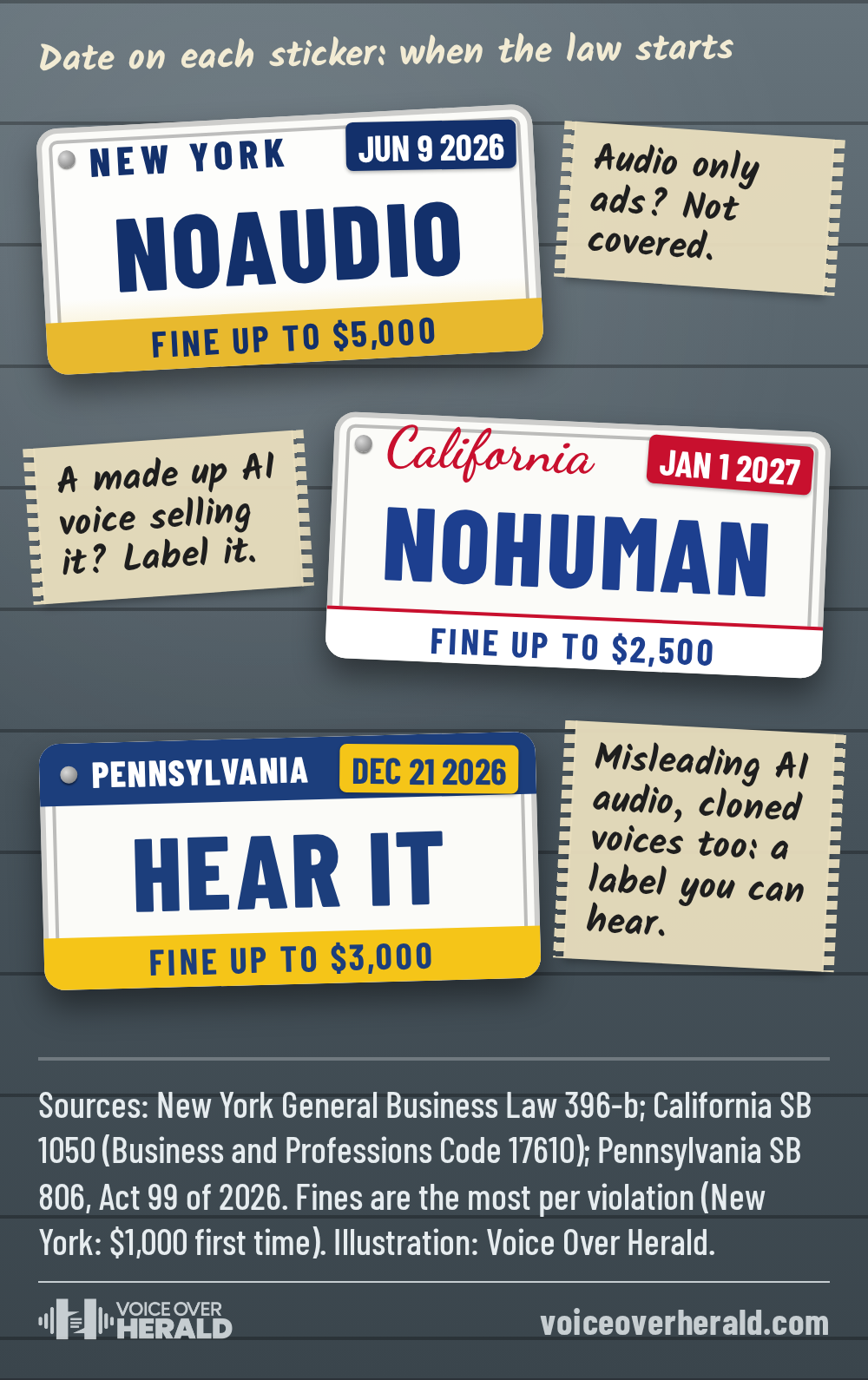
New York’s law took effect in June, and it’s about “synthetic performers”, digital humans that look like they’re performing. The firm Cooley put it plainly when New York’s law passed: “The law does not apply to audio advertisements or where AI is used solely for language translation of a human performer.”
California’s law goes further. As Voice Over Herald reported when it was signed, California’s SB 1050 names the off-camera narrator, so a made-up AI voice that sells the product needs a label there. But California’s definition only covers a synthetic performer who isn’t recognisable as a real person. A clone of an actual voice falls outside it.
 VoiceEditSuiteA director's notes on every take.Upload a take and Performance Coach scores delivery, energy, pacing, character and authenticity, with timestamped notes on what to fix next.See how it worksYour recordings are never used to train AI.
Pennsylvania doesn’t mention performers at all. It talks about content. That’s what pulls in an audio clip on its own, and it’s what pulls in a clone. Loeb & Loeb’s Libby O’Neill made the comparison directly: “An AI-altered real person giving a fake endorsement, which New York and California don’t reach, may.”
She also flagged the other side of the coin. In her reading, “an AI spokesperson delivering accurate information may not require disclosure in Pennsylvania.” In other words, a synthetic voice reading true facts about a real sale may not need a tag at all, because nobody is misled about the product. That’s the trade off at the centre of this law. It’s broader than its neighbours about what counts, and narrower about when a label is due.
Three states, three different tests
Put the three laws side by side and they don’t line up neatly. New York asks whether a synthetic human appears in the ad and the advertiser knows it. California asks whether a synthetic performer, voice included, is prominent in it. Pennsylvania asks whether any AI-made content, sound included, gives a false impression of what’s on sale. A national campaign that runs everywhere could need to pass all three.
For a working voice actor, that patchwork is handy when a client asks why a human read is worth booking for a spot that runs across state lines. A real performance doesn’t need a tag in any of them.
What it means if you voice ads
The law doesn’t ban AI voices, and it doesn’t create a right for you to stop a client using one. What it does is put a cost on getting it wrong. Ballard Spahr’s Alan Kaplinsky and John Culhane told advertisers in a 2 November alert to start “implementing appropriate disclosure controls before the December 21 effective date,” and to check the controls used by their agencies and vendors too.
That creates a few practical moments for you. If a client wants to build an AI version of your voice for spots that will air in Pennsylvania, ask who decides whether a tag is needed and who reads it. A tag that has to be clear and unhurried is a line of copy, and somebody gets paid to record it. If you’ve licensed your voice for synthetic use, the risk of a clone being used to fake an endorsement now sits with the advertiser in one more state, which is a good reason to make sure your contract says what your voice can and can’t be used to say. Our guide to the contract clauses that decide what happens to your voice after the session is a good place to start.
And if you already voice the fast legal lines at the end of car and pharmacy spots, there’s a new kind of tag on the way. The bill says it has to come in the first instance the AI content is presented, not tucked away somewhere later. Speed-reading it won’t do.
- It covers sound. Pennsylvania’s law counts an audio clip made or heavily changed by AI as synthetic content.
- It’s about misleading ads. A label is due when the AI content gives a false idea of the product, not every time a machine speaks.
- Clones are in. Unlike New York and California, it can reach an AI-altered real person giving a fake endorsement.
- The label must be heard. In an audio ad, the disclosure goes in the audio, at a volume and pace a listener can follow.
What happens next
The act starts on 21 December, right in the middle of holiday ad season. California’s law follows on 1 January 2027. Neither state has put out guidance on what a spoken tag should sound like, so the first versions will be written by advertisers’ lawyers, and the first test cases will come from state prosecutors rather than listeners.
Until then, the first state rule that clearly covers a radio spot is about selling soap, not senators. And for the actor who reads the soap ad, the simplest way to stay out of it is the oldest one: be the real voice in the booth.
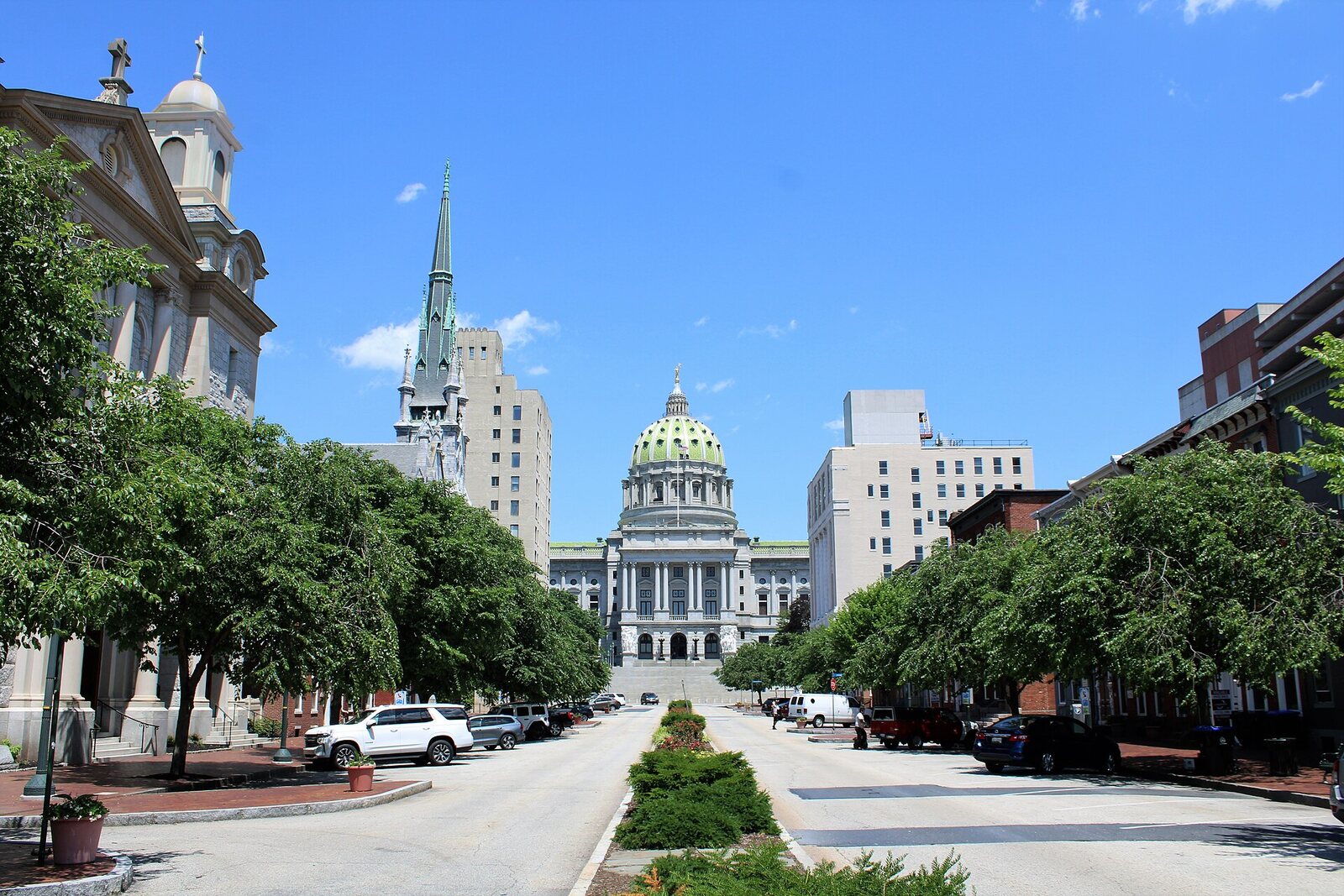
Sources: Pennsylvania General Assembly, Senate Bill 806 (Printer’s No. 1808) and bill history, Act 99 of 2026; KDKA / CBS Pittsburgh, Ricky Sayer (22 October 2026); Loeb & Loeb, Libby O’Neill, “A New AI Disclosure Law from Pennsylvania. But What Does It Actually Cover?” (23 October 2026); Ballard Spahr via The National Law Review, Alan S. Kaplinsky and John L. Culhane, Jr. (2 November 2026); Frankfurt Kurnit Klein & Selz, Brian Murphy, “The Emerging Disclosure Regime for Using AI in Advertising” (29 October 2026); Cooley, “New York Enacts ‘Synthetic Performer’ Disclosure Law for Advertisements” (29 January 2026). Hero image: State Street and the Pennsylvania State Capitol, Harrisburg, by Farragutful, Wikimedia Commons, CC BY-SA 4.0.
Lee este artículo en español: La ley de Pensilvania sobre IA en anuncios alcanza a la radio. Desde el 21 de diciembre, una voz de IA engañosa necesita un aviso que se oiga
Know something about this story, or spotted an error? Tell the newsroom.