


ACTRA’s New Commercial Deal Offers Voice Actors 2.5%, and It Ends in May. Members Vote From 16 November
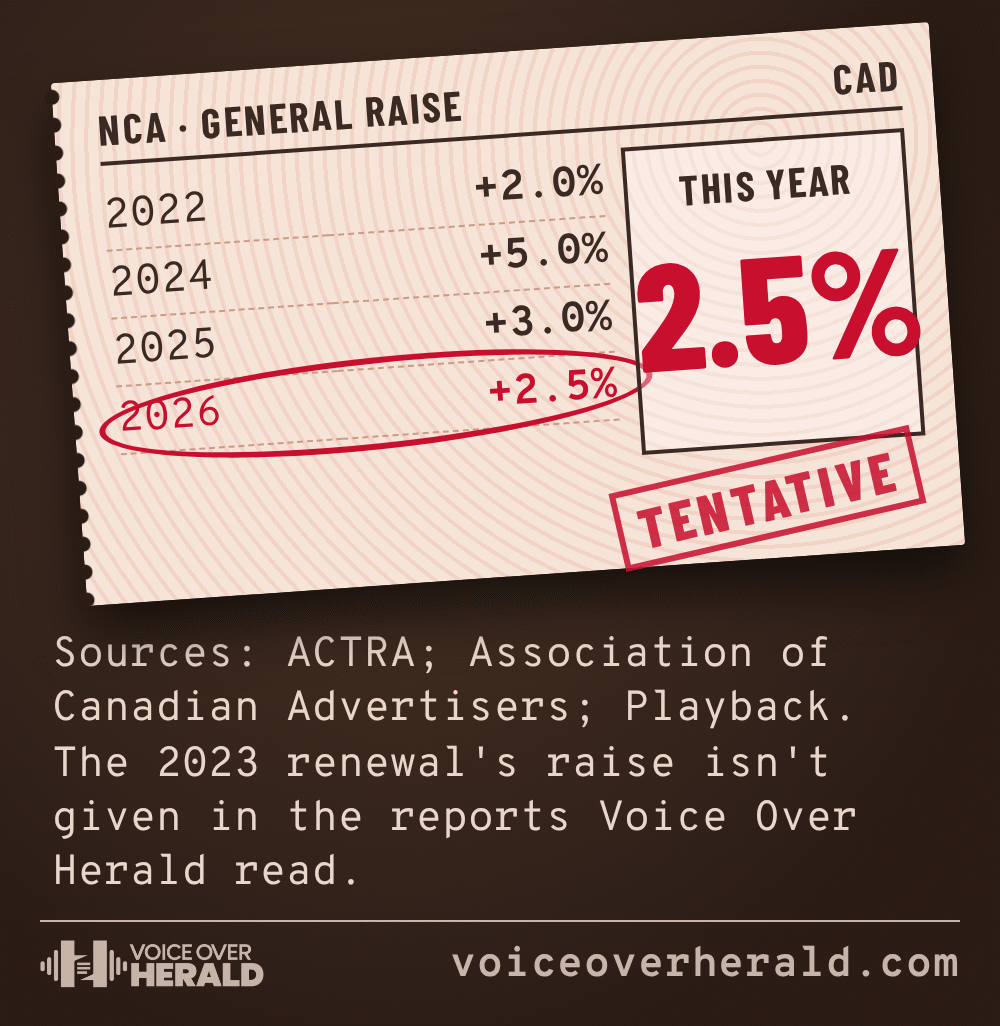
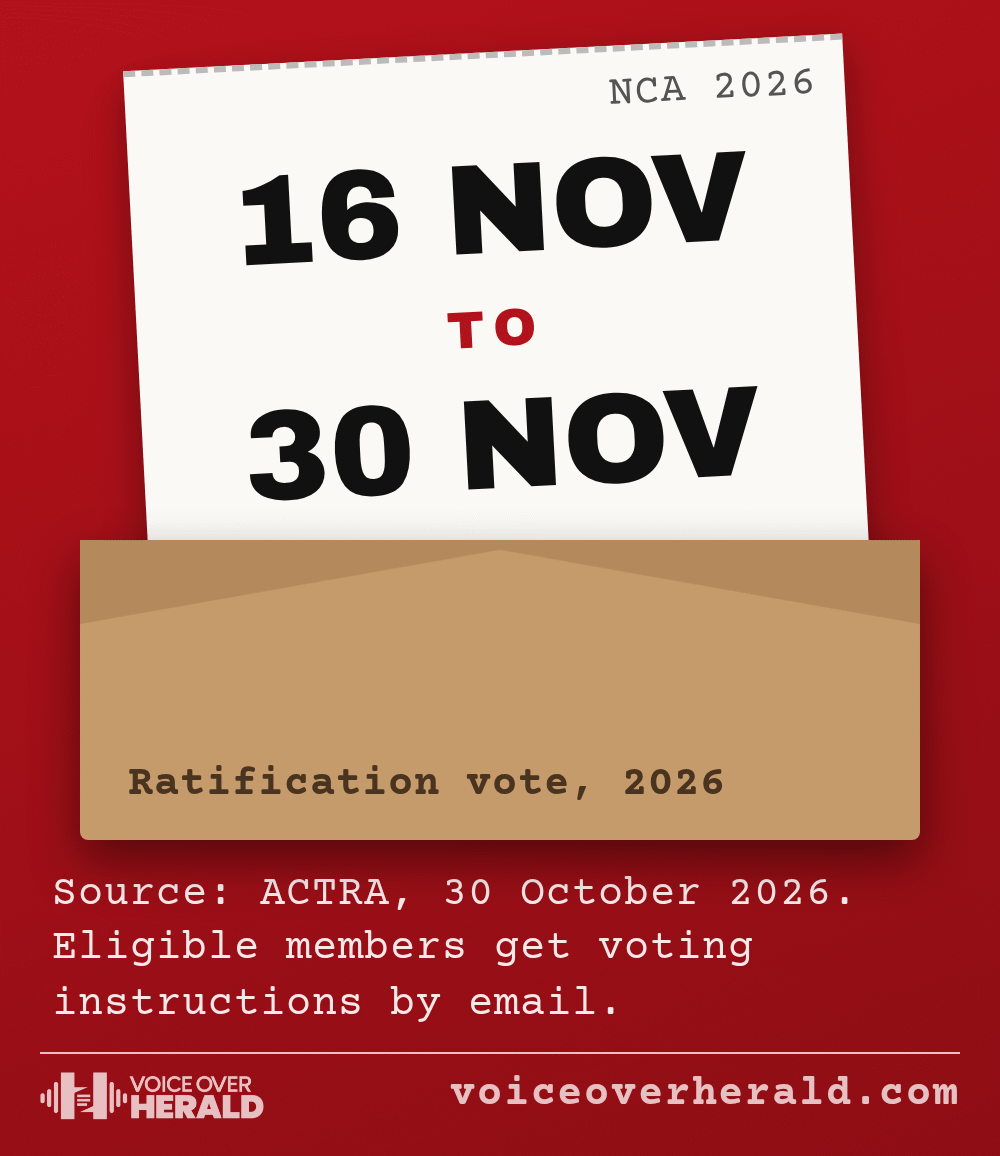
Canada’s union for screen and radio performers has a new commercial deal to put to its members. It offers a 2.5% general raise and more for ads that run online, it ends on 31 May 2027, and voting runs from 16 to 30 November. For the voice actors who read Canada’s radio spots and TV voice-overs, it’s the fifth one-year deal in a row, and the smallest raise of the last three.
ACTRA, the Alliance of Canadian Cinema, Television and Radio Artists, told members on 30 October that it had reached tentative terms with the Association of Canadian Advertisers to renew the National Commercial Agreement, the contract that sets minimum fees for union performers in English-language commercials made in Canada.
The NCA covers performers on camera and off it, which means the voice-over artist in a booth in Toronto or Vancouver is paid from the same rate chart as the actor holding the coffee cup on screen. A small change to that chart reaches a lot of working voices.
What’s on the table
ACTRA’s notice to members is short. “Your Bargaining Committee secured a 2.5% general wage increase with an additional increase to digital media use rates,” it says, and the union’s National Executive “has unanimously endorsed this tentative agreement.” The full terms go to eligible members by email before the vote.
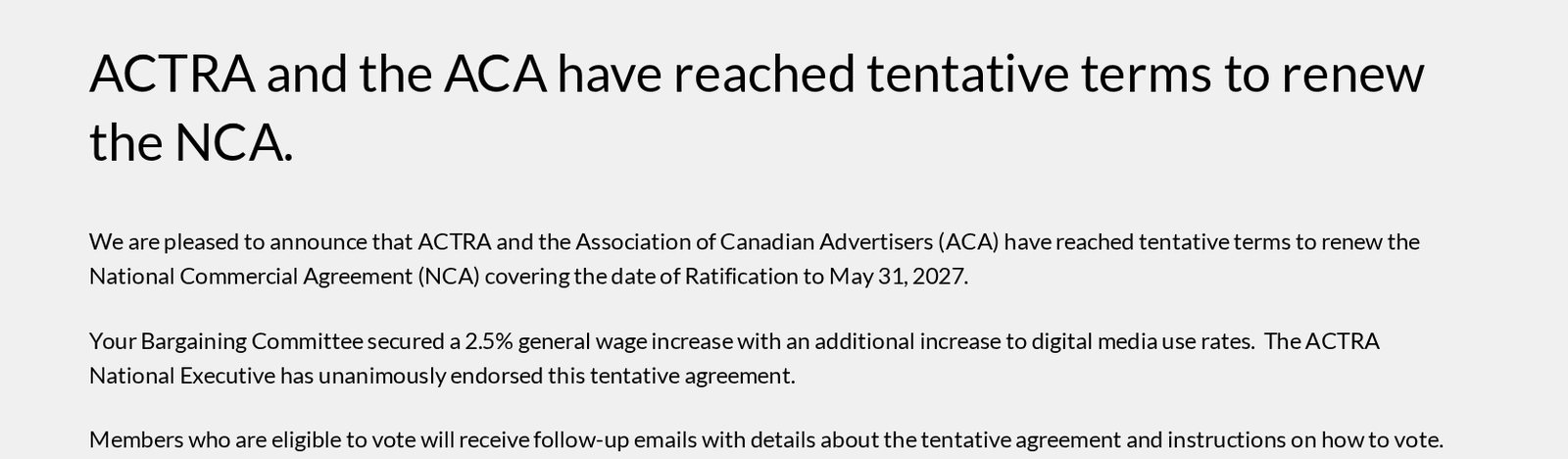
Screenshot: ACTRA, actra.ca, taken 2 November 2026
The term is the part worth reading twice. The deal covers “the date of Ratification to May 31, 2027.” If members say yes at the end of November, that’s a contract of roughly six months. The previous renewal ran from 1 June 2025 to 31 May 2026, so the last agreed rates have been more than five months past their end date while talks went on.
ACTRA’s notice doesn’t say whether the 2.5% reaches back to June, and it doesn’t put a number on the extra increase for digital media use. Those details should be in the package members receive before they vote.
The headline figure also keeps a slide going. It’s the smallest general raise in three rounds, with the digital bump on top for ads that live online, which is where a growing share of commercial voice work now ends up.
Where voice work sits in the agreement
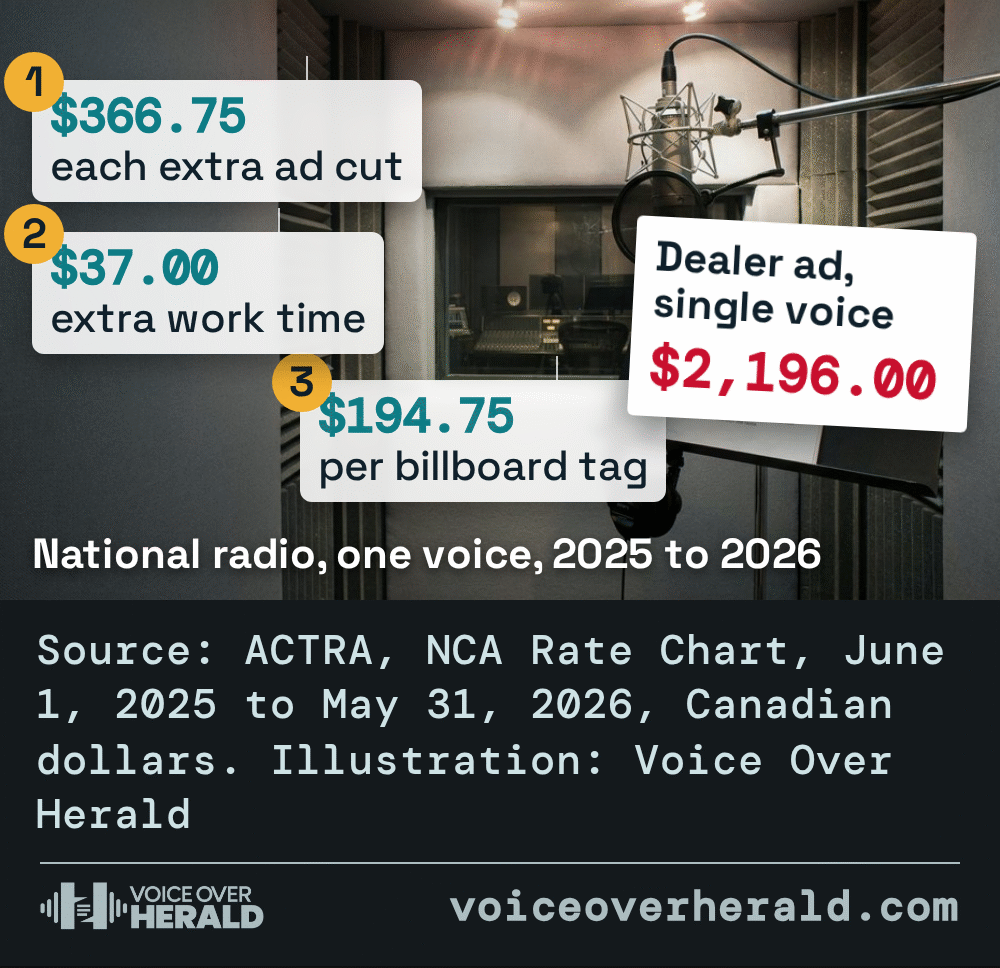
On the 2025 to 2026 rate chart, which ACTRA publishes as a PDF, voice actors appear under their own lines. A national TV commercial pays an off-camera voice-over performer a session fee of $685.00, which includes four hours of work time. National radio has its own table: a single voice is paid a minimum of $731.50 per session and 13-week cycle, with separate fees for extra cuts, tags and dealer ads. All figures are in Canadian dollars.
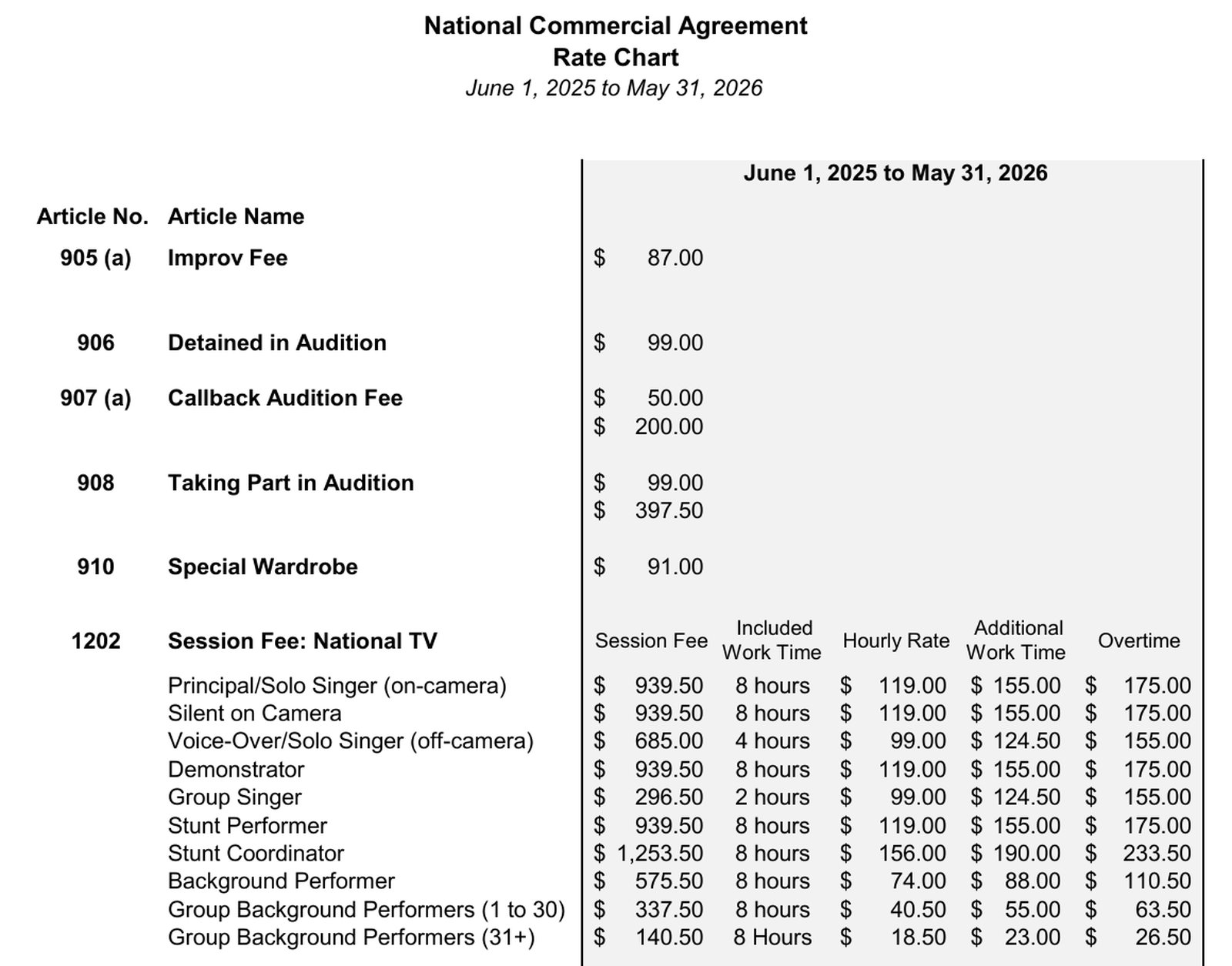
Screenshot: ACTRA, NCA Rate Chart 2025 to 2026, page 1, taken 2 November 2026
Run the new general raise across that radio minimum and it comes to about $18.29 more, taking it to roughly $749.79, by Voice Over Herald’s arithmetic. That assumes the 2.5% lands evenly on every minimum fee, which is how a “general wage increase” usually works but which the members’ package will confirm.
The digital side is where the extra increase goes. Under the current chart, a single voice in an audio ad used online is paid a use fee of $1,012.50 for a year, with shorter terms for six months and 45 days. Those online use fees are the “digital media use rates” ACTRA says will rise by more than 2.5%.
For a voice actor who mostly works on regional radio, the numbers are smaller. The Local and Regional addendum has its own scale, split into regional categories, and the new raise would flow through those tables too if the general increase applies across the board.
Five one-year deals since 2022
Short contracts weren’t the plan. In 2022, after the Institute of Canadian Agencies stepped away from the agreement and ACTRA and the advertisers carried on without it, both sides told Playback they were committed to working together, in Playback’s words, “on a more long-term NCA that’s modernized and simplified.” That renewal gave performers 2%, the first pay increase in roughly two years, and ACTRA’s chief negotiator Marie Kelly said it “will provide stability in the commercial industry.”
A year later the two sides renewed again for twelve months. Playback, carrying a report from Strategy, described the NCA as “currently over 200 pages long” and in need of simplification, and quoted Kelly: “This agreement ensures that Canada’s advertisers and partner agencies can engage ACTRA members on terms that respect and recognize the value professional performers bring to the industry.”
The 2024 renewal was the big one. In a joint release published by the advertisers’ association, Kelly said: “This renewal fosters stability for our members and includes an unprecedented five per cent general pay increase across the board for ACTRA performers.” Judy Davey, the ACA’s vice president of media policy and marketing capabilities, said the association’s advertisers “recognize the value ACTRA performers bring to every commercial production.”
Then came 3% for 2025 to 2026, which ACTRA’s agreement page says was renewed “to provide stability for the industry.” And now 2.5%. Each year the word is stability, and each year the long-term rewrite is still to come. ACTRA’s NCA page also still tells members not to accept work from the engagers that “have unlawfully locked out ACTRA performers from the workplace.”
The AI promise from last year
The 2025 deal carried something new. The memorandum of agreement, signed in Toronto on 29 April 2025, included a letter of understanding on artificial intelligence. In it, the ACA “recognizes the importance of Artificial Intelligence as an urgently evolving topic” and commits to working with ACTRA through a joint committee to “share information, discuss developments, and address matters related to the use of AI in commercials including the parties mutual desire for the protection of human employment and creative opportunities.”
The memorandum set a timetable: a first meeting within four months of ratification, then quarterly meetings for the rest of the term. For voice actors, whose reads are among the easiest parts of an ad to replace with a synthetic voice, that committee is the part of the contract that talks about the future of the work.
ACTRA’s 30 October notice doesn’t mention AI at all, and Voice Over Herald found no public report of what the committee has discussed since 2025. Whether the AI letter carries over, grows or stays a promise to keep talking is one more thing members will only learn from the full package.
How the vote works, and what to look for
ACTRA says members who are eligible to vote will get a follow-up email with details of the tentative agreement and instructions. Voting opens on 16 November and closes on 30 November 2026. In past rounds the advertisers’ board has ratified on its side as well, so both votes need to land before the new rates apply.
 VoiceEditSuiteNewAuto Clean Up now learns you.Learns from numbers, never your audio. Never used to train AI.See how it works
If you voice Canadian commercials under the NCA, four things are worth checking when that email arrives: whether the 2.5% is backdated to 1 June, how big the digital use increase is and which tables it touches, whether the AI letter of understanding is renewed or strengthened, and whether there’s a date for the longer, simplified agreement both sides first promised in 2022.
A raise is a raise, and plenty of performers in other countries would take one. But six months of contract after five months without one is a short runway, and the people who read the ads will be back at the table by spring.
Sources: ACTRA National, “ACTRA and the ACA have reached tentative terms to renew the NCA”, 30 October 2026; ACTRA National, National Commercial Agreement page and 2025 to 2026 NCA Rate Chart; ACTRA and ACA, Memorandum of Agreement, 29 April 2025; Association of Canadian Advertisers, “ACTRA performers and ACA advertisers ratify the one-year renewal of National Commercial Agreement in Canada”, 13 June 2024; Playback, “ACTRA members ratify new contract with Association of Canadian Advertisers” (2022) and “ACTRA and ACA renew agreement for another year” (2023, from Strategy). Images: ACTRA (screenshots taken 2 November 2026); hero photo © Voice Over Herald.
Lee este artículo en español: El nuevo acuerdo comercial de ACTRA ofrece 2,5% a los actores de voz y vence en mayo. La votación abre el 16 de noviembre
Know something about this story, or spotted an error? Tell the newsroom.