
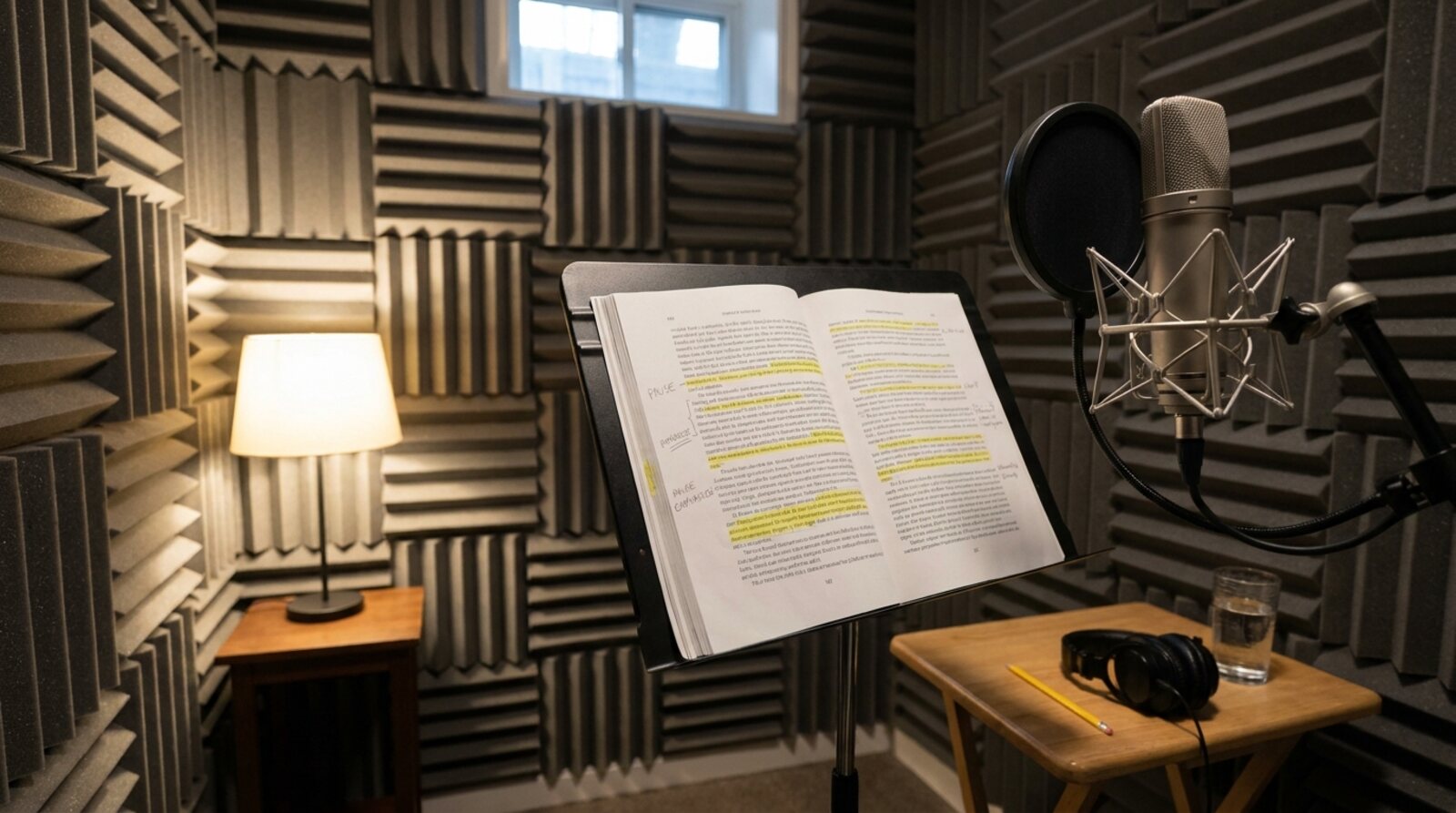
The Book Before the Booth: How Audiobook Narrators Prep, and What Happens When the Pickup List Arrives
Most of an audiobook happens off the microphone. Narrators read the book before they record a word, build lists of who speaks and how every strange name is said, and then, weeks later, open a list of timestamps telling them what to record again. Here’s how that prep and those pickups actually work, from the people who do it and the contracts they sign.
Ask a working narrator how long a book takes and you’ll rarely get the running time. You’ll get the running time multiplied. Listeners imagine the recording. The reading, research, lists, questions and pickups decide whether a narrator makes a living or quietly loses money on every finished hour.
The read nobody hears
Every guide starts in the same place. ACX, Audible’s production platform, puts it at the top of its producer’s checklist: “We recommend reading the manuscript from beginning to end before you begin recording.”
The reason is practical. A character described as hoarse on page 300 may already have spoken on page 12. A twist in the last chapter can change how an early line should land. You can fix a mispronounced word in a pickup; you can’t easily fix a voice you chose for a character before you knew who they were.
Cassandra Campbell, who narrated Where the Crawdads Sing, told Behind the Mic, the audiobook podcast from AudioFile magazine, that the first read is about listening. “When I’m reading silently to prepare a book, what I’m really doing is kind of listening to the author’s tone,” she said, in the interview published by Literary Hub. She also keeps her script bare: “I don’t make any marks on my manuscript; I like it to be clean,” she said, so her questions and pronunciation notes go on a separate sheet instead.
Image: Literary Hub, screenshot taken 1 November 2026
Plenty of narrators do the opposite and mark up every page. The method matters less than the timing: the decisions get made before the microphone is on.
Two lists: who talks, and how to say it
Ask narrators what they actually produce during prep and two documents keep coming up. Julia Whelan, who has narrated hundreds of audiobooks, described both to the Associated Press in 2025: “I create character lists. I create pronunciation lists, and I do the necessary research for that.” She added a warning for anyone quoting a flat rate of prep time: “The prep time can vary book to book significantly, depending on how complicated the book is.”
The character list is a continuity bible: who each person is, how the author describes their voice, their age and accent, and a note of how you played them. In a series, that note saves you when book four brings back someone last heard two years ago.
Campbell explained to Behind the Mic why the voice has to stay steady: “there has to be a vocal through line for the listener so that immediately they know she’s the one who’s talking.”
The pronunciation list is the other half. Editors who prepare books for narrators are advised to help. Carol Saller, writing for the Chicago Manual of Style’s CMOS Shop Talk, tells authors and editors to “prepare a single list of pronunciations” for names and words that recur, rather than marking every instance. If nobody hands you one, ask before you start.
Some publishers take the research off the narrator altogether. When Publishers Weekly visited the studios of Recorded Books, a dedicated research department checked pronunciations for its narrators. One of its researchers, David Gassaway, explained why the effort matters: “People believe things that they hear, and people trust publishers to get things right.” Many smaller productions leave it all to the narrator, which means the hours belong on your side of the ledger.
Fifteen minutes that set the rules
On ACX, the first formal check comes early. Its Audiobook Production Standard Terms (version 2.2, last revised in January 2021) say the producer “will deliver the first 15 minutes of the Audiobook to Rights Holder for Rights Holder’s approval”. The rights holder will try to respond within 4 business days, and the producer will make up to two sets of revisions to that opening.
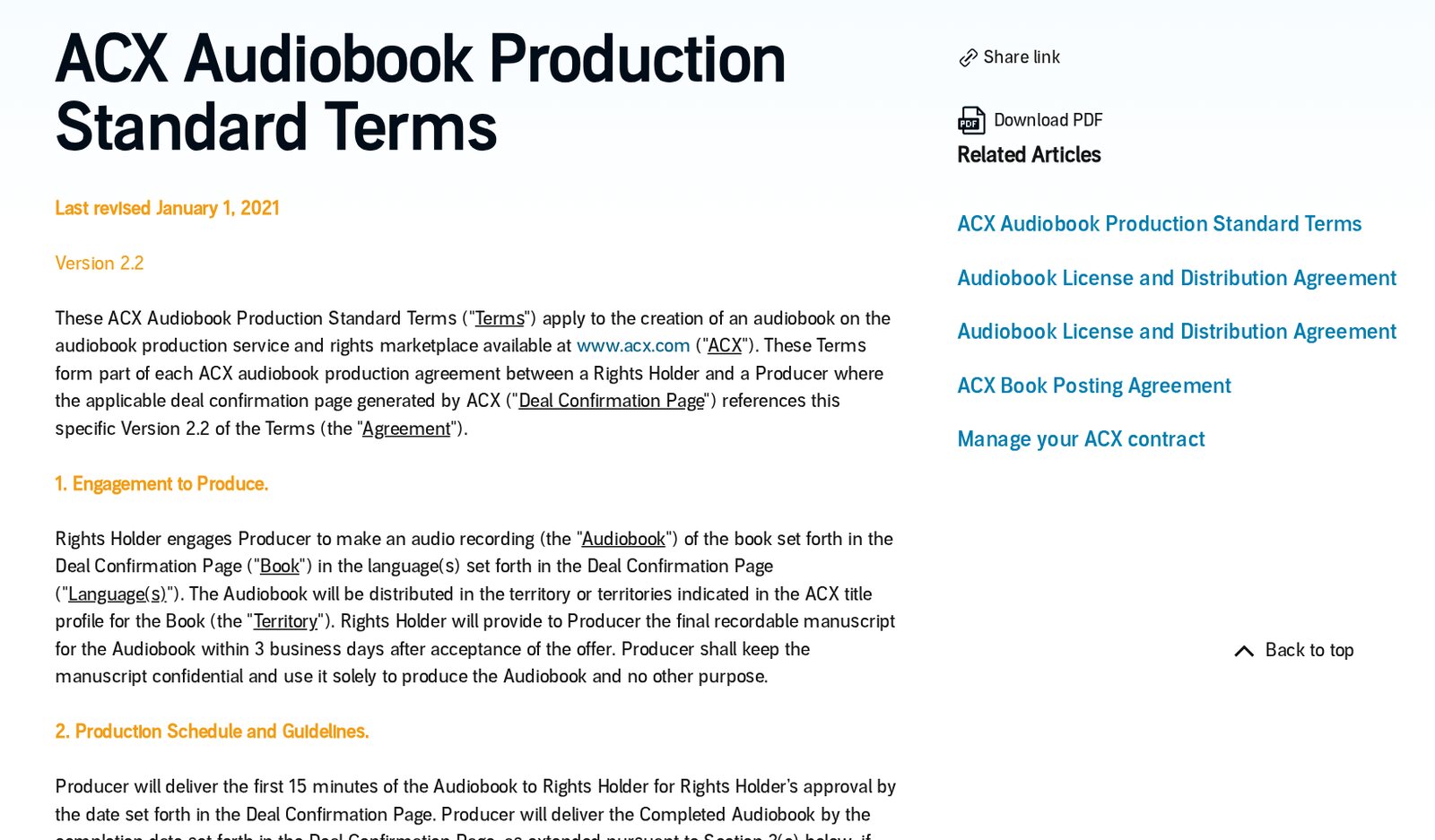
Image: ACX help center, screenshot taken 1 November 2026
ACX’s own checklist says the checkpoint covers “accents, pronunciations, character voices, pacing, and tone”. That’s your prep, put to a vote. If the author hears your lead and says she sounds too old, this is the cheap moment to find out, not chapter 30.
The same terms say the rights holder must supply “the final recordable manuscript” within 3 business days of accepting your offer. Final is the word to hold on to. If the text changes after you’ve recorded it, the terms are silent on who pays for the new lines, so agree that in writing before day one.
There’s a safety valve on length too: a producer can end the deal if the rights holder’s word count is off by 20% or more. A longer book means more prep, recording and pickups for the same rate.
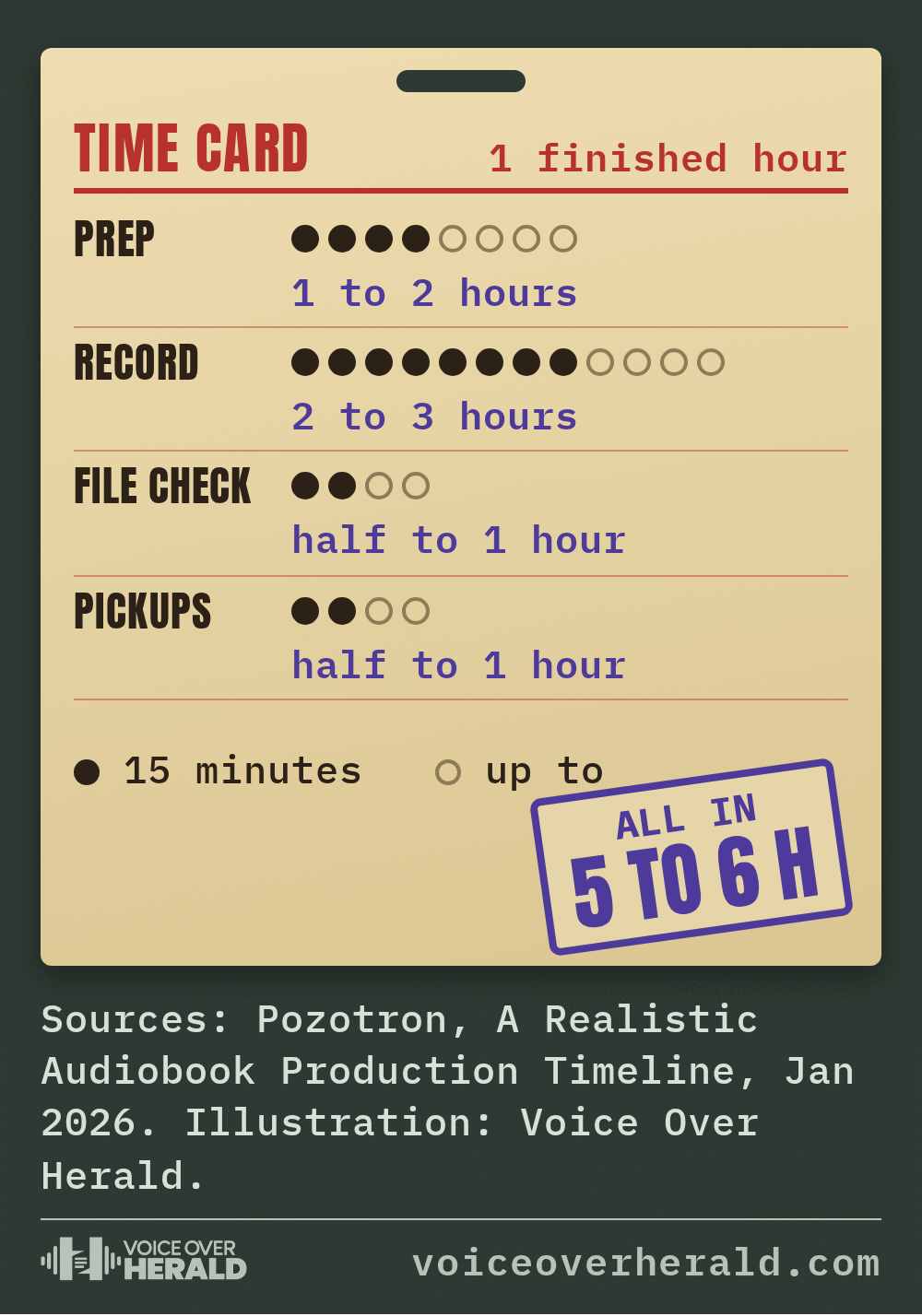
What one finished hour really costs
The numbers narrators quote for their working hours are remarkably consistent. Anne Marie Lewis, a Chicago narrator interviewed by the Vernon Area Public Library in Illinois, put it this way: “It takes five to six hours of work for each finished hour of audio, plus the time it takes to prep a script.” A profile of Whelan in Palm Springs Life, republished by her old college, said: “For every hour of narration, Whelan takes about four hours to prepare and research.”
 VoiceEditSuiteSave the take. Lose the noise.Studio Rescue strips hiss, mains hum, fan wash and room noise out of a recording and leaves your voice untouched, with the noise floor measured before and after.See how it worksYour recordings are never used to train AI.
The proofing software company Pozotron broke it down further in a production timeline published in January 2026: one to two hours of manuscript review and script prep per finished hour, two to three hours of recording, half an hour to an hour of file review and naming, and another half hour to an hour for pickups. It puts the total at five to six hours of labor, and three to six more if you edit, proof and master the audio yourself.
Publishers Weekly found the same ratio inside a big studio more than a decade ago: “On average, it requires twice the final length of an audiobook in order to do the recording.” Prep and pickups sit on top of that.
So a per finished hour rate is not an hourly rate. Divide it by five or six before comparing it with anything else. Our earlier piece on how ACX changed the way narrators get paid covers the royalty side of the same sum.
Then the pickup list arrives
When the recording is done, someone listens to every minute against the text. Lewis described the job her proofer does as checking for “misreads, mispronunciations, inconsistencies with voices.” Each one becomes a pickup: a short line or passage you record again so an engineer can drop it in.
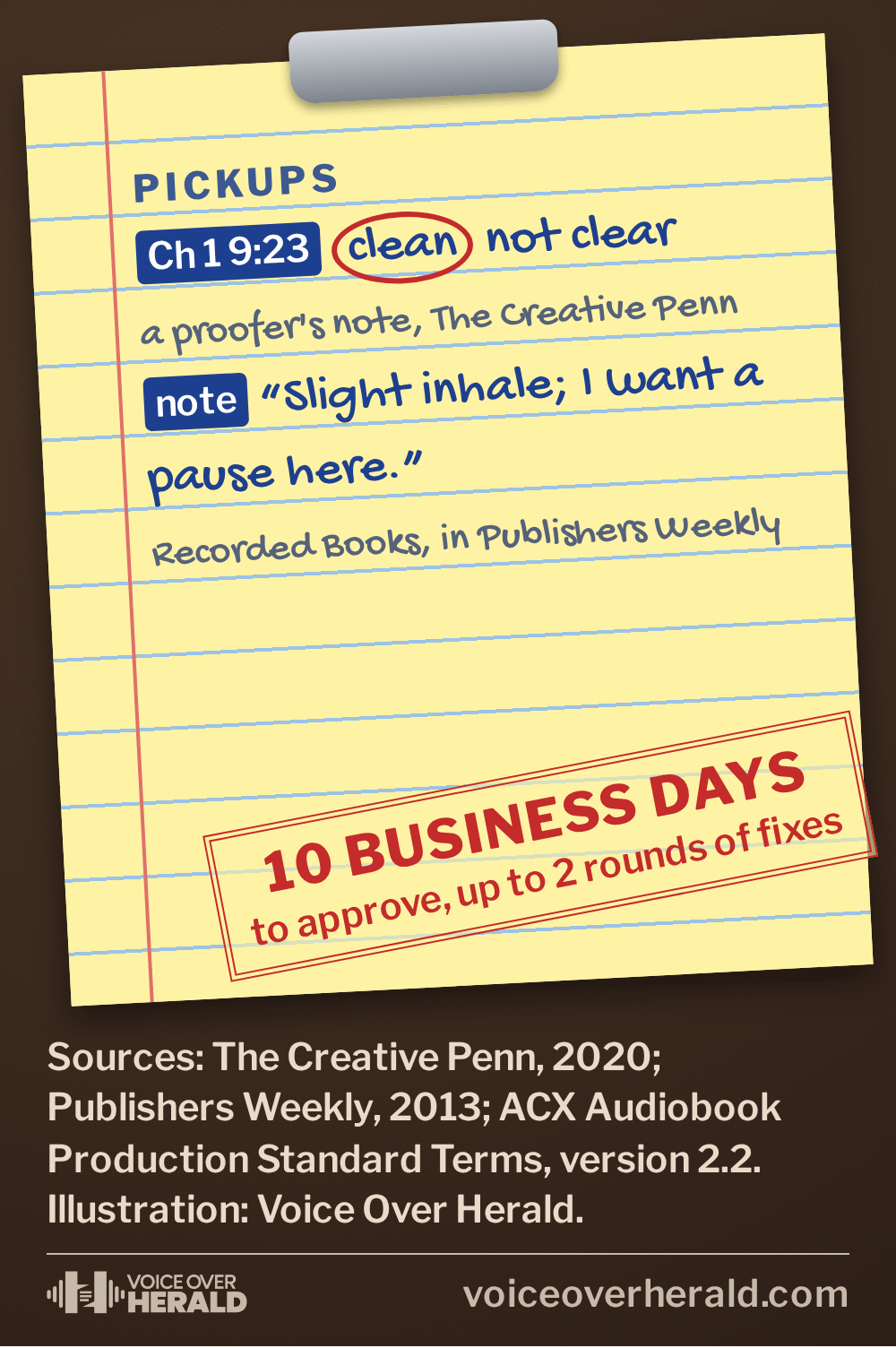
The list usually arrives as timestamps. Maxwell Cantrell, writing about proof listening for The Creative Penn, set out the format with his own example: chapter 1, 9:23, “clean not clear”. “Your audiobook narrator/producer will need to know the chapter and the time stamp as well as the details of the issue,” he wrote. He also told proofers to “improve the audiobook within the constraints of the agreed performance”, which is a useful line to quote back if a note asks you to reinterpret a character you’ve already had approved at the checkpoint.
Recording pickups is its own skill. One sentence has to drop into a chapter recorded weeks earlier, so the mic position, the room, your energy and the character’s voice all have to match. Your character list and a quick log of mic distance and settings earn their keep here.
On ACX, the contract caps the back and forth. The rights holder has 10 business days to approve the completed audiobook and is treated as having approved it if they say nothing, though they can ask for two extensions of up to 10 business days each, which the producer may grant or refuse. The producer “will make up to two sets of revisions to the Completed Audiobook”, any rejection needs “specific and detailed feedback”, and once approval is given the terms say it’s final. Saller’s advice to authors points the same way: “at least one round of corrections is included when you hire a narrator,” she wrote, and anything beyond that costs extra.
Your own misreads are part of the job. A rewritten paragraph or a name changed late is new work, and saying so politely, with the timestamp, is normal business.
What to settle before you press record
- The final manuscript. Confirm in writing that it’s the published text, and what happens if it changes.
- The pronunciation list. Who supplies it, and how fast questions get answered.
- The checkpoint sample. Pick pages with the hardest voices and accents, as ACX suggests.
- Rounds of fixes. Two and two on ACX. Off platform, write the number down.
- Who pays for author changes. Your misreads are on you. New text is new work.
- How notes arrive. Chapter, timestamp, the line as written and what was heard.
None of this makes you difficult to work with. A character list, a short set of questions and a clear plan for what happens after the last chapter are how a book comes in on time, and on time is what everyone in the chain wants.
And if you want a sense of how the very best do the reading itself, our look at the first five narrators in audiobook’s Hall of Fame goes inside their methods.
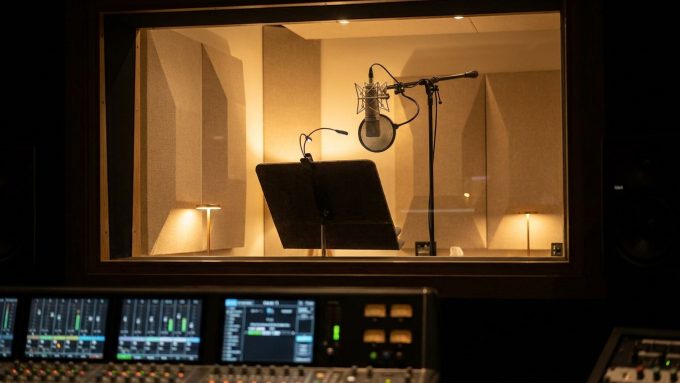
Sources: ACX Audiobook Production Standard Terms, version 2.2 (help.acx.com); ACX, The ACX Producer’s Checklist; Literary Hub, A Conversation with Cassandra Campbell (AudioFile’s Behind the Mic, 25 June 2021); Associated Press, Alicia Rancilio, 31 July 2025; Palm Springs Life profile of Julia Whelan, republished by Middlebury College; CMOS Shop Talk, Carol Saller, 15 October 2019; Publishers Weekly, Grace Bello, 11 May 2013; Vernon Area Public Library, interview with Anne Marie Lewis, 29 March 2022; The Creative Penn, Maxwell Cantrell, 19 November 2020; Pozotron, A Realistic Audiobook Production Timeline, 28 January 2026. Hero image: an empty home narration booth, © Voice Over Herald.
Lee este artículo en español: El libro antes de la cabina: cómo se preparan los narradores de audiolibros y qué pasa cuando llega la lista de pickups
Know something about this story, or spotted an error? Tell the newsroom.