


Japan Opens a Free Help Desk for Voice Actors Whose Voices Were Copied by AI
Japan’s voice actors now have somewhere to call when an AI copy of their voice turns up online. A free “voice consultation desk” opens today, Monday, September 28, run by NTT West’s VOICENCE unit with a Tokyo intellectual property lawyer. It arrives two days before a Tokyo court rules on the country’s first lawsuit over a cloned voice, and it’s run by a company that also sells licensed AI voices. Both facts matter.
The desk is called Koe no Sodan Madoguchi, which translates simply as “voice consultation desk.” Anyone can use it: voice actors, stage and screen actors, narrators, musicians, comedians, the agencies that represent them, and the brand managers who want to use AI voices without starting a fire on social media. It costs nothing. You fill in a form on a dedicated website and someone gets back to you.
That sounds modest. The people who set it up say modest is the point. In Japan, the first hurdle for a performer who finds a copy of their voice isn’t the law. It’s knowing who to ask.
Forty thousand copies and nowhere to start
The announcement leans on numbers from a nonprofit that tracks misuse of performers’ likenesses. Its survey for the 2025 fiscal year found more than 40,000 images and videos that appeared to use AI to generate celebrities’ likenesses or voice actors’ voices without permission, with estimated economic losses of about 2 billion to 4.5 billion yen.
The law has moved a little. In August 2026, Japan’s Ministry of Justice published a report and interpretive guidelines on civil liability for the unauthorized use of a person’s likeness and voice. VOICENCE is careful about what that did and didn’t do. The guidelines, its announcement says, organize how existing law should be read. “It does not mean a new law has been created that directly protects the voice itself,” the company writes.
So a performer who hears their voice selling something on YouTube is left with a patchwork: publicity rights, unfair competition rules, platform complaint forms and a lawyer’s bill. The announcement says the barrier is highest for freelancers with no agency or union behind them, for whom “finding the entrance to consult a lawyer is itself a hurdle.”
- It’s free. There’s no charge to use the desk, whether you’re a performer, an agency or a company.
- It’s a first stop, not a law firm. The desk gives general guidance and does not give legal opinions on individual cases.
- Lawyers come on request. If a case needs legal action, the desk refers you to outside specialists, but only if you want that.
- Freelancers are the focus. Performers with no agency behind them are the ones the organizers say struggle most to find help.
- Your case becomes data. Consultations are anonymized and used to build shared guidelines on voice rights and AI contracts.
What you can actually ask
The examples VOICENCE lists read like a voice actor’s inbox in 2026. A performer finds an AI voice that sounds exactly like them posted or sold on YouTube or social media without permission. A performer receives an offer to have their voice turned into an AI model and doesn’t know what to check before saying yes. A performer simply wants to talk through whether using AI with their own voice is a good idea, and has no idea where to go.
Companies get their own list. How do you reach proper agreement before making an AI version of a character’s or voice actor’s voice? How do you use the technology without a public backlash or a rights claim?
The desk is run by VOICENCE together with Hajime Idei, a lawyer at Kotto Dori Law Office, which is cooperating on the project. Idei says the questions won’t all be legal ones. “The matters people consult about are not necessarily limited to legal problems,” he says, pointing to practical questions such as what can be done with current technology and how an agency should explain voice risks to the performers on its books.
How the desk works
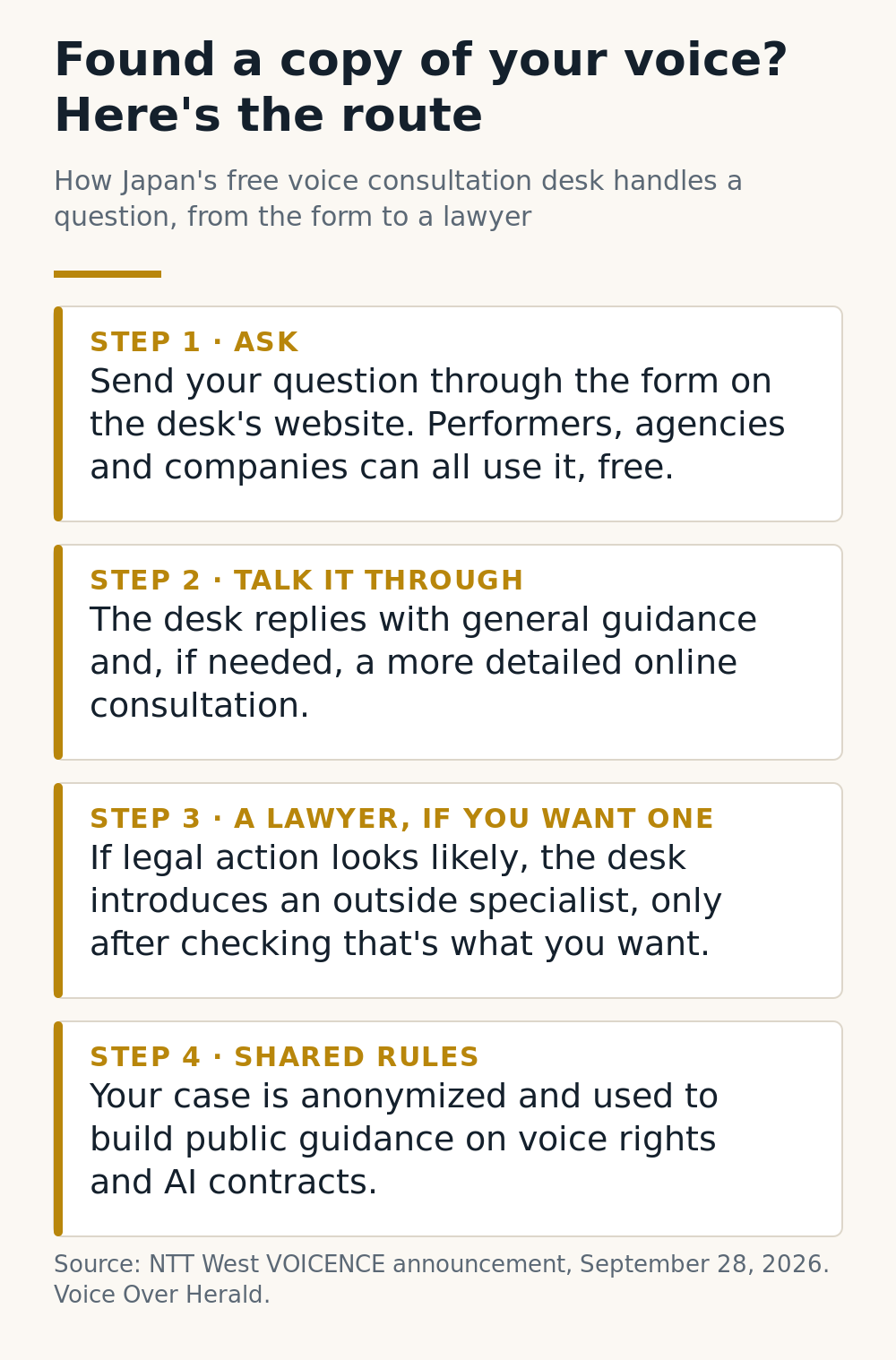
The process has four steps. You send your question through the form. The desk reviews it and replies with general information and ways of thinking about the problem, with a more detailed online consultation if needed. If legal action looks likely, it introduces an outside expert, after checking that’s what you want. Finally, your case is stripped of anything that could identify you and added to a pool of knowledge the organizers plan to turn into public guidance.
 VoiceEditSuiteRaw take in. Clean take out.
That last step is the ambitious one. According to the announcement, one of the biggest problems right now is that there is no standard for what to watch out for or what kind of contract a voice needs. VOICENCE says it plans to publish basic guidance on voice use and contracts in the generative AI era, and a guide to the agreements that should be in place before anyone’s voice is used.
The seller running the help desk
There’s an obvious question here, and it deserves a straight answer. VOICENCE isn’t a union or a charity. NTT West launched it in October 2025 as a voice AI business: performers deposit their voice, NTT builds an AI model of it, and companies license that model, with earnings shared back to the performer. Its chief executive, Takashi Hanashiro, calls the company “a voice AI business born in Japan.”
So the help desk is being run by a firm that has a stake in how Japan settles the rules on AI voices. The announcement addresses this head on. The desk, it says, doesn’t recommend any particular technology or service, and aims instead to help people on all sides weigh the risks and possibilities and make their own choices. Its motto is that protecting a voice and using a voice are not in conflict.
Performers can hold both thoughts at once. A free first stop with a real lawyer behind it is useful, whoever pays for it. It’s also worth remembering, when someone there talks about AI offers, that the host is in the AI offer business.
Hanashiro frames the desk as a listening post. “Issues surrounding voices cannot be solved by technology alone,” he says. He calls the desk “a place to take in the concerns of the wide range of people who make their voice their work or their means of expression, and to think together about the next step.”
Two days before Tsuda’s verdict
The timing is hard to miss. On Wednesday, September 30, the Tokyo District Court is due to rule in Kenjiro Tsuda’s case against TikTok, the first lawsuit in Japan to defend a performer’s vocal identity against an AI imitation. Tsuda, the voice of Kento Nanami in “Jujutsu Kaisen,” says an anonymous account narrated its videos with a copy of his voice. TikTok calls it a “generic male voice.”
The Japan Actors Union has put the stakes in personal terms. “An actor’s voice is the result of years of rigorous training and apprenticeship,” its executive director, Yuko Sasaki, told AFP.
Whatever the court decides, most performers will never file a lawsuit. They’ll find a clip, feel sick, and wonder whether it’s worth the fight. That’s the gap the new desk is built for. The guidelines tell a judge how to read the law. The desk is for the step before that: working out whether you have a problem, and who to call about it.
For voice actors outside Japan, the model is worth watching. The question “who do I even ask?” isn’t a Japanese one. Most freelancers everywhere face it alone, and few countries have a free first stop for it.
Sources: NTT West VOICENCE announcement on PR Times (September 28, 2026) and the voice consultation desk website; NTT West launch announcement for VOICENCE (October 27, 2025); AFP reporting by way of Japan Today (September 27, 2026). Quotations from Japanese sources are translated by Voice Over Herald.
Lee este artículo en español: Japón abre una ventanilla gratuita para actores de voz cuyas voces fueron copiadas con IA
Know something about this story, or spotted an error? Tell the newsroom.