


Jujutsu Kaisen Voice Actor Sued TikTok Over an AI Copy of His Voice. A Tokyo Court Rules Wednesday
Kenjiro Tsuda, the Japanese voice of Kento Nanami in “Jujutsu Kaisen” and Seto Kaiba in “Yu-Gi-Oh!”, has taken TikTok to court over videos he says were narrated by an AI copy of his voice. The Tokyo District Court is due to rule on Wednesday, September 30. It’s believed to be the first case in Japan to defend a performer’s vocal identity against a machine-made imitation, and voice actors far beyond Japan are watching.
The facts are simple enough to fit on a phone screen. An anonymous TikTok account, with a profile picture that looked like a “Jujutsu Kaisen” character Tsuda voices, posted short videos about urban legends, the occult and conspiracy theories. The narration was a low, smooth baritone. Tsuda says it can only be his.
TikTok says it’s nobody’s in particular. In court records seen by the news agency AFP, the platform calls it a “generic male voice” and argues that any resemblance to Tsuda’s is subjective at best.
Wednesday’s ruling will decide which of those descriptions a judge believes, and whether a platform had a duty to take the videos down.
A voice that paid the bills, just not his
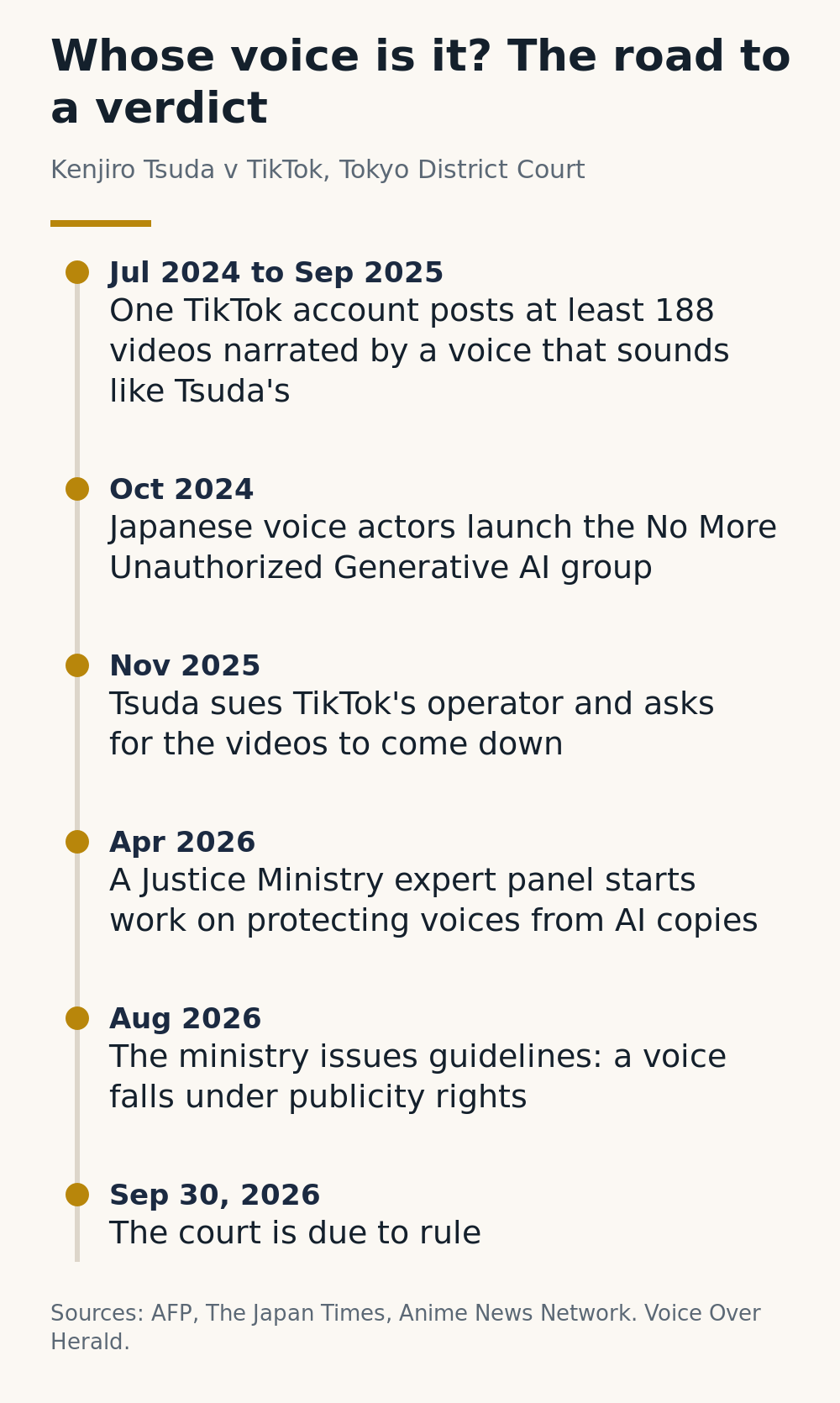
The account wasn’t a small one. According to the complaint, it posted at least 188 videos between July 2024 and September 2025 and gathered about 210,000 followers, The Japan Times reported when the case first became public in May. Tsuda’s side estimates the videos earned between 500,000 and 750,000 yen a month from views.
His lawyers say the audience came for the voice, not the stories. The account, whose posts mostly lacked original substance, “only gained popularity because its dubious, sordid content was narrated by the attractive voice of a popular actor,” they argued, according to the court records reported by AFP.
Tsuda filed the suit in November 2025. His side says an analysis of the audio found the narration resembles his distinctive deep and mellow voice, and argues the account violated his publicity rights: the right to control and profit from the commercial use of your identity. He has also claimed the account was free-riding on a well-known brand, which would breach Japan’s unfair competition law.
The account itself can no longer be viewed. What the court will decide is whether TikTok was responsible for deleting the posts.
Whose voice is it? TikTok’s answer
TikTok’s defense goes beyond saying the voice isn’t his. The company has questioned whether Tsuda has “national fame” at all, which matters under the unfair competition claim. And it has argued that, as a platform, all it did was “host a forum where users could post creative and ingenious content within the scope of free speech.”
That second argument is the one working actors everywhere should read twice. If a platform only hosts, and a voice that sounds like yours is merely “generic,” the burden of proving the copy falls on the performer, one clip at a time.
The industry lines up behind him
Japan’s voice actors aren’t treating this as one man’s fight. An actor’s voice “is the result of years of rigorous training and apprenticeship,” Yuko Sasaki, a voice actor and executive director of the Japan Actors Union, told AFP in a report carried by the Kuwait Times.
 VoiceEditSuitePro audio tools built for working voice actors.Auto Clean UpACX Audiobook PrepAudition Director
“It’s something we spend lots of time and money perfecting,” she said, adding that “we support Tsuda wholeheartedly.” The court, she said, should “acknowledge that ownership of a voice is a fundamental right.”
Sasaki is part of No More Unauthorized Generative AI, a campaign group Japanese voice actors launched in October 2024 against using AI to mimic performers without permission. Bin Shimada, another member, put the stakes plainly. “Our industry can be crushed” if a win for TikTok opens the door to “unbridled” AI voice cloning on social media, he told AFP, warning it could make younger actors “lose hope.”
Veteran actor Michihiro Ikemizu, 83, backed Tsuda too, but doesn’t think a machine will ever do the job. “You need to constantly feel and adapt while performing your role. That’s something AI can never do,” he said. “That’s our only weapon.”
Japan has no voice law, but it has new guidelines
No Japanese statute protects a voice by name. The government has been moving toward it, though. In April, a Justice Ministry expert panel held its first meeting on the problem, and State Minister of Justice Hidehiro Mitani said the burden of settling it in court “is too great to place on voice actors,” Anime News Network reported.
Last month the ministry published non-binding guidelines on how existing law covers voices. As “the symbol of one’s personality,” the ministry said, a voice falls under “publicity rights” and “rights to prevent unauthorized use of one’s portrait and likeness.” Nobody knows yet how much weight a judge will give them on Wednesday.
One expert thinks Tsuda starts from a strong position. Tatsuhiro Ueno, a professor of intellectual property studies at Waseda University, told AFP it was “very unlikely” Tsuda’s voice would be denied publicity rights outright. His Nanami role, Ueno said, had made the voice “highly recognizable in Europe,” and he expects the verdict to “garner a lot of international interest.”
Why it matters outside Japan
The International Federation of Actors warned last year that “in many countries copyright and data protection laws are not being adequately adapted” to protect performers from AI clones. Countries are filling that gap one at a time. Mexico now requires written consent to clone a voice, which Voice Over Herald covered last week, and several US states have their own rules.
The Tsuda case tests something those laws don’t always reach: the anonymous account that never asks, and the platform that says it only hosts. For anyone whose voice is recognisable enough to be worth copying, three things are worth doing now:
- Keep dated proof of your work. Credits, session files and broadcast dates are what show a voice is yours and known.
- Report copies fast, in writing. A takedown request with a date on it is evidence that the platform was told.
- Read the AI clauses. Know what you’ve already licensed before you argue about what you haven’t.
Whatever the court decides on Wednesday, the argument won’t end there. A ruling for Tsuda would give Japanese performers their first court-tested answer to “whose voice is it?” A ruling for TikTok would tell every anonymous account that “generic” is a defense worth trying.
Sources: AFP reporting by way of Philstar and the Kuwait Times (September 27, 2026); The Japan Times (May 26, 2026); Anime News Network (April 27, 2026).
Lee este artículo en español: La voz de Nanami en Jujutsu Kaisen demandó a TikTok por una copia de su voz hecha con IA. Un tribunal de Tokio decide el miércoles
Know something about this story, or spotted an error? Tell the newsroom.