
Mexico Now Requires Written Consent to Clone a Voice. ViX Is Already Dubbing With AI
Mexico has spent 2026 building the most explicit legal protection for voice actors anywhere in the world. Cloning a performer’s voice with AI now requires their prior, written consent and an agreed fee. Dubbing foreign films and series into Spanish or any other national language must, by law, be done by human performers. And in the same summer those laws took effect, the country’s biggest broadcaster confirmed it is already dubbing its telenovelas with AI. Here is what the law says, what it doesn’t, and where the gap is.
Two laws, one spring
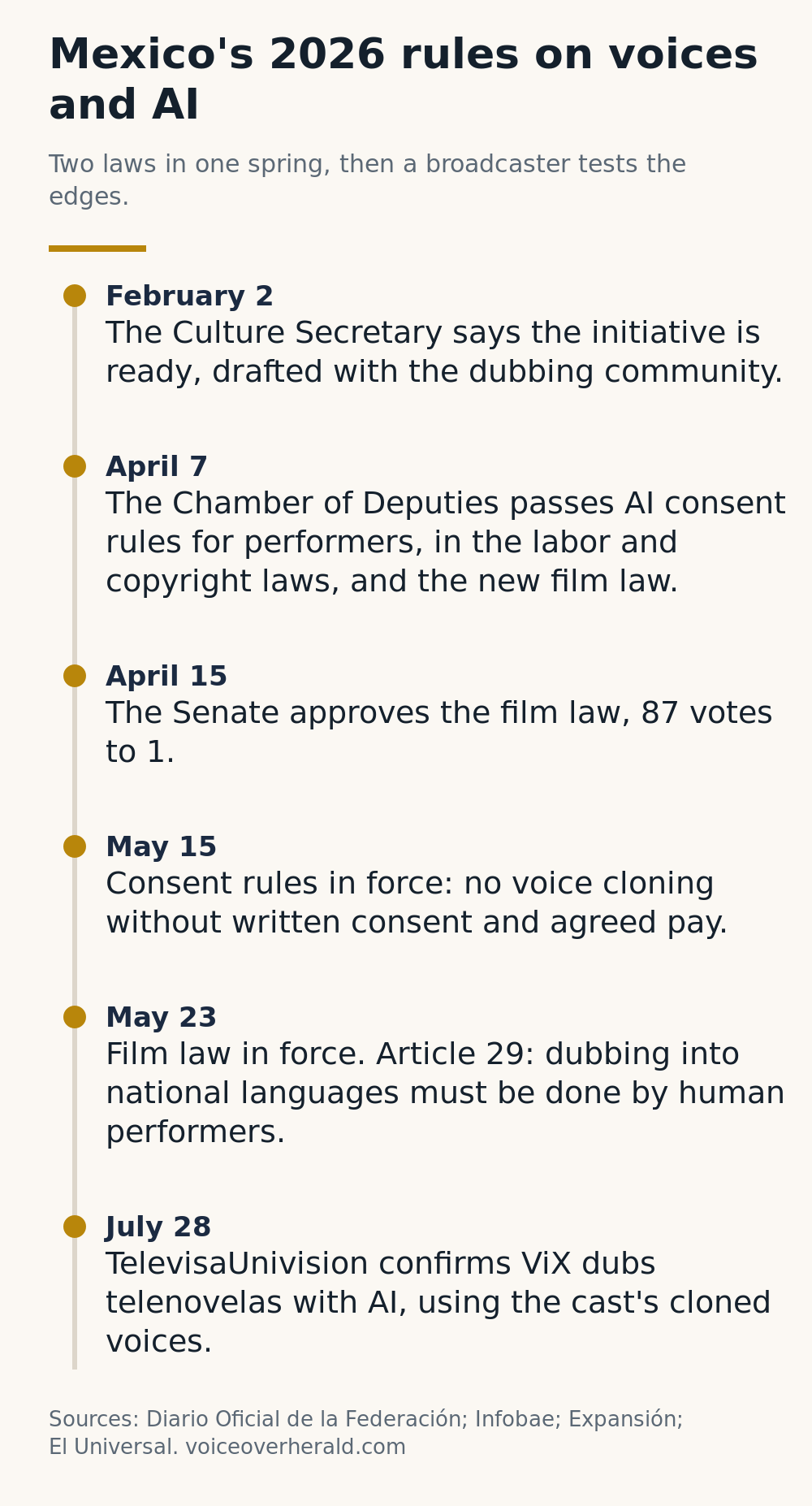
The groundwork was laid in February. At the government’s morning press conference on February 2, Culture Secretary Claudia Curiel de Icaza said an initiative to protect dubbing actors’ image and voice rights was ready and had been drafted with the profession itself: “Trabajamos con toda esa comunidad y llegamos a un acuerdo y un diseño con la Consejería Jurídica y ya está esa iniciativa lista,” she said, as Infobae reported. We worked with that whole community, reached an agreement, and the initiative is ready.
 VoiceEditSuiteRaw take in. Clean take out.
Two separate pieces of legislation followed.
The performers’ reform. On April 7 the Chamber of Deputies approved changes to the Federal Labor Law and the Federal Copyright Law aimed squarely at AI. As Infobae set out, a new Article 305 Bis of the labor law requires contracts with performers to “definir con claridad las condiciones y el pago por el uso de imagen o voz, incluso si se emplea inteligencia artificial”: to define clearly the conditions and the payment for the use of image or voice, including when AI is used. Article 87 of the copyright law now demands express consent for the use of a person’s image and voice, extends that protection to results generated by AI, and lets the consent be revoked for just cause. Article 121 says cloning a voice or image “requiere acuerdo previo y por escrito entre las partes”: it requires a prior written agreement between the parties. The decree was published in the Official Gazette on May 14 and took effect the next day.
The film law. Alongside it, Congress replaced the 1992 cinema law with a new Ley Federal de Cine y el Audiovisual. The Chamber passed it on April 7; the Senate approved it on April 15 by 87 votes to one, the lone no from Senator Lily Téllez, as El Universal reported. It was published on May 22 and took effect the following day. Its Article 29 is the one dubbing actors had fought for:
“Con el fin de conservar la identidad lingüística nacional, el doblaje de obras cinematográficas y obras audiovisuales extranjeras en cualquiera de las lenguas nacionales, deberá ser realizado por personas trabajadoras artistas intérpretes o ejecutantes, en términos de la Ley Federal del Derecho de Autor y la Ley Federal del Trabajo.”
In plain terms: to preserve the country’s linguistic identity, dubbing of foreign films and audiovisual works into any national language must be performed by working artists, interpreters or performers. The same law keeps the rule that cinemas devote at least 10% of weekly screen time to Mexican films, and requires streaming platforms to keep a permanent, visible section for Mexican productions and to offer subtitled, dubbed and accessible versions.
Aurora Mijangos, an actress and dubbing director who coordinated the movement for regulation, told Expansión when the Chamber passed it: “Estamos contentos con este artículo porque es un paso para proteger el trabajo.” We’re happy with this article because it is a step toward protecting the work.
Then ViX said the quiet part
On July 28, Expansión reported that TelevisaUnivision is already using AI to dub its telenovelas for export on its ViX platform, using ElevenLabs technology to produce versions in Portuguese and Korean, with Turkey among the markets in view. Alfonso de Angoitia, the company’s president and chief executive, put it this way: “Ahora es posible realizar doblajes de gran calidad con las voces de los actores y actrices gracias a la IA. Esta empresa nos ofrece un producto excelente que nos permite, por ejemplo, traducir una telenovela al portugués o al coreano de manera rápida.” It is now possible, he said, to make high-quality dubs with the actors’ and actresses’ own voices thanks to AI; the vendor’s product lets them translate a telenovela into Portuguese or Korean quickly.
Note the phrase “with the voices of the actors and actresses.” This is not a synthetic stand-in. It is the cast’s own voices, cloned, speaking languages they don’t speak.
Where the law reaches, and where it doesn’t
Here is the gap. Article 29 governs dubbing into Mexico’s national languages. A Mexican telenovela dubbed out into Korean for a Korean audience is not what that article regulates. As Xataka México noted on July 31, the company has not explained under what scheme these AI-assisted dubs operate or how they fit the new legal framework, and has not said which telenovelas have been adapted.
What does reach the ViX case is the other law. If the cast’s voices are being cloned, the copyright and labor reforms require each performer’s express consent and a contract that spells out the conditions and the pay for that use, and the consent can be withdrawn for just cause. Whether those agreements exist, and what they say, is the question nobody outside the company has answered yet. The performers’ organisations that pushed for the law, and the actors who have spoken against unregulated AI dubbing over the past year, will be watching the first contract that reaches a court.
What the rest of the world can borrow
Mexico’s package is worth reading closely wherever you work, because it separates two things that usually get muddled. One is the job: who performs the dub. The other is the instrument: who may reproduce your voice, on what terms, for how much. Spain’s dubbing actors are fighting for the second through a contract clause and a refusal to sign, as we reported this week. The US video game contract of 2025 wrote consent and disclosure into a union agreement. Mexico wrote both into national law, then watched a national broadcaster test the edges within weeks.
For a working voice actor, the model clause is now easy to describe in one sentence: nobody clones my voice without my written consent, a stated purpose, an agreed fee, and a way out. If your next contract doesn’t say that, Mexico has shown it can.
Sources: Infobae (2 February and 7 April 2026); Expansión (7 April and 28 July 2026); El Universal (15 April 2026); the text of the Ley Federal de Cine y el Audiovisual; Xataka México (31 July 2026). Spanish quotes translated by the Herald.
Lee este artículo en español: México ya exige consentimiento por escrito para clonar una voz. ViX ya dobla con IA