




The Job After the Job: How Working Voice Actors Turn One Booking Into a Regular Client
Most voice over marketing is about strangers: the cold email, the audition, the demo someone has never heard. Yet the work that keeps a home studio busy often comes from people who’ve already hired you once. Here’s what working voice actors and coaches say about turning one booking into a regular client, from the first email to the card you send in December.
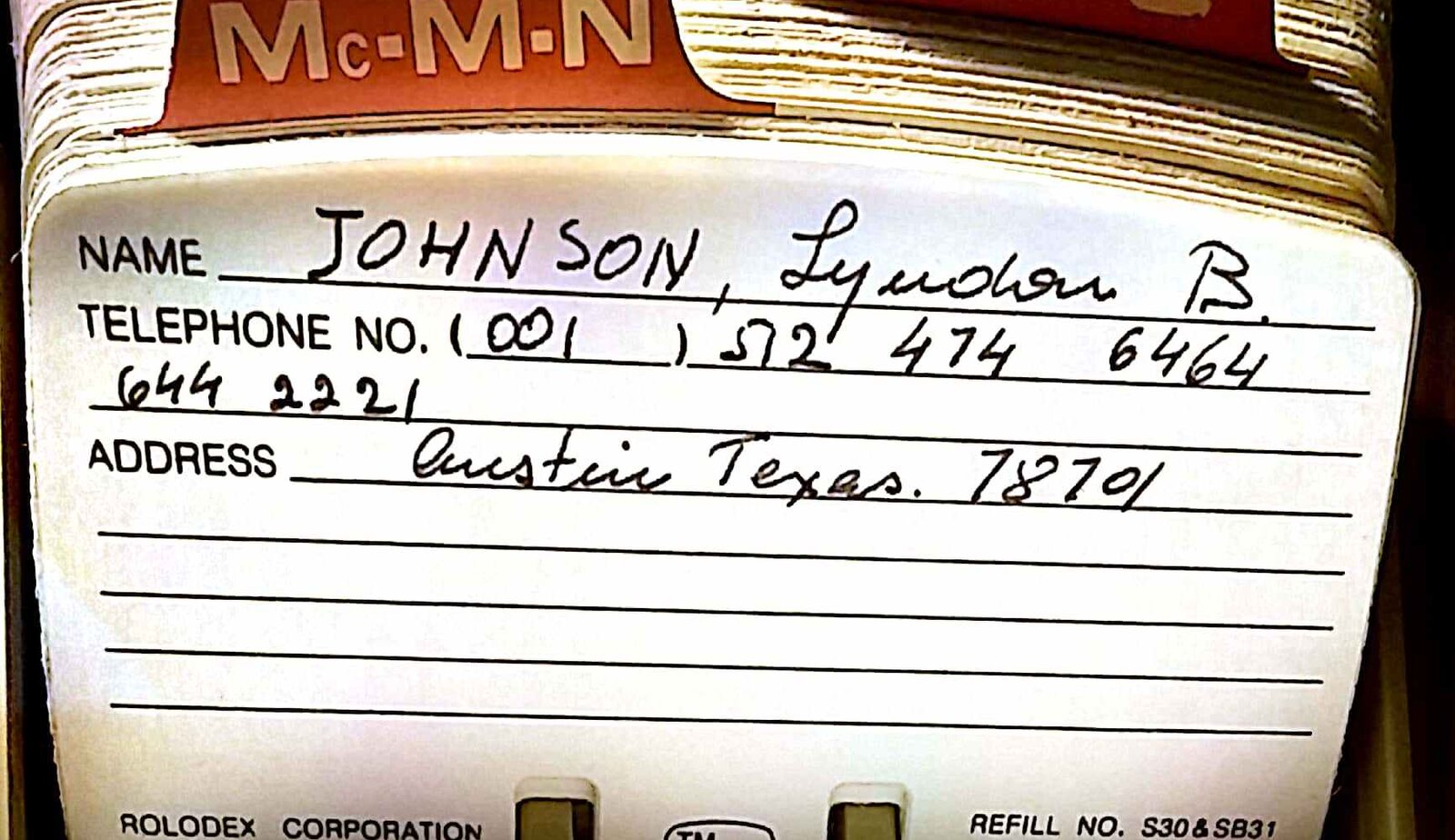
The photo at the top of this page is a desk file that belonged to Levi Eshkol, Israel’s prime minister from 1963 to 1969, open at the card for Lyndon B. Johnson. A head of government kept the people he dealt with in one place, with a number to hand. The clients who’ve already booked you deserve at least that much care.
Your best clients have already hired you
Randye Kaye, a voice talent with a home studio in Connecticut, says the goal after a first booking is “not quantity of clients as much as quality,” and by that she means “you want these first-time customers to become regular clients.” Once that happens, she writes, “your demo won’t matter to that client, nor will an audition (most of the time). Once they know you, and love your work, they may send you work. Just like that.”
She still courts new clients, but she’s frank about where the bookings come from: “the bulk of my work comes from those delightful entities called ‘repeat clients.’”

Randye Kaye, voice talent. Image: randyekaye.com
There’s a business case behind the feeling. Fred Reichheld, the Bain & Company consultant known for his work on loyalty, wrote in 2001 that “Across a wide range of businesses, customers generate increasing profits each year they stay with a company.” He gives two reasons that fit a one-person voice business surprisingly well: “Return customers tend to buy more from a company over time,” and the cost of serving them falls as they do.
Jillian Nielsen, a voice talent who writes for the training company Such A Voice, puts it in fewer words. She borrows a line from her husband about their marriage, “It’s cheaper to keep her!”, meaning “if you have done business with someone already, it’s usually less costly in time and resources to continue doing business with them than to acquire new clients.”
The client decides during the first job
Paul Schmidt, who runs the coaching business VO Pro, says the second booking is won or lost before the first one is finished. “Every client is making a subconscious decision about whether they want to work with you again before the first project is even over,” he writes. “Every email, every file delivery, every interaction adds up.”
Robin Brooke learned that the practical way. She was dubbing cartoons in a Miami studio when she decided to move to a small town in the mountains of Virginia, so she had to build a list of clients she could take with her. Her rules are simple. “If you have any questions: ask. Don’t assume.” And mind the time zones: “Nothing like being 12 hours late on a deadline for an audition in Singapore.”
Debbie Grattan, a full-time voice talent, says the same about the brief. Ask about tone, file type and delivery up front, and “If things are unclear, clear them up before you begin.”
Then fit the way each client works. Schmidt’s list of what keeps a client includes “Delivering files exactly how they prefer without needing to be asked” and “Responding quickly to messages and being available within reason.” He notes that e-learning clients “might need meticulous file splits and naming,” while an ad agency “might need same-day pickups.” A short note on each client, with their file format, naming pattern and the pronunciations from last time, means job two starts where job one finished.
Put your pickup policy where clients can see it
Nothing sours a good first job like a surprise bill for a fix. Brooke’s advice is to “Be clear about your policies. For example, how many revisions are included in your price, if any.”
Some voice actors publish theirs. Bill Celler’s website opens his with a promise: “Retakes because I made a mistake are included at no cost.” On sessions he records at his own direction, he’ll redo lines for performance once, free. After that, and for any change to the script, he charges, and he asks for change requests within 30 days. He also closes a common loophole: retakes for pronunciation preferences that weren’t given in writing “will be treated as Revisions and are billable,” and his examples are the classics, “ee-ther” versus “eye-ther” and “oh” versus “zero.”
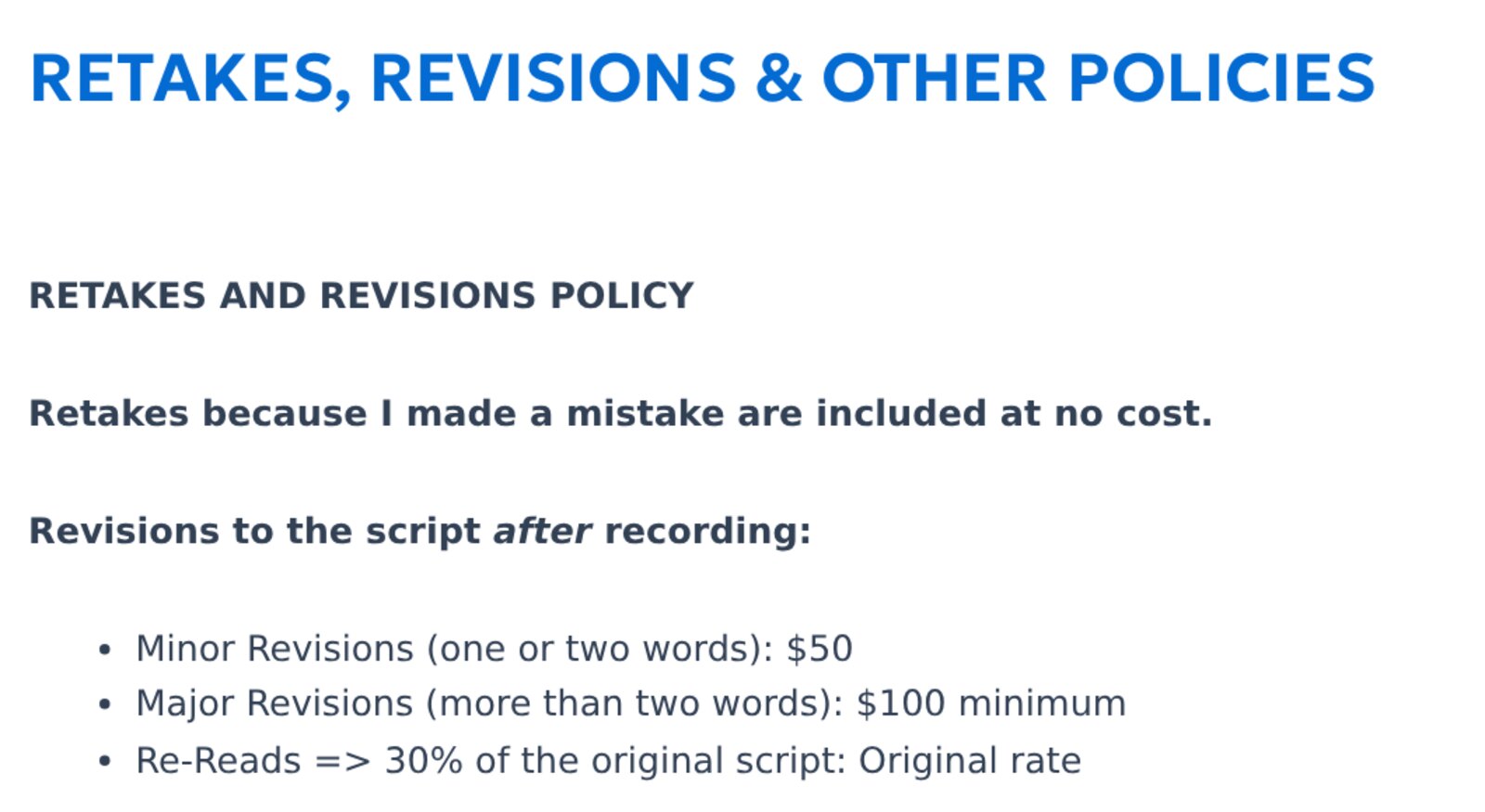
Bill Celler's published retakes and revisions policy, as shown on billceller.com on November 6, 2026. Screenshot: Voice Over Herald
Kaye’s FAQ page takes a similar line. “If it’s my error, of course I will happily re-record corrections at no extra charge,” it says. If the client changes the script or the approach within 30 days, those revisions are charged at half the original rate. “After 30 days, it is treated as a fresh project.”
Your numbers will differ. What matters is that a regular client knows the rules before they need a fix.
The rate you start with is the rate you keep
A low first quote feels like a smart way in. Brooke warns it’s the price you’ll be held to: “Offer a reasonable rate, but don’t quote too low! Come up with a rate that you can live with because you’ll have to stick to your agreement.”
She’s speaking from experience. “I remember kicking myself in the wee hours of the night, while I was editing training modules, agreeing to a ridiculous number to get the job…don’t do it!”
Her better way to stand out is to be useful. If a client writing in their second language sends a script with errors, she suggests offering “to proofread for free on the first job and offer a discounted rate for repeat business.”
After you hit send
“One of the biggest mistakes voice actors make? Thinking that once a project is delivered, the relationship is over,” Schmidt writes. His suggested note after delivery is short: “Loved working on this! Let me know how the final cut turns out.” It isn’t a pitch.

 VoiceEditSuiteNewYour breath. Your pace. Your edit.Learns from numbers, never your audio. Never used to train AI.See how it works
Nielsen says thanks can be small: “a simple note at the end of an email thanking someone for their time, for an audition opportunity, or for paying an invoice.” A card goes further. “Who gets handwritten thank you notes anymore? Because it is so rare, you’ll stand out.”
Grattan has tried “postcards, personalized notes, birthday cards, gifts,” and she suggests one that costs nothing: “Posting a review for a client on their LinkedIn page or other platform shows your thoughtfulness and may help them with their marketing.” With clients she’s known for years, she relaxes the formal tone. “I find ways to personalize communication, to make it feel more like a friendship when appropriate.”
Keep a file on every client
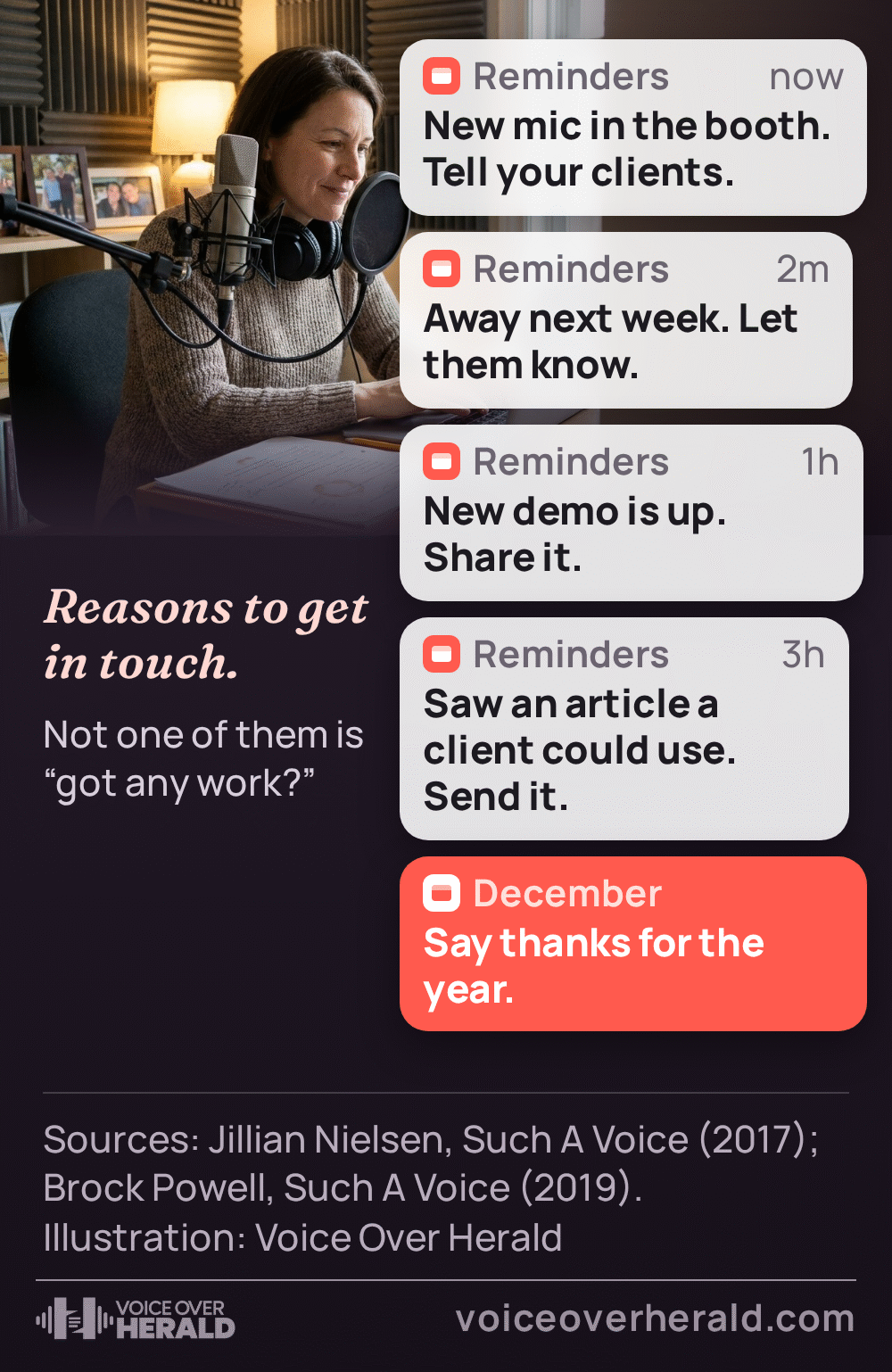
Bridget Renshaw, writing for Such A Voice in 2023, puts the admin plainly: “Keep a list of the clients that you work with, what projects you worked with them on, who your point of contact was and their contact information.” Nielsen adds two details people skip. Get a postal address, because email alone won’t carry a card. And “create a tickler file, or use your calendar or a CRM (Customer Relationship Management) software, to help remind you when to reach out to your clients.”
The hard part is having something to say. Nielsen’s test for every message is “How is this contact going to help their business?” Her good reasons include news the client can use, like better equipment or time away, and she says the best messages often aren’t about you at all: “It doesn’t always have to be about what you are doing, in fact, it’s better when it isn’t.”
December is the easy excuse
The end of the year is a reason to say thanks that never looks like a sales email. Brock Powell, in a Such A Voice piece on holiday greetings, says to ask first. “Reach out to your agency, clients, and VO network to see what their preference is for holiday gifts.” Some offices, he notes, “have a designated day for drop off and delivery.”

Christmas mail for soldiers being sorted in a New York post office, filed by the US government in January 1919. Photo: Press Illustrating Service, U.S. National Archives, via Wikimedia Commons
He passes on a family rule, “Don’t forget the janitor,” which means thinking beyond whoever signs off on bookings. “Production assistants, editors, and custodial staff at your go-to studio all fit the bill.” And he points out a gift only a voice actor can send: a short digital card with your voice on it, which is “a great way to spread holiday cheer and remind folks what you sound like.”
If that’s too much, his simplest version still works: “A quick note, a sincere text or, dare I say, even a phone call, to thank them for the chance to work together this past year.”
Ask while they’re happy
The moment a client says they love the finished piece is the moment to ask for something that brings in the next one. Renshaw says satisfied clients “are often willing to provide testimonials that attest to your skills and professionalism,” which can go on your website, and adds “don’t hesitate to ask satisfied clients for referrals.”
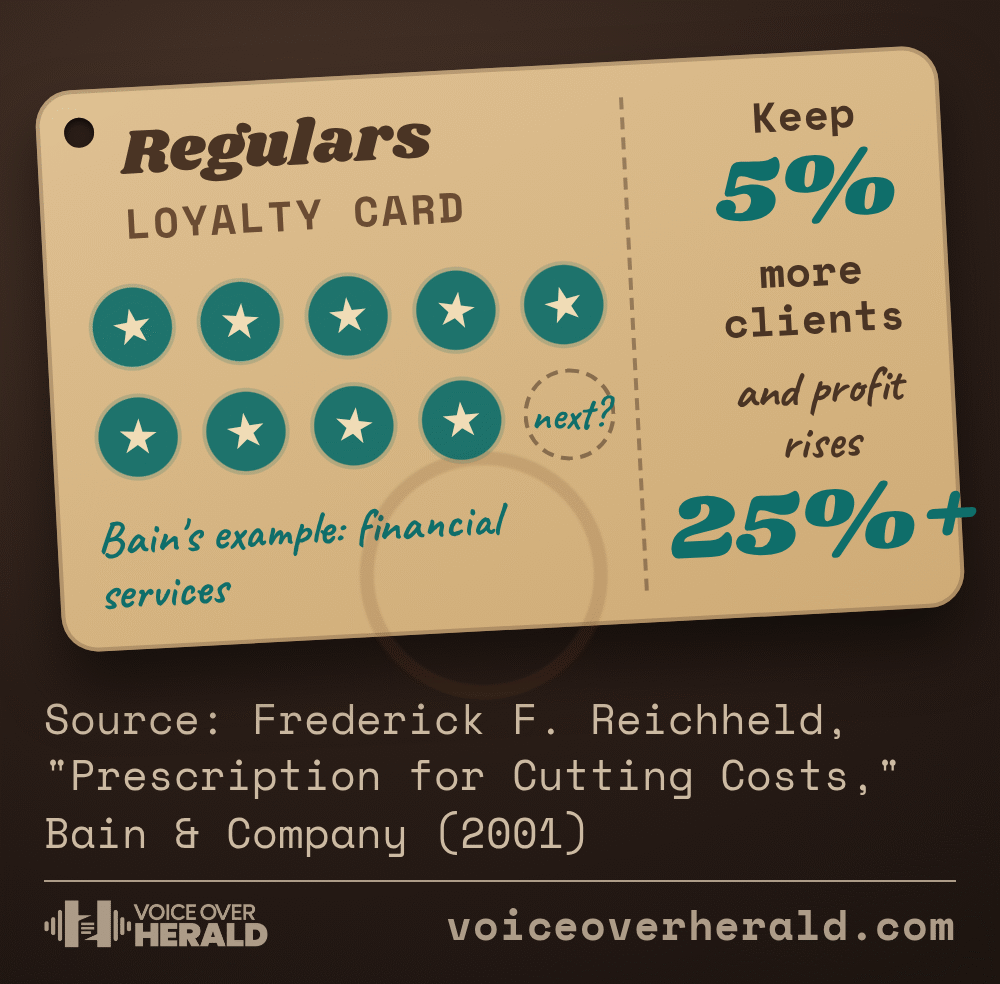
Reichheld saw the same pattern far outside voice over: “What’s more, return customers refer others to your company.” A producer who books you twice is likely to mention you to a colleague, and that beats any cold email.
Kaye ends her piece on regular clients with the old Girl Scout song, and it’s as good a marketing plan as any: “Make new friends, but keep the old. One is silver and the other’s gold.”
Sources: Randye Kaye, “Voiceover Clients: Is the Goal Quantity or Quality?” and Voiceover FAQ, randyekaye.com; Frederick F. Reichheld, “Prescription for Cutting Costs,” Bain & Company (2001); Jillian Nielsen, “Keeping Your Client Relationships Close and Fresh,” Such A Voice (April 27, 2017); Paul Schmidt, “Want a Thriving VO Business? MASTER This One Skill!,” VO Pro (March 6, 2025); Robin Brooke, “Working Wednesday: How to Turn an Audition into Repeat Business,” Such A Voice (May 20, 2020); Debbie Grattan, “Communication is Key for Voice Over Success,” debbiegrattan.com (September 19, 2019); Bill Celler, “Retakes, Revisions & Other Policies,” billceller.com; Bridget Renshaw, “Ten Tips for Building a Client List,” Such A Voice (August 24, 2023); Brock Powell, “Seasons Greetings: When and How to Send Clients Glad Tidings,” Such A Voice (December 11, 2019). All read November 6, 2026. Main image: Yoram Shoval, CC BY-SA 4.0, via Wikimedia Commons, cropped.
Lee este artículo en español: El trabajo después del trabajo: cómo los locutores convierten un encargo en un cliente habitual
Know something about this story, or spotted an error? Tell the newsroom.