



Do It Different: How New Voice Actors Learn to Take Direction
Your first directed session can feel like being handed notes in a language you half speak. “More conversational.” “Throw it away.” “Can you smile on that?” Here’s what directors usually mean, what the engineer is asking for, and how to stay calm when the notes stop making sense.
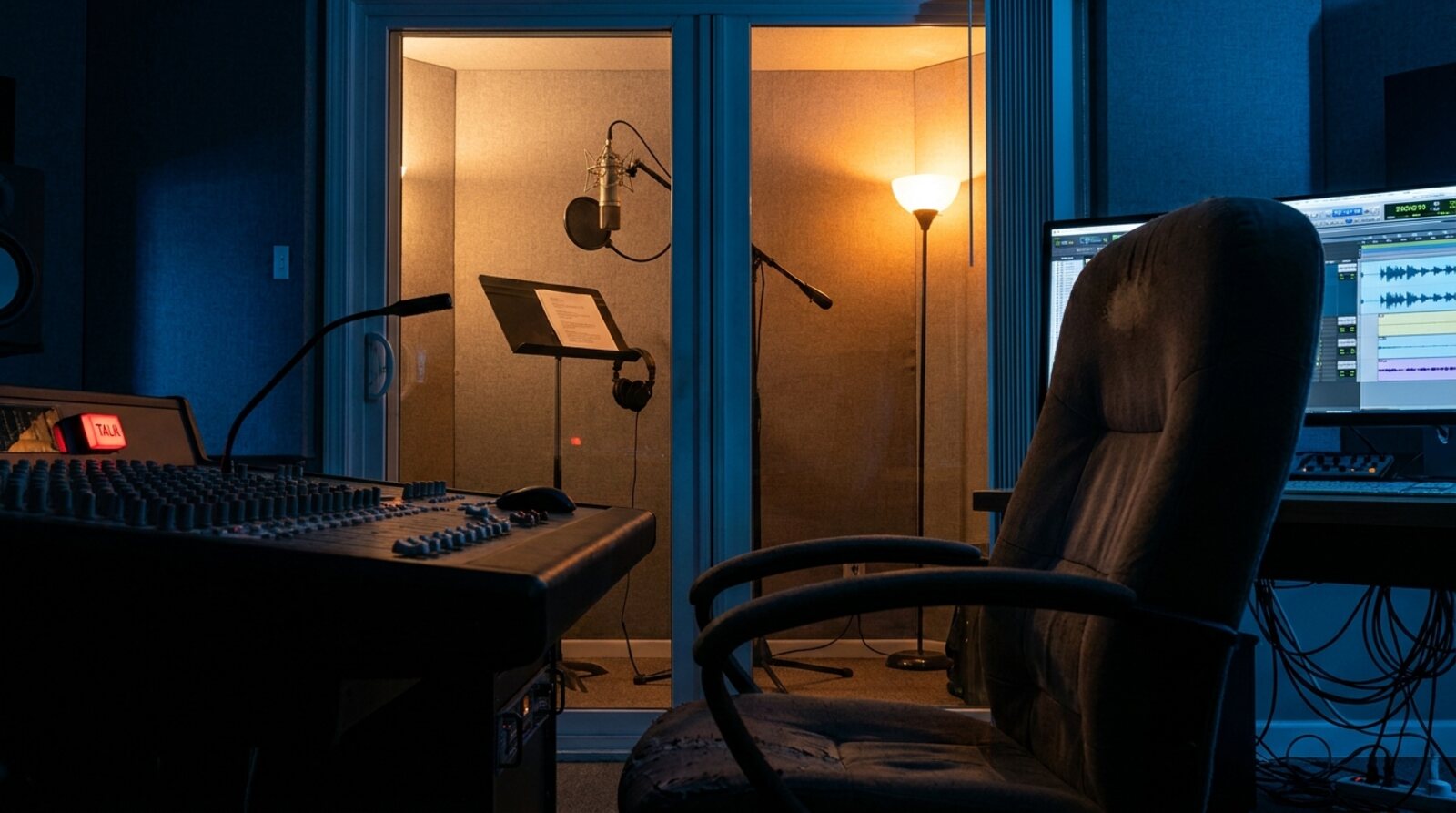
Nobody warns you about the talkback button. You’ve rehearsed the script, your water’s on the stand, and then a voice in your headphones says something like “lovely, now just do it different” and goes quiet. That’s the moment new voice actors find out the job isn’t only reading well. It’s taking a note, turning it into a new take, and doing it again a minute later.
The good news: the vocabulary is small, and most of it has been written down by people who sit on either side of the glass. We read what working voice actors, coaches and a team of researchers have published on it, and pulled out the parts a beginner can use at the very next session.
Before take one, answer three questions
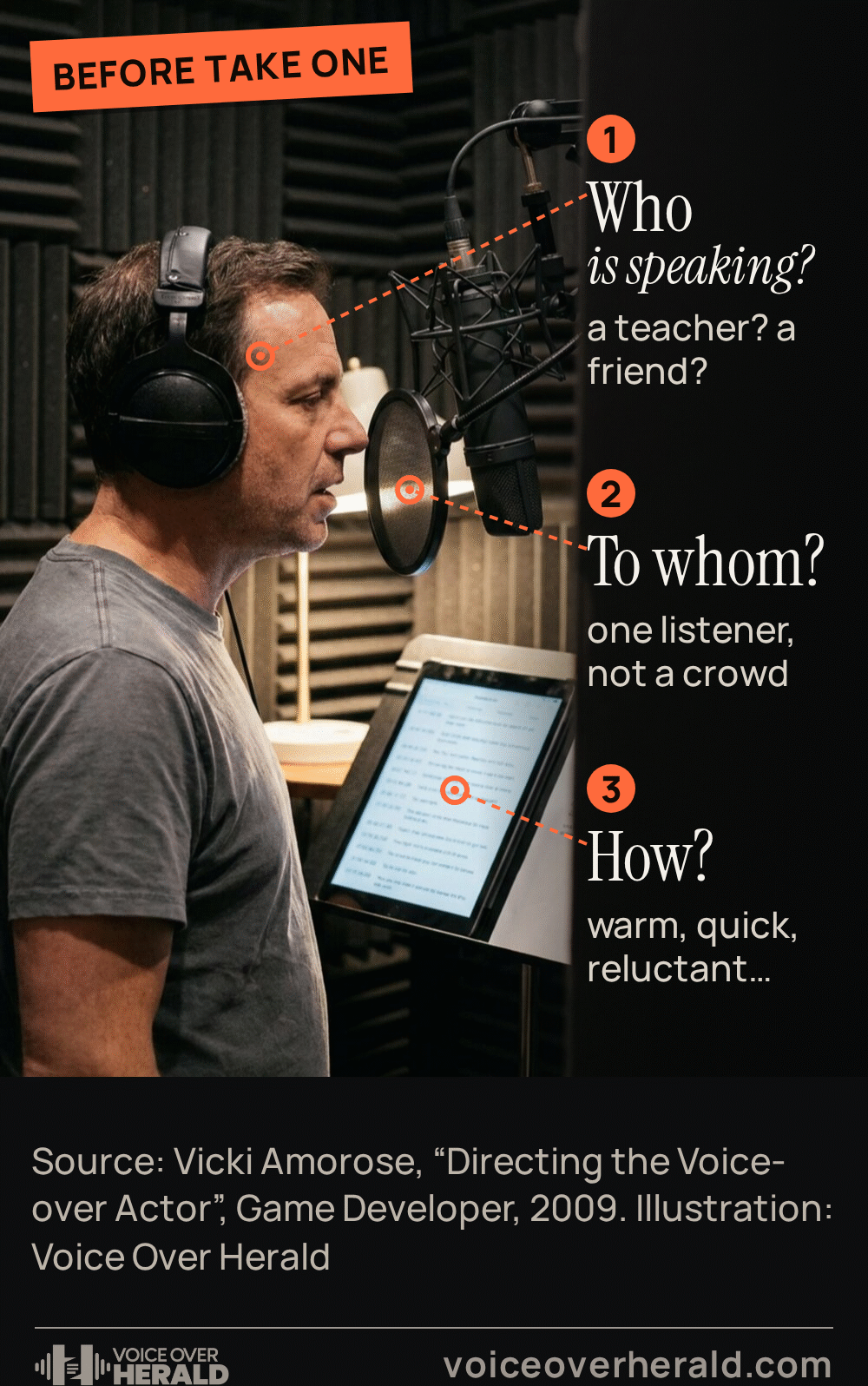
Voice actor Vicki Amorose, writing a crash course on direction for Game Developer, boils the brief down to three questions every actor needs answered: “Who is speaking? To whom are they speaking? How are they speaking?” She adds that when a director answers them, “communication is well underway and confusion is reduced drastically.”
Her colleague Diane Havens, quoted in the same piece, says: “The first thing I expect to hear from a director is the role the voice will have in achieving the intended impact.” In other words, you’re never just “the voice”. You’re a helpful teacher, a wry neighbour, a nervous first-time buyer. If the brief doesn’t tell you who you are and who you’re talking to, ask before you start. It’s the cheapest question you’ll ever ask in a session.
Amorose also makes a point beginners often miss: descriptive words tell you how a character feels, not why. That’s deliberate. Directors expect you to find the why yourself, so a note like “reluctant” or “exasperated” is an invitation, not a puzzle.

The notes you’ll hear, decoded
“Make it more conversational.” The most common note in commercial voice over, and the vaguest. Amorose calls “conversational” a word that’s “overused to the point where it has lost meaning”. What the director is usually after is something closer to the notes she’d rather hear: “Toss off that last phrase like it’s something you’ve discussed a million times”, or “I don’t feel like you are speaking directly to me.” So pick one real person and talk to them. Drop the announcer lift at the ends of lines.
“Throw it away.” This one trips people up because it sounds like “don’t care”. Coach Paul Liberti, writing for the actor training studio Actors Connection, explains: “Throwing a take away is to RELEASE the idea with simplicity or a shrug.” He warns that many actors overshoot into contempt instead: “To ‘throw a phrase or word away’ is to RELEASE it with a shrug and NOT DISCARD IT WITH DISGUST.” Think of how easily you’d say “oh, and it’s free delivery too” to a friend.
“Can you smile on that?” It sounds like an old studio myth, but there’s research behind it. In a 2008 study at the University of Portsmouth, volunteers answered every interview question with the same line, “I do in the summer”, while the questions got sillier. Listeners who only heard the recordings could pick out different kinds of smile. Lead author Amy Drahota told NPR that “Most people were good at hearing the Duchenne smile”, the full smile that reaches the eyes. “A voice contains a variety of acoustical characteristics,” she said in the university’s announcement. “It’s possible that we interpret these ‘flavours’ in someone’s voice almost without noticing.” So when you’re asked to smile, actually smile, eyes and all.
 VoiceEditSuiteA director's notes on every take.Upload a take and Performance Coach scores delivery, energy, pacing, character and authenticity, with timestamped notes on what to fix next.See how it worksYour recordings are never used to train AI.
The line read. Sometimes a director will just say the line the way they want it. Amorose defines it plainly: “A ‘line read’ is when the director says the line and instructs the actor to repeat it exactly, as a parrot would.” Actors don’t love it. Voice actor Donna Burke’s course notes for SIGGRAPH list it among actors’ common complaints: “directors want the actor to parrot them EXACTLY, just like a robot”. But you’re there to serve the job. Copy the shape of the read (where the stress falls, the pace, the pause), keep your own voice, and offer your version on the next take if there’s time.
“Do it different.” Darryl Green, in his studio glossary for Acting Magazine, describes it like this: “A favorite term of producers for when they liked your previous take and they want another, but they’re not exactly certain of what they want.” His advice for the moment is short: “Your job: build on what you’ve already done to make it even better.” Change one thing on purpose (pace, warmth, where you land the key word) rather than throwing the whole read out.
What the engineer is asking for
Some of what comes through your headphones isn’t creative direction at all. It’s the engineer setting up the next take, and Green’s glossary covers the words you’ll hear most.
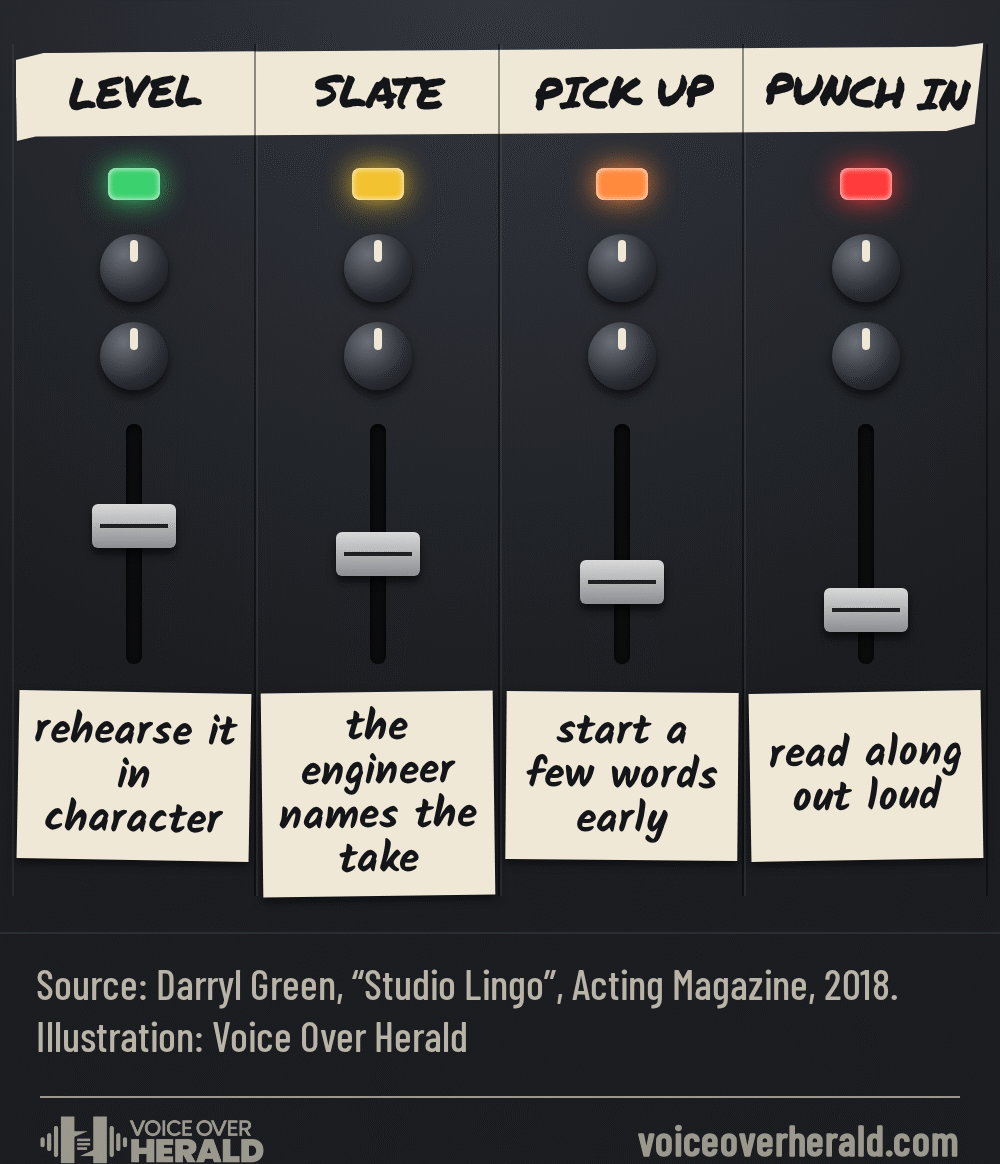
A level is the engineer checking how loud you’ll be. Green’s tip is to skip the “testing, one, two” and “use your level check as an opportunity to rehearse your performance in character and at the volume you will actually be performing.” A slate is the spoken label at the start of a recording. At auditions you usually slate yourself; in a session, Green notes, the engineer normally does it for you.
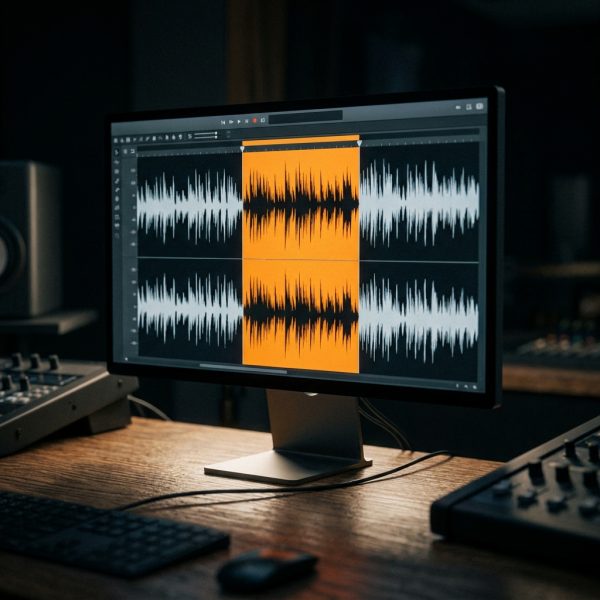
A pick-up is a restart from a point in the script, say “pick up at the top of the 2nd paragraph”, and your new recording needs to sound like it carries straight on from the old one. Green’s trick is to start reading several words before the pick-up point, so you’re already in the rhythm when you reach it. A punch-in is the engineer dropping into record during playback; read along out loud with the playback before the punch so the join doesn’t show.
And keep a pencil in the booth. Green again: “When making copy changes or corrections, always use a pencil. There’s a very good chance that you may be changing the changes.”
When the notes don’t make sense
Every voice actor gets a session where the notes contradict each other. A February 2025 post on the website of Manchester voice actor and broadcaster Emma Clarke lists the classics, including clients asking you to “sound relaxed and excited, read it quicker but sound slower”. It also notes that “Often different people in the room are asking the voice to do completely different things, all at the same time.”

The advice that follows is worth printing out. “Firstly, don’t take it personally. This is all part of the process. Don’t get defensive, don’t get arsey.” Then a technique: “I reflect the direction back to my client.” Saying back what you’ve heard (“so, warmer, but keep the pace up?”) clarifies the note and gently shows the room where it’s pulling in two directions. Burke’s notes make the same point from the other side, telling directors to decide in advance who’s directing so the actor isn’t taking instructions from several people at once. Remember, as the post says, “Everyone in the room wants the same thing”.
Voice actor and coach Crispin Freeman, answering a listener on his Voice Acting Mastery podcast who kept getting notes that seemed to reverse themselves, puts the whole skill in one line: “The secret is giving the director what they want, not what they ask for!” A note is a symptom. Your job is to hear the problem behind it.
Practise it before anyone’s listening
You don’t need a director to build this muscle. Take a short script, a 30-second ad is perfect, and record it three times, each against a different note: one person across a table, the last line thrown away with a shrug, a real smile on the product name. Listen back and ask whether a stranger would hear the difference. If they wouldn’t, push further.
Then practise the mechanics. Stop halfway through, go back a sentence, and pick up as if you never stopped. Do it until the join disappears. Mark your script in pencil as you go, the way you would in a real session, and say your own notes back out loud before each take. It feels silly alone in a booth. It feels a lot less silly the first time a director says “perfect, that’s the one” after two takes instead of twelve.
Directors remember the actors who are easy to steer. You won’t always get clear notes, but you can always be the person in the booth who listens, asks the right question and comes back with something new.
Sources: Vicki Amorose, “Directing the Voice-over Actor: Tips for Better Communication”, Game Developer, 2009; Paul Liberti, “Just throw it away: what does that direction really mean?”, Actors Connection, July 2023; Darryl Green, “Studio Lingo”, Acting Magazine, April 2018; University of Portsmouth via ScienceDaily, “Smile, and the world can hear you, even if you hide”, January 2008, and NPR, “Hearing a Smile in Tone of Voice”, January 2008 (Drahota, Costall and Reddy, Speech Communication); “Taking direction with good humour is a core skill for anyone who works with their voice”, EmmaClarke.com, February 2025; Crispin Freeman, Voice Acting Mastery episode 40, December 2012; Donna Burke, “Successful Voice Acting Recording Sessions”, SIGGRAPH Asia 2009 course notes.
Lee este artículo en español: Hazlo diferente: cómo los locutores nuevos aprenden a recibir dirección
Know something about this story, or spotted an error? Tell the newsroom.