


Akane-banashi’s Star Trained in Rakugo for a Year Before Recording. Anna Nagase Says the Trick Isn’t Changing Your Voice
In rakugo, one storyteller kneels on a cushion with a folding fan and a cloth and plays every person in the story. Anna Nagase, the voice of Akane Osaki in Akane-banashi, trained in the real thing for more than a year before she recorded a line, and she says the secret isn’t a new voice for each character.
Most voice actors get a character sheet and a session time. Nagase got a teacher, a stack of classic stories and a year of homework. Akane-banashi, the anime of Yuki Suenaga and Takamasa Moue’s Weekly Shonen Jump manga, follows a high school girl who sets out to reach shin’uchi, the top rank of rakugo, after her father is thrown out of the profession in front of her.
In an interview from Anime Expo published by Anime News Network on November 4, Nagase explains what the training taught her about acting with only her voice. “In rakugo, you play many different characters in a story, and you have to act out each person even though you’re only one person,” she says. “However, it’s not a matter of you having to change your voice in order to become that different character. It comes through your expression, your feelings, and your emotions to bring that personality to life.”
For voice work, she adds, it’s the same job: “for voice acting as well, you have to play different characters, not just through your voice, but through your emotions.”
Hear the voice: Anna Nagase as Akane Osaki in the anime’s second official trailer, in Japanese with English subtitles. Video: Akane-banashi Global, on YouTube
A year of homework before the first take
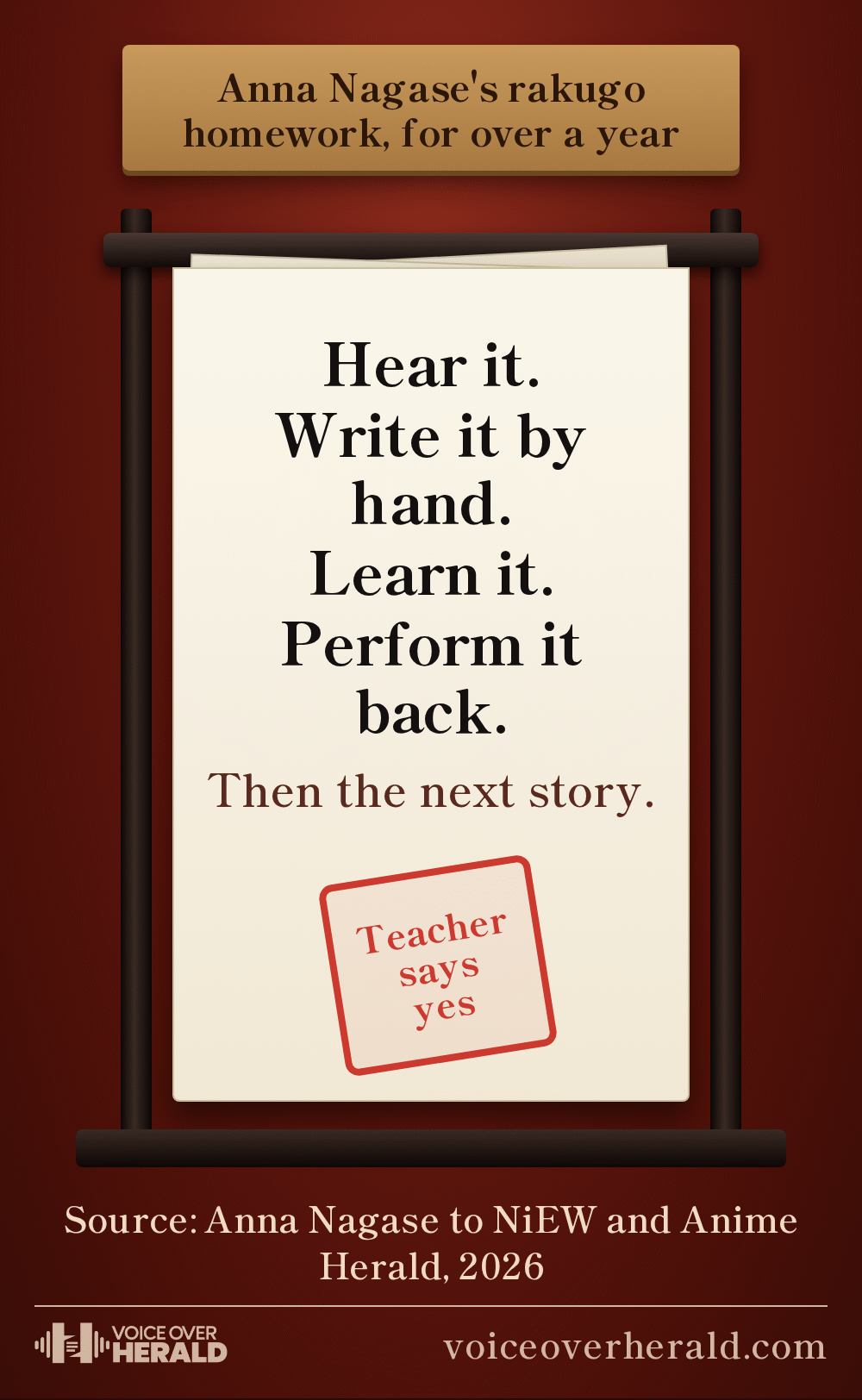
Nagase trained under the show’s rakugo supervisor, Kikuhiko Hayashiya, and the method was the one real apprentices use. “He would first perform an entire story for me, then I would transcribe the recording by hand, memorize it, and perform it back to him,” she told NiEW. “Once he gave me his approval, I could move on to the next story.”
She’d been in drama club all through school and thought memorizing was her strong suit. It wasn’t enough. “My very first performance was awful,” she says. “When I watched the recording back, my eyes kept wandering, my gestures didn’t look natural, and even my delivery felt uncertain.”
The breakthrough came with Hatsu Tenjin, a classic story about a father and son at a festival. “Up until then, I was memorizing the lines and reciting them,” she says. “With Hatsu Tenjin, though, the words came naturally. They just flowed.” Her teacher, she says, kept telling her “not to simply recite the story, but to let it come from within.”

Akane Osaki in the first season. Image: TV Asahi
She also picked up advice from a veteran in the cast. Akio Otsuka, who plays Isshō Arakawa, talked with her about style. “Akio-san told me that it’s the attitude of needing to know how people perceive you that helped shape him as an actor,” she told Anime Herald. Her own takeaway: “You have to be able to practice over and over, so you can figure out what works for you and what your own personal style is.”
A cushion, a script and three microphones
When recording started, the studio brought the theatre to the booth. A koza, the small raised stage rakugo is performed on, was set up for the rakugo scenes. “Since you switch between characters by subtly turning your head from side to side, the staff set up three microphones around me to capture those movements,” Nagase says. “I performed sitting in the traditional kneeling position while holding the script.”
Not everyone did it her way. Takuya Eguchi, who plays Karashi Nerimaya, a two-time student rakugo champion in the story, recorded standing up, and the engineers moved the setup to suit each actor. “I think that’s why every rakugo scene ended up reflecting the individuality of the actor performing it,” she says.
The hardest piece was Jugemu, the tongue twister of a story about a child given an absurdly long name. She performed it three times and calls it “one of the toughest for me to learn and to remember.” It aired in episode 10, and she says the Jugemu performance “was mostly done in one take.”
Rakugo has been a mostly male art for centuries, and Anime News Network notes that fewer than one in ten rakugoka today are women. Nagase watched many female performers while she trained and thinks the show could change that. “Women rakugoka do, you know, portray these rakugo stories and act them in a different way,” she says. “It’s just a different kind of flavor.”
The voices in Japanese, English and Spanish
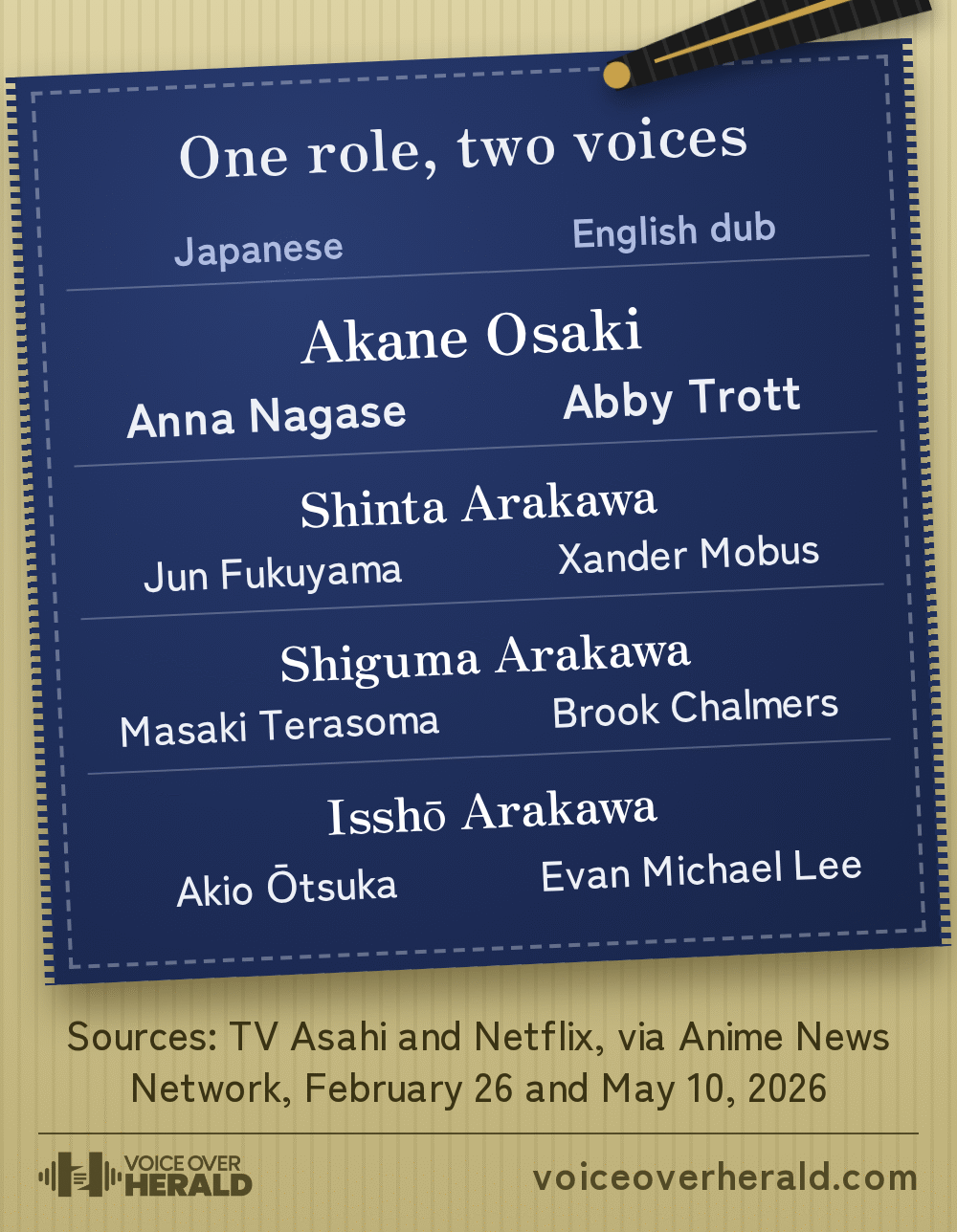
The first season of 12 episodes aired on TV Asahi from April 4, animated by ZEXCS and directed by Ayumu Watanabe. Netflix began streaming the English dub on May 17 with Abby Trott as Akane, recorded at Bang Zoom! Studios with Alex Von David as ADR director and writer. Anime News Network’s encyclopedia lists Nycolle González as Akane in the Latin American Spanish dub.
A second season starts in January 2027. Its teaser, released on October 25, picks up after Akane finishes high school and formally joins her teacher Shiguma’s school under the stage name Akane Arakawa, starting her training at a bustling theatre called Yasaka-tei.
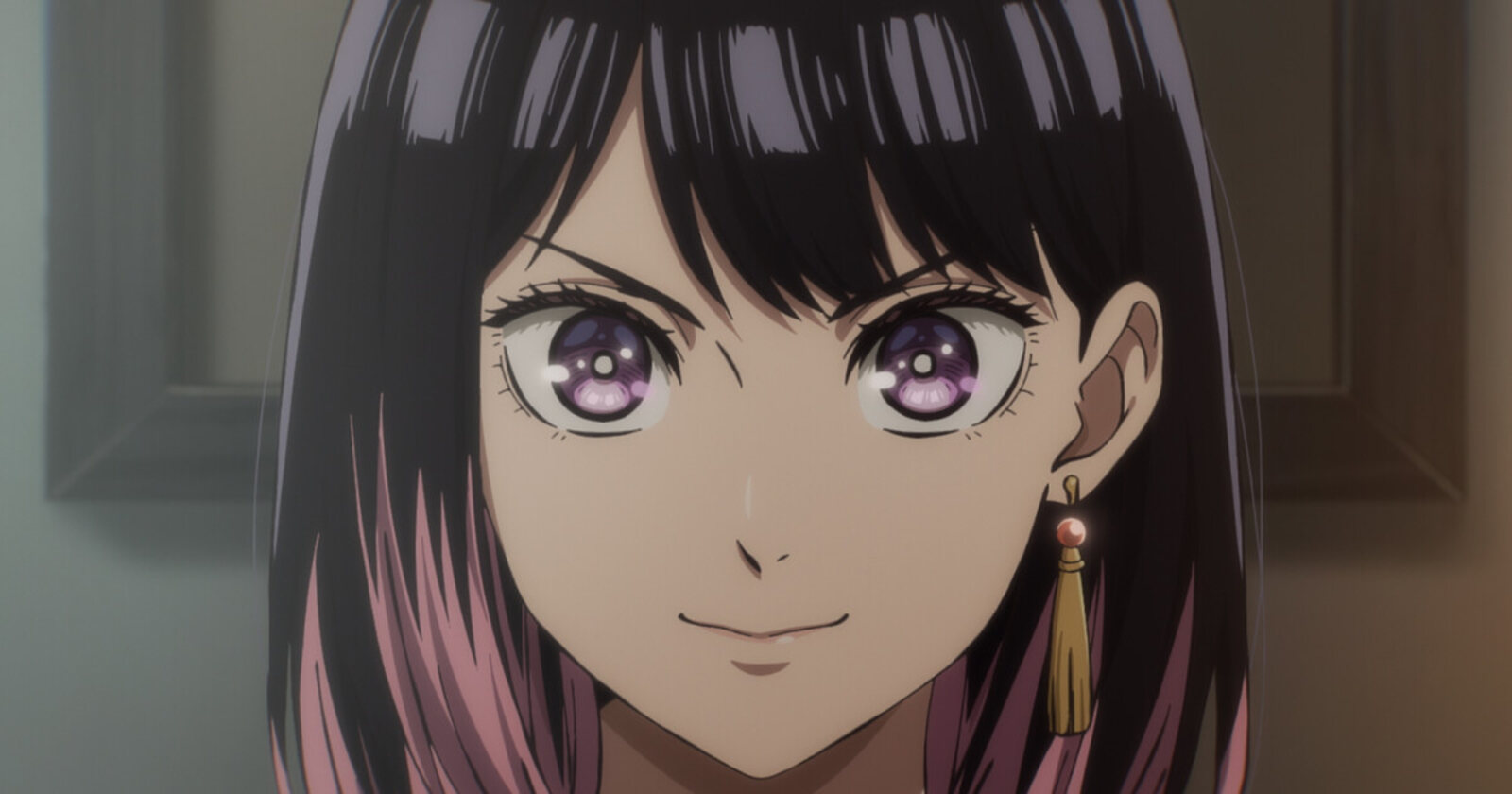
Akane in the season 2 teaser, released October 25. Image: TV Asahi
New season two voices include Taku Yashiro as Asagao Konjakutei and Yōji Ueda as Hassho Tsubakiya, joining six actors announced in June for characters who appeared in the first season’s finale, among them Shinichirō Miki, Tomokazu Seki and Mutsumi Tamura.
The show’s own YouTube channel, Akane-banashi Global, streams full episodes free in North America and Latin America after they air in Japan, and the season 2 teaser is up there now in English, Spanish and Portuguese versions.
What a booth can borrow from a cushion
Nagase’s lessons travel well beyond rakugo. Character comes from feeling first and pitch second. Writing a script out by hand is how you learn it, not just read it. And watching your own playback, wandering eyes and all, is where the improvement starts.
It suits audiobook narrators especially. A long book with a dozen speaking parts rewards the same slow preparation she went through, with someone you trust checking each piece before you move on to the next.
 VoiceEditSuiteHome Studio AnalysisHow your room really sounds, measured.Reverb, noise floor and hum measured. Free.See how it works
And then there’s the episode 10 line about what makes a professional, the one she says is “something I will never forget, even in my own voice acting.” In her reading, the belief comes before the applause. That’s handy for anyone sitting by the phone waiting on a callback.
Sources: Anime News Network (Anna Nagase interview, Anime Expo 2026, published November 4, 2026; season 2 teaser and cast, October 25, 2026; season 2 announcement, June 20, 2026; English dub cast, May 10, 2026; trailer and broadcast details, February 26, 2026; encyclopedia entry); NiEW (Anna Nagase interview); Anime Herald (Anna Nagase interview, July 22, 2026); Akane-banashi Global on YouTube. Images: TV Asahi.
Lee este artículo en español: La protagonista de Akane-banashi estudió rakugo un año antes de grabar. Anna Nagase dice que el truco no es cambiar la voz
Know something about this story, or spotted an error? Tell the newsroom.