

Google Can Copy a Voice From 30 Seconds of Audio. First, the Owner Has to Say Yes Out Loud
Google’s newest speech models can copy a voice from a 30-second recording. Before they’ll do it, the person whose voice it is has to say yes, out loud, on tape. That consent step is the most interesting part of this week’s launch for working voice actors, and so is the short list of places where Google won’t switch the feature on at all.
What Google released
On September 23, Google introduced two text-to-speech models, Gemini 3.8 Flash TTS and Gemini 3.8 Flash-Lite TTS, in a post on its company blog by Group Product Manager Leland Rechis and Alan Cowen, Director of Research Science, writing for the Gemini Audio team.
The two models split the work. Flash TTS is “Built for deep creative direction and character design,” and Google pitches it at “gaming, immersive audiobooks, podcasts, and interactive media.” Flash-Lite is “Optimized for high-volume dubbing, audio content creation, and expressive voice agents.”
If that list reads like a map of where voice actors earn a living, that’s not an accident of phrasing. Google says users can “Direct every performance line by line with granular control over acting cues, pacing, dialect shifts, and backchanneling.” Scripts can carry cues such as laughs, sighs and gasps. The company claims the models hold voice quality “across hours of continuous audio with minimal speaker drift,” calling that “ideal for podcasts and audiobooks.” There are more than 2,000 ready-made voices across over 100 languages and dialects, with regional varieties including Mexican Spanish, Quebec French and Scots English.
Tech press read it the same way. Android Authority’s headline on September 24 was blunt: “Gemini can now clone your voice and perform scripts like an actor.”
The consent gate
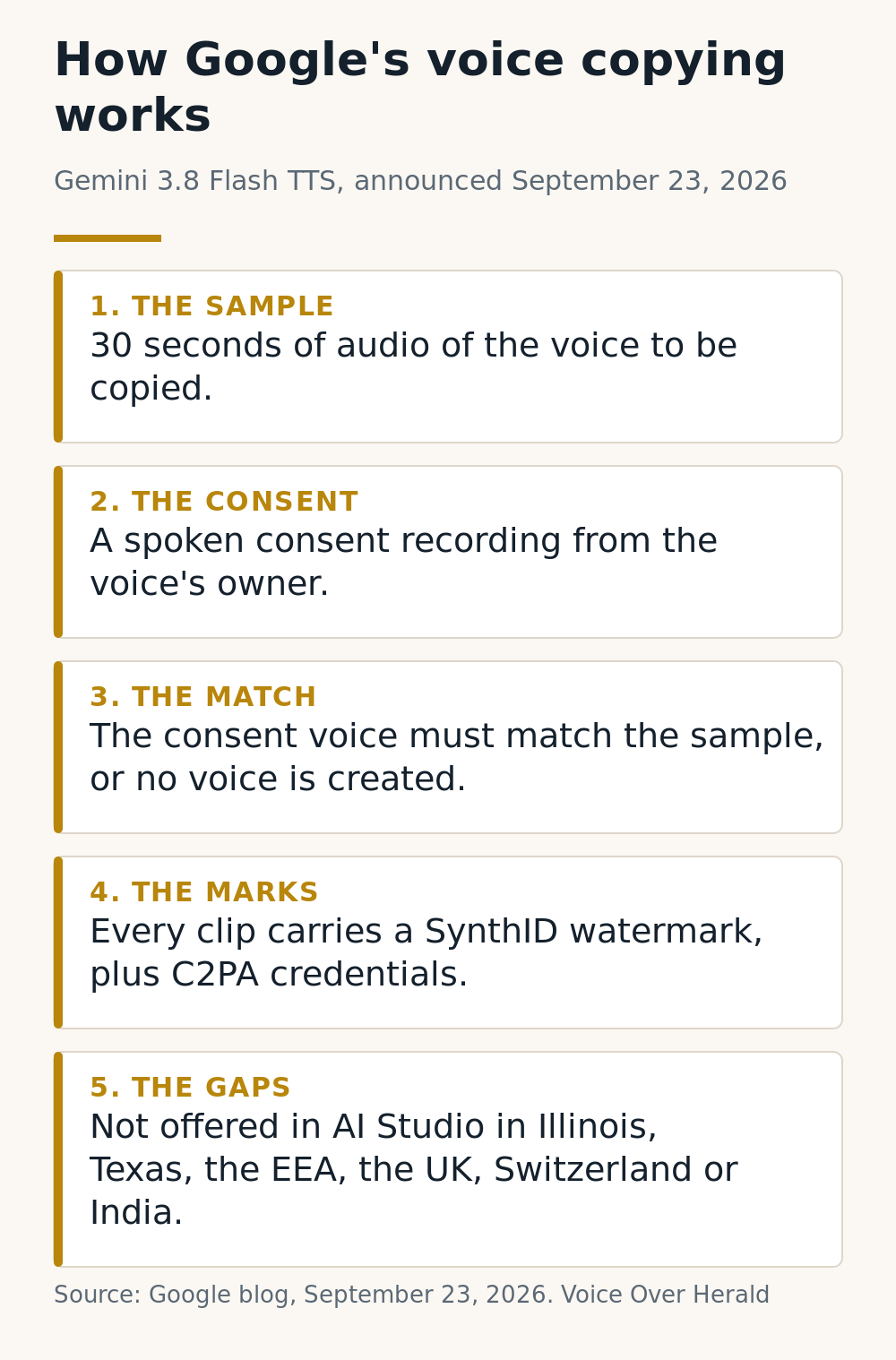
The part that matters most for performers sits in the voice replication feature. Google says it can “Recreate consistent vocal profiles from just a 30-second audio sample of your voice or a voice you have the rights to use.”
Then comes the safeguard. “For voice replication our system leverages consent verification: users must provide a verbal consent recording from the voice owner that matches the reference speaker before a voice can be created,” the post says. The system compares the consent recording with the sample. If the voices don’t match, no clone.
On top of that, “every audio clip generated by our Gemini Audio models is watermarked with SynthID,” which Google describes as an “imperceptible watermark” that is “woven directly into the audio output.” Copied voices also carry C2PA content credentials, a standard for labelling where media came from. Google says it built all this “to help protect voice talent, respect identity, and ensure content transparency.”
Where it won’t run
A footnote at the bottom of the post is short and telling: “Voice replication through AI Studio is not available in Illinois, Texas, EEA, UK, Switzerland, and India.”
 VoiceEditSuiteRaw take in. Clean take out.
Google doesn’t explain the list. What several of those places share is law that treats a voice as something close to personal property. Illinois’s Biometric Information Privacy Act and Texas’s biometric identifier statute both name voiceprints. European and UK data protection rules treat biometric data used to identify a person as a specially protected category. When a company builds a feature and then fences it off in exactly the places with the strongest voice and biometric rules, that tells you something about where it expects the legal risk to be.
What it means for working voice actors
The clone isn’t the main competition. The library is. Most of what Google shipped doesn’t copy anyone. It’s 2,000 stock voices plus a tool to design new ones from a written description, “whether you’re bringing a dramatic, fire-breathing dragon to life or crafting a charismatic narrator with a distinct regional cadence,” in Google’s words. Game characters and narrators are exactly the jobs in that sentence.
Your spoken consent is now paperwork. Google’s system turns “yes” into a recording. Treat any request to read a consent statement the way you’d treat a contract. If a client asks you to record “one quick extra line” at the end of a session and it sounds like permission, stop and ask what it’s for, which platform, for how long and what it pays. A consent recording in your own voice is a lot harder to argue with later than a signature you don’t remember.
“Rights to use” still points back to your contract. The feature is offered for your own voice “or a voice you have the rights to use.” The consent check asks for the owner’s voice, which is a real barrier. But the phrase shows where the argument will land when things go wrong: what you signed, and whether it mentions AI.
Watermarks can work for you. If a clip that sounds like you turns up somewhere it shouldn’t, a detectable watermark is one more way to show it wasn’t a session you recorded.
Dubbing is the target market. Google names partners including Figma, HeyGen, Linguana, Wondercraft, 99.co and Ollang, which it says are integrating the models “to help accelerate global dubbing, localize media with nuanced regional accents, and power conversational voice agents at scale.” Mexican Spanish is one of the languages where Google says the models take top positions in blind listening tests.
There’s a direct line from this launch to the ad market, too. In California, a commercial voiced by a synthetic narrator will soon have to tell listeners that no human performer is depicted. Tools like this one are what that new law was written for.
None of this answers the bigger question every voice actor is asking, which is how much of the work moves to machines. What it does show is that the biggest AI companies now expect to be asked for consent, and that spoken permission is becoming part of the job. Know what you’re agreeing to before you say it.
Sources: Google, “Gemini 3.8 text-to-speech says hello”, September 23, 2026; Android Authority, September 24, 2026.
Lee este artículo en español: Google puede copiar una voz con 30 segundos de audio. Antes, el dueño tiene que decir que sí en voz alta
Know something about this story, or spotted an error? Tell the newsroom.