
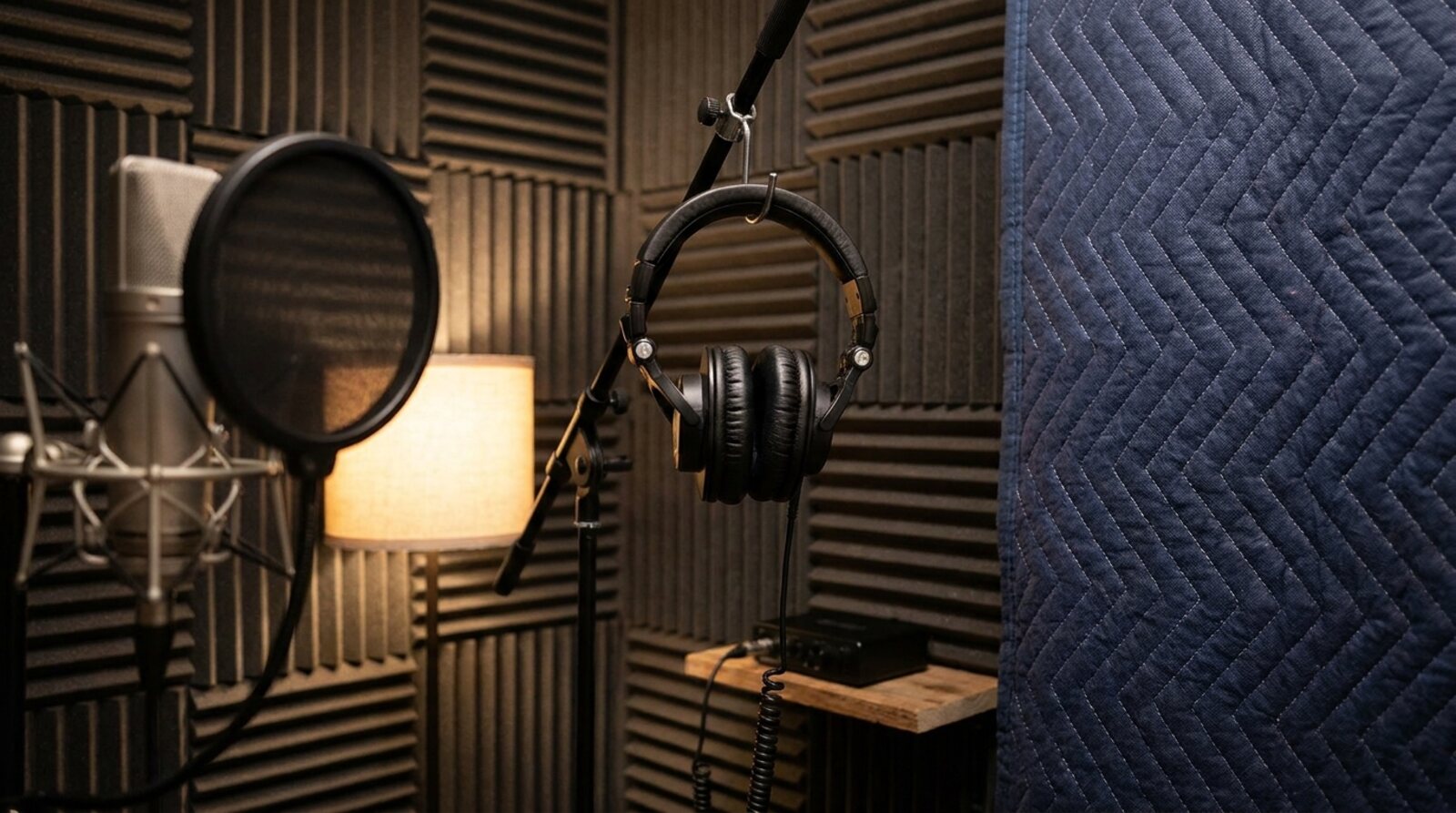
Your Headphones Can Leak Into Your Take: How to Choose a Pair for Voice Work, From Ohms to Earpads
Your headphones never show up in the finished file, but they can still ruin it. The wrong pair leaks the director’s voice into your take, goes quiet on your interface, or pinches so hard that chapter nine sounds tired. Here’s how to pick a pair for voice work from what the makers actually publish, and why one well known voice actor wears his over only one ear.
Most voice actors buy a microphone after weeks of reading reviews, then grab whatever headphones are on sale. It’s an easy habit to fall into, because headphones feel like the passive part of the chain. They don’t record anything.
But in a home booth they do three jobs at once. They carry the director’s voice on a live session, they let you hear clicks and room noise before a client does, and they sit on your head for hours. Each of those jobs maps to a number on a spec sheet, and once you know which numbers matter, the choice gets a lot smaller.
Why the back of the earcup matters in a booth
Headphones come in two broad builds. Open-back models have vented cups that let sound out, which many engineers love for mixing. Closed-back models seal the sound in. For anyone recording a voice, the makers themselves point the same way.
“For use in combination with a microphone, we recommend closed-back headphones, as they provide better isolation from external noise and reduce sound leakage into the microphone,” beyerdynamic says in the questions section of its DT 770 PRO page. The same page warns that open-back models “may bleed into sensitive microphones and cause feedback at high volumes.”
Sennheiser puts it even more plainly in a piece about its studio range: “Closed-back isolation prevents bleed into microphones during vocal sessions, overdubs, and live recording.” That matters more for voice actors than for singers, because a condenser mic a few inches from your mouth hears everything, and a voice track has no band to hide a faint, tinny copy of the director’s notes or your own playback.
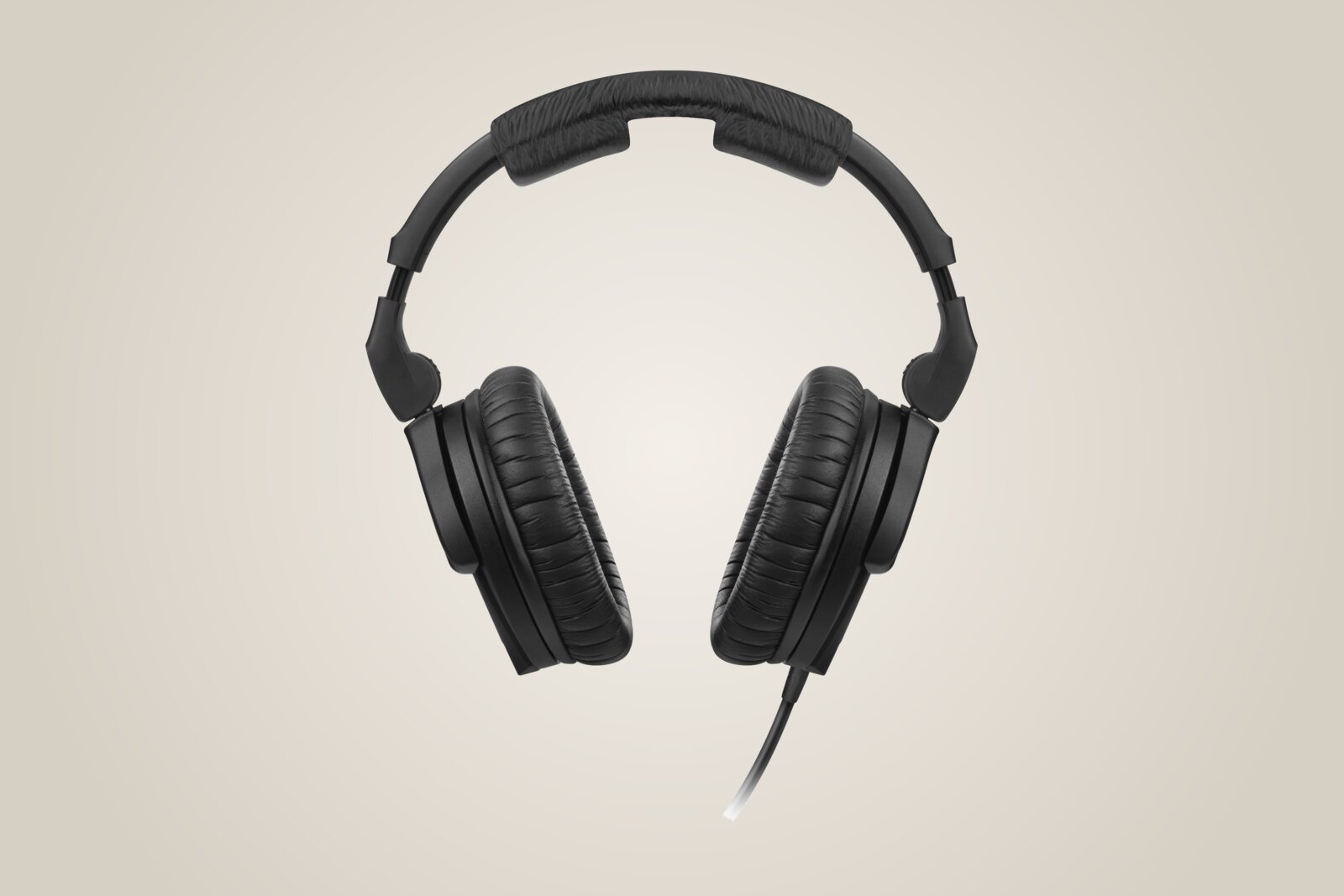
Some makers publish how much outside sound their cups keep out. Sennheiser lists “High ambient noise attenuation (up to 32 dB)” for its HD 280 PRO. That’s handy when a bus goes past your window, but the bigger win in a booth is the reverse: what stays in doesn’t reach the mic.
Ohms, without the maths homework
Impedance is the number that confuses people most, and it’s the one most likely to leave you squinting at a quiet signal. beyerdynamic’s own guide calls it “the electrical resistance of a headphone,” measured in ohms, and adds that “the higher the impedance, the more voltage is needed for the headphones to sound loud enough.”
The company sells its DT 770 PRO in three versions and labels them by where they’ll be plugged in: 32 ohms for “Mobile Devices”, 80 ohms for “Universal Studio” and 250 ohms for “Professional Devices”. Its guide spells out the ranges. Low impedance, 16 to 32 ohms, “works optimally with smartphones, laptops and other mobile devices.” Medium impedance, 32 to 80 ohms, “is well-suited for audio interfaces, creator setups and home-studio environments.” High impedance, from about 250 ohms, “requires a powerful amplifier.”
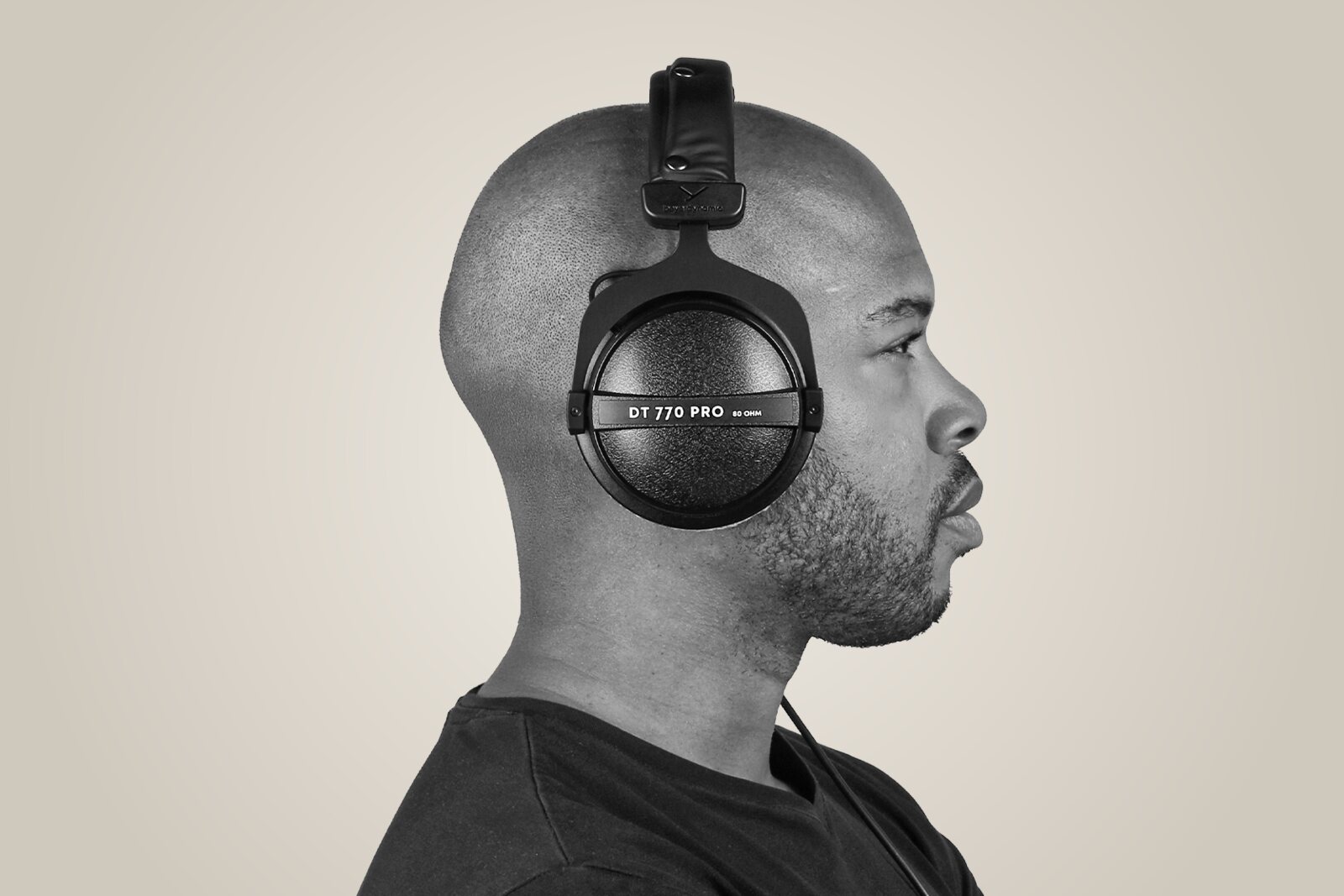
The DT 770 PRO in its 80 ohm version. Image: beyerdynamic
The guide also does a worked sum. Feed one volt into a pair of 80 ohm DT 770 PRO headphones and they get about 12.5 milliwatts. Feed the same volt into a 600 ohm model and it gets about 1.6. Same output, roughly an eighth of the power. If your interface has a modest headphone amp, that’s the difference between hearing a mouth click and missing it.
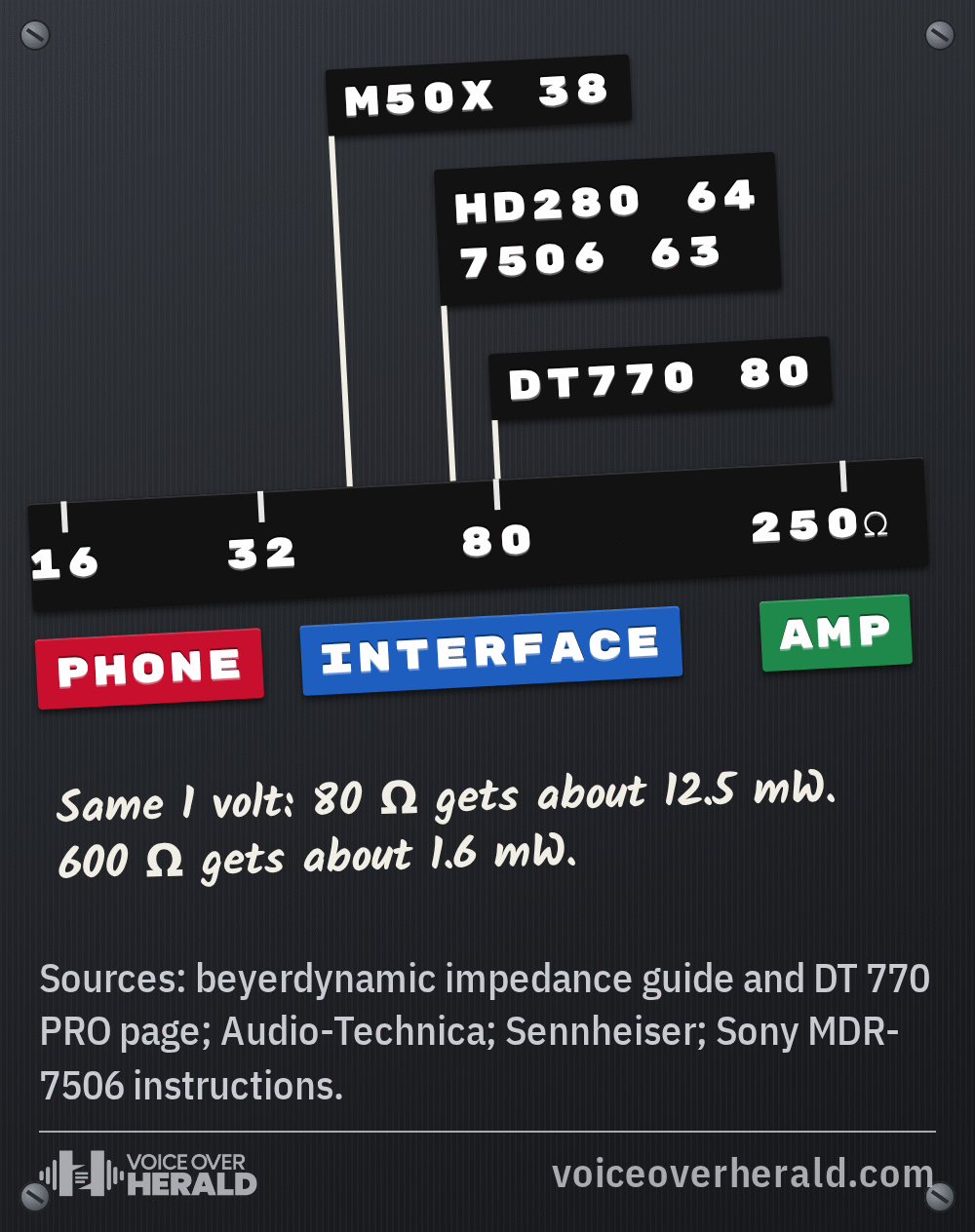
For most people recording on a small USB interface, that puts the sweet spot in the middle. The popular closed-back models already sit there: Audio-Technica lists its ATH-M50x at 38 ohms, Sennheiser lists the HD 280 PRO at 64 ohms, and Sony’s printed instructions for the MDR-7506 give 63 ohms at 1 kHz.
When the spec sheet argues with itself
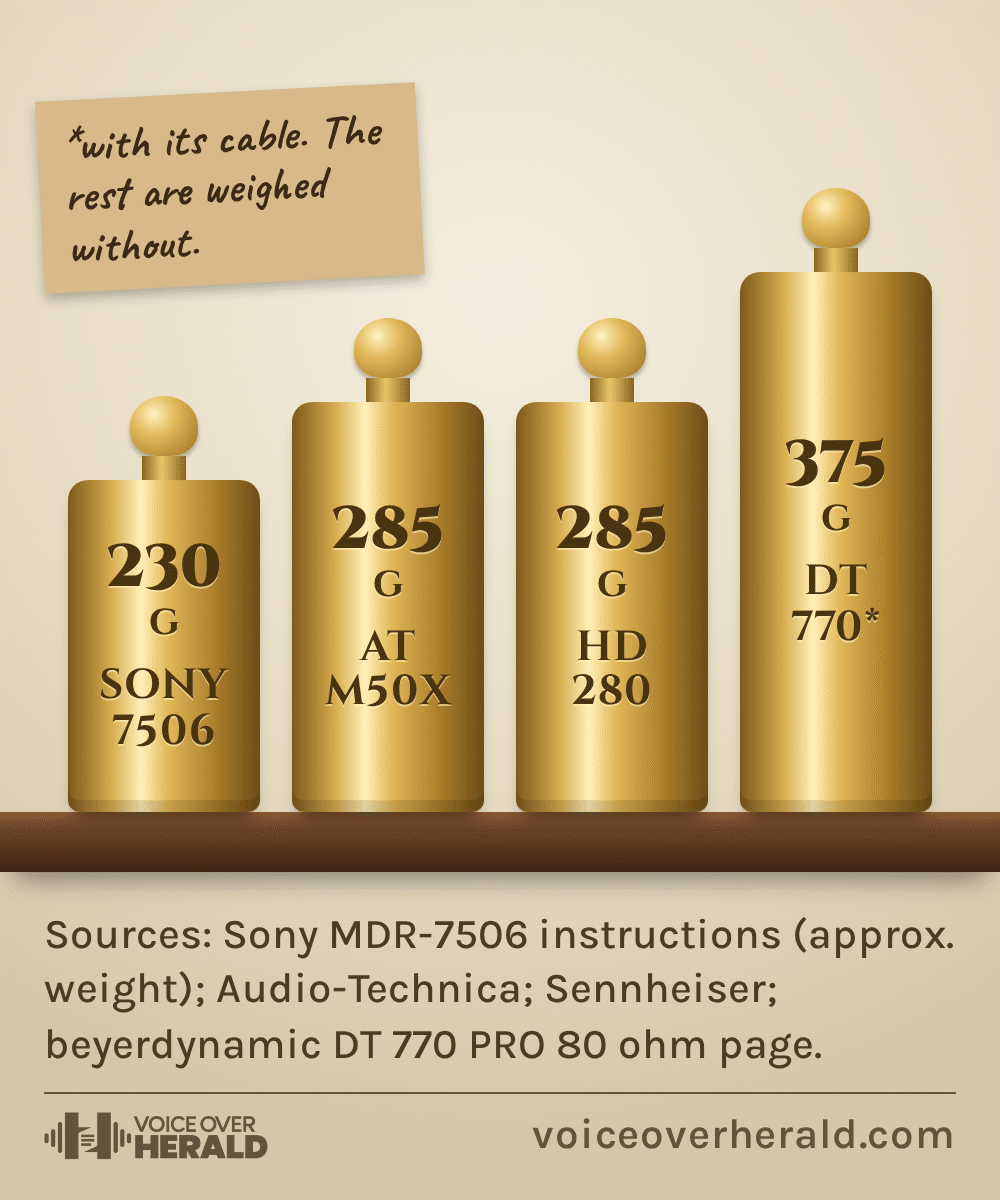
That Sony figure comes with a warning. The operating instructions Sony packs with the MDR-7506 say “Impedance: 63 Ω at 1 kHz” and “Mass: Approx. 230 g without cable”. Sony’s own online store in Malaysia lists the same model at “24 ohm (1KHz)” and 260 g without the cord. Sony’s US pages wouldn’t load for us when we checked, so we couldn’t compare those.
We’re not saying either number is a con. Sizes get rounded, regions sell slightly different versions, and web pages get copied by hand. But it’s a good reason to treat any single spec as a starting point, read the printed manual where you can, and judge the last few details with your own ears.
Here’s what each maker publishes for four well known closed-back pairs. We’ve left sensitivity out on purpose, because the makers don’t all state it the same way.
| Model | What the maker lists |
|---|---|
| beyerdynamic DT 770 PRO | 32, 80 or 250 ohms. Straight cable, 3.5 mm plug, 6.35 mm adapter. |
| Audio-Technica ATH-M50x | 38 ohms. Three detachable cables. |
| Sennheiser HD 280 PRO | 64 ohms. Coiled, single-sided cable. |
| Sony MDR-7506 | 63 ohms in the manual. Coiled cable, approx. 1.2 m, about 3 m stretched. |
Comfort is a spec too
A four-hour audiobook session is a long time to wear anything. Weight is the obvious number, but clamp, earpad material and whether the pads can be replaced matter as much. Sennheiser lists “Soft, replaceable earpads for extended comfort” for the HD 280 PRO, and Sony lists earpads as a replacement part in the MDR-7506 manual. Pads wear out. A pair you can re-pad will outlast one you can’t.
Glasses wearers have it harder, because a tight clamp presses the arms into your head. Steve La Cerra, reviewing beyerdynamic’s 48 ohm DT 770 PRO X Limited Edition for Mix magazine in 2024 at a listed $199, wrote that it “is very comfortable even while wearing glasses for long sessions.” He also tracked vocals with it and found it “isolated the cue mix well enough that leakage into a vocal microphone wasn’t an issue, even when the singer moved one earcup slightly to the side of their ear.”
Cables are the other quiet comfort issue. A coiled cable stretches as you lean in, while a long straight one tangles round the mic stand. Audio-Technica ships three detachable cables with the ATH-M50x, which Audio-Technica’s US store lists at $159, and says its “90° swiveling earcups” are there “for easy, one-ear monitoring”. That last feature leads to an old argument.
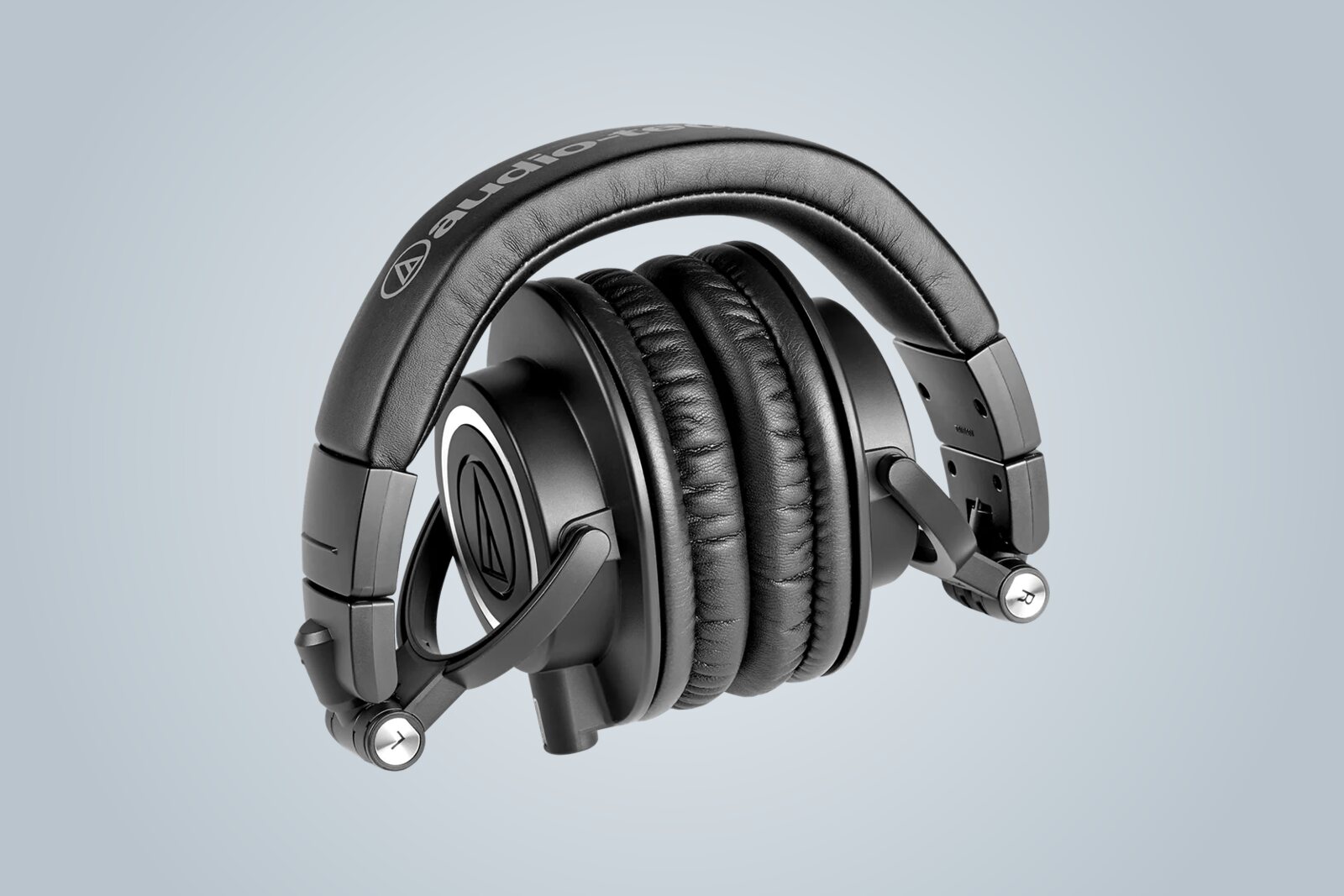
The ATH-M50x folds and its cups swivel for one-ear listening. Image: Audio-Technica
The case for one ear off
Not every working voice actor wants both ears covered. Bob Souer, who narrates non-fiction audiobooks, wrote on his blog that “wearing headphones gives me (and you, no matter what you think) an unnatural perspective on my voice.” The more he listens to himself, he argued, the less he’s thinking about the message he’s reading.
 VoiceEditSuitePractise the skill that books work.The Cold Read hands you a fresh 30-second script and casting brief every take, then hides the timer so you build your own internal clock.See how it worksYour recordings are never used to train AI.
When a session does need headphones, such as a phone patch with a director, Souer wrote: “I wear the phones over only one ear. Again, so I can hear my voice the way it sounds in real life; and concentrate on telling the story.” His second reason goes back to a 1997 voice-over training session with Dick Orkin, who told him: “Take off your headphones and leave them off.”
You don’t have to pick a side forever. Plenty of narrators record with one cup off and then put both cups on to edit, which is where a closed, honest pair earns its keep. The point is to choose on purpose. If you work one-eared, swivelling cups and a single-sided cable make life easier. If you like both cups on, keep the level low enough that nothing leaks.
A five-minute shopping check
- Closed back. Both beyerdynamic and Sennheiser recommend it for recording near a mic.
- Match the ohms to the socket. For a typical USB interface, look in the 32 to 80 ohm range unless you own a dedicated headphone amp.
- Read the printed manual. If two of the maker’s own pages disagree, the manual is the safer bet.
- Replaceable pads. They’ll wear out before the drivers do.
- Test for leaks. Record ten seconds of silence with your playback running at your normal level, then listen back. If you can hear it, so can your client.
None of this needs a big budget. It just needs the right numbers, a pair that stays comfortable past lunchtime, and a habit of checking what the mic heard.
Sources: beyerdynamic, DT 770 PRO product page and “What impedance should I choose for my headphones?” (December 2023); Sennheiser, HD 280 PRO product page and its HD 480 PRO studio story; Audio-Technica ATH-M50x product page (US); Sony MDR-7506 operating instructions and Sony Store Online Malaysia specification page; Steve La Cerra, Mix, 19 November 2024; Bob Souer, “Headphones!”. Specifications as the makers listed them in November 2026; the ATH-M50x price is from Audio-Technica’s US store in November 2026 and the DT 770 PRO X Limited Edition price from Mix’s 2024 review. Product images: beyerdynamic, Audio-Technica, Sennheiser.
Lee este artículo en español: Tus audífonos pueden colarse en tu toma: cómo elegir un par para locución, de los ohmios a las almohadillas
Know something about this story, or spotted an error? Tell the newsroom.