

Hear the Hum: What ACX’s -60 dB Noise Floor Actually Sounds Like
Every audiobook uploaded to ACX has to clear the same technical checks, and one of them trips up home narrators more than any other: the noise floor. ACX’s rule is short. “Each file must have a noise floor no higher than -60dB RMS to avoid background noise distractions.” What the rule doesn’t tell you is what -60 dB actually sounds like, or how close your own room is to it.
So Voice Over Herald made it audible. Below is the same narration four times, mastered the same way, over four different amounts of room noise. Play one, then tap another while it runs.
What the noise floor actually is
ACX’s own audio explainer series, fronted by a character called Alex the Audio Scientist, defines it as the “level of background noise in a recording, when no narration is taking place.” In other words, it’s what’s left when you stop talking: the room tone in the pauses between sentences.
That’s why the clips above sound identical while the narrator is speaking and so different in the gaps. A voice at a normal audiobook level covers a lot of room noise. The pauses don’t. On a long book, a listener hears thousands of them.
 VoiceEditSuiteTrim it, clean it, deliver it. One pass.
The decibel scale is also less intuitive than it looks. Each 10 dB step is ten times the noise energy, so the -50 dB clip carries ten times the noise of the -60 dB one, and the -40 dB clip a hundred times. On laptop speakers the first two can sound much the same. On headphones, which is how a lot of audiobooks are heard, they don’t.
Where the hum comes from
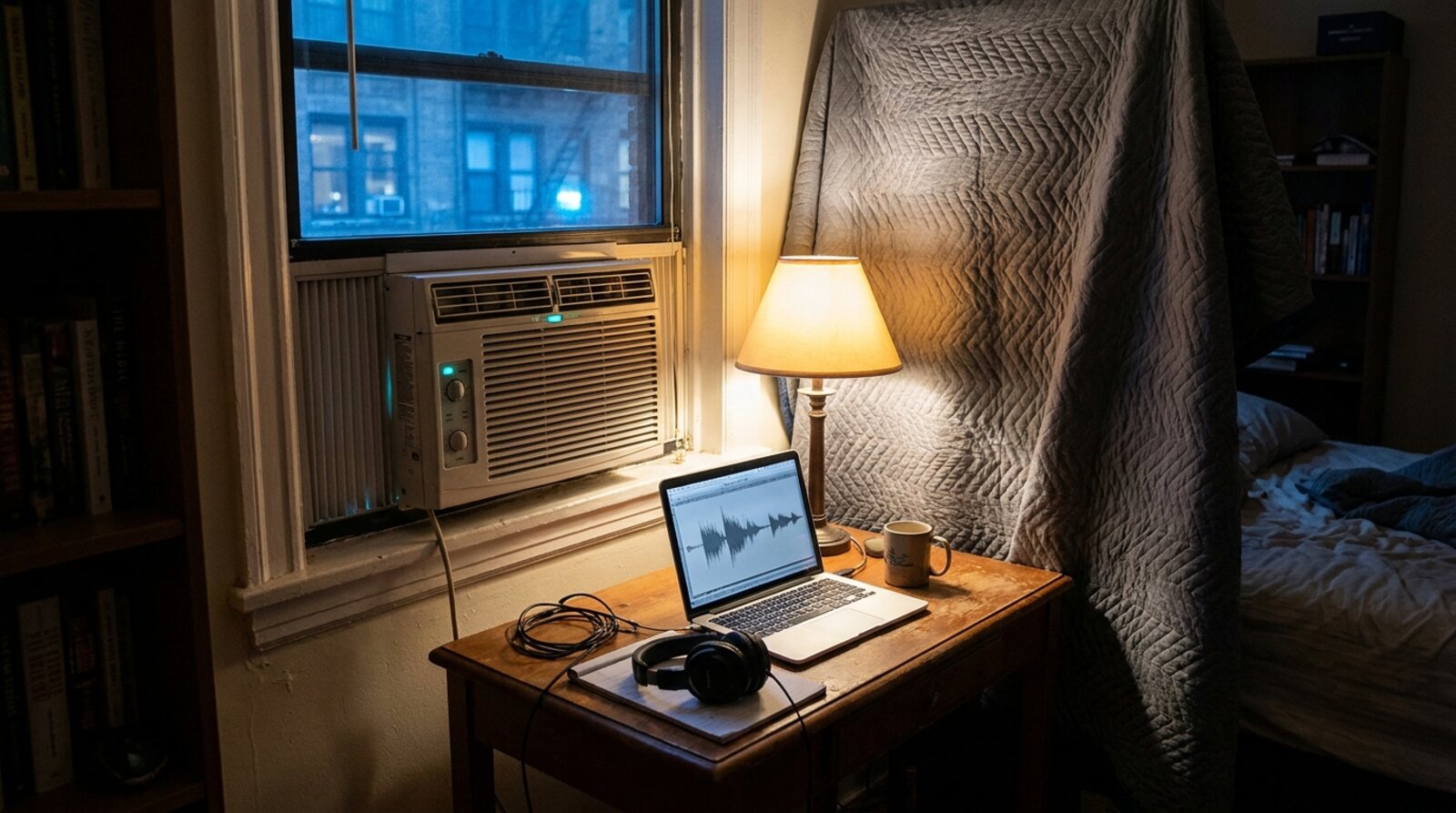
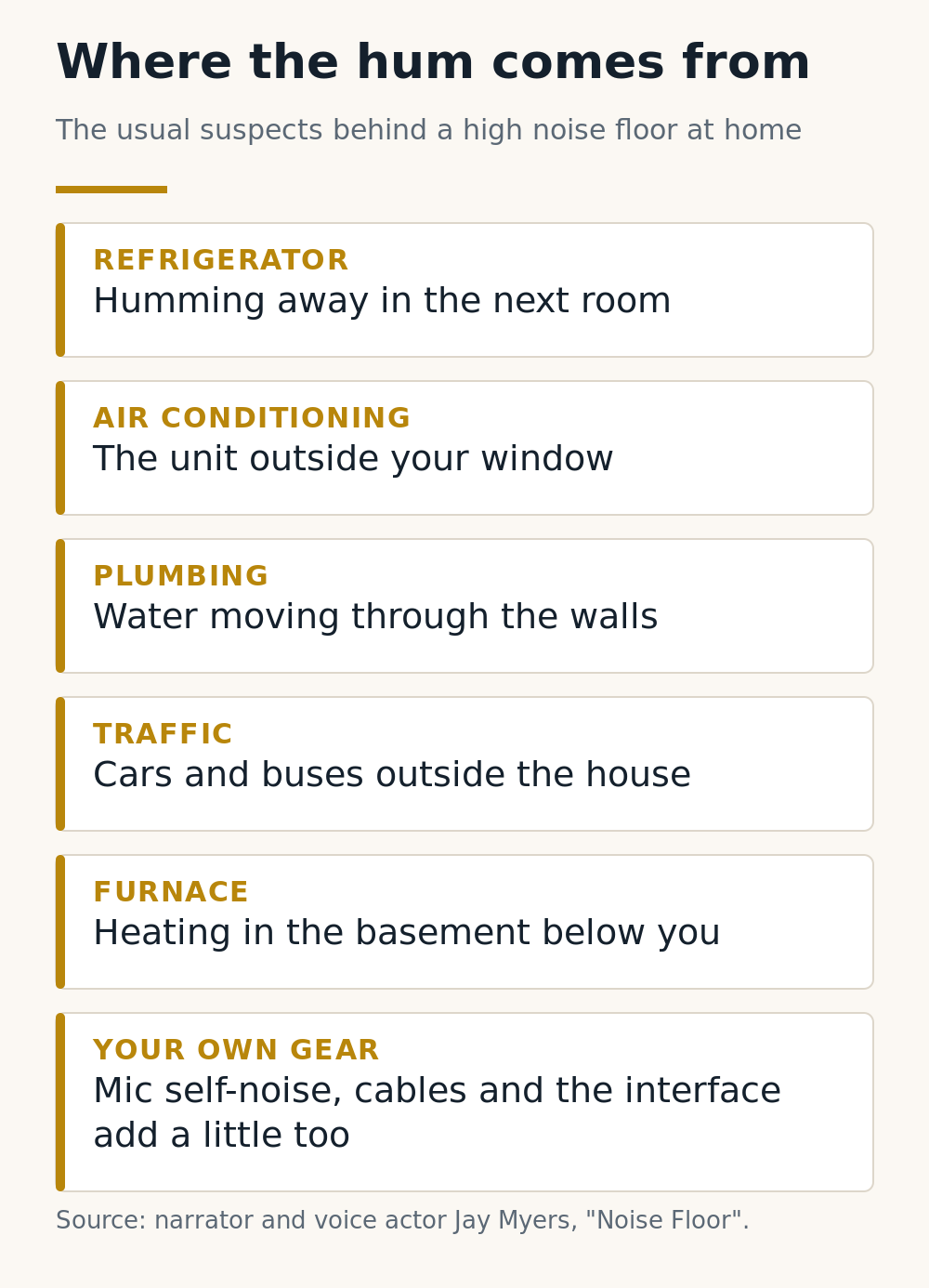
Almost never from the narrator. Narrator and voice actor Jay Myers lists the usual suspects in a guide on his site: “This can include things like your refrigerator humming in the next room, the AC outside your window, the plumbing in your walls, traffic outside of your home, the furnace in the basement beneath you, etcetera.”
Most of those are steady sounds, which is exactly why they’re easy to stop hearing while you record. The ear tunes out a fridge in a minute or two. A microphone never does. Myers puts the danger zone a little above ACX’s line: “If you find your noise floor creeping above -50dB you may start running into issues.”
Consistency matters as much as the number. ACX asks that an audiobook stay even from file to file, and spells out what that covers: “This includes audio levels, tone, noise level, spacing, and pronunciation.” A chapter recorded with the heating on and the next one with it off will sound like two different rooms, even if both pass.
Check your own numbers
ACX checks three levels on every file, and the noise floor is only one of them. On loudness, the requirement reads: “Each file needs to fall between the specific volume range of -23dB and -18dB RMS for consistent volume.” On peaks, the submission requirements say “Each file must have peak values no higher than -3dB to avoid distortion.”
Measure a pause in your own recording for the noise floor, and the whole file for loudness and peak, then try your numbers here.
The gap line in the checker is the one worth watching. With narration mastered around -20 dB RMS, a -60 dB floor leaves about 40 dB between the voice and the room. Every dB you lose there is room noise the listener can hear in the pauses.
Getting under the line
The fixes are mostly free, and they happen before you press record.
- Record ten seconds of silence first. Sit still, record the room, and measure that stretch. It’s the honest number, and it tells you whether the problem is the room or the edit.
- Switch things off. Air conditioning, heating fans, desk fans, a humidifier, anything with a motor. If a computer has to stay on, move it as far from the mic as the cable allows, or out of the room.
- Close the room. Doors and windows shut. Recording at a quieter hour does more for traffic noise than any plug-in.
- Work closer to the mic. The closer you are, the less gain you need, and the room comes down with it. The Voice Realm’s guide to mic distance and angle lets you hear that effect too.
- Measure before you buy. A free home studio analysis tells you where your room actually stands, so you fix the real problem instead of guessing.
Noise reduction software can pull a floor down, but heavy use leaves a watery, swirling sound in the pauses that listeners notice as quickly as the hum it replaced. It works best as a light touch on a room that’s already close.
One more detail from the same requirements: ACX wants room tone at the start and end of every file, “between 1 and 5 seconds,” and that room tone is exactly where the noise floor gets measured. A quiet room makes those seconds easy. A noisy one puts the problem at the very top of every chapter.
Sources: ACX, “ACX audio submission requirements”; ACX Blog, “All About Noise Floor with Alex the Audio Scientist”; Jay Myers, “Noise Floor”.
Lee este artículo en español: Escucha el zumbido: así suena el piso de ruido de -60 dB que exige ACX
Know something about this story, or spotted an error? Tell the newsroom.