


Who Says the Number First? How Working Voice Actors Handle the Rates Conversation
Almost every new client gets round to the same question in the first email or two: how much do you charge? Lots of voice actors dread it, and the answer can set what they earn from that client for years. Here’s how working voice actors, coaches and one negotiation researcher say to handle it, from the questions to ask before you name a figure to what you do when the budget comes in low.
The photo at the top is a carpet alley in the souks of Fez, Morocco, where the first price is rarely the last. A professor’s haggle over two Moroccan rugs turns out to say a lot about voice over quotes. We’ll get to it.
“It depends” is true, but it isn’t a quote
Ask a room of voice actors what a job pays and you’ll hear the same two words. On an episode of Voice Coaches Radio about pricing, the producers Josh Heller and Sam Booty put it plainly: “It really depends on a lot of factors.”
The Global Voice Acting Academy (GVAA), whose free rate guide lots of freelancers use as a starting point, explains why. “Voiceover is not a flat per hour or per allotment service model,” its rates page says. “A voice actor’s rate (read: value) for a national tv commercial for a large sports apparel brand is going to be different than a 3-minute internal corporate narration for that same brand.”
So the useful answer to “how much?” is a few questions of your own.
Answer the question with questions
Kelly Condron, a voice artist who records from her home studio in Manchester, puts her questions on her website so clients answer them before they ask. “So I can give you the best possible price please include the following,” her quote page says, and the list starts with “The type of production (Broadcast, web only, internal corporate, IVR, eLearning etc.)” She also asks whether any social media or YouTube use will be “paid for or promoted,” how long the script is, who the end client is, how long the licence should run, and whether anyone wants to listen in and direct the session.
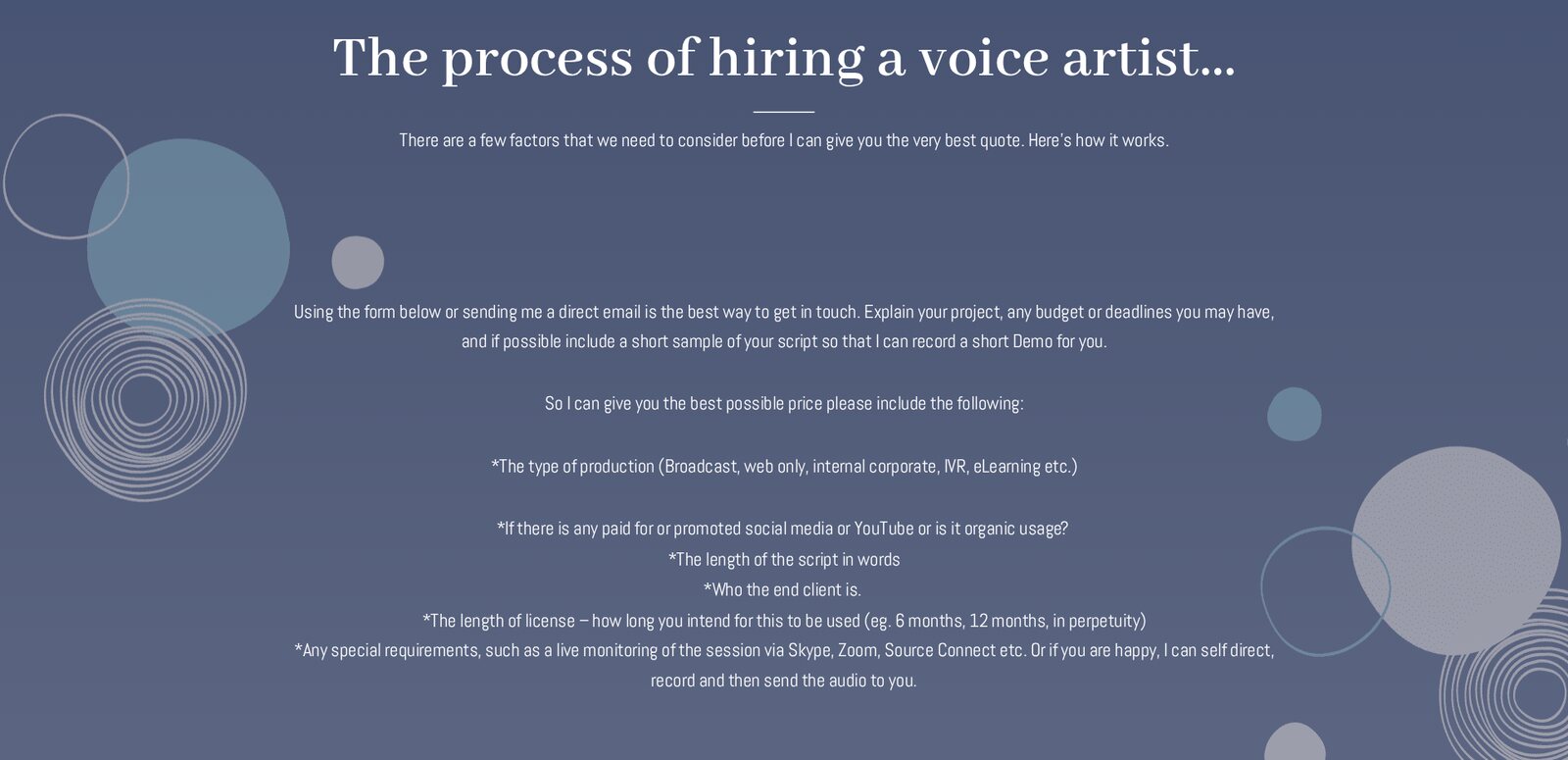
Kelly Condron's quote request list, as shown on kellycondron.co.uk on November 13, 2026. Screenshot: Voice Over Herald
Each answer moves the price. Jessica Lynn Lewis, a narrator in northwest Pennsylvania, boils it down for clients to three things a voice talent wants to know: usage, reach and time. First, how will the voiceover be used? Then, “How large of an audience will you be reaching? The more people, the higher the cost.” And finally, “How many weeks, months or years will you use it?”
One read, two prices
Anthony Pica, a full-time voice actor who founded the coaching school VO Journey Academy, remembers not knowing where to start. “When I first started, I charged maybe $50 per finished hour for audiobooks,” he writes. “I didn’t know whether to charge $5 or $500, so I pretty much took whatever people would pay me.”
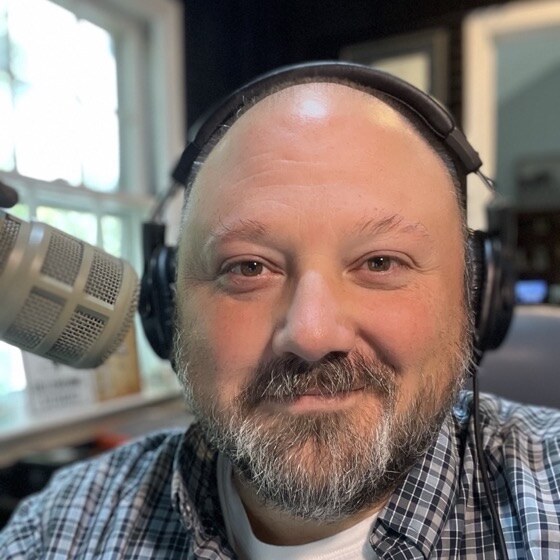
Anthony Pica, voice actor and founder of VO Journey Academy. Image: avosjourney.com
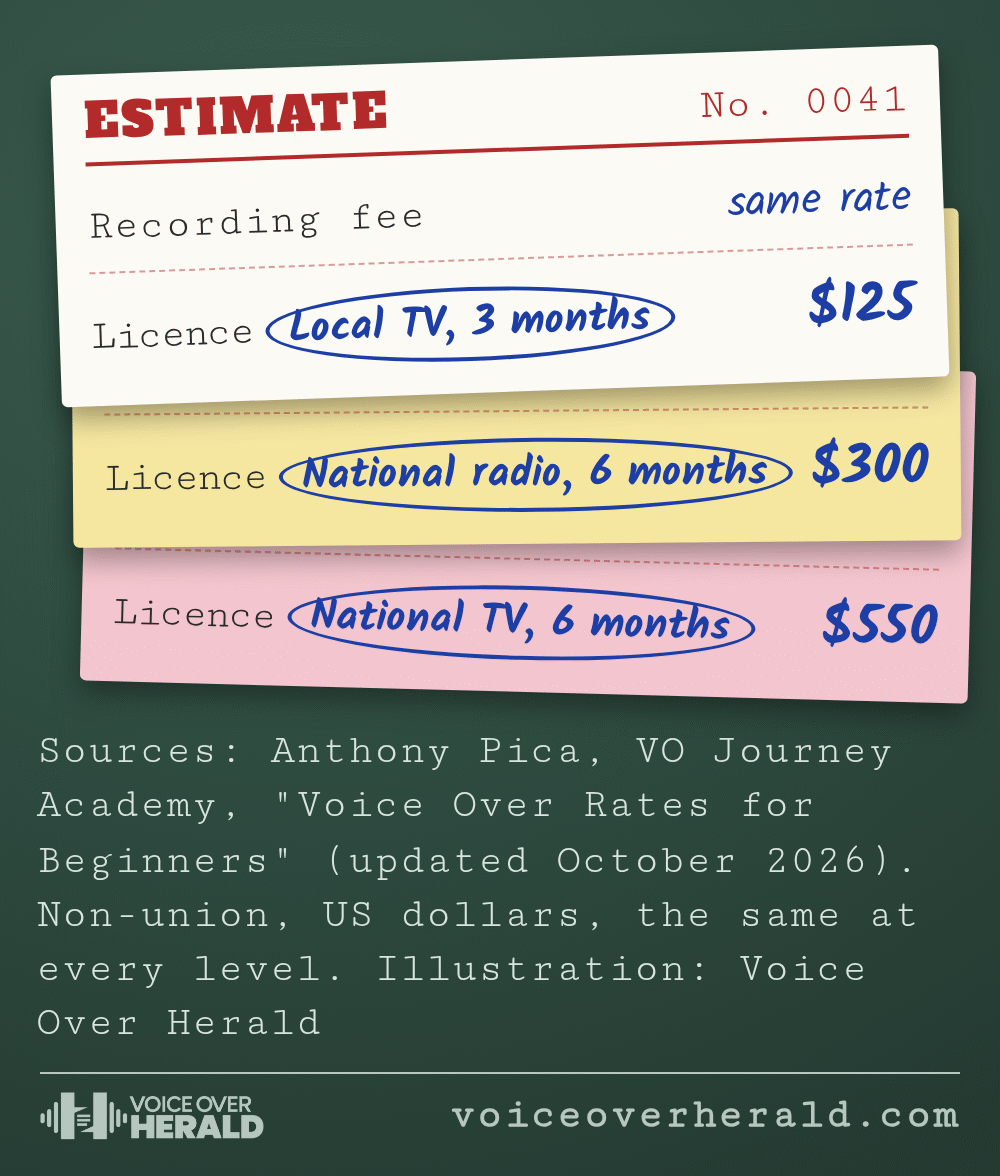
His fix for ads is to split the price in two. “An ad has two prices. One is your recording fee and the other is a license for where it runs.” The licence pays for the audience, not the hour.
GVAA describes usage the same way, as “the term a voice actor’s work is licensed for a particular project,” where “the client is paying a licensing fee to use the voice over for that period.” It names three things that set that licence: the media (TV, radio, digital streaming and so on), the market (national, regional or local) and how long the media buy runs.
Splitting the fee makes a quote easier for a client to read, and it gives you something to adjust later without touching your rate. Pica’s published licence figures show how far apart that second line can sit for exactly the same recording.
Who says the number first?
The old advice is to let the client go first. Research on negotiation says it depends on who knows more. Adam D. Galinsky, then a professor at Northwestern University’s Kellogg School of Management, and two colleagues report that many studies point the same way: “the final selling price tends to be higher when the seller makes the first offer and lower when the buyer moves first,” as Kellogg Insight summed up their work. It’s called anchoring. People adjust from the first number they hear, and not far enough.
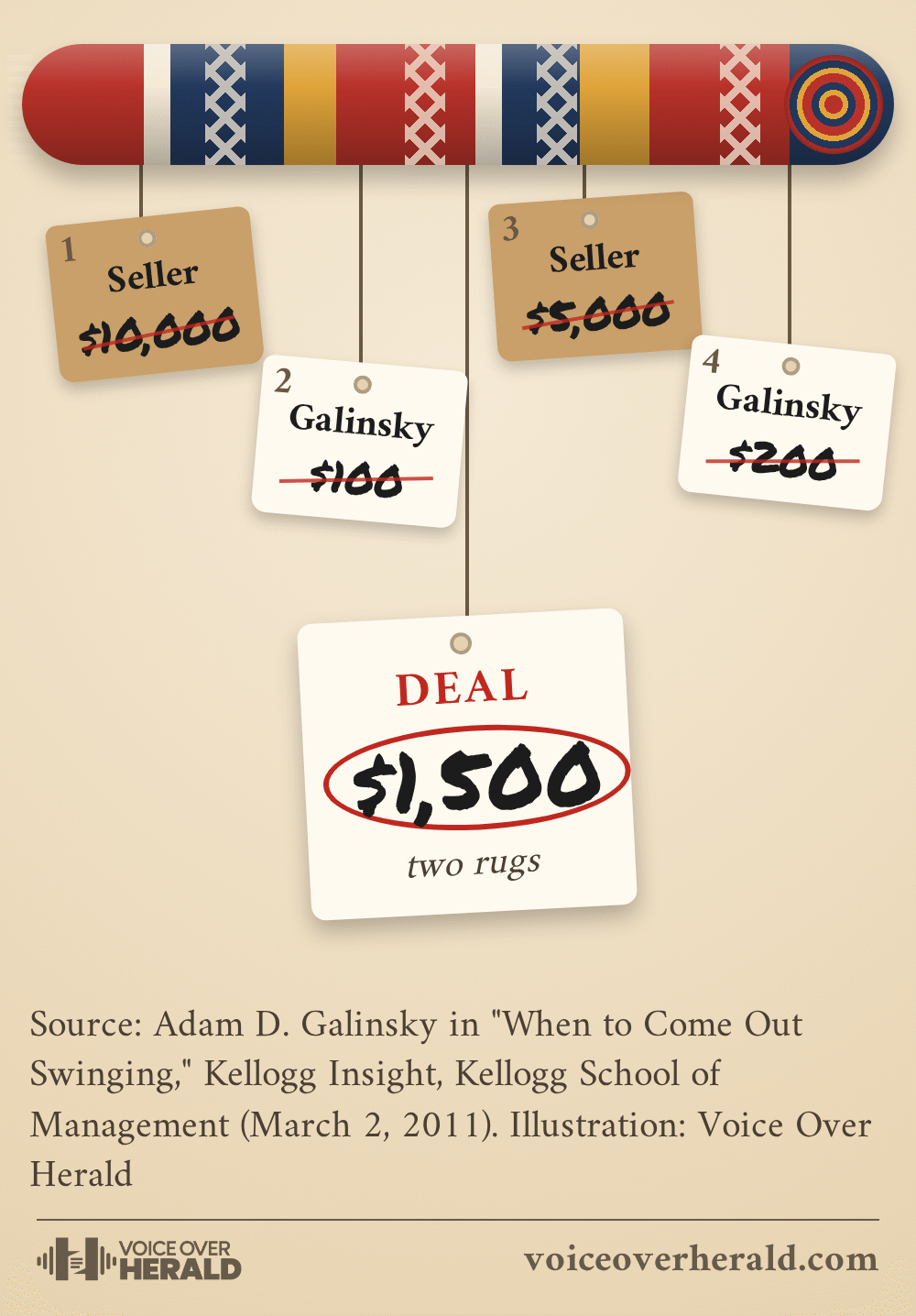
Galinsky has haggled for real. When a Moroccan rug seller opened with a price far above anything he planned to pay, he answered at the other extreme, and they settled much closer to his end. “One strategy is to go first in a negotiation and go high,” he told Kellogg Insight.
There’s one exception, and it matters for voice actors. Going first is risky when the other side knows far more about the job than you do, because your number could land far too low. Galinsky’s answer isn’t to wait. It’s to find out more first. “These processes are hard to overcome, so you need to have psychological protections in place,” he says. For a voice actor, the questions in the last section are those protections.
Heller and Booty take the other route and ask for the client’s figure first, with their own number ready. One of them pictures asking a big company for its budget and hearing more than his usual hourly rate. “You just made 250 an hour instead of 150 an hour,” he says. Both routes start in the same place: know your number before you hear theirs.
When the budget is lower than your rate
Sooner or later a client names a figure below your rate. Pica’s advice is not to take it personally. “A lowball usually means the client doesn’t know how voice-over is priced. List the recording fee and the license as separate lines. A shorter term or a smaller market can bring the total down without cutting your rate.”
If you do choose to come down, say so out loud, and ask for something back. The Voice Coaches hosts suggest a line like “I’m willing to work with you so long as you keep me in mind next time,” followed by a question that every freelancer should ask more often: “Who do you know?”
Be careful how far you drop, though, because the first price tends to stick. One of the hosts started a long-term client at 75 and later tried to move them up. “I tried to raise my price to 125 and they’re like, no, no, no, that’s what it was 75 before,” he says, adding that it’s “so much easier to drop prices than raise prices.” GVAA makes the same point more formally: “If you accept rates that are lower than what you’re worth, you’ll be setting an unsustainable precedent for future work and limiting your earning potential.”
Price the forever, and the AI
The licence question gets harder when the answer is “forever.” GVAA warns that in-perpetuity or unlimited use “can be dangerous for your career and doesn’t honor or respect your value.” The Voice Coaches hosts put the money side simply: “it’s not like you’re getting paid residuals.” If a client wants perpetuity, that’s a much bigger licence, and it belongs on its own line of the quote.
Then there’s AI. A quote that says where a recording can run doesn’t always say what it can’t be used for. The National Association of Voice Actors (NAVA) publishes a free Synthetic Voice/Artificial Intelligence Rider that a voice actor can attach to a client’s agreement. Version 4.5, updated in April 2026, opens with the client agreeing “not to utilize any portion of the Talent’s file, recording or performance of Talent for purposes other than those specified in the initial Agreement between the parties, including but not limited to creation of synthetic or ‘cloned’ voices or for machine learning or AI training.”
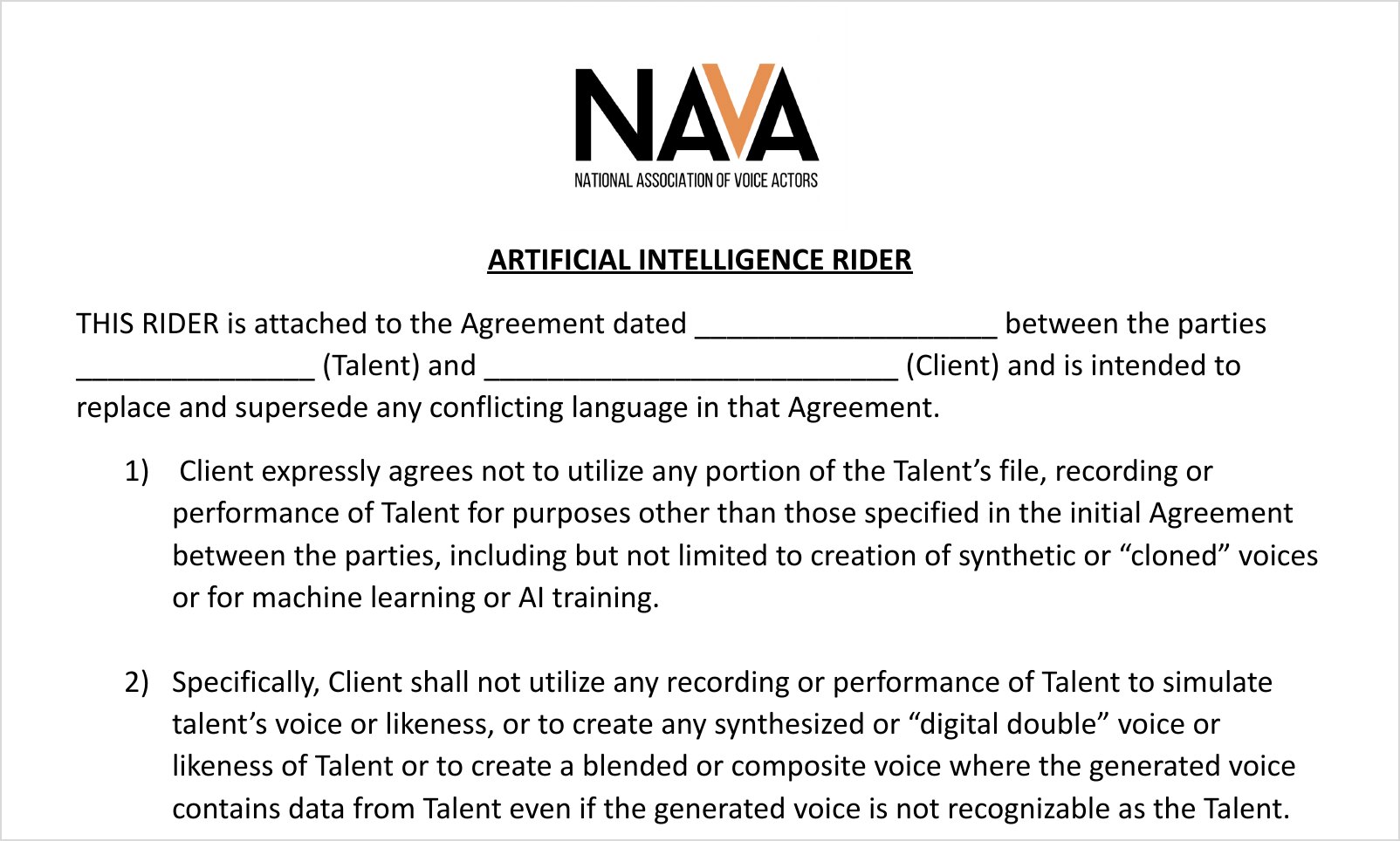
The opening of NAVA's Artificial Intelligence Rider, version 4.5, updated April 14, 2026. Image: National Association of Voice Actors
NAVA says the rider is for education and isn’t legal advice, and that you “should always consult your own attorney or agent to review the terms of any contracts you are offered.” Still, if a client’s paperwork says nothing about cloning or AI training, it’s worth asking before you sign.
Put it in writing, then raise it properly
A good quote also says what the fee covers. Condron’s does: “My fee always includes 1 round of minimal pick-ups.” If the script or the brief changes after recording, there may be a re-recording fee, which she says “is usually £50 for up to 100 words changed.” Pica puts his rule in one line: “If it’s my mistake, I fix it for free.” We looked at published retake policies in more detail in our piece on turning one booking into a regular client.
 VoiceEditSuitePractise the skill that books work.The Cold Read hands you a fresh 30-second script and casting brief every take, then hides the timer so you build your own internal clock.See how it worksYour recordings are never used to train AI.
When the work is steady, raise your rates. Pica says to raise them “when your queue stays full and you’ve got the training and a good studio behind you. Move up a tier instead of a few dollars at a time.”
GVAA’s rates page puts the mindset first: “You have to believe and be confident in your worth in order to command it.” Then ask your questions, and send the number.
Sources: Global Voice Acting Academy, “Rates & Negotiation,” globalvoiceacademy.com; Josh Heller and Sam Booty, “Voice Coaches Radio #418: How much should you charge?,” Voice Coaches (April 8, 2019); Kelly Condron, quote page, kellycondron.co.uk; Jessica Lynn Lewis, “How Much Does Voiceover Narration Cost?,” on her website (July 13, 2020, updated March 2, 2024); Anthony Pica, “Voice Over Rates for Beginners: What to Charge in 2026,” VO Journey Academy (updated October 13, 2026); “When to Come Out Swinging,” Kellogg Insight, Kellogg School of Management (March 2, 2011), on research by Adam D. Galinsky, Gillian Ku and Thomas Mussweiler; National Association of Voice Actors, “AI Rider” and Artificial Intelligence Rider version 4.5 (April 14, 2026). All read November 13, 2026. Main image: Esin Üstün, “Carpet shops, Fez Souks, Morocco,” CC BY 2.0, via Wikimedia Commons, cropped.
Lee este artículo en español: ¿Quién dice la cifra primero? Cómo manejan los locutores la conversación sobre tarifas
Know something about this story, or spotted an error? Tell the newsroom.