

The Floor Under the Fee: How to Read the Voice Over Rate Cards Four Unions Publish
Sooner or later every voice actor gets asked, “What’s your rate?” In four countries, a union has already written down the smallest acceptable answer. Here’s where SAG-AFTRA, ACTRA, MEAA and Equity keep their voice over rate cards, what’s actually printed on them, and how to use one even if you’ve never done a union job in your life.
Rate cards have a reputation for being dull paperwork. But the best of them are the closest thing this business has to a shared price list, and they answer the questions working voice actors fight with every week: how long a client can use a recording, what happens when a radio spot turns up online, and whether an AI copy of your voice costs the client anything.
Every figure below comes from the union’s own documents, in that country’s currency, with the dates the union prints. Rates change every year or so, so treat this as a map of where to look, and check the current sheet before you quote from it.
A floor, not a price tag
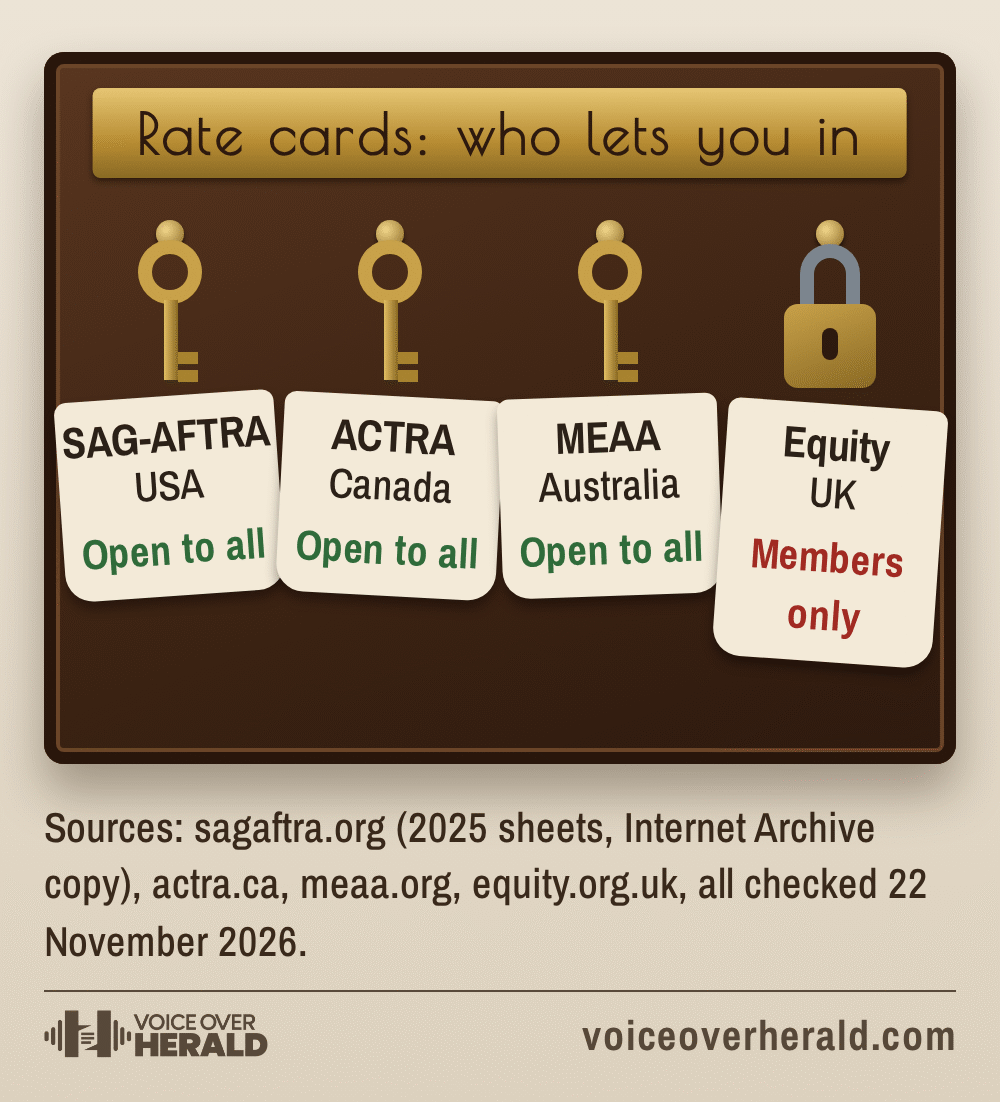
The first thing every card has in common is that it’s a minimum. MEAA’s card for Australia says its figures “are the agreed industry minimum for the engagement of Voiceover Artists in Australia.” Equity in the UK describes the same idea from the other side: “Where we don’t yet have collective agreements, we provide recommended minimum rates and template contracts for you to use.”
That matters for non-union work too. A published number is a lot easier to defend than one you made up on the spot. The catch is that not every union lets you read the numbers. Three of the four put theirs where anyone can open them. One keeps them behind a login.
United States: SAG-AFTRA’s audio sheet
For radio and audio ads, the document to know is the SAG-AFTRA Audio Commercials Contract rate sheet. The 2025 sheet’s Year One “Audio Standard” rates run from April 1, 2025 to March 31, 2026, and the first line is the one most voice actors want: a session for an actor or announcer is $365.00. A 13 week wild spot (a radio ad bought station by station rather than on a network) starts at the same $365.00 for the first unit, with small per-unit amounts after that and higher figures when New York, Chicago or Los Angeles are in the buy.
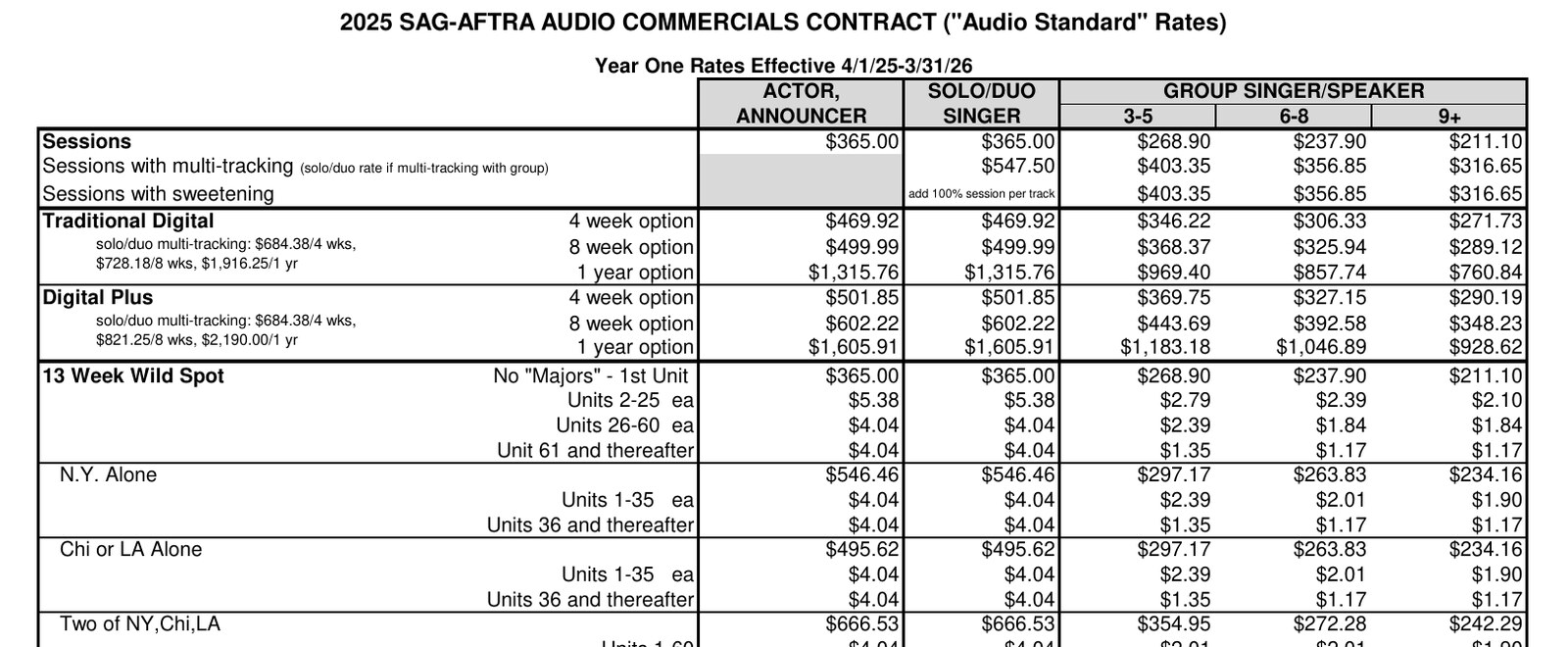
Image: SAG-AFTRA, 2025 Audio Commercials Contract rate sheet, Year One, as published in May 2025
The sheet also prints a separate “Audio Flex” set of rates, with a $404.30 session, and a health and retirement contribution of 23.5% that the producer pays on top of the fee (19.95% for some employers).
Read the year on the sheet before anything else. SAG-AFTRA’s own summary of the 2025 commercials contracts sets increases of 5% from April 1, 2025, then “Effective April 1, 2026: Increase wages and use fees by 4%”, and 3% from April 1, 2027. A sheet that’s a year old is already out of date.
The same summary is also where the union writes down its AI rules for commercials. It defines a digital replica as “a computer program made in whole or in part using the voice, image and/or performance of a performer that can independently generate new performances,” and requires producers to seek consent to create one, in most cases at least 48 hours in advance. We went through clauses like these in our guide to what to check before you sign.
Canada: ACTRA counts the session in hours
ACTRA’s National Commercial Agreement covers English-language commercials made in Canada, and its rate chart is a free download from ACTRA’s agreement page. The union says the current renewal “came into effect on June 1 and provides a three per cent increase to rates.”
The chart’s national TV session fee for a voice-over performer is $685.00, and it includes four hours of work time, against eight hours for an on-camera principal at $939.50. Radio has its own table. A single voice on a national radio spot earns a minimum of $731.50 per session and 13 week cycle, which means the fee comes round again if the ad keeps running.
One caution: when we checked in November 2026, the newest chart on ACTRA’s site still covered June 1, 2025 to May 31, 2026, so ask ACTRA before you lean on it in a quote.
Australia: MEAA prices the usage on the card
MEAA, which calls itself Australia’s union for creative and media workers, publishes the most complete card of the four, and it’s the easiest to learn from. The MEAA Voiceover Industry Rate Card took effect on July 1, 2025 and sits in the union’s resources library alongside an explanatory memo and a contract template. Its voiceover page is blunt about why it bothers. Voice actors, it says, “increasingly face job insecurity, downward pressure on fees, misuse of recordings, and the growing replacement of performers with synthetic voices and AI technology.”
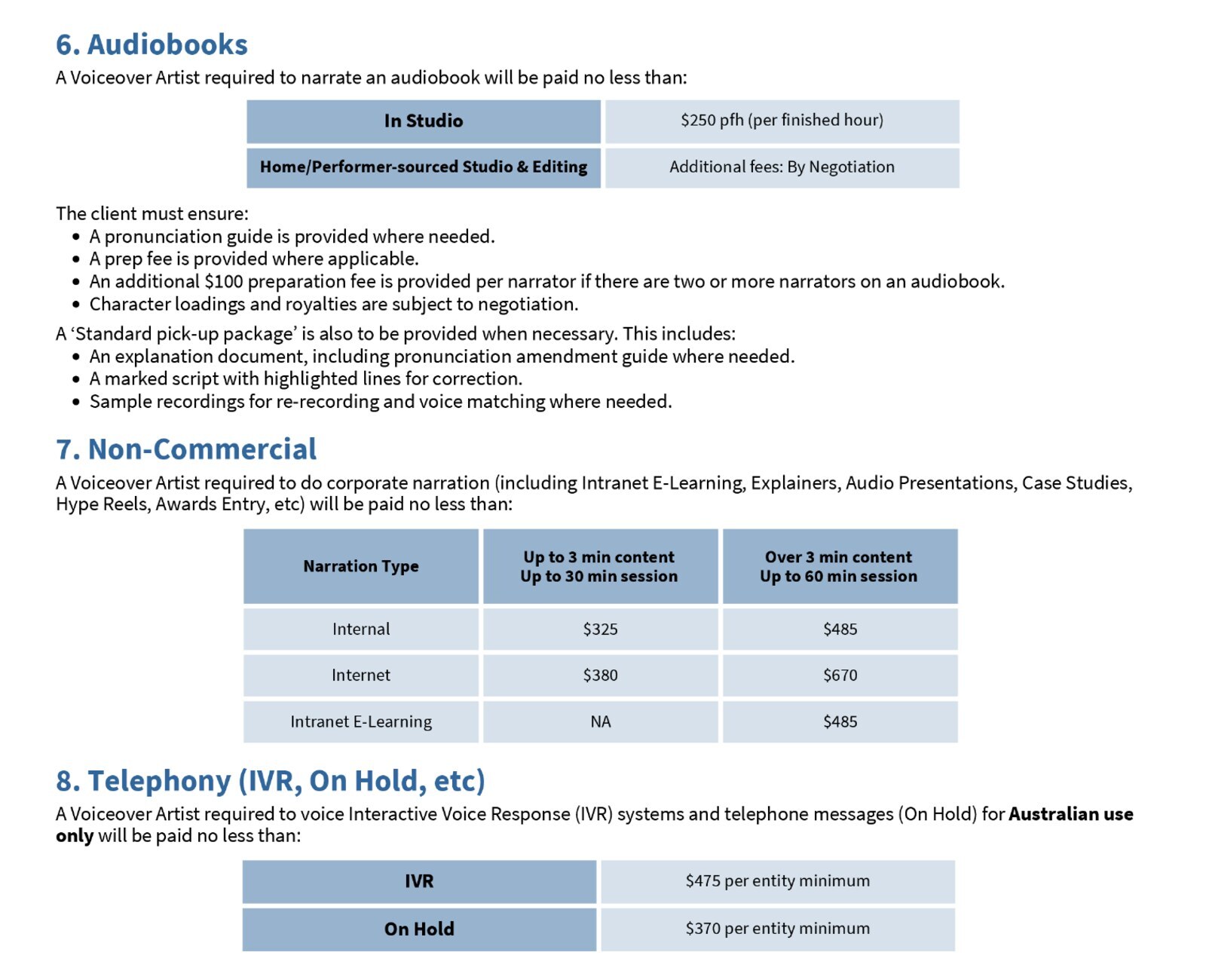
Image: MEAA Voiceover Industry Rate Card, page 3, last updated July 1, 2025
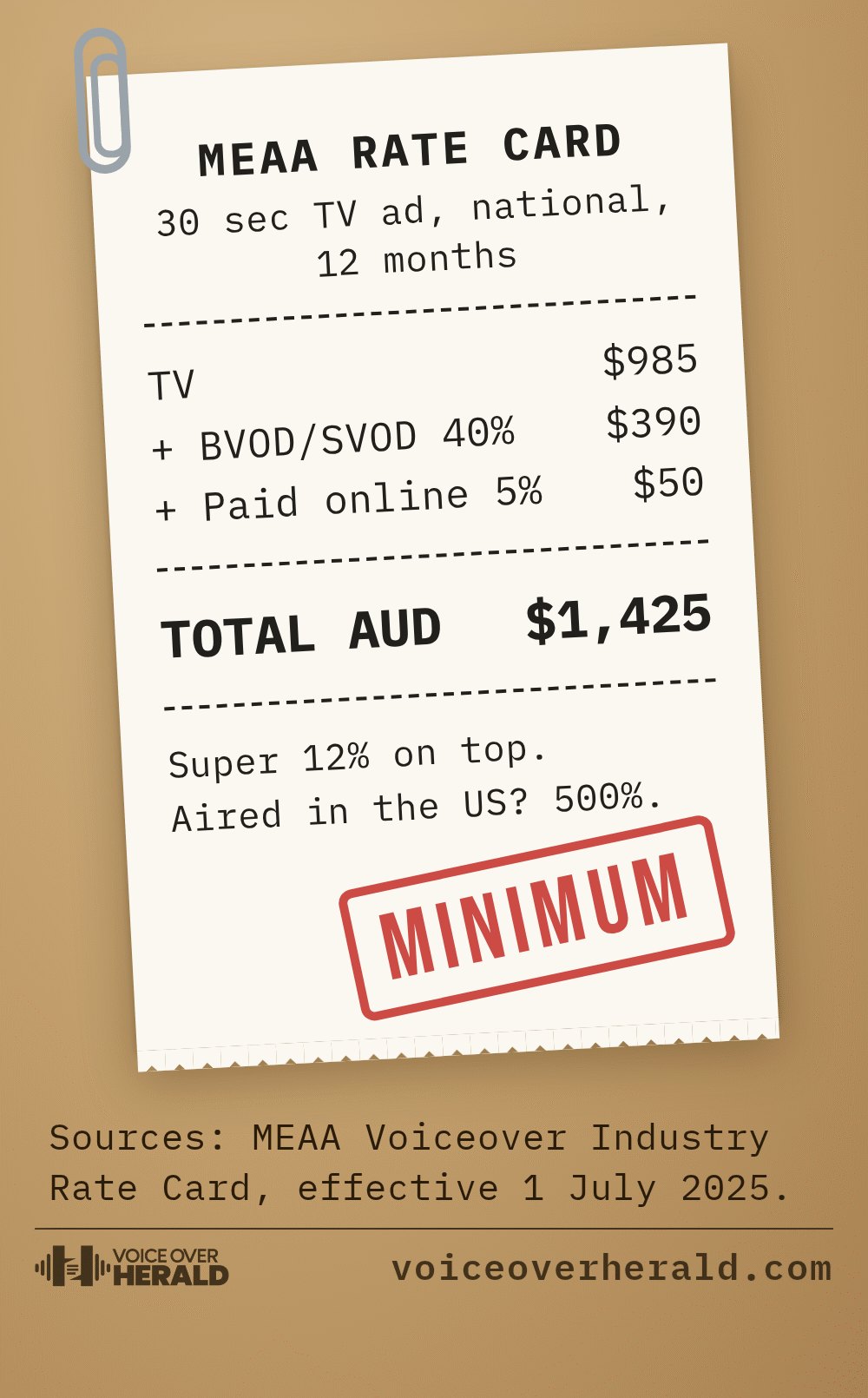
The useful part: the fee already includes the usage. A 15 or 30 second TV ad running nationally for 12 months has a minimum of $985. The same ad for three months in a single state is $445. Streaming TV and paid online placement can be bundled on top at 40% and 5%, and radio has its own table, from $545 for 12 months nationally down to $385 for three months in one state. Ads that air overseas are multiplied: 300% for the UK, 500% for the US, 600% for global use.

 VoiceEditSuiteIt edits like you would, and it gets better every file.Every fix you make in the editor teaches Auto Clean Up more, so each file comes back sounding like you edited it yourself.See how it worksLearns from numbers, never your audio. Never used to train AI.
The card goes well beyond ads, which is rare. It sets $250 per finished hour for audiobooks recorded in a studio, with a $100 preparation fee per narrator when a book has two or more. Corporate and e-learning narration over three minutes is $485 for internal use and $670 on the internet. Phone menus are $475 per entity and on-hold messages $370. A submission or revision is $220.
Two lines on the card deserve a highlighter. On super: “The rates detailed on this card DO NOT include Superannuation.” It’s payable on top, at 12% from July 1, 2025. And on AI: “Voiceovers created using generative AI technology for the purposes of any of the platforms or usage found on this rate card will be paid at the same MEAA rate and for the same periods of usage as a studio-recorded voice.”
The explanatory memo in MEAA’s library also explains why the numbers moved. It says fees rose “11.48% compounded over two increases” between the 2015 card and the new one, while prices in Australia rose 31.99% over the same stretch. It also closes a loophole: bundle discounts now apply only when the usage is quoted at booking, and “if a usage quote is not provided at the time of booking, every platform is to be invoiced at 100% each.”
United Kingdom: Equity keeps the figures for members
Equity’s rates page is organised like a menu, with voice work under Audio, Singers and Video Games: radio, video games, education, film, TV and online, plus a template contract. Click through to the figures, though, and you meet a login box: “You need to be a member to gain access to our pay rates and agreements.”
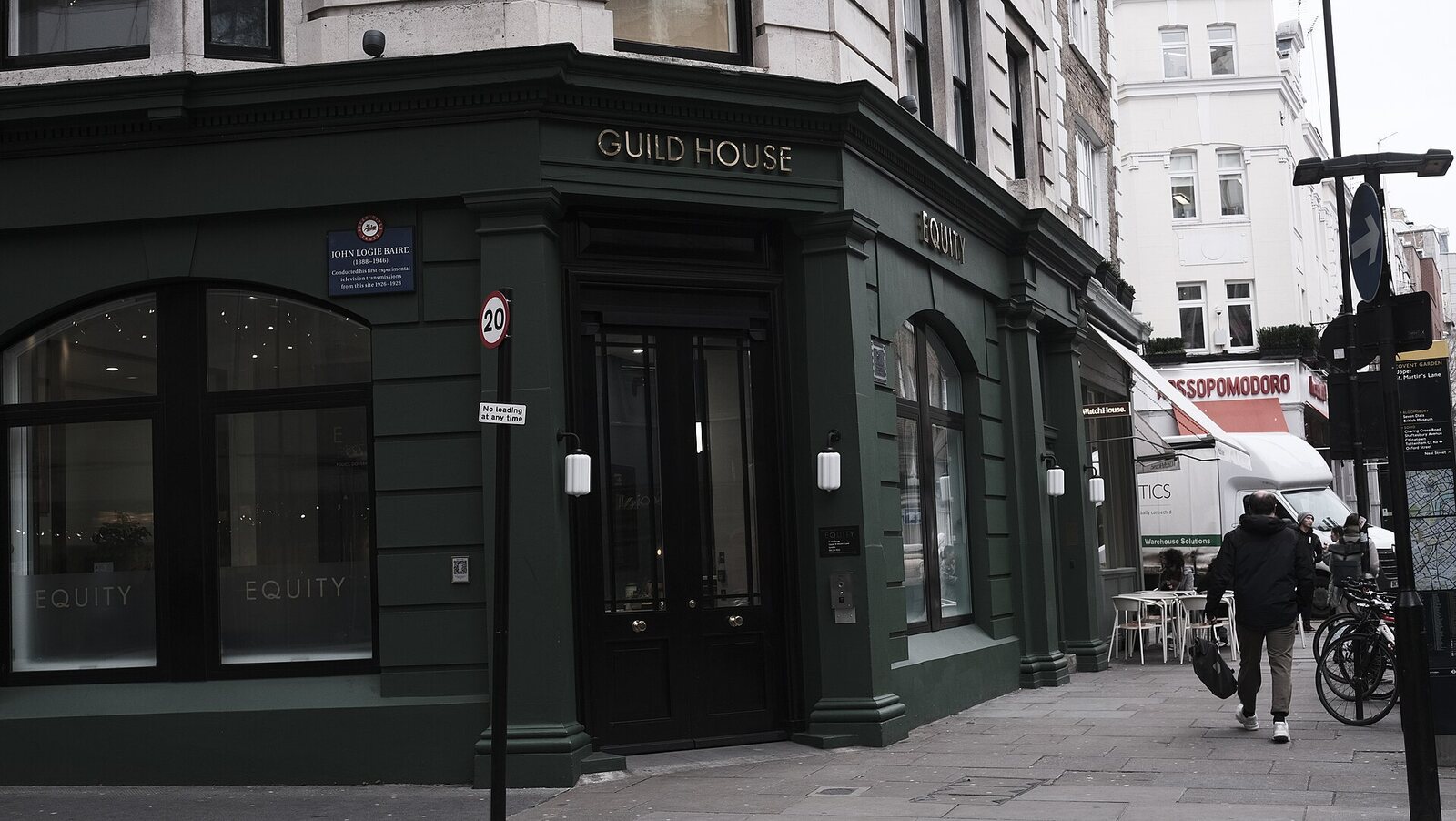
Photo: Roy Katzenberg, CC BY 2.0, via Wikimedia Commons
Equity also says on its rates and agreements page that it is “fighting for union contracts in gaming, audio and commercials”, which tells you that UK games, audio and commercials work still has no union contract, only recommended minimums. And there’s a line worth knowing if you’re not a member: “You don’t need to be an Equity member to be working on Equity agreed rates or agreements.” So a UK voice actor who isn’t a member can still be paid at Equity rates. They just can’t look the rates up on Equity’s site.
Using a card when the job isn’t union
Most voice work booked online isn’t covered by any of these agreements, and that’s fine. A card still gives you a starting point and, more usefully, a vocabulary. MEAA’s contract template is a good teacher here, because its usage box asks for exactly the details that decide a fair fee: the media, the territory, the duration of usage, the number of tracks, the length of each track, and whether the recording will be used for machine learning or an AI digital double. Its payment clause is simple too: “Payment for the work shall be made within 14 days from when the work is performed.”
If a brief can’t answer those questions, you can’t price it properly yet. For the tax and super side, our guide to what four tax offices say to home-studio voice actors has the detail.
- The dates. Every card prints when it starts and ends. Last year’s sheet is already wrong.
- Session or usage. SAG-AFTRA and ACTRA price the session, then pay again for each use cycle. MEAA’s figures already include the usage period.
- What’s on top. Health and retirement in the US, super in Australia, paid by the client, not taken from you.
- The territory. A local ad and a global one are very different jobs. MEAA multiplies the fee up to 600% for global use.
- The AI line. SAG-AFTRA requires consent for a digital replica, and MEAA prices AI voiceovers the same as studio ones.
None of these cards will tell you exactly what to charge a small business for a two minute explainer. What they show is how the people who negotiate for a living break a job into parts. Once you see a fee as session plus usage plus territory plus time, “what’s your rate?” turns into a few sensible questions back.
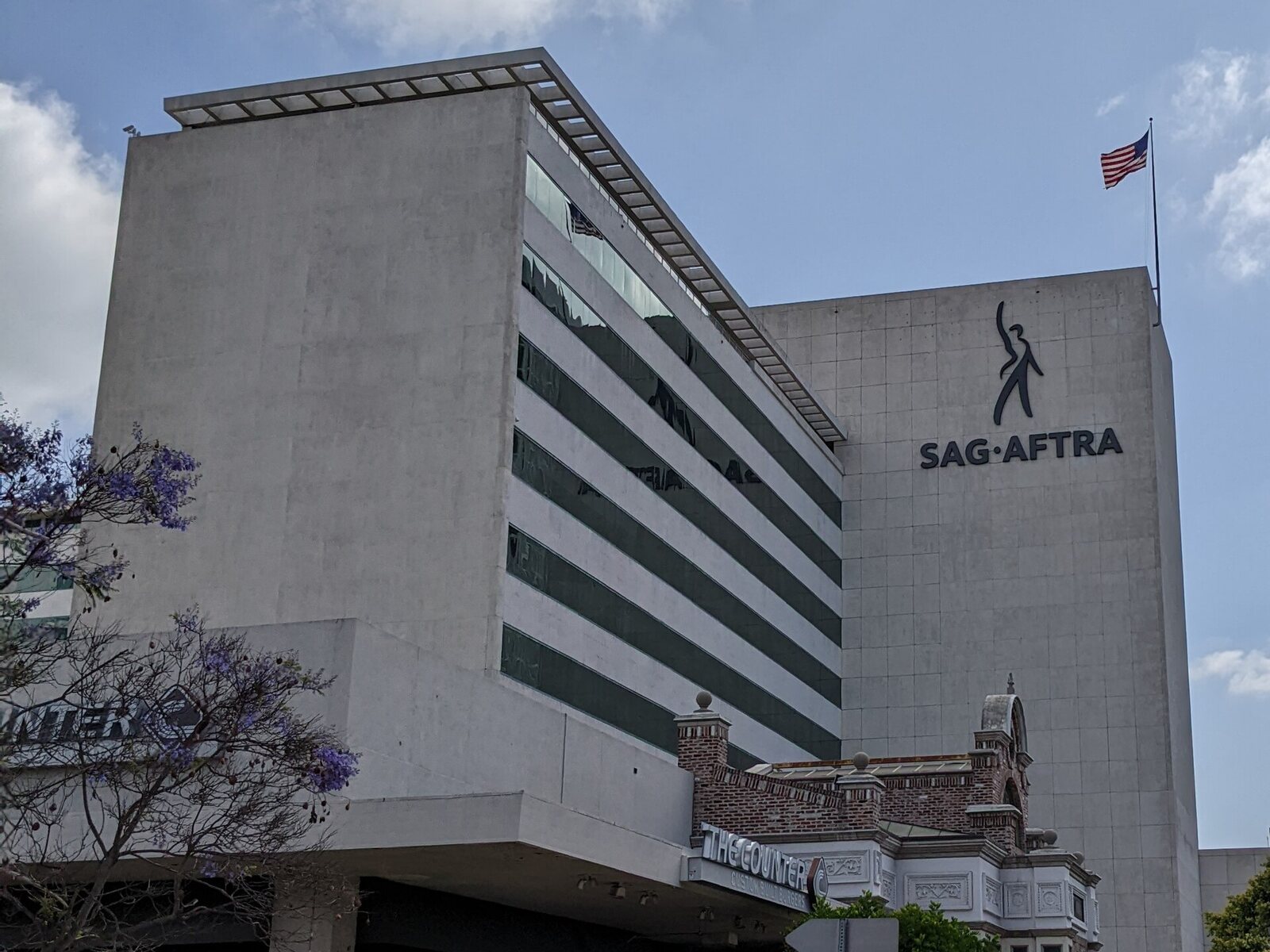
Sources: SAG-AFTRA, 2025 Audio Commercials Contract rate sheet, Year One (sagaftra.org, read via the Internet Archive copy of 13 May 2025) and 2025 Commercials Contracts Summary; ACTRA, National Commercial Agreement page and NCA Rate Chart, June 1, 2025 to May 31, 2026 (actra.ca); MEAA, Voiceover Industry Rate Card effective July 1, 2025, Explanatory Memorandum of July 3, 2025, Voiceover Artists page and Standard Voiceover Performance Contract template (meaa.org); Equity, Rates and agreements (equity.org.uk). All read on 22 November 2026. Rates are in each country’s own currency. Photos: ishmael daro, SAG-AFTRA headquarters in Los Angeles, CC BY 2.0; Roy Katzenberg, Guild House, London, CC BY 2.0; both via Wikimedia Commons.
Lee este artículo en español: El piso bajo la tarifa: cómo leer los tarifarios de locución que publican cuatro sindicatos
Know something about this story, or spotted an error? Tell the newsroom.