

Receipts in the Shoebox: What Four Tax Offices Actually Say to Voice Actors Working From Home
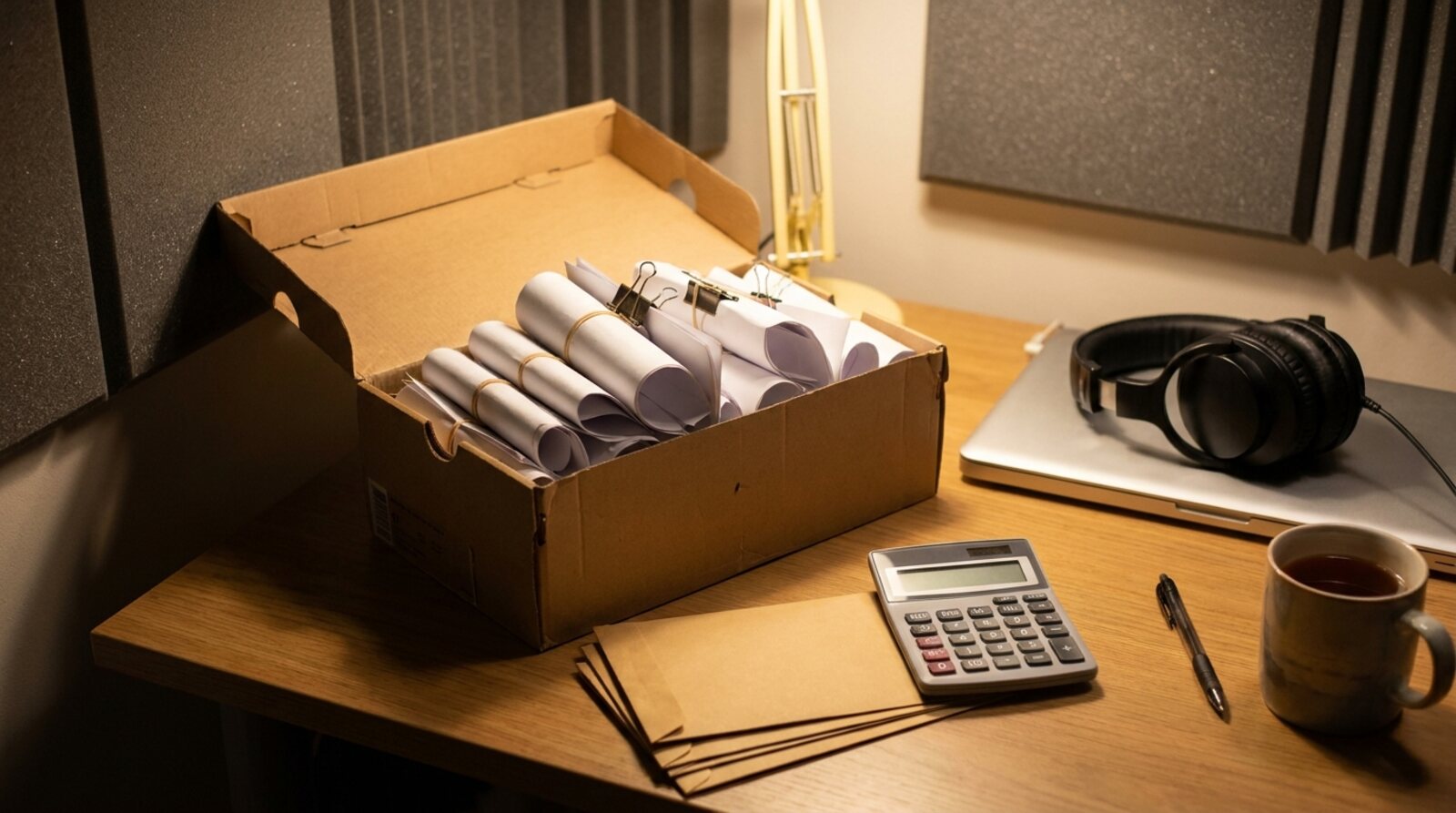
Most voice actors run a one-person business out of a spare room, and sooner or later every one of them stares at a shoebox of receipts and wonders what actually counts. The tax offices in the US, the UK, Canada and Australia publish the answers in plain language. These are the lines that matter for a home studio, quoted from their own pages and checked on November 8, 2026.
This is a reference, not tax advice. An accountant who knows freelancers is worth the fee, but it helps to walk in knowing the official wording, so you can ask something sharper than “can I claim my microphone?”
The moment your voice work becomes a business
In the US the bar is low. The IRS says self-employment tax applies once your “net earnings from self-employment (excluding church employee income) were $400 or more.” That tax pays for Social Security and Medicare, and “the self-employment tax rate is 15.3%”: 12.4% for Social Security and 2.9% for Medicare. It sits on top of income tax, which is why first-year freelancers who forget about it get a nasty surprise in April.
The UK gives beginners a gentler start. GOV.UK describes the trading allowance as “a tax exemption of up to £1,000 a year for individuals with trading income,” and if your gross takings stay at or under that, “you do not need to tell HMRC,” apart from a few exceptions the page lists. The catch is that the allowance replaces your costs instead of adding to them. If you’ve just spent more than £1,000 on a mic, an interface and some foam, the real costs are the bigger number.
In Australia it starts with an ABN, the Australian Business Number. Business.gov.au says “To get one you need to be running a business or other enterprise,” and its page for contractors explains why voice actors shouldn’t skip it: “Hirers may legally withhold the top rate of tax from a contractor’s pay if they don’t give them an ABN when they start a job.”
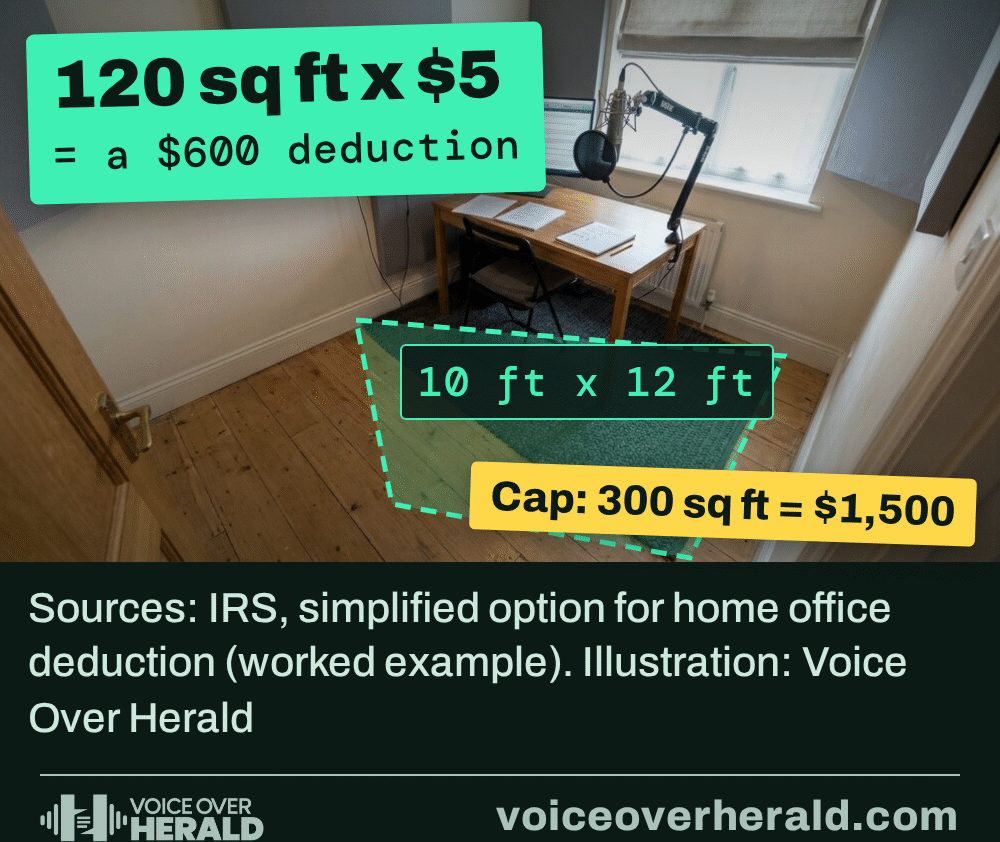
The room you record in
The IRS offers a simplified home office deduction worth “$5 per square foot of home used for business (maximum 300 square feet).” The condition that matters is in the small print: it’s “allowed only if that portion is exclusively used on a regular basis for business purposes.” For a voice actor, “exclusively” is the word to think about. A spare room that’s a studio all year round is the easy case. A booth tucked into the corner of a guest room that fills up every Christmas is a question for your accountant.
The UK does it by the clock instead of the tape measure. HMRC’s simplified expenses give a flat monthly amount based on how many hours you work from home, from £10 a month at the low end to £26 at the top, so you don’t split every bill. There’s a floor: “You can only use simplified expenses if you work for 25 hours or more a month from home.” And one thing many people miss: “The flat rate does not include telephone or internet expenses.” Those you claim separately, for the share that’s really business.
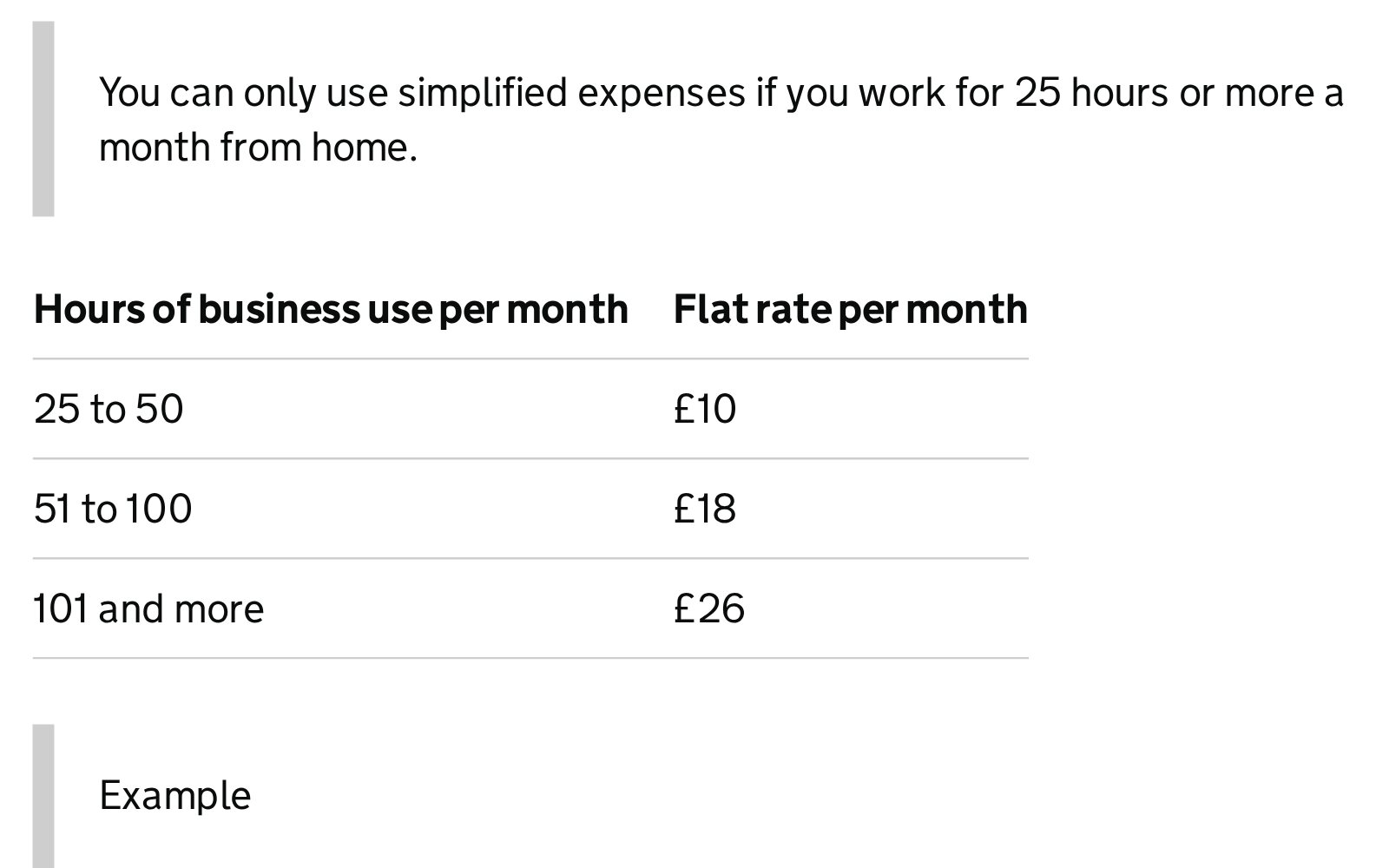
HMRC's flat rates for working from home. Screenshot: GOV.UK, taken November 8, 2026
Canada sets two tests, and you need to pass one. Either “it is your principal place of business,” or “you use the space only to earn your business income” and “you use it on a regular and ongoing basis to meet your clients, customers, or patients.” Most home voice actors will rely on the first. If you qualify, the Canada Revenue Agency lets you deduct part of costs such as “heating, home insurance, electricity, and cleaning materials,” along with a share of property taxes and mortgage interest. There’s a limit worth knowing in a slow first year: “you cannot use these expenses to increase or create a business loss.” The page explains that anything you couldn’t use can be carried forward to the next year.
Australia’s government business site lists “home-based business” among the common deductions and gives the rule that covers the whole house: “if the expense is for a mix of business and private use, you can only claim the portion that is used for your business.” The Australian Taxation Office sets out the methods for working out that portion on its own site.
The gear, the coaching and the rest of the shoebox
For everything that isn’t the room, the principle is the same in all four countries: business costs yes, personal costs no. HMRC puts it in one line, “You can only claim allowable expenses for the business costs,” and its expenses guide treats big purchases differently from everyday ones. For equipment it tells you to “claim capital allowances when you buy” it, rather than listing it with running costs.
Coaching gets a specific mention too. HMRC lists “training courses related to your business, for example refresher courses.” That’s worth noting if you book sessions to sharpen a genre you already work in. Australia’s list of deduction categories includes “depreciating assets and other capital expenses” as well as “repairs, maintenance and replacement expenses,” which is where a mic that has to be serviced or an interface that dies mid-session belongs.
When you have to start charging sales tax
Three of the four countries have a turnover line past which you have to register and add tax to your invoices, and they’re far apart. In the UK you must register for VAT “if your total taxable turnover for the last 12 months goes over £90,000,” and you have to do it “within 30 days of the end of the month when you went over the threshold.”
 VoiceEditSuiteIt edits like you would, and it gets better every file.Every fix you make in the editor teaches Auto Clean Up more, so each file comes back sounding like you edited it yourself.See how it worksLearns from numbers, never your audio. Never used to train AI.
Australia’s GST line is lower. You must register if “your business has a GST turnover of $75,000 or more,” and “You have to register for GST within 21 days of becoming aware that your GST turnover will go over the threshold.” Once you’re registered, contractors “must add GST to the price of their services.”
Canada’s is lowest of all. The CRA treats you as a small supplier, who doesn’t have to register for GST/HST, as long as your taxable sales stay at or under $30,000 over four consecutive calendar quarters. Go over it in a single quarter and the rules bite straight away, so a busy Canadian voice actor can reach it quickly. The US has no national sales tax of this kind, so there’s no IRS line to quote here.
When the client is in another country
Voice work crosses borders more than most freelance trades, and each direction has its own paperwork. If you live outside the US and a US company pays you, expect to be asked for Form W-8BEN. The IRS says to “Give Form W-8 BEN to the withholding agent or payer if you are a foreign person and you are the beneficial owner of an amount subject to withholding.” The form’s instructions are clear about where it goes: “Do not send Form W-8BEN to the IRS. Instead, give it to the person who is requesting it from you.” A signed form stays in effect until the last day of the third calendar year after the year you sign it, unless your details change.
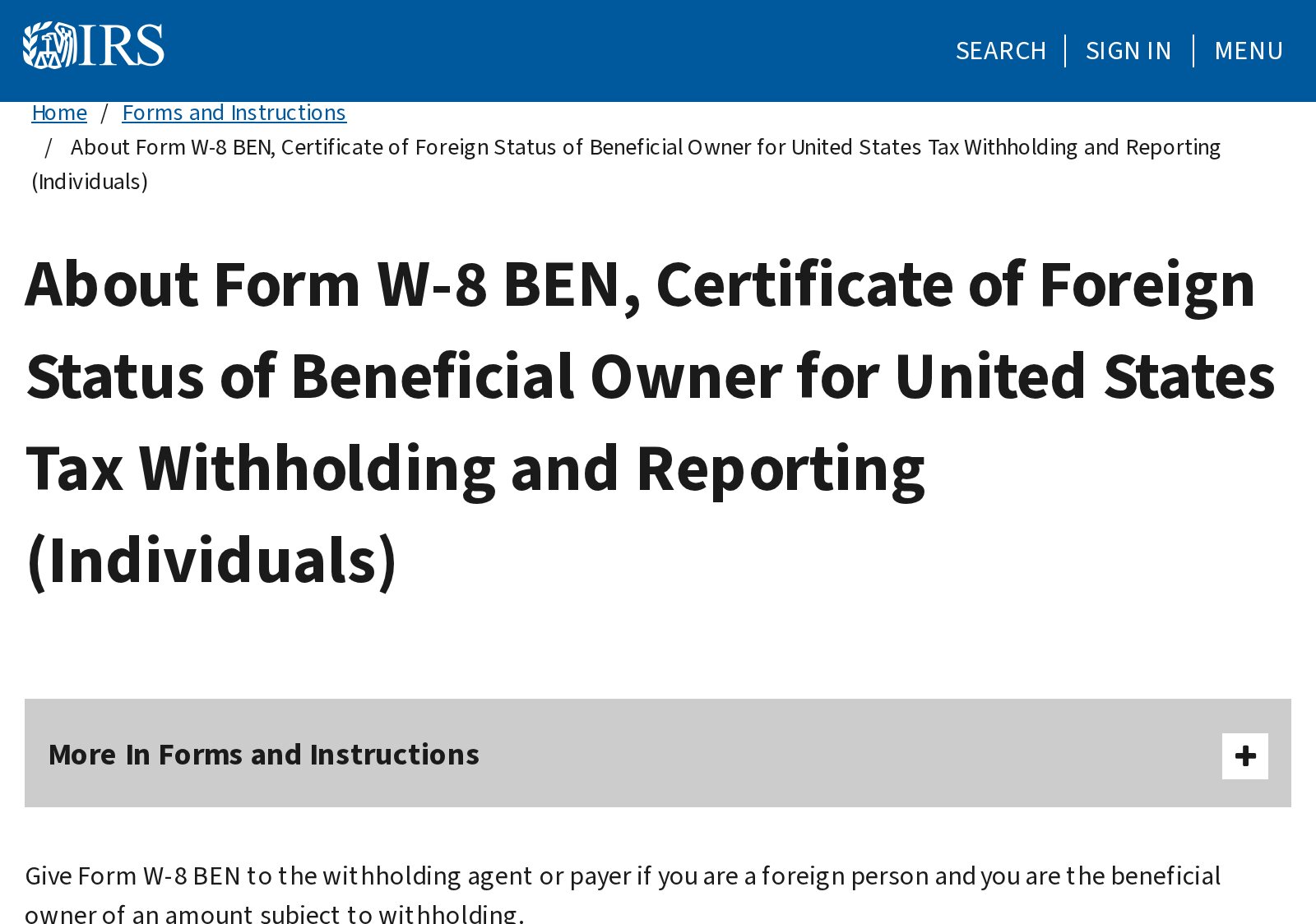
The IRS page for Form W-8BEN. Screenshot: IRS.gov, taken November 8, 2026
For a VAT-registered UK voice actor billing a business abroad, HMRC’s starting point is this: “The B2B general rule for supplies of services is that the supply is made where the customer belongs.” And “Services which, under the place of supply rules, are supplied in another country are outside the scope of UK VAT.” The notice has exceptions, so check your case before you leave VAT off an invoice.
Canada’s general guide for GST/HST registrants lists among zero-rated supplies “exports (most goods and services for which you charge and collect the GST/HST in Canada, are zero-rated when exported).” The same guide has a section on exported services that sets out when work for a non-resident client qualifies.
How long the shoebox stays in the cupboard
The four offices don’t agree on how long you keep everything, and the clock starts at different moments. HMRC counts from its filing deadline and gives a worked example: “If you sent your 2022 to 2023 tax return online by 31 January 2024, you must keep your records until at least the end of January 2029.” Canada counts from the end of the tax year the records belong to. Australia’s period “starts from when you either got the records or completed the transactions or actions they relate to.” The US has the strictest rule of all for anyone who skips a return: “Keep records indefinitely if you do not file a return.”
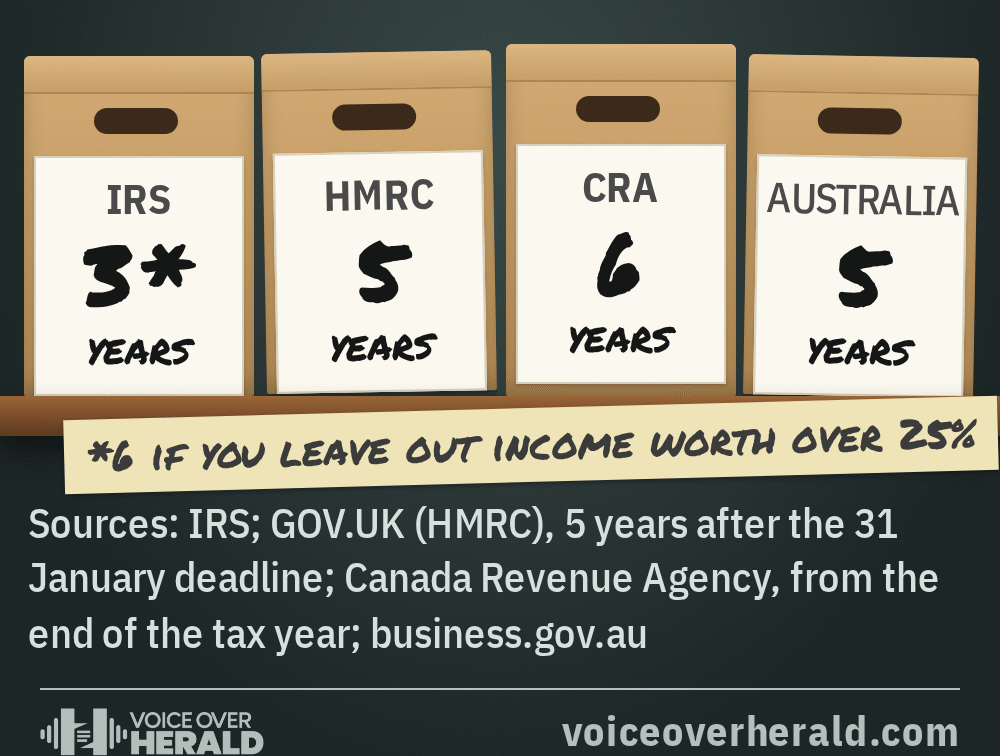
Whichever office you answer to, the habit that saves you is the same: one folder per tax year, receipts scanned on the day they arrive, and nothing thrown out early because the cupboard’s full. A faded thermal slip at the bottom of a box is no use to anyone when a letter arrives asking about it.
- Log your booth hours. The UK flat rate depends on them, and they’re useful evidence for any home office claim.
- Measure the room. The US simplified option is worked out per square foot, and you’ll want the number on file.
- Split phone and internet. They sit outside the UK flat rate, so keep a note of the business share.
- Keep a copy of every W-8BEN. It goes to the client who asked for it, not to the IRS.
- Watch the sales tax line. £90,000 in the UK, $75,000 in Australia, $30,000 in Canada.
Thresholds and rates move with each budget, so read the pages linked here yourself before you file. A microphone you bought for the work is a business cost. How much of it you claim this year is the accountant’s call.
Sources: IRS, Self-employment tax (Social Security and Medicare taxes), Simplified option for home office deduction, About Form W-8 BEN, Instructions for Form W-8BEN and How long should I keep records; GOV.UK (HMRC), Tax-free allowances on property and trading income, Simplified expenses if you’re self-employed: working from home, Expenses if you’re self-employed, VAT registration: when to register, Business records if you’re self-employed and VAT place of supply of services (Notice 741A); Canada Revenue Agency, Business-use-of-home expenses, When to register for and start charging the GST/HST, Where to keep your records and how long, and RC4022 General information for GST/HST registrants; business.gov.au, Contractor responsibilities, Register for an ABN, Register for GST, Tax deductions and Record keeping. All pages read on November 8, 2026. Screenshots: GOV.UK and IRS.gov, taken November 8, 2026.
Lee este artículo en español: Recibos en la caja de zapatos: lo que cuatro autoridades fiscales les dicen de verdad a los locutores que trabajan desde casa
Know something about this story, or spotted an error? Tell the newsroom.