
Opinion: Google Gave YouTube Ads an AI Voice by Default. Its Own Advice Says Use a Human
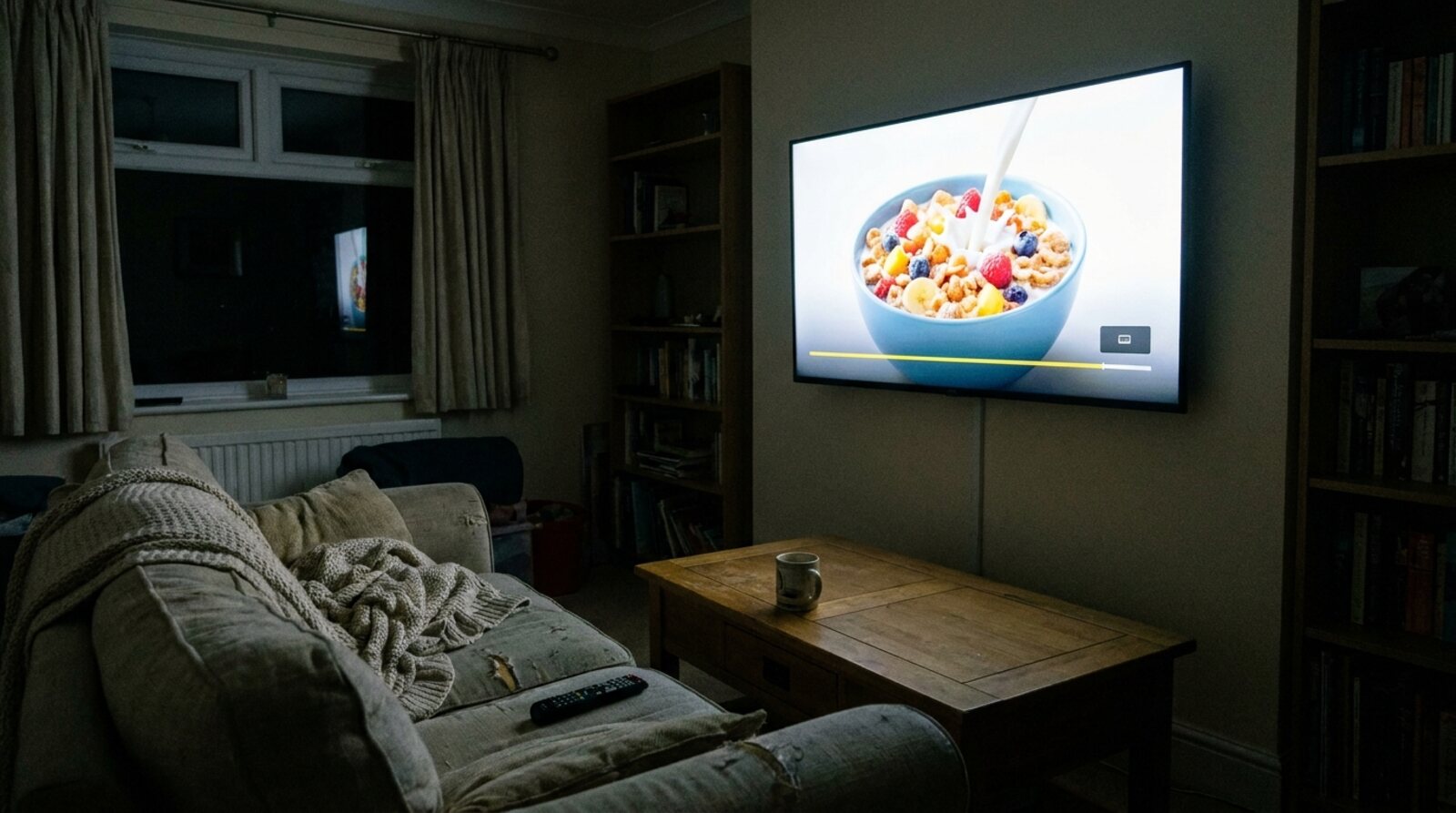
Spend ten minutes on YouTube and you’ll hear it: a smooth, even, slightly too pleased narrator selling a meal kit, then a phone plan, then a language app. AI voices are spreading through video advertising, and this year Google started adding them to ads by default. The same company’s own advice says a human voice sells better. Advertisers should listen to that part.
I’m not imagining the narrator. In March, Google emailed advertisers who run Performance Max campaigns, the automated ads that play across YouTube, Display and Discover, to say a new feature would add a “realistic voice-over” made by Google’s AI voice models to their video ads. It writes the script from the advertiser’s own headlines and descriptions. Unless an advertiser switched off a setting called video enhancement control by March 20, the feature was on.
There’s one limit, and it’s a revealing one. According to Google’s email, “The voice-over feature will only apply if the ad doesn’t already contain a voice.” So the ads most likely to get an AI narrator are the cheapest ones: the silent product clips and music beds made by businesses that never budgeted for a voice at all.
Google, March and August
Here’s where it gets interesting. At the end of August, Google published new advice for advertisers in its Google Ads Help Center, based on data from its Demand Gen campaigns, which also run on YouTube. Tubefilter, which reported the post, picked out the headline finding: when a human voice is present in an ad, the conversion rate goes up by 12%.
The same post goes further. “YouTube runs on human connection, so feature faces or people actively engaging with your product wherever it fits your campaign,” it says, according to Tubefilter’s report.
Add an AI voice
A “realistic voice-over” from Google’s AI voice models, added to silent Performance Max video ads unless the advertiser opts out.
Use a human voice
Its Demand Gen data: ads with a human voice present convert 12% better.
To be fair to Google, the post talks about human voices, not human speakers, and Tubefilter points out that the line between them is getting harder to draw. But read the two messages side by side and the advice to advertisers is muddled. Switch on our AI narrator. Also, people buy more when a person is talking.
What viewers actually think
We don’t have to guess how audiences feel about this, because they’ve been asked. In February, Adobe Express published a survey of 850 consumers and 205 marketers in the United States. Eighty-eight percent of the consumers said they’d heard a voice and wondered whether it was AI. Seventy-seven percent said they trust human voices the most.
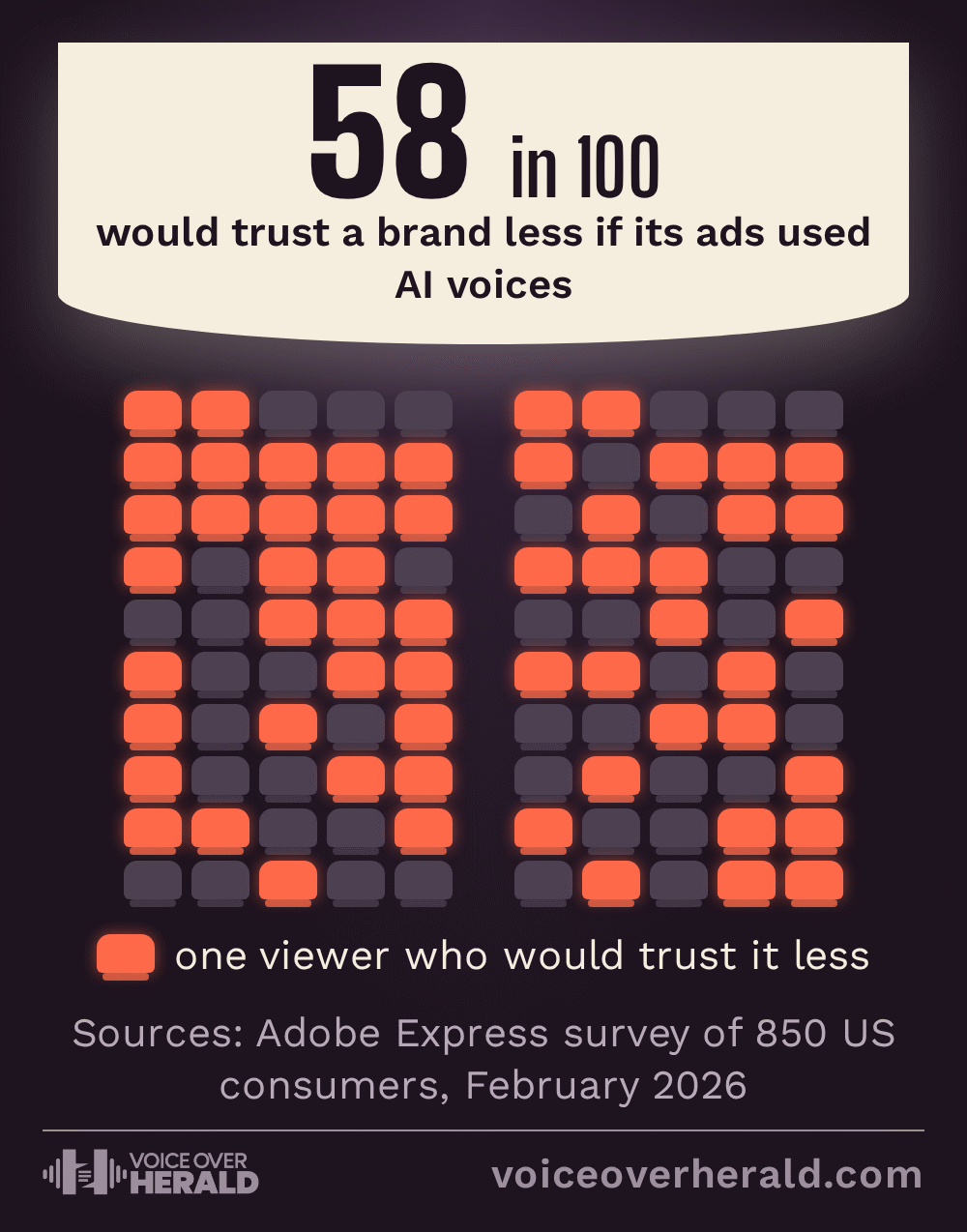
On advertising specifically, the numbers are blunt. Adobe found that 58% would trust a brand less if it used AI-generated voices in its ads, and 56% said they’d be less likely to buy from a brand that used AI audio in ads. Nearly three in four believe brands should say when they’re using an AI voice or AI music.
Meanwhile, 22% of the marketers already use AI voiceovers, and another 33% are considering AI audio. Their reasons are speed and money: 49% pointed to faster turnaround, and 41% to cost savings.
Everyone sounds the same
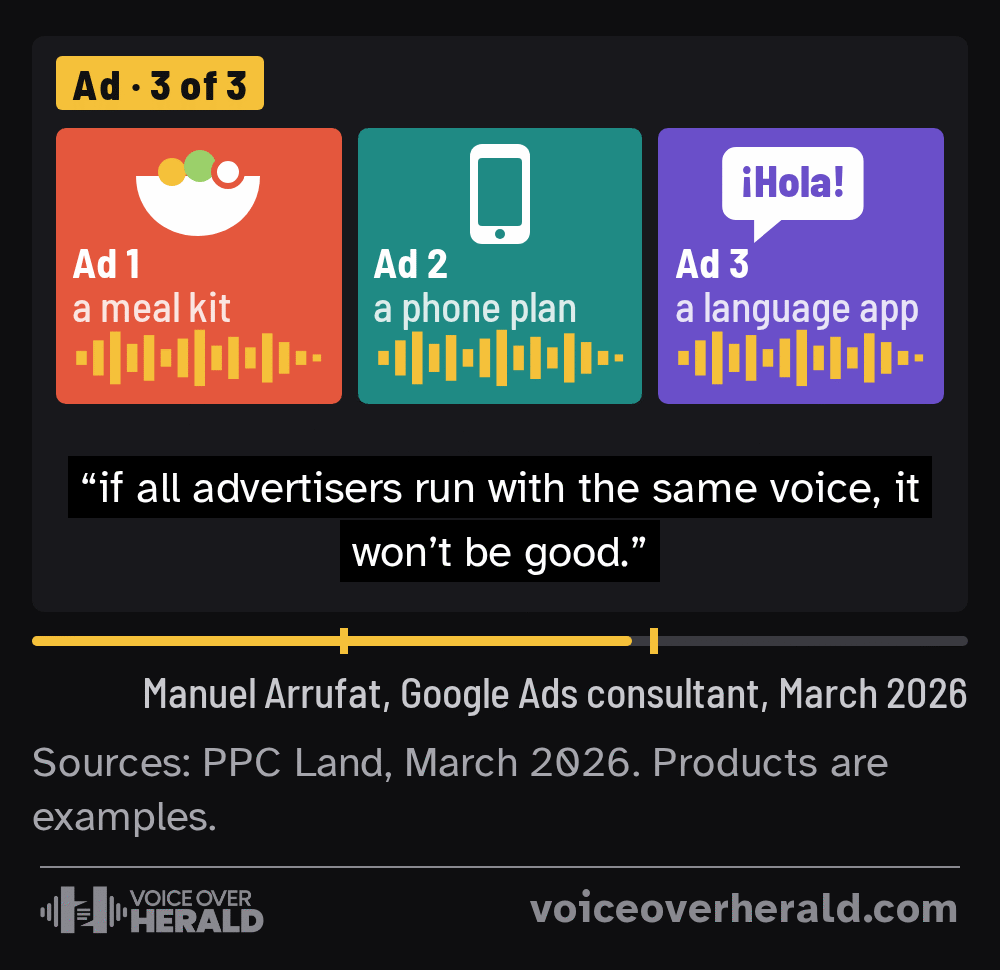
This is the part that should worry advertisers more than voice actors. When Google’s feature was announced, Manuel Arrufat, a Google Ads consultant, put the problem in one line on LinkedIn, as PPC Land reported: “if all advertisers run with the same voice, it won’t be good.”
 VoiceEditSuiteLoudness NormalizerHit the broadcast spec first time.ACX, EBU R128, Spotify and podcast presets.See how it works
He’s right. A brand spends years making sure its logo looks like nobody else’s. Then it lets its ads sound like everybody else’s. On a platform where you hear six ads before lunch, the voice is often the only thing that tells you whose ad it was. Give that away and your ad blends into the one before it and the one after it, including, sometimes, a scam.
Because the cloned voice has already arrived in advertising. Earlier this month, Voice Over Herald reported that Desireé González, the Latin American voice of Luffy in One Piece, found an AI copy of her voice in an ad she never recorded. When viewers can’t tell an honest synthetic narrator from a stolen one, every brand using a synthetic voice pays a little of the price.
Good enough is the real danger
The voice actor Dane Reid put his finger on it in July, writing about his mother, who watches videos read by the same AI voice over and over and has stopped noticing. “Over time, what once sounded wrong starts to sound normal,” he wrote. “The audience stops looking for good and starts looking for good enough.”

That’s the trap. An ad that’s good enough doesn’t get skipped any less. It just doesn’t get remembered. And the whole point of paying to put a video in front of someone is that they remember it.
I’m not against AI. I’m against sounding like nobody
There’s an honest case for AI voices in ads. A small business with a silent product clip and no budget may be better off with a synthetic narrator than with nothing, and Google has clearly bet on exactly that. For a test cut before the real campaign, or a hundred versions of a local offer, fine.
But a brand that wants to be remembered shouldn’t leave its voice to a default setting. If you advertise on YouTube, check whether video enhancement control is on in your campaigns, and decide for yourself what your ads say and who says it. If you do use an AI voice, say so: three in four viewers want to know. And for the ad that matters, book a person. Google’s own numbers say it’ll pay you back.
The narrator who sells everything will keep talking. The question is whether your brand wants to be one more thing it sold today.
This is an opinion piece. Sources: PPC Land (Google’s March 2026 email to Performance Max advertisers, and Manuel Arrufat’s comment); Tubefilter, August 31, 2026 (Google Ads Help Center guidance on Demand Gen creative); Adobe Express survey of 850 consumers and 205 marketers in the United States, February 2026; Dane Reid, “Do TikTok and YouTube Audiences Notice AI Voiceover?”, July 14, 2026; Voice Over Herald reporting, October 3, 2026.
Lee este artículo en español: Opinión: Google les dio una voz con IA a los anuncios de YouTube. Sus propios consejos dicen que uses una humana
Know something about this story, or spotted an error? Tell the newsroom.