
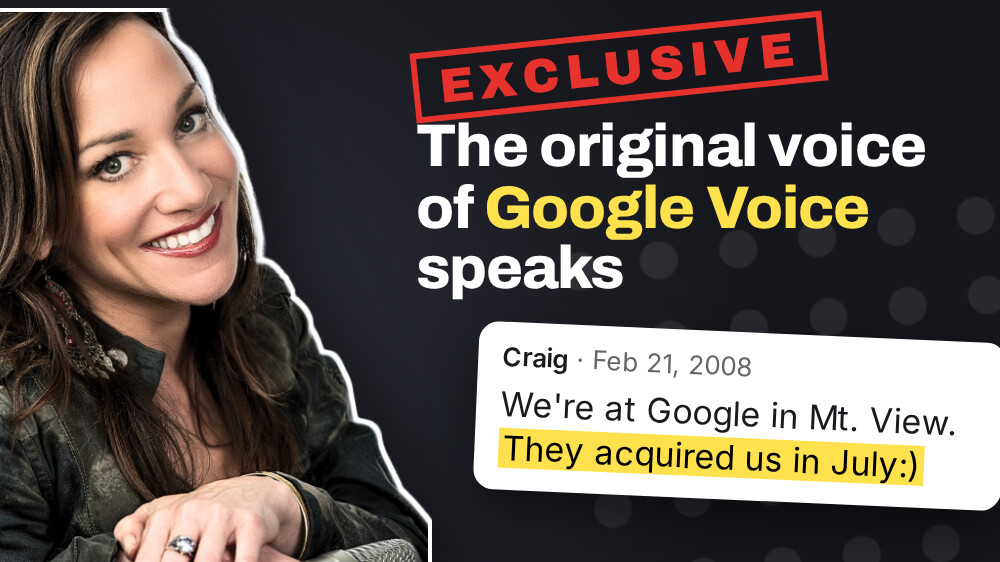
Exclusive: The Original Voice of Google Voice Found Out Google Had Bought the Company Seven Months Later
Voice Over Herald exclusive. Laurie Burke was the first voice people heard when they called GrandCentral, the start-up that became Google Voice. She was paid by the hour, with no written contract. Google bought the company in July 2007, and she found out seven months later, from a clue in an email signature. Nobody talked to her about her recordings. Now she tells Voice Over Herald what happened, and what every voice actor should get in writing now.
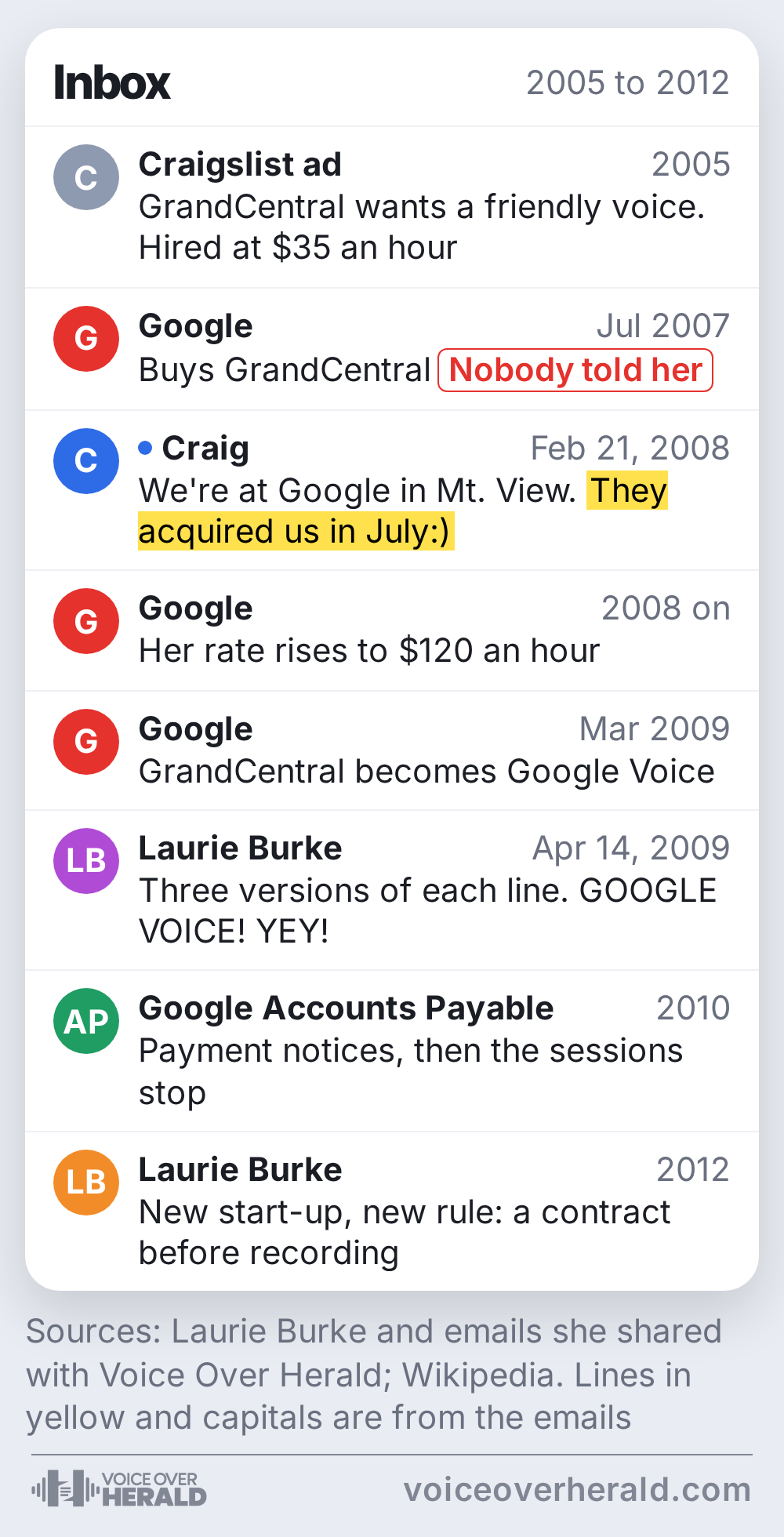
It started, as plenty of voice careers did in the mid 2000s, with a classified ad. “Around 2005, I answered a Craigslist ad looking for a friendly, conversational voice for a new telephone service called GrandCentral,” Burke says.
GrandCentral gave people one phone number that rang all their phones, with voicemail and call screening, and it needed a voice to guide callers through it. Burke had just made her first demo. “I’d recently made my voiceover demo and brought it to our meeting on a CD. Remember those?” she says. “I was hired for $35 an hour and thrilled to have steady work with a group of nice guys building something exciting.”
She recorded greetings, instructions and prompts at a studio in Fremont, California, and later from her home studio. “Even a simple telephone prompt requires thoughtful delivery, pacing, and warmth,” she says. In an email from April 2009 that she shared with Voice Over Herald, she tells co-founder Craig she has recorded three versions of each line for his review, and signs off: “GOOGLE VOICE! YEY!”
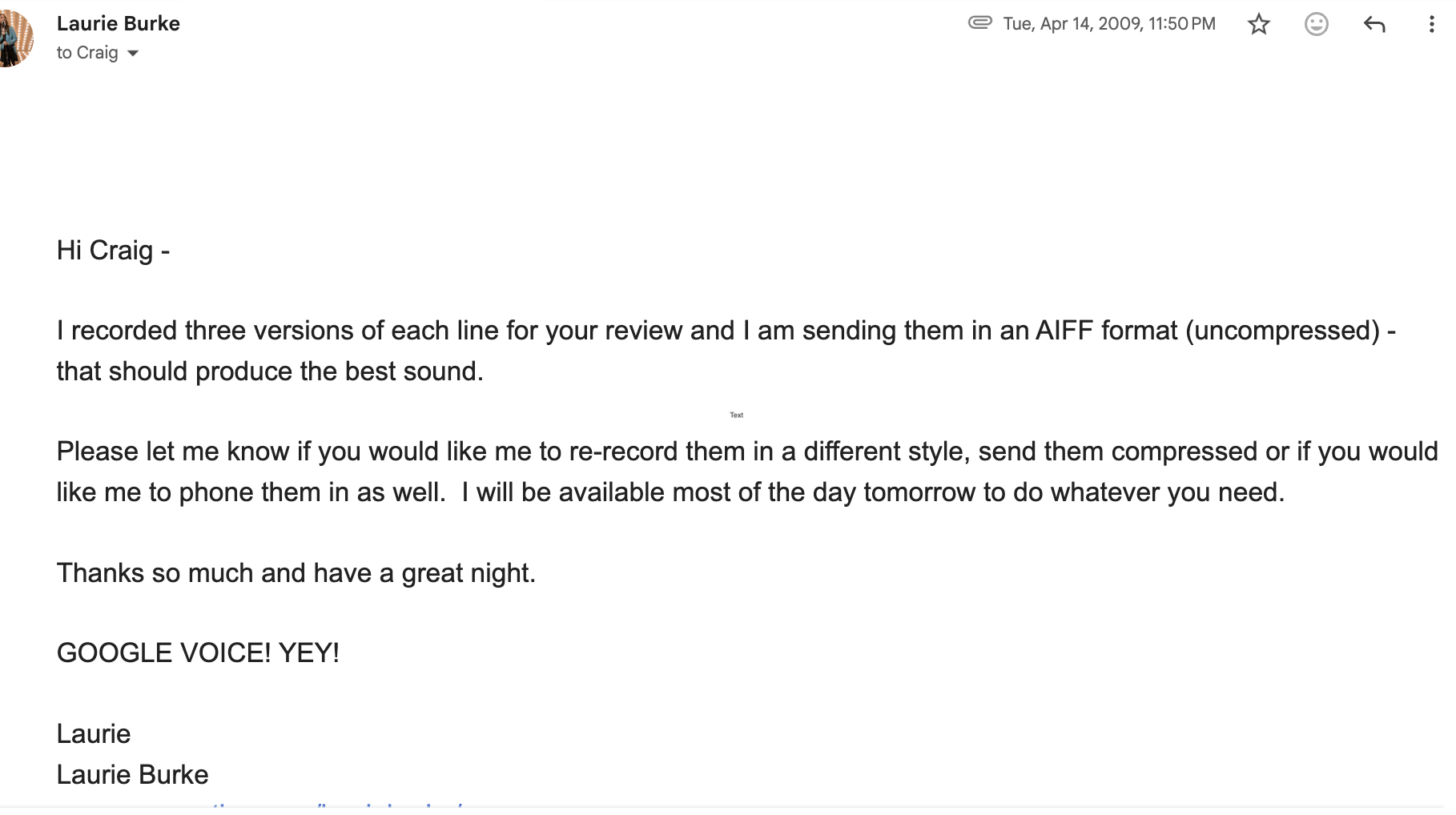
Laurie Burke's email to Craig, April 14, 2009. Image: courtesy of Laurie Burke
“They acquired us in July”
Google bought GrandCentral in July 2007, for a price reported at the time at about $50 million. Burke didn’t know. She learned about it in February 2008, when Craig asked her to come in and record a new version of the script, and she noticed something new in his email signature.
She wrote back asking whether this was a new partnership with Google. Craig’s reply, in an email dated February 21, 2008, which Voice Over Herald has seen, gave a time, an address at Google’s Mountain View campus and one line of news: “They acquired us in July:)”
“Until then, I hadn’t known about the sale,” Burke says. “There had been no discussion with me about my existing recordings, usage rights, or additional compensation. I’d been working hourly without a written contract.”
She kept working, and Google paid more. “Google increased my compensation from $35 to $120 an hour, which I appreciated,” she says. By then she had an agent, and they talked about negotiating usage rights. “But this work was part of my livelihood, and I worried that pushing too hard might cost me the opportunity.”
Welcome to Google Voice
Google relaunched GrandCentral as Google Voice in March 2009. Burke recorded for it, including promotional voiceovers for its videos. One of them, simply titled Google Voice, is still on Google’s official YouTube channel. She says there was no additional payment for that use.
That 2009 video is Google explaining its new phone service, voiced by Burke. If it doesn’t load, you can find it on Google’s YouTube channel under the title Google Voice.
Her invoices show she recorded for Google through 2010. Then the sessions stopped. “I wasn’t told that another voice actor had been hired, and I don’t know why the recording work ended,” she says.
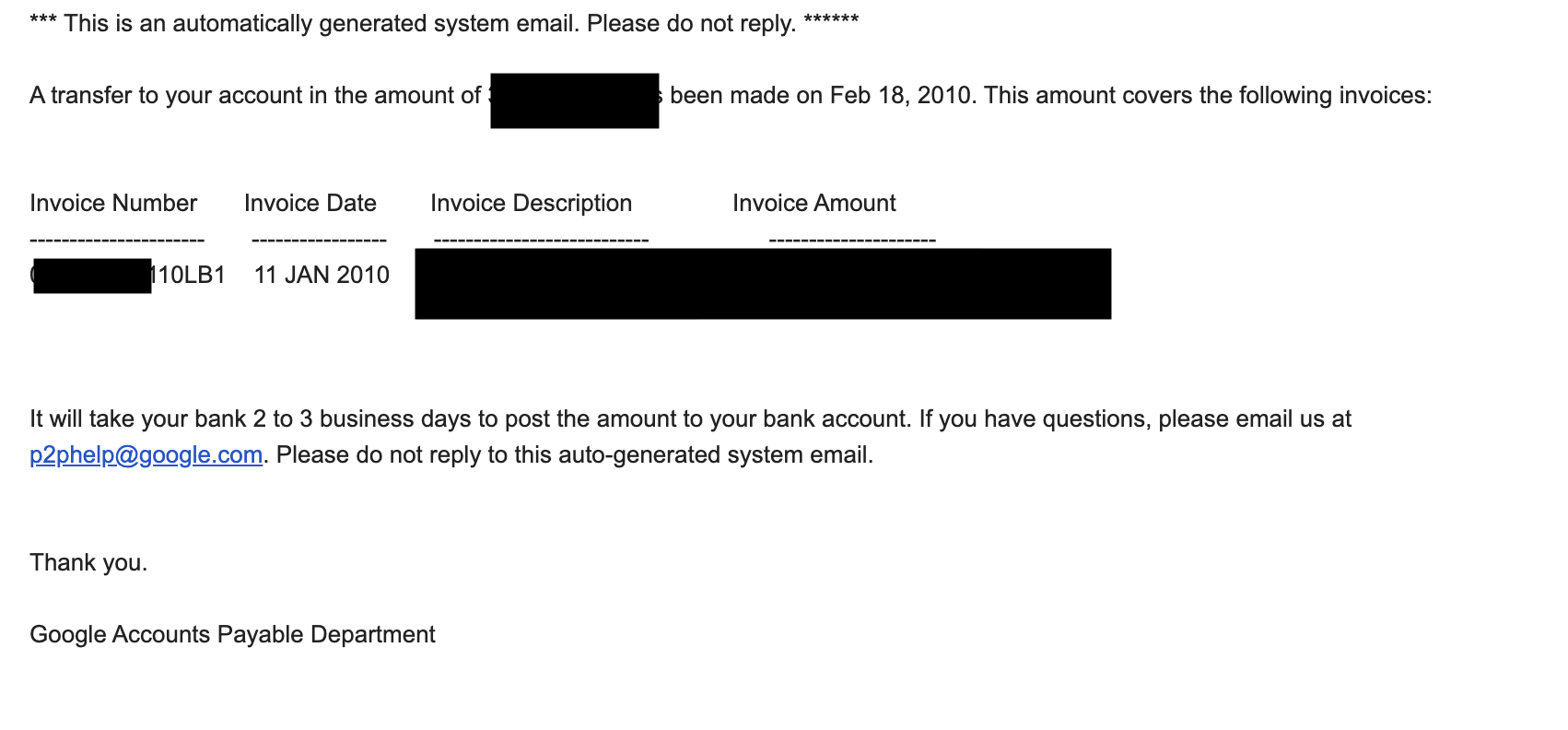
A 2010 payment notice from Google, amounts hidden. Image: courtesy of Laurie Burke
The timing is pointed. This week, Voice Over Herald reported that Google now adds AI voice-overs to silent YouTube ads by default. The company that once paid a human by the hour to welcome its callers now generates voices for its advertisers.
“I wanted a contract in place before recording”
Burke is careful not to blame anyone. “I don’t believe Craig or the other GrandCentral partners were trying to do anything dishonest. I really liked working with them,” she says. Being bought by Google, she adds, was “like winning the startup lottery! We were excited about the technology, and these issues simply weren’t part of our conversations.”
 VoiceEditSuiteNewIt edits like you would, and it gets better every file.Learns from numbers, never your audio. Never used to train AI.See how it works
Craig clearly thought well of her, too. A note from him that she keeps on her website reads: “I still think fondly of all the good times at GrandCentral (Google Voice) and how lucky we were to find you.”
In 2012 he came back with another start-up. Burke says that in an in-person conversation, she remembers him “acknowledging that I hadn’t received a fair shake in the GrandCentral sale,” and suggesting they record first and sort out an agreement afterwards. This time she said no to that order of things. “This time, I wanted a contract in place before recording,” she says.
They negotiated by email, and the company eventually handled the recordings in house. “There was no ill will,” Burke says. “But I was also happy with my decision to negotiate an agreement first. It showed me how much I’d learned.”
What she’d want in writing
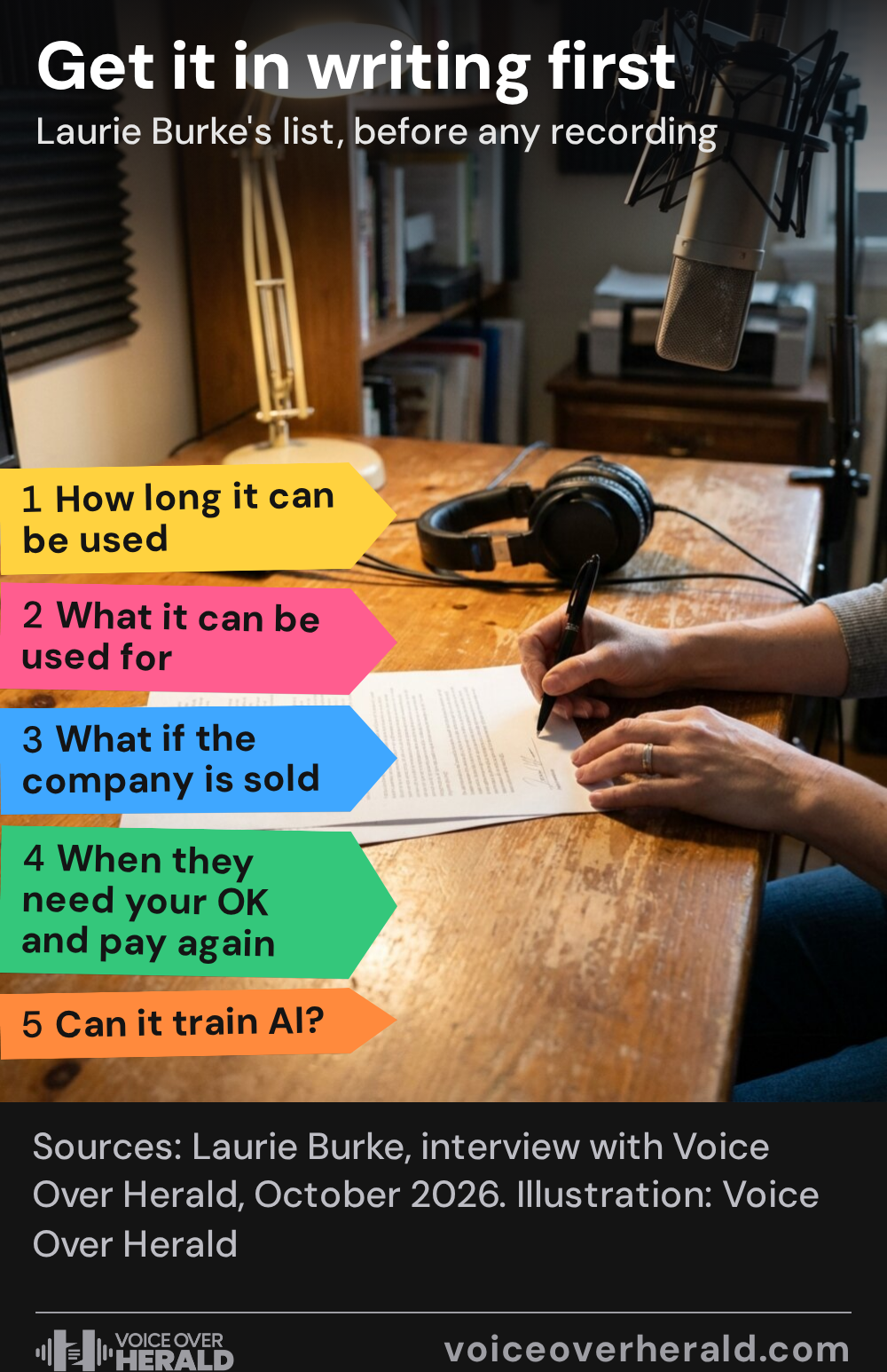
Asked what she wishes she’d had back in 2005, Burke lists it plainly: “An agreement establishing how long my recordings could be used, their permitted uses, what would happen if the company was acquired, and when additional consent or compensation would be required.”
That third item is the one she wants every voice actor to think about. “When a company is acquired, its recordings and associated rights may become part of the transaction. That’s why clearly defining those rights from the beginning matters,” Burke says.
“How do performers know where their recordings end up?”
When AI voice cloning started making headlines, Burke thought about every voice recorded before anyone imagined it as data. “I thought about how many human voices have been recorded over the years, including mine, long before anyone imagined they might become digital assets capable of generating new performances,” she says.
She is precise about what she does and doesn’t know. “I don’t know whether my original recordings have ever been used for AI training, voice cloning, or other purposes beyond their original intended use. That’s part of what makes this conversation so important. How do performers know where their recordings end up or how they may be used as technology evolves?”
She isn’t against the technology. “I’m genuinely excited about technology. After all, my voice was part of an important chapter in its evolution, and I’m proud of that!” But she believes people will keep choosing people. “AI may be able to simulate the sound of emotion, but I don’t believe it can truly experience or fully deliver the emotional depth of a human performance,” she says. “Technology should enhance human creativity, not replace the humanity behind it.”
Would she want an invisible watermark in her recordings, so a copy could be traced? “Absolutely, if they’re reliable and don’t compromise the audio. Any technology that helps performers protect their work is worth exploring,” she says. “But watermarking doesn’t replace clear agreements, informed consent, and fair compensation.”
Her advice to voice actors
Burke now coaches voice actors through her company, Virtual Voiceover, and she’s been working as a voice actor and on-camera actor for more than 20 years. Her advice before you record for any tech company is short: “Understand what you’re recording, how it will be used, for how long, and whether your recordings can be transferred, repurposed, or used for AI training.”
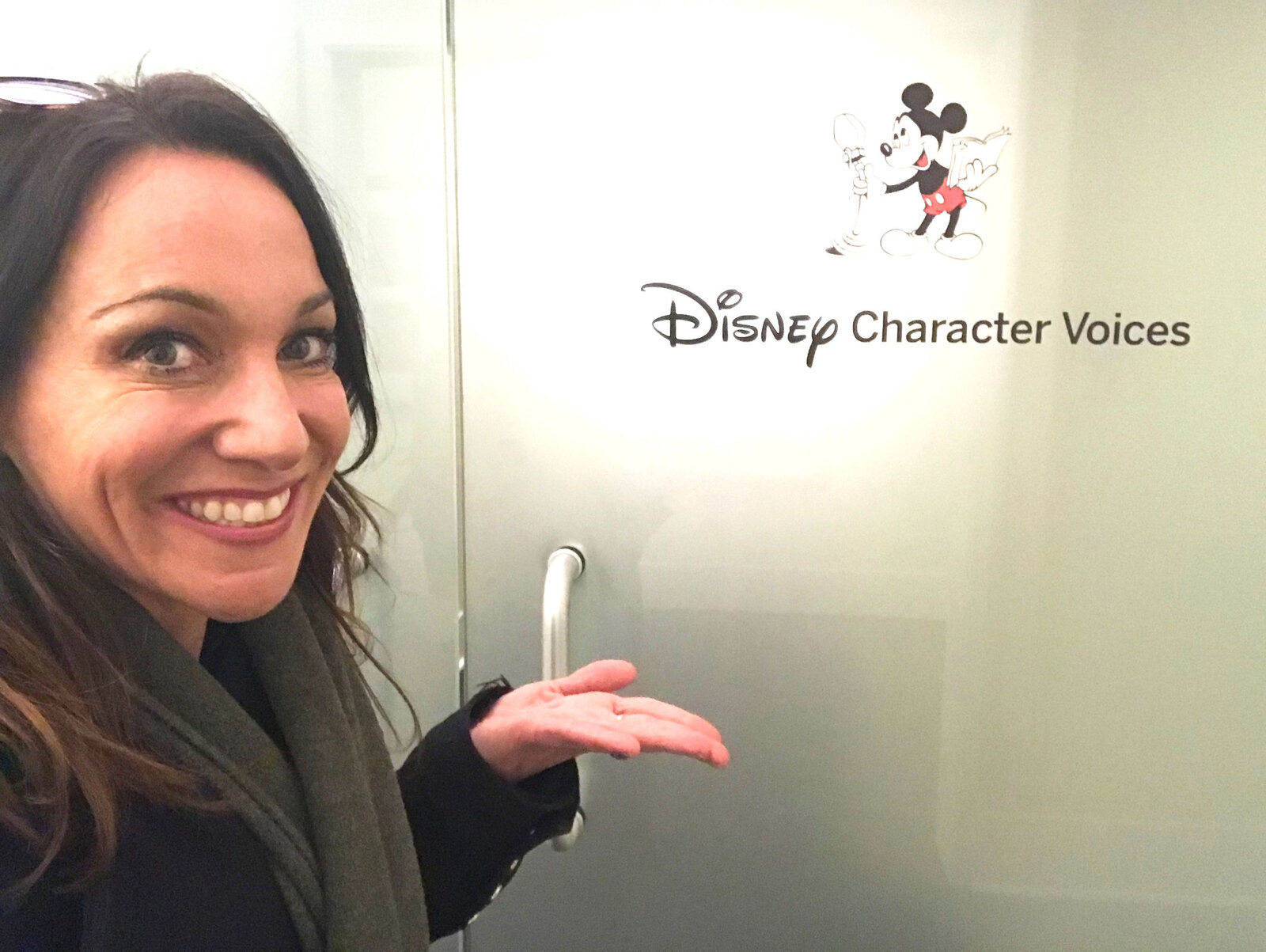
Laurie Burke at Disney Character Voices. Photo: Laurie Burke
“If you have an agent, discuss the agreement with them. Ask questions and get the terms in writing before recording,” she says. And she knows how hard that is when you want the job. “I’ve been there! But you and your skills have value.”
“One of the most important things I’ve learned is that advocating for yourself isn’t being difficult,” she says. “It’s respecting the value of your work.”
Burke says many of her students come to her with questions about contracts and usage rights, and she has worked in casting and with companies on contracts that treat voice talent “respectfully and fairly in this AI environment.” Readers can learn more about her work and contact her at laurieburke.com.
She wants one thing understood about her story above all. “I was the original human voice of GrandCentral and subsequently Google Voice. These were real performances, recorded long before today’s AI technology,” she says. “This isn’t a story about assigning blame. It’s about how technology evolves, how our understanding of creative ownership changes, and what we can learn along the way.”
She keeps working in front of the camera and the microphone: she recently finished voicing a character for an animated film with Amazon, and she teaches voiceover courses and coaching through Virtual Voiceover. She signs off her emails with two words that would suit any phone greeting: “KEEP TALKING!”
Sources: Laurie Burke; emails from 2008 and 2009 and a 2010 Google payment notice, shared by Laurie Burke and seen by Voice Over Herald; Craig’s note on laurieburke.com; BetaNews (reported price, July 2007); Google’s Google Voice video on YouTube (2009); Wikipedia (GrandCentral history and the March 2009 Google Voice launch); Voice Over Herald reporting, October 2026. Photos: Steve Cozart (headshot) and Laurie Burke.
Lee este artículo en español: Exclusiva: la voz original de Google Voice se enteró siete meses después de que Google había comprado la empresa
Know something about this story, or spotted an error? Tell the newsroom.