



Thirty Seconds, Small Print Included: How Commercial Voice Jobs Are Briefed, Read and Licensed
An ad job is often the shortest script you’ll read all week, and the one with the most rules attached. It comes with a clock, quite often a block of small print, and a licence that decides how long your voice stays on air. Here’s how commercial voice jobs are briefed, read and paid for, taken from the people who write the rules and the voice actors who work under them.
Commercials are what most people picture when they hear “voice over”: a radio spot on the drive home, a pre-roll before a video, a streaming ad between songs. The scripts are short and, set up properly, the fee follows how widely the ad is heard. They’re also where a thin brief hides the most expensive surprises.
What a good brief tells you
Radiocentre, the industry body for UK commercial radio, publishes a guide for advertisers and agencies on briefing, writing and producing radio ads. Read from the booth side, it’s a handy list of what a brief should hand you. It asks writers to start with one question: “What do you want people to think, feel and do as a result of hearing your radio ad?” Then: “Include some context too. What’s the business problem?”
On timing it’s blunt. “Know your spot length. Before you start, be very clear on how much time you have to play with, including any ‘legal’ copy you may be required to include.” And for the session itself, it tells producers to “Give the VO artist some background on the product or project,” and to “Work out who is giving direction to the voiceover beforehand. It’s much better if direction comes from one source to avoid confusing the VO.”
So when a brief arrives with nothing but a script, ask: how long is the finished spot, legal line included? Who’s listening, and what should they do next? Who directs, and who has the final word? And where will the ad run, and for how long? That last one decides your fee.
The read they’re buying now
The sound clients ask for has changed. “The big, booming voice-over announcer type of sound has been largely replaced with something that’s very casual and real,” the voice actor Debbie Grattan wrote on her blog. “Most folks are no longer apt to listen to the very polished, big, booming voice,” she added.
The announcer hasn’t vanished, though. “The announcer-type delivery remains particularly popular for local and regional spots,” Grattan noted. Her post dates from 2017, but her description of the hard part hasn’t dated: “taking the copy that someone else wrote and truly making it your own. The words need to feel like they came from your own heart, instead of a script sitting in front of you.”
When a brief just says “conversational,” ask who you’re talking to. A tired parent at a kitchen table and a site manager in a van are both conversational, and they’re very different reads.
Reading to the clock
A 30 second spot is 30 seconds, and the station won’t stretch it for a lovely pause. Grattan’s list of what an ad read has to do includes “come in under 30 seconds.”
 VoiceEditSuiteNewIt edits like you would, and it gets better every file.Learns from numbers, never your audio. Never used to train AI.See how it works
So time the script, legal line included, against a stopwatch before you quote or record. If it only fits when you rush, tell the client before the session. When copy is tight, send two takes: one at the pace that sounds right, even if it runs long, and one that fits. The client hears the problem, and the cut is theirs to make.
Some jobs are only the legal line. Radiocentre’s production notes say that when an ad uses “one VO for the main body of the script and another for the legal,” the producer should “get the legal VO in first because then you’ll know how much time you have for the creative bit.” If you’re booked as the legal voice, your read sets the clock for everyone else.
The small print is a real read
Radiocentre’s guide to terms and conditions on radio explains why the small print is hard: “unlike other media, for radio they have to be read aloud in real-time.” Its advice to advertisers could be pinned to a booth wall. “Don’t try to gabble them so fast that it’s difficult for the ear to follow. Not only is it against the rules but it can irritate the listener. Always remember that any Ts&Cs you do need to include must be audible.”
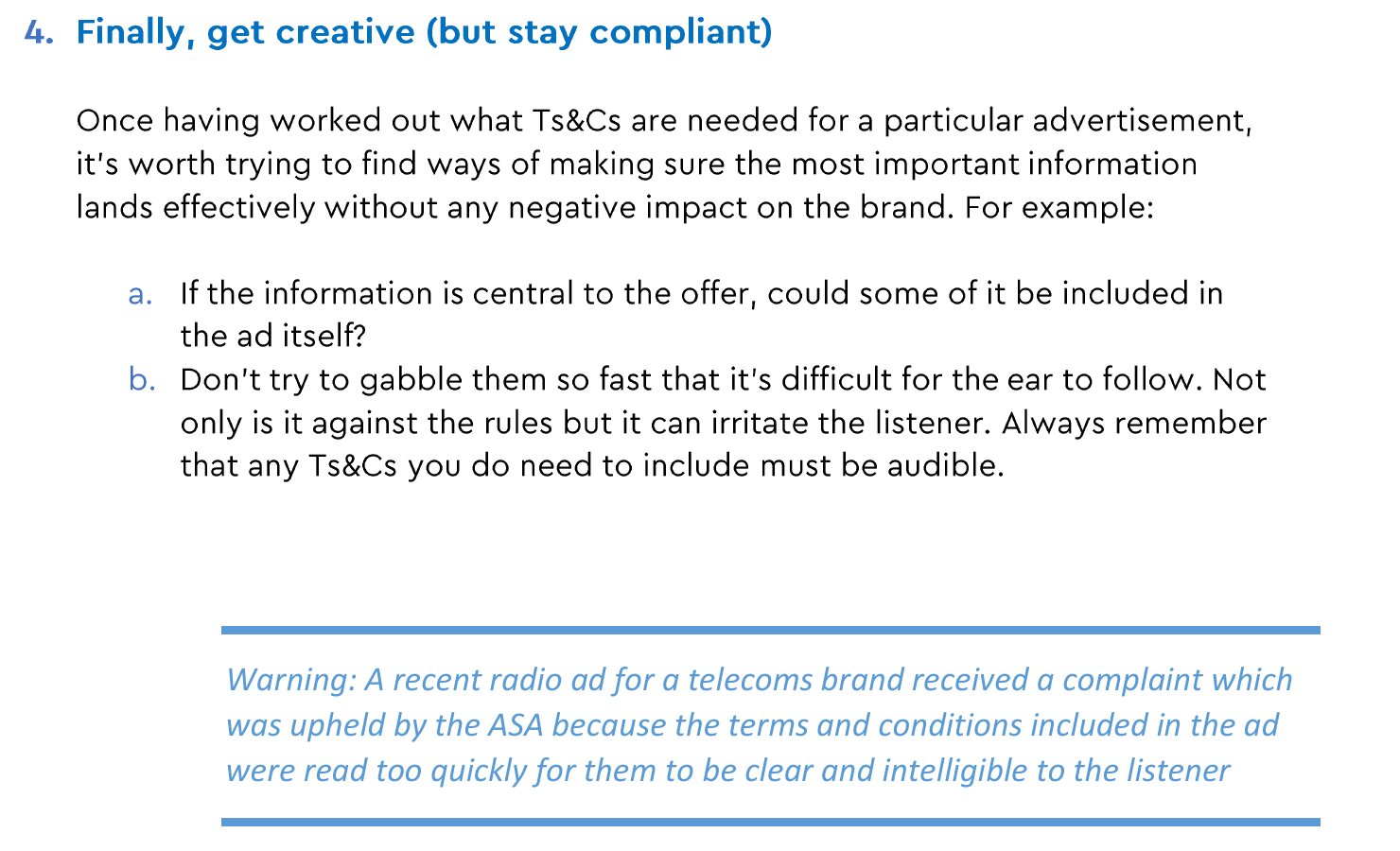
Radiocentre's guide to terms and conditions on radio, as it appeared on 29 November 2026. Screenshot: radiocentre.org
It isn’t just advice. The UK’s Advertising Standards Authority has pulled radio ads because the terms were read too fast. In a 2017 ruling on two Plusnet ads, the ASA said the terms “were spoken at a much faster pace compared to the rest of the ad.” It added: “We considered that the words were difficult to make out and that they had been delivered too quickly to be understood by listeners.” Plusnet told the regulator the terms “were presented at the pace in which they were spoken by the voice-over artist; the terms had not been speeded up in post-production.” In other words, that was the human read. The ruling was blunt: “The ads must not appear again in their current forms.”
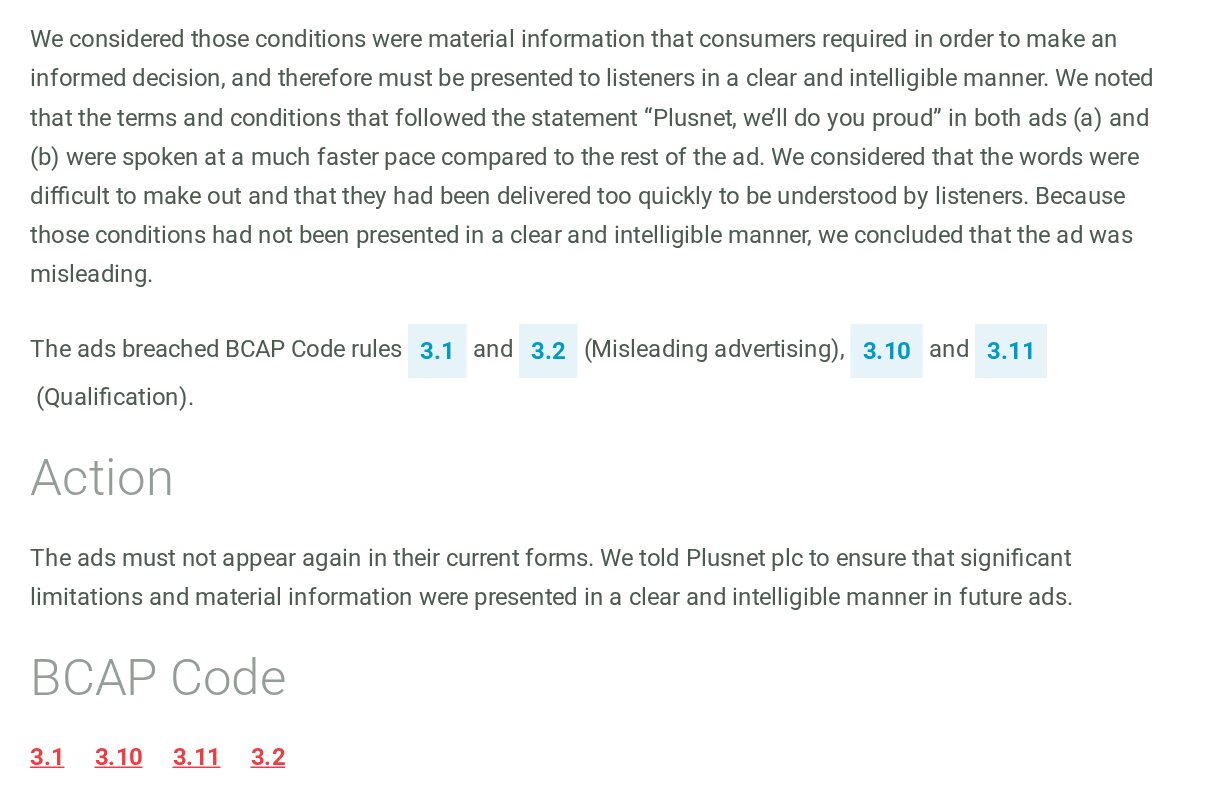
The ASA's 2017 ruling on two Plusnet radio ads, as it appeared on 29 November 2026. Screenshot: asa.org.uk
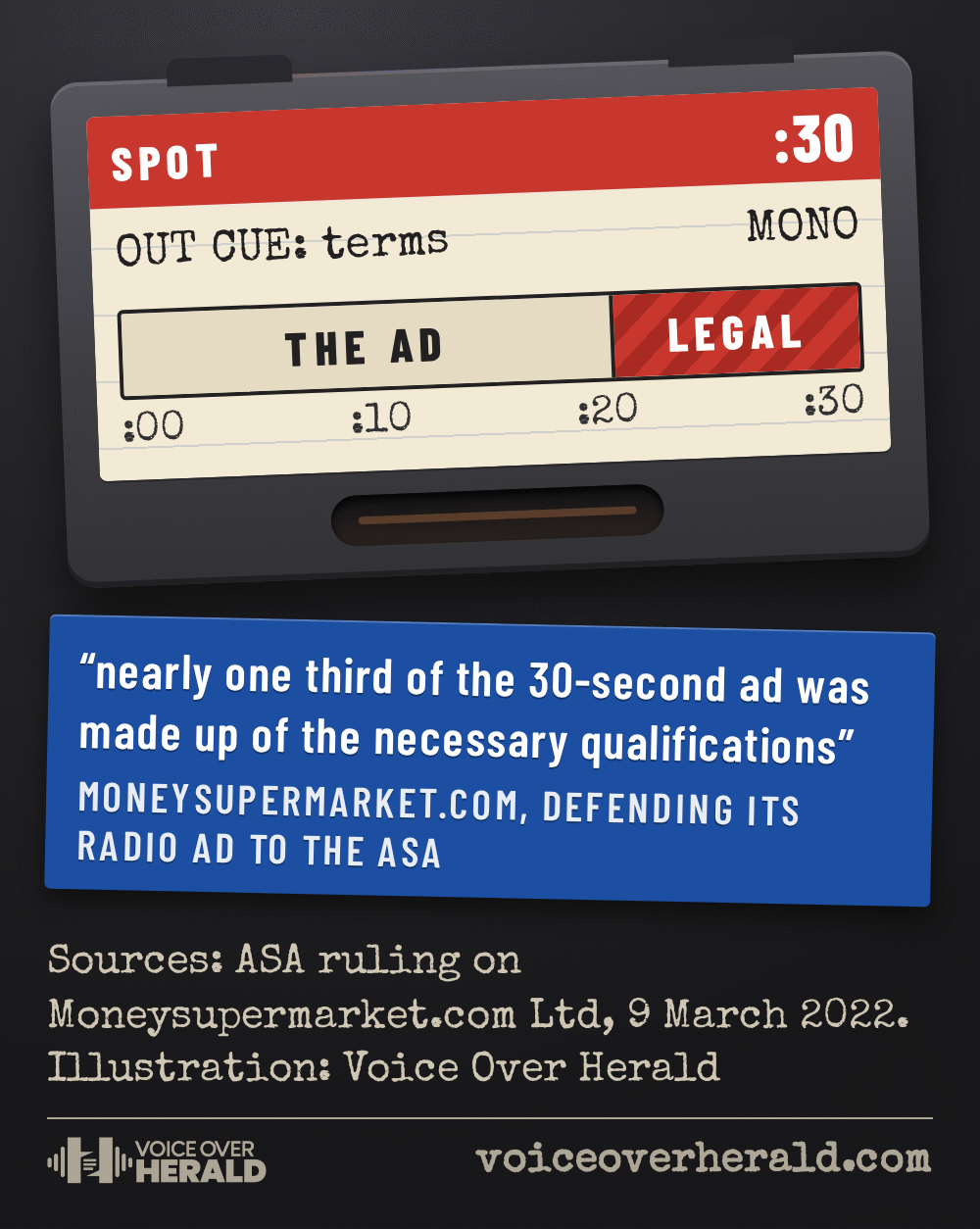
In 2022 the same thing happened to a Moneysupermarket.com credit card ad. The company told the ASA that “nearly one third of the 30-second ad was made up of the necessary qualifications,” and argued that judging whether someone was speaking too quickly “was somewhat subjective.” The ASA disagreed: the terms were “spoken at a much faster pace than the earlier part of the ad,” delivered “in such a way that listeners would not have been able to understand its content.” Radiocentre had cleared the script only on condition that the terms could be easily heard and understood, which, it said, “included the speed at which they were read, the volume and any background noise that could interfere with them.”
The regulator rules against the ad, not the actor, but a pulled ad means a rewrite and often a fresh session. If the legal copy won’t fit at a pace a listener can follow, say so in writing, give a clear read, and let the client trim the words or buy more seconds.
Session fee first, then usage
Commercials are usually priced in two parts: a fee for the recording, then a fee for using it. Marcus Hutton, a British voice actor, sets it out on his own rates page. “Usage is applied for broadcast TV and radio ads,” he writes, along with paid online advertising, and “is usually paid in the form of a buyout.” The size of that buyout depends on the reach, how long the ad runs and where it’s heard. His rule of thumb is that a shorter term and tighter limits on the licence mean a lower fee.
So “radio, one region, three months” and “all media, worldwide” shouldn’t get the same quote, even for the same 30 seconds of audio. Get the media, territory and term in writing before you price, and keep them with the invoice so you know when a renewal is due. Our guide to getting paid for remote voice work covers the invoice side.
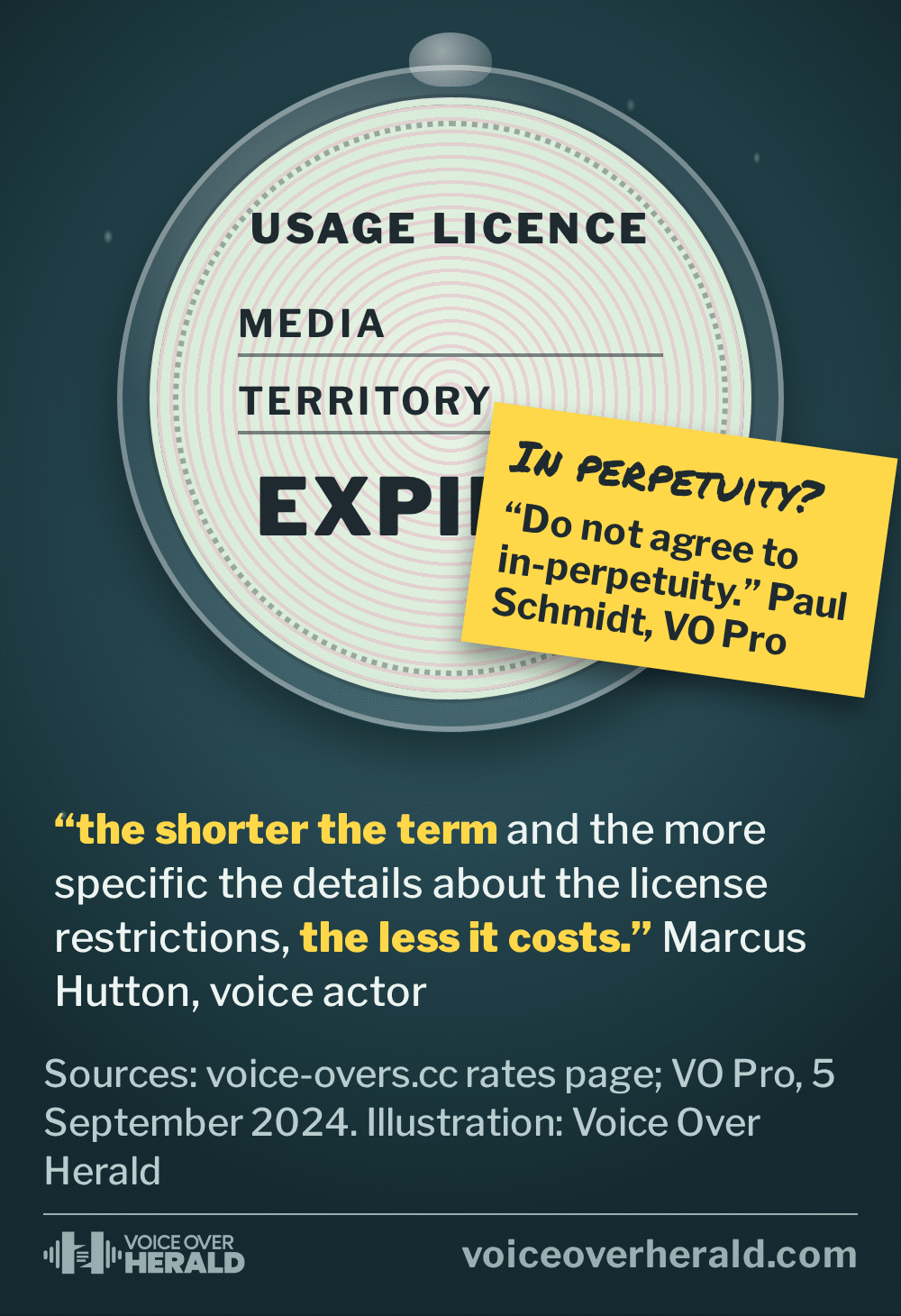
The term you most want to read twice is “in perpetuity.” Paul Schmidt, who runs the voice over business training site VO Pro, describes it as “a term that essentially translates to ‘forever.'” If the ad runs for years, he warns, “You’re essentially locked out of any future earnings from a project that might continue to be hugely profitable for the client.” His alternative: “Suggest a term that aligns with the typical lifecycle of an ad campaign,” with “an option to renew at an additional fee.”
Union work follows agreed rates instead, and those deals change: in Canada, ACTRA members have been voting this month on a new commercial agreement.
When software makes the ad
A newer clause turns up in some ad contracts: permission to build more ads from your voice. In the US, SAG-AFTRA introduced a Dynamic AI Audio Commercials Waiver in June 2024 for personalised digital audio ads made with a digital voice replica. A summary by the law firm Frankfurt Kurnit Klein & Selz sets out the terms: the producer “must obtain the performer’s consent for each original commercial created that includes the digital voice replica.” The performer “must be paid one session fee ($550) per commercial created using performer’s digital voice replica,” and “is paid 50% of a session fee for the creation of customization elements.” The waiver “covers digital use only, not use on terrestrial radio.”
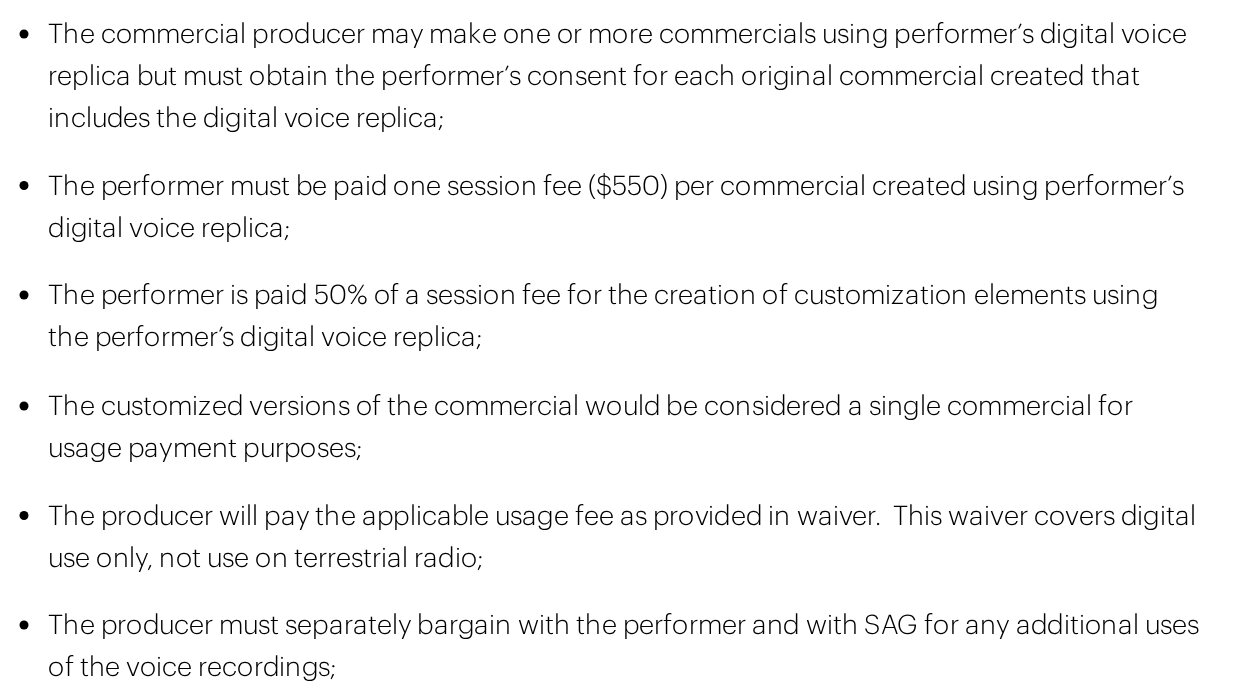
Frankfurt Kurnit Klein & Selz's summary of the SAG-AFTRA waiver, as it appeared on 29 November 2026. Screenshot: fkks.com
Duncan Crabtree-Ireland, the union’s national executive director, told Radio Ink at the launch that it “establishes necessary safeguards, such as requiring consent and fair compensation.” Outside a union, ask the same of any contract that mentions synthetic versions of your voice: is your consent needed for each new ad, are you paid for each one, and what happens to the files when the licence ends? Pennsylvania’s new rules on misleading AI voices in ads start on 21 December.
- Length. You know the finished spot length and whether it includes a legal line.
- Listener. You know who the ad talks to and what they should do next.
- Direction. You know who directs, and that only one person has the final say.
- Timing. You’ve read the full script, legal included, against a stopwatch at the pace the brief asks for.
- Licence. Media, territory and term are in writing, and “in perpetuity” isn’t hiding anywhere.
- AI clause. Any use of your voice to make new ads needs your consent and its own fee.
Commercial work rewards the actor who asks the dull questions early. For the file side of the job, see our guide to the delivery specs radio and other clients write down.
Sources: Radiocentre, “Creativity” (radiocentre.org) and “Ts&Cs May Not Always Apply: Making them work for brands and listeners” (June 2021); Advertising Standards Authority rulings on Plusnet plc (31 May 2017) and Moneysupermarket.com Ltd (9 March 2022); Debbie Grattan, “Changes in VO Styles Over the Years,” debbiegrattan.com, 15 February 2017; Marcus Hutton, rates page, voice-overs.cc; Paul Schmidt, “How In-Perpetuity Contracts Can Limit Earnings in Voice Over,” VO Pro, 5 September 2024; Dorian Slater Thomas, “UPDATES: SAG-AFTRA Commercial Contract Waivers,” Frankfurt Kurnit Klein & Selz, June 2024; Cameron Coats, “SAG-AFTRA Allows Contextual AI Audio Ads Under New Waiver,” Radio Ink, 5 June 2024. All read 29 November 2026. Screenshots: asa.org.uk, radiocentre.org and fkks.com, 29 November 2026.
Lee este artículo en español: Treinta segundos, letra chica incluida: cómo se encargan, se leen y se licencian los trabajos de voz para comerciales
Know something about this story, or spotted an error? Tell the newsroom.