


Spotify Brings Audiobooks to Mexico, Colombia and Spain. Its Plan for Smaller Languages Is AI Narration
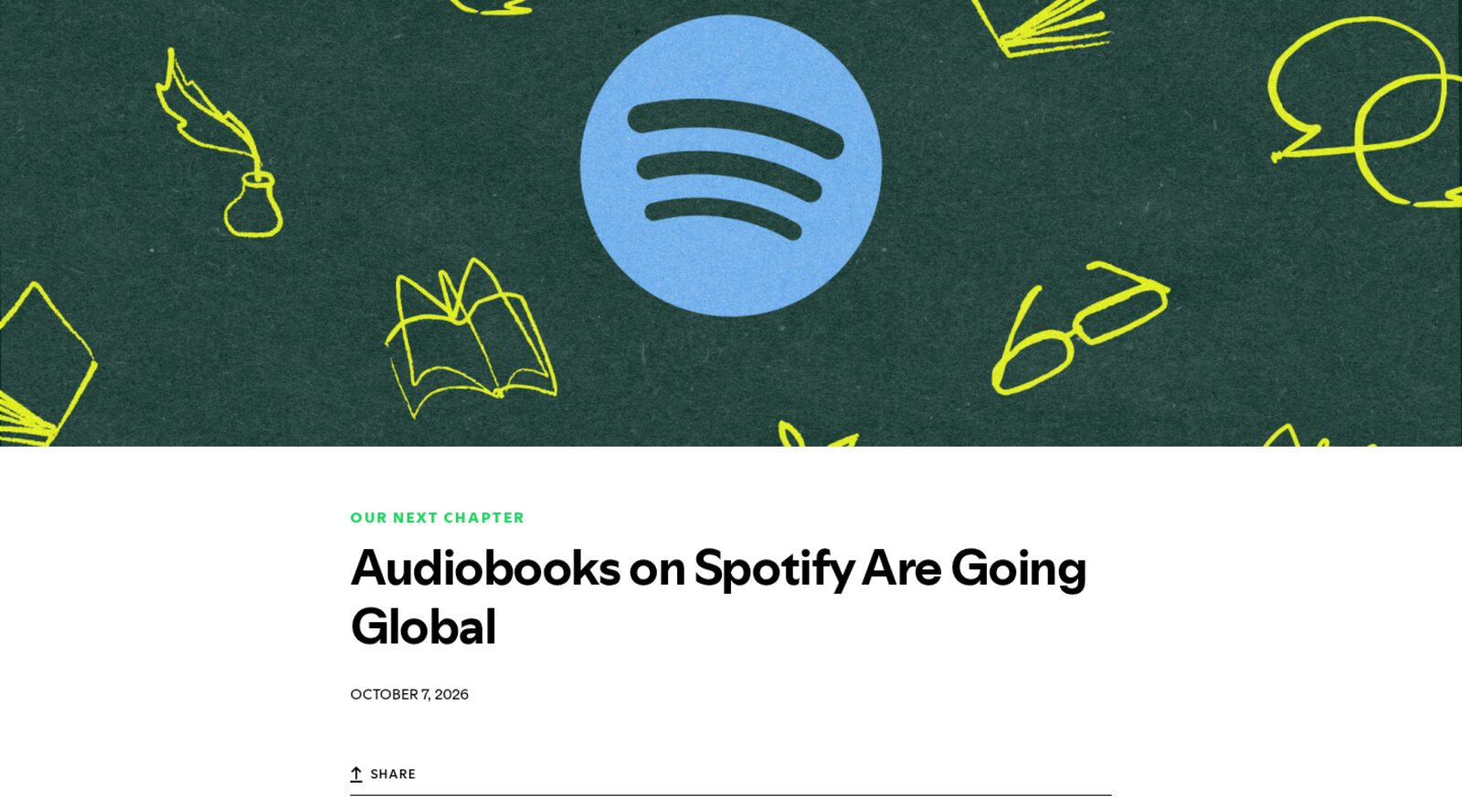
Spotify switched on audiobooks in Mexico, Colombia, Spain and Italy on Wednesday and says more than 180 markets will have them by the end of the year. For narrators, the bigger news is in one sentence from the company’s head of audiobook partnerships: AI narration is how it hopes to fill the shelves in languages that have never had many audiobooks.
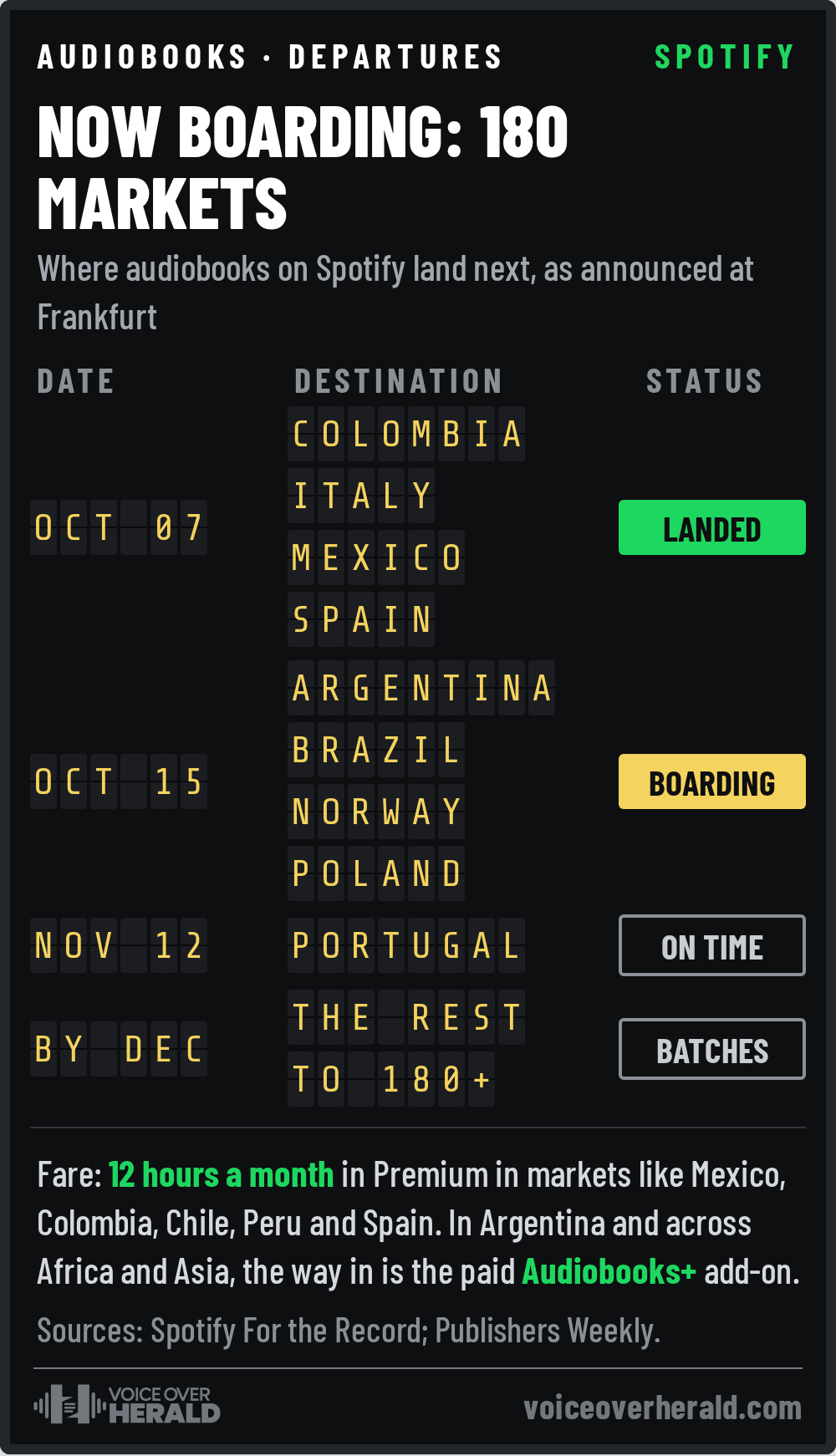
Spotify made the announcement at the Frankfurt Book Fair on October 7. Audiobooks on the app go from 22 markets to more than 180 by the end of 2026, which Spotify says puts them in front of more than 750 million people. Colombia, Italy, Mexico and Spain went first. Argentina, Brazil, Norway and Poland follow on October 15, Portugal on November 12, and the rest come in batches through December, Publishers Weekly reported.
“For a lot of people, audiobooks are how they find their way back to reading, on the commute, on a walk, or at the end of a long day,” said Owen Smith, Spotify’s VP of Audiobooks, in the company’s announcement.
What listeners in the new markets get
In most of the big new markets, eligible Premium subscribers get 12 hours of audiobook listening a month, included in the plan. Spotify lists Italy, Spain, Portugal, Brazil, Mexico, Colombia, Poland, Chile, Norway and Peru among them. Anyone who wants more can add Audiobooks+, a paid add-on with extra hours, and in Argentina and across Africa and Asia that add-on is the main way in. Single titles can also be bought outright.
Spotify’s own help page for authors already carries the change. It says titles published through Spotify for Authors will become available in each new market by default as the rollout reaches it.
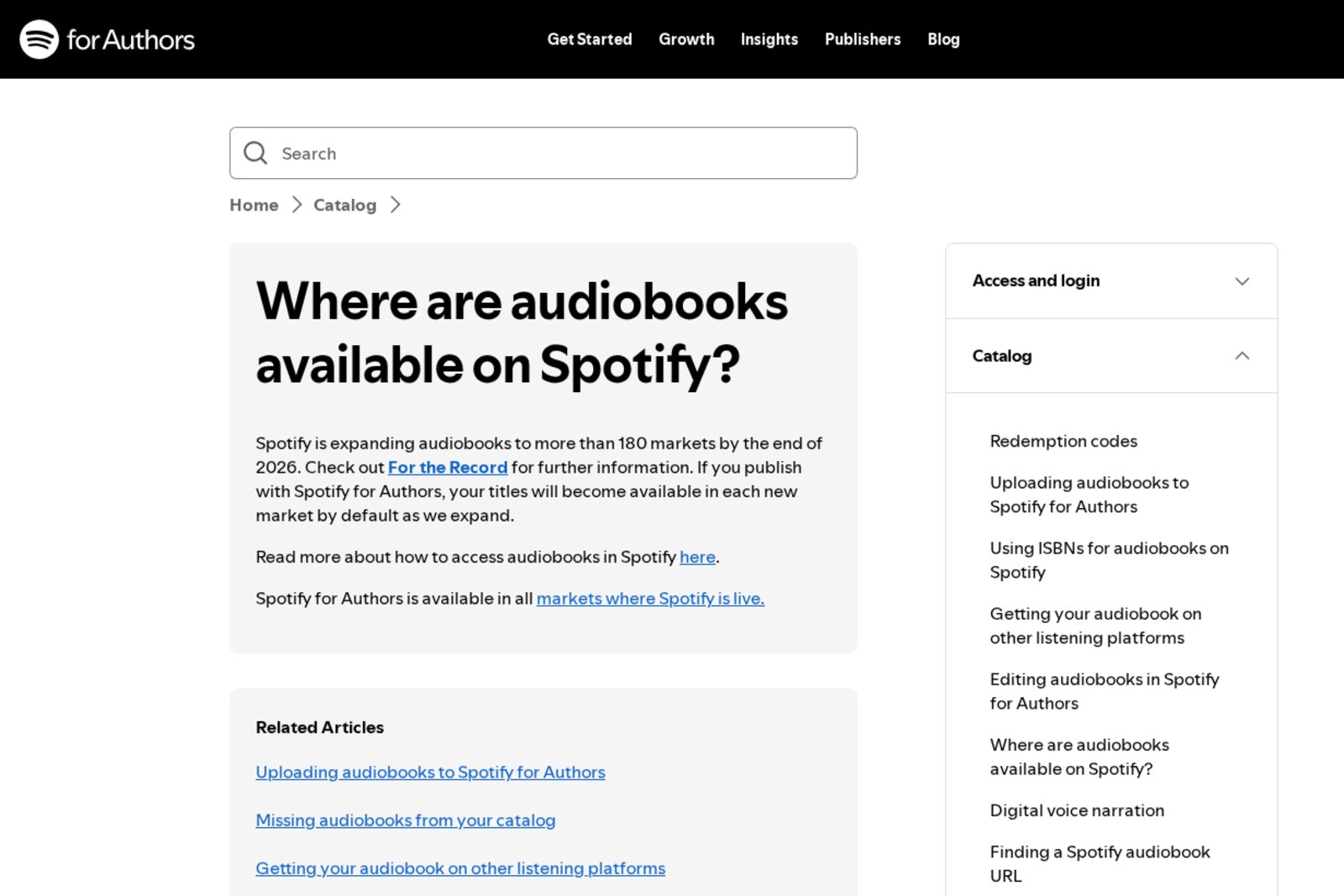
Image: Spotify for Authors help page, screenshot 8 October 2026
That default matters for anyone who has narrated a self-published book distributed that way. A title recorded for listeners in the United States or the United Kingdom can now be heard in Bogotá or Monterrey without anyone lifting a finger.
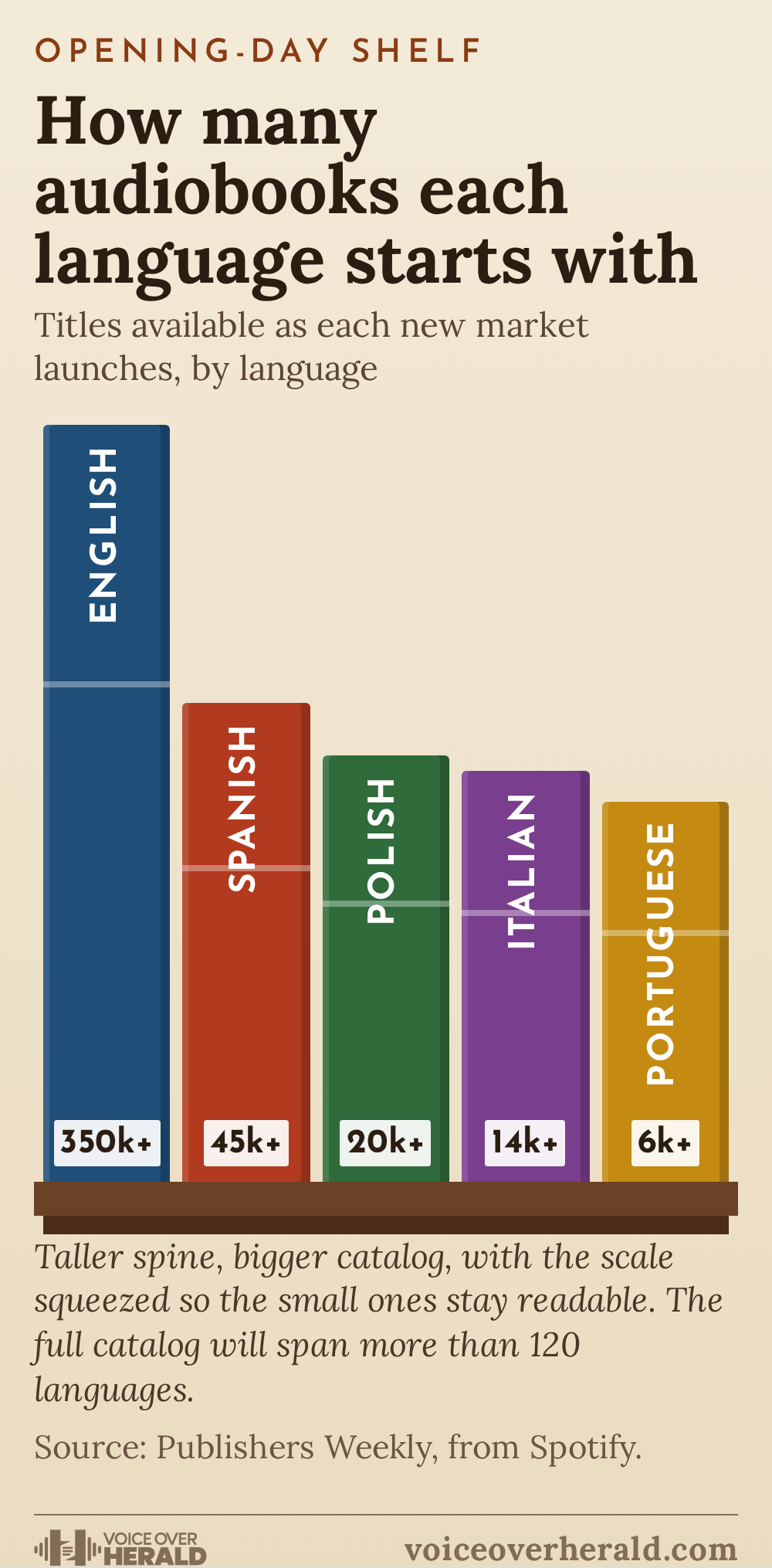
Spanish starts with 45,000 titles
Each new market opens with an English catalog of more than 350,000 titles, according to Publishers Weekly. The Spanish catalog is much smaller, at more than 45,000.
Duncan Bruce, Spotify’s director of audiobook partnerships and licensing, told the magazine the company would put the local language up front. “In markets where we have rights, we will always lead with the local language first and foremost,” he said.
He was frank that the gap is real. “Part of that has been supply and demand,” Bruce said. “Us opening up in these markets, we think, is going to be a great opportunity for local-language publishers to invest in audiobooks.” He named the Arabic-speaking world, India and other Asian markets, and sub-Saharan Africa as the places where it’s hardest to find books in the listener’s own language.
The sentence narrators will notice
Here’s where it gets personal for anyone who reads books for a living. Spotify, Publishers Weekly wrote, sees AI narration as a way to bring some titles to audio faster, “especially in languages where the market may be too small to justify the expense of a human narrator and producers.”

 VoiceEditSuiteRaw take in. Clean take out.
Bruce put it this way: “AI done responsibly can give authors and publishers the opportunity to launch an audiobook in local languages, which they may have never done or had the financial ability to do.”
The tools are already there. Self-published authors can upload local-language titles through Spotify for Authors, and Spotify has a partnership with ElevenLabs that lets authors produce AI-narrated audiobooks. On its help pages Spotify calls this “digital voice narration” and says it accepts it from providers like Google Play Books and ElevenLabs. Authors tick a box saying the book uses a digital voice, and Spotify adds a short sentence to the description so listeners know. Those titles aren’t currently shared with Spotify’s referral partners.
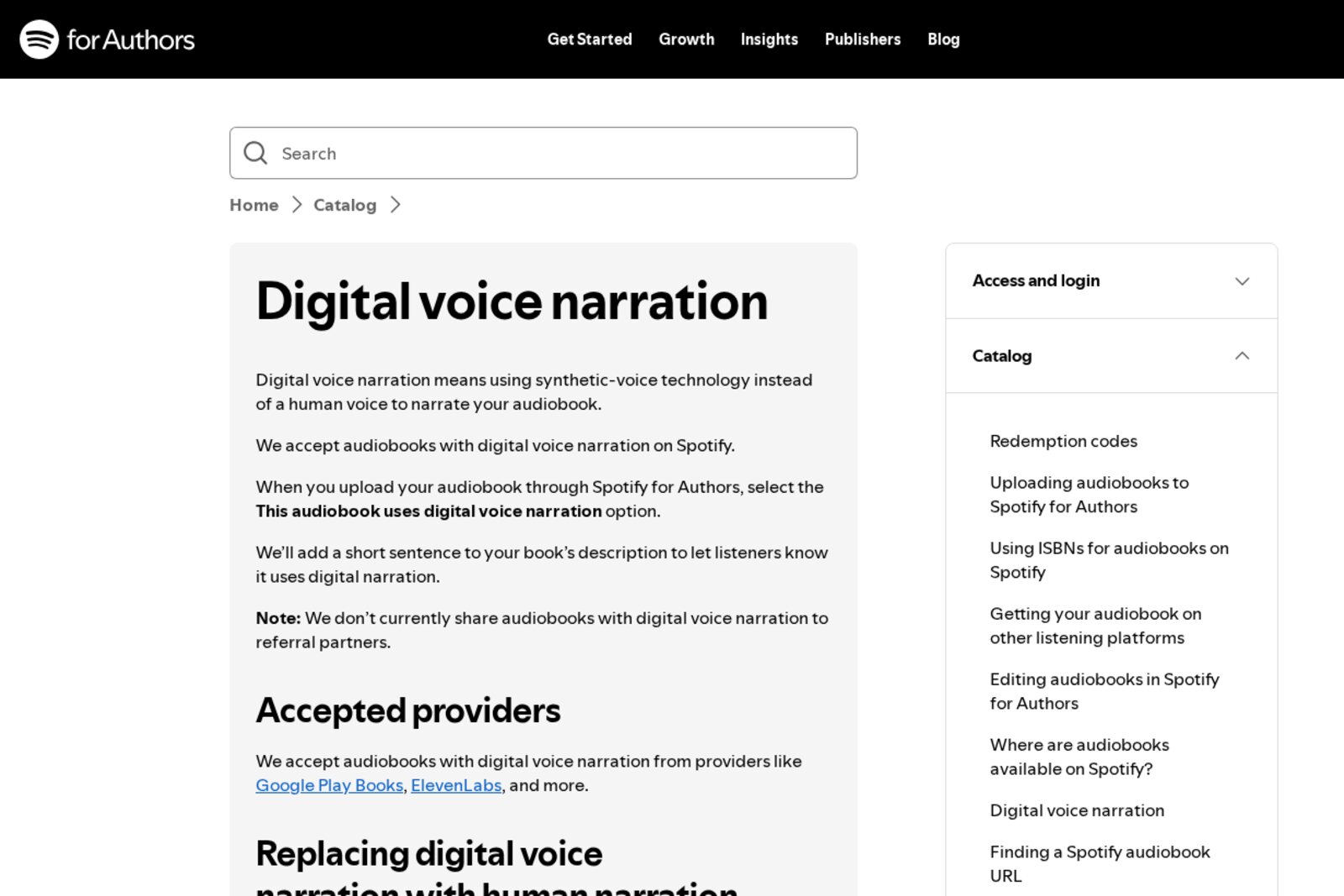
Image: Spotify for Authors help page, screenshot 8 October 2026
There’s one line on that page worth reading twice. If an author later replaces the digital narration with a human recording, they untick the box and Spotify removes the disclosure. A book can start life with a synthetic voice and get a person later.
Why Spanish-language narrators should pay attention
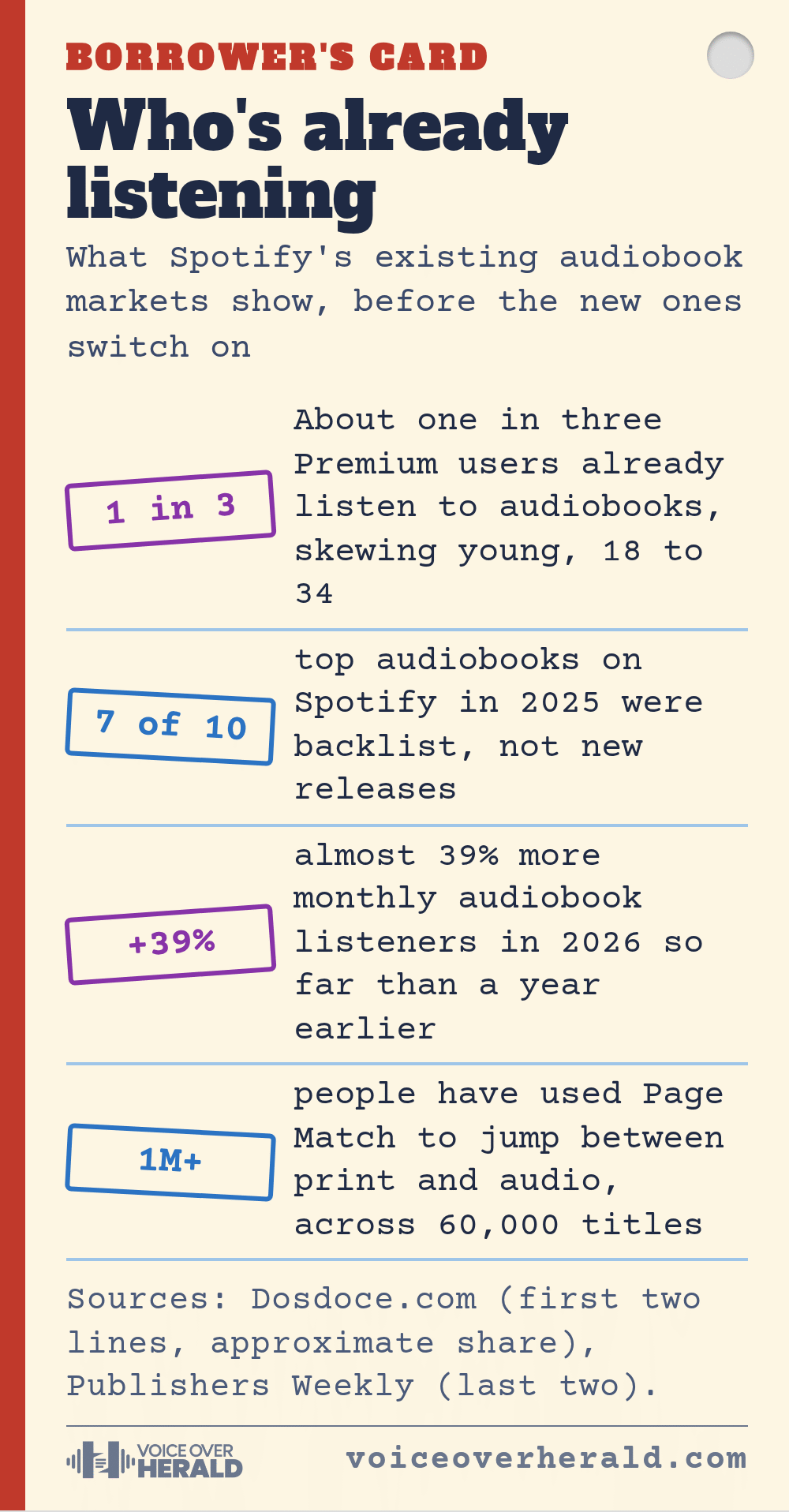
The Spanish books trade site Dosdoce.com called the launch “excellent news for the Spanish-language audiobook industry” and pointed to what happened when Spotify arrived in France, Belgium, the Netherlands and Luxembourg: revenue from audiobook listening in those markets grew 30%, according to figures the distributor Bookwire presented at a LIBER industry event.
Dosdoce also put the AI question in proportion. “Although human narration is still preferred for many genres,” it wrote, AI is proving its worth in nonfiction, educational content and short stories.
Read together, the two sources sketch the likely split. Fiction, memoir and anything that needs acting keep going to people, and there’s suddenly a much bigger shop window for them in Spanish. The long tail of manuals, textbooks and small-language back catalogs is where synthetic voices get their first real chance. Narrators who work in Spanish, Portuguese, Italian or Polish now have both a larger market and a cheaper rival in the same app.
The money behind the move
Spotify isn’t doing this for love of literature alone. Audiobooks+ has passed one million subscribers and more than $100 million in annual recurring revenue, the company says, and monthly audiobook listeners grew nearly 40% over the past year while listening hours rose more than 30%.
Investors liked it. Spotify shares rose 5.18% on Wednesday to $513.40, Bloomberg Línea reported, and Citi expects Spotify to raise Premium prices by about 10% in the new markets around mid-2027, following its habit of putting prices up a couple of quarters after audiobooks arrive.
For narrators, that’s the part to watch. A platform that wants audiobooks to justify a price rise needs a lot more of them, in a lot more languages, quickly. How many of those get a human voice will depend on what listeners in Mexico City, Madrid and Medellín choose to finish.
Sources: Spotify For the Record (7 October 2026), Spotify for Authors help pages, Publishers Weekly, Dosdoce.com, Bloomberg Línea. Quotations from Spanish-language sources are translated by Voice Over Herald. Images: Spotify (screenshots of Spotify’s own pages, 8 October 2026).
Lee este artículo en español: Spotify lleva sus audiolibros a México, Colombia y España. Su plan para los idiomas pequeños es la narración con IA
Know something about this story, or spotted an error? Tell the newsroom.