Netflix Raises German Dubbing Residuals and Pays Into Voice Actors’ Pensions. The AI Training Clause That Split the Industry Stays
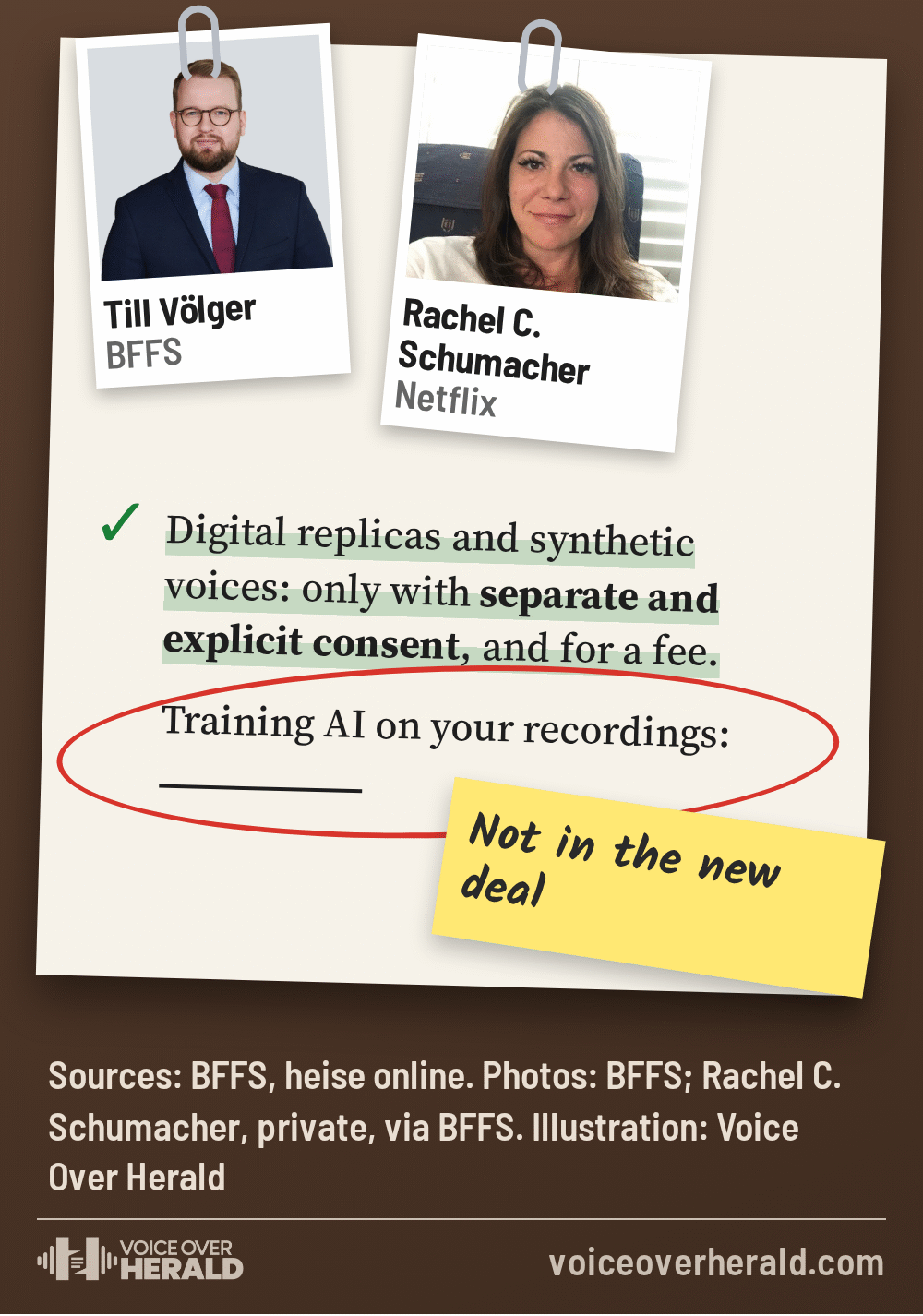
Netflix will pay more to German voice actors whose dubbed series and films become hits, and it will now pay into their broadcasting pension fund too. The actors’ union BFFS announced the deal in Berlin on November 16. The AI training clause that has kept some of Germany’s best known voices away from Netflix for months isn’t part of it.
The agreement is a new joint remuneration rule, a Gemeinsame Vergütungsregel in German, for actors working in German-language dubbing on Netflix productions. It starts on January 1, 2027. The union calls it a significant raise, and on paper it is: the yearly pot shared by the voices of Netflix’s most successful dubbed titles grows by more than half.
“Actors contribute to the success of films and series in the dubbing studio,” said Till Völger, a board member of the BFFS. “The considerably higher residuals for successful Netflix productions are therefore a strong sign of recognition for our work.”
What Changes on January 1
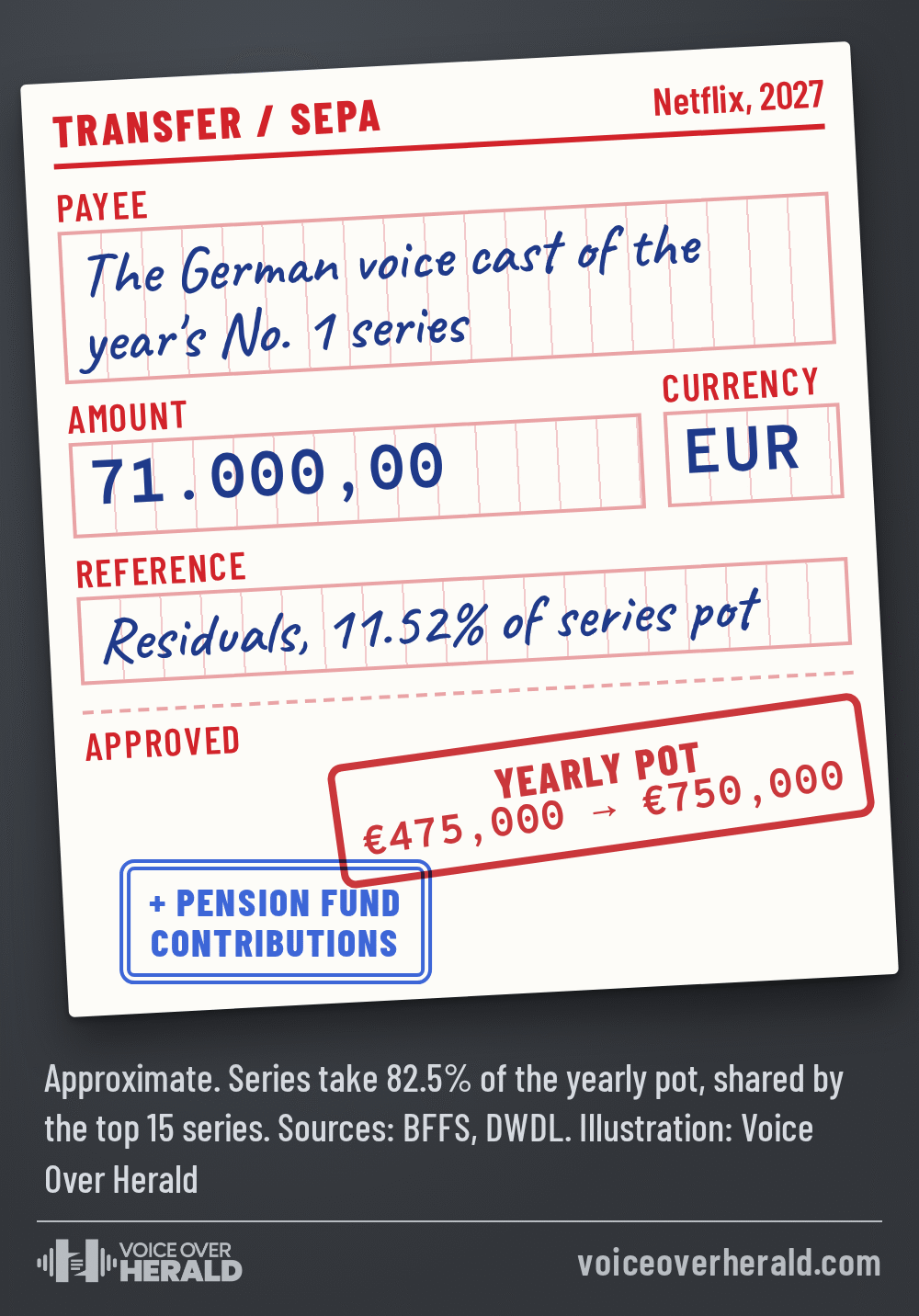
According to the trade site DWDL, the residual pot rises from 475,000 euros a year to 750,000 euros. Series take 82.5% of it and films the rest. The money goes to the voices of the 15 most successful series and the 15 most successful films each year, on a fixed key, and the series in first place shares about 71,000 euros among its cast.
That’s a bonus on top of the session fee, paid because a show did well, which is exactly the kind of money dubbing actors have long said streaming had squeezed out of the job. It’s also why the size of the pot matters less to many of them than the conditions they have to sign before they can share in it.
A Pension Line on the Pay Slip
The second change may last longer. Netflix will reimburse employers’ contributions to the Pensionskasse Rundfunk, the pension fund for freelancers in German broadcasting, on the German dubbing it commissions. It already did this for its film and series shoots. Netflix says no other streaming service supports retirement savings for dubbing work this way.
Völger tied it straight to a fear that runs through the profession. The partnership, he said, “helps to address the risk of poverty in old age in our profession.” The two sides also plan joint initiatives for the dubbing trade, such as further training and steps to improve diversity.
Netflix sent its own message about people. “Human acting performance in dubbing is and remains important to us,” said Rachel C. Schumacher, who handles labour relations and content localization law at the company. “In recent years we have commissioned thousands of hours of German-language dubbing. We also want to make work of a comparable scale possible in the future and support the use of human voices.”
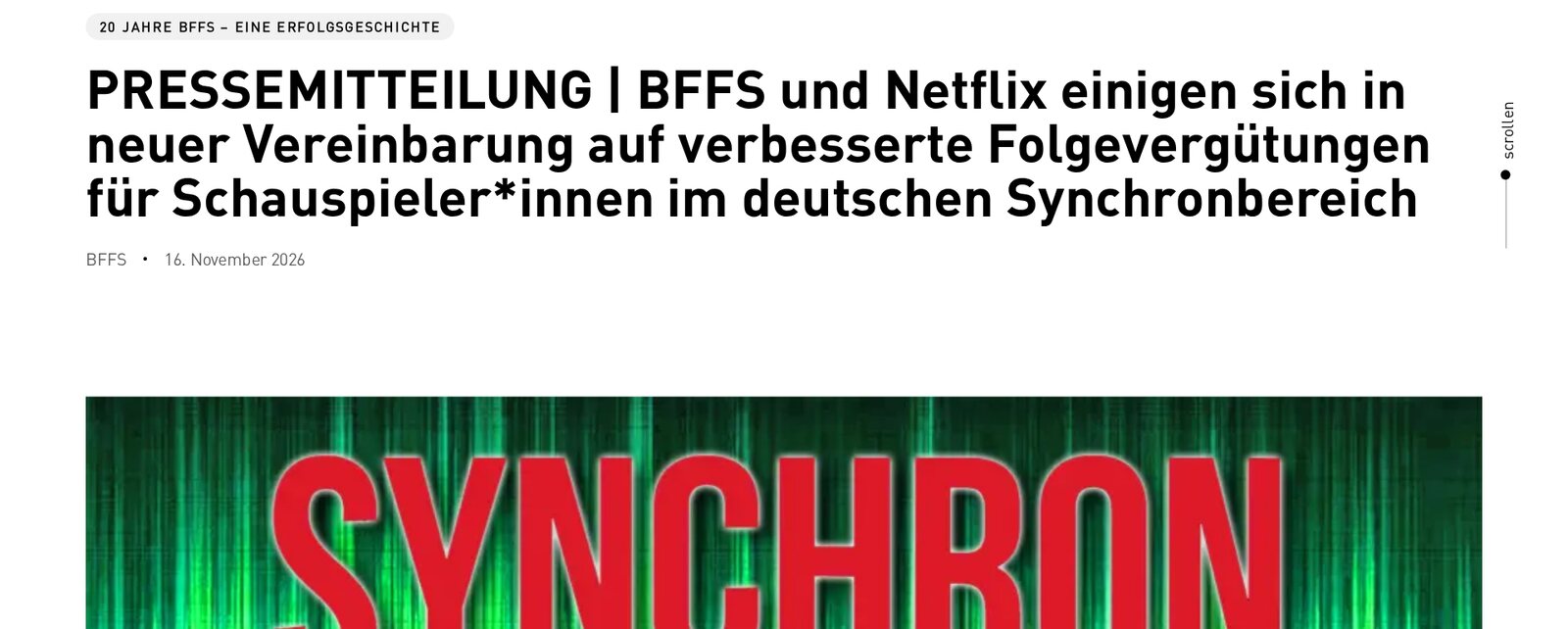
The BFFS announcement of November 16, 2026. Image: BFFS
The Clause the Deal Leaves Alone
On AI, the new rule carries over what the BFFS and Netflix agreed in 2025. Digital replicas and synthetic voices made from an actor’s recordings may only be used with that actor’s separate and explicit consent, and the union’s release adds that an appropriate fee has to be paid when a digital replica is used.
What it doesn’t touch is training. As heise online pointed out, the announcement says nothing about using voice recordings to train AI models, and that is the point the fight has been about all year. The Verband Deutscher Sprecher:innen, the voice actors’ association known as VDS, says Netflix’s assignment of rights contract asks performers to hand over far reaching rights, AI training included. Actors who won’t sign aren’t hired, and so they can’t share in the bigger pot either.

The Bundeskartellamt in Bonn, where the VDS filed its complaint. Photo: Atelier Ralf Majewska, Wikimedia Commons, CC BY 3.0
The VDS has taken its objection to the Bundeskartellamt, Germany’s competition authority in Bonn. Several voice actors have also filed a data protection complaint with Berlin’s data protection commissioner. In May, VDS chair Anna-Sophia Lumpe told the magazine The Spot that Netflix was in effect asking for blanket consent to use voices in an AI context, according to a summary by GIGA.
Stars Without Their German Voices
Viewers in Germany have already heard the result. Katrin Fröhlich, the German voice of Cameron Diaz, Luise Helm, who dubs Scarlett Johansson, and Anne Helm, who dubs Margot Robbie, have not signed the clause and said in a joint video that they won’t voice those stars in coming Netflix productions. According to FILMSTARTS, Diaz will have a new German voice in Netflix’s Bad Day, and Johansson’s voice will be replaced in the animated film Ray Gunn.
The boycott has already reached Lupin. In its fourth season, Ludivine Sagnier’s character lost Anne Helm’s voice, and Omar Sy’s role went to Alexander Doering instead of Sascha Rotermund. Several Netflix originals have also arrived in Germany with no German audio at all.
Netflix and the BFFS
A bigger yearly pot for the voices of the 15 most successful series and films, Netflix paying into the broadcasting pension fund, joint training and diversity initiatives, and the 2025 consent rules for digital replicas carried over with a fee for their use.
What the VDS objects to
The training of AI models on dubbing recordings, which the announcement doesn’t address. Actors who refuse the rights contract over that point still aren’t hired, and they miss the higher residuals too.
One Voice Goes to Court
Matti Klemm, the German voice of Jason Momoa and Mahershala Ali, wants a judge to settle the training question. He says a data access request showed Netflix had used his voice recordings to train AI systems without his knowledge. The civil rights group Gesellschaft für Freiheitsrechte and the law firm Spirit Legal are backing him, and the suit is planned for the end of the year, FILMSTARTS reports. Supporters see it as a test case for the whole industry: may a company train AI on a performer’s voice without asking?
Klemm’s case turns on proof, on showing which recordings are his and where they went. That’s the problem Voice Lock was built for on The Voice Realm. The Voice Realm says it’s the world’s first voiceover marketplace to protect voice actors’ demos with an invisible watermark, and once a voice actor switches Voice Lock on, each protected recording gets a dated certificate anyone can check online. It doesn’t detect clones. It proves which recordings are theirs.
Directors and Writers Sign Too
Netflix also reached a separate agreement with the BSD, the association of German dubbing directors and dialogue writers. DWDL reports that it runs from January 1, 2026, to the end of 2029, pays residuals on the 15 most successful films and series each year and, for the first time, includes rules on AI.
 VoiceEditSuiteIt edits like you would, and it gets better every file.Every fix you make in the editor teaches Auto Clean Up more, so each file comes back sounding like you edited it yourself.See how it worksLearns from numbers, never your audio. Never used to train AI.
“Dubbing is cultural bridge building and contributes decisively to the success of foreign-language films and series,” said Tobias Neumann of the BSD’s executive board. “Since AI will play an increasing role in the dubbing industry in the future, effective protection for our members is of great importance.”
The BFFS still recommends that its members work for Netflix. It negotiated the 2025 AI rules, which are now part of the rights contract. So German dubbing goes into 2027 with better pay for the voices who sign, a pension line for the first time, and the same open question for the ones who won’t. The answer may come from a court rather than a negotiating table.
Sources: BFFS press release (November 16, 2026); DWDL; heise online; GIGA; FILMSTARTS. Quotations from German sources are translated by Voice Over Herald.
Lee este artículo en español: Netflix sube los pagos residuales del doblaje alemán y aporta a las pensiones de los actores de voz. La cláusula de entrenamiento de IA que dividió al sector se queda
Know something about this story, or spotted an error? Tell the newsroom.