
Ten Seconds a Scene: How New Voice Actors Build a First Demo Worth Sending
Your first demo is the thing an agent or a client hears before they’ve met you, and often the only thing. Working voice actors who have made dozens of them agree on two points that surprise most beginners: wait longer than you want to, and make it shorter than you think.
Almost everyone starting out has the same plan. Take a class or two, record a reel, send it to a handful of agents, get signed. Dee Bradley Baker, the voice of Captain Rex and the clone troopers in Star Wars: The Clone Wars and Perry the Platypus in Phineas and Ferb, has spent years answering beginners’ questions on his advice site, and he describes that plan as a trap. “Many believe that all you need to get a voice over career rolling is to produce a quick VO demo,” he writes. “It’s an easy fantasy to buy into.”
He’s not telling people to skip the demo. He calls a good one “an essential part of what you need to get an agent, auditions and work.” He’s telling them that a demo can only show what’s already there, so the order matters. Skill first, reel second.
Baker has a short way of putting what the people hiring are listening for, and you can hear him say it himself in this clip from the interview show VO Buzz Weekly.
Hear the voice: Dee Bradley Baker on why voice work can’t be approached purely as a calculation, and what casting people respond to. Video: VO Buzz Weekly, on YouTube
Ready means competitive, not “finished a course”
Baker’s test for readiness is blunt. “First off, you must be ready as a voice actor for it to be worth making a demo,” he writes on his page about demos. “If you aren’t there yet, hold off on making a demo. It’ll just be a big waste of time and money.”
The reason is that a weak first impression sticks. “In a business where time is precious, you rarely get the chance to make a bad impression twice,” he warns. Jeremiah Mullins, a working voice actor interviewed for Apogee’s voiceover guide, says the same thing about agents. “Most likely, you’re only going to get one shot with an agent, so it’s important not to send out your demo until it’s ready,” he told the guide. “Agents have assistants that will remember if they’ve already dealt with you before.”
Mullins learned that the slow way, with a father who also voices for a living. “I would do a demo and be like, ‘Dad, what do you think of this?’ And he would say, ‘It’s good. You’re not ready yet, though.'” It took three or four versions, he says, before the answer changed.
 VoiceEditSuiteThe audio editor that learns how you breathe.Auto Clean Up keeps the best take of every line, cuts false starts and retakes, and quietens breaths the way you would.See how it worksLearns from numbers, never your audio. Never used to train AI.
Crispin Freeman, who teaches voice acting and hosts the Voice Acting Mastery podcast, puts “Making Your Demo Too Soon” first on his list of the three big demo mistakes. “Demos are one of the most important and at the same time most misunderstood components of a voice acting career,” he writes.
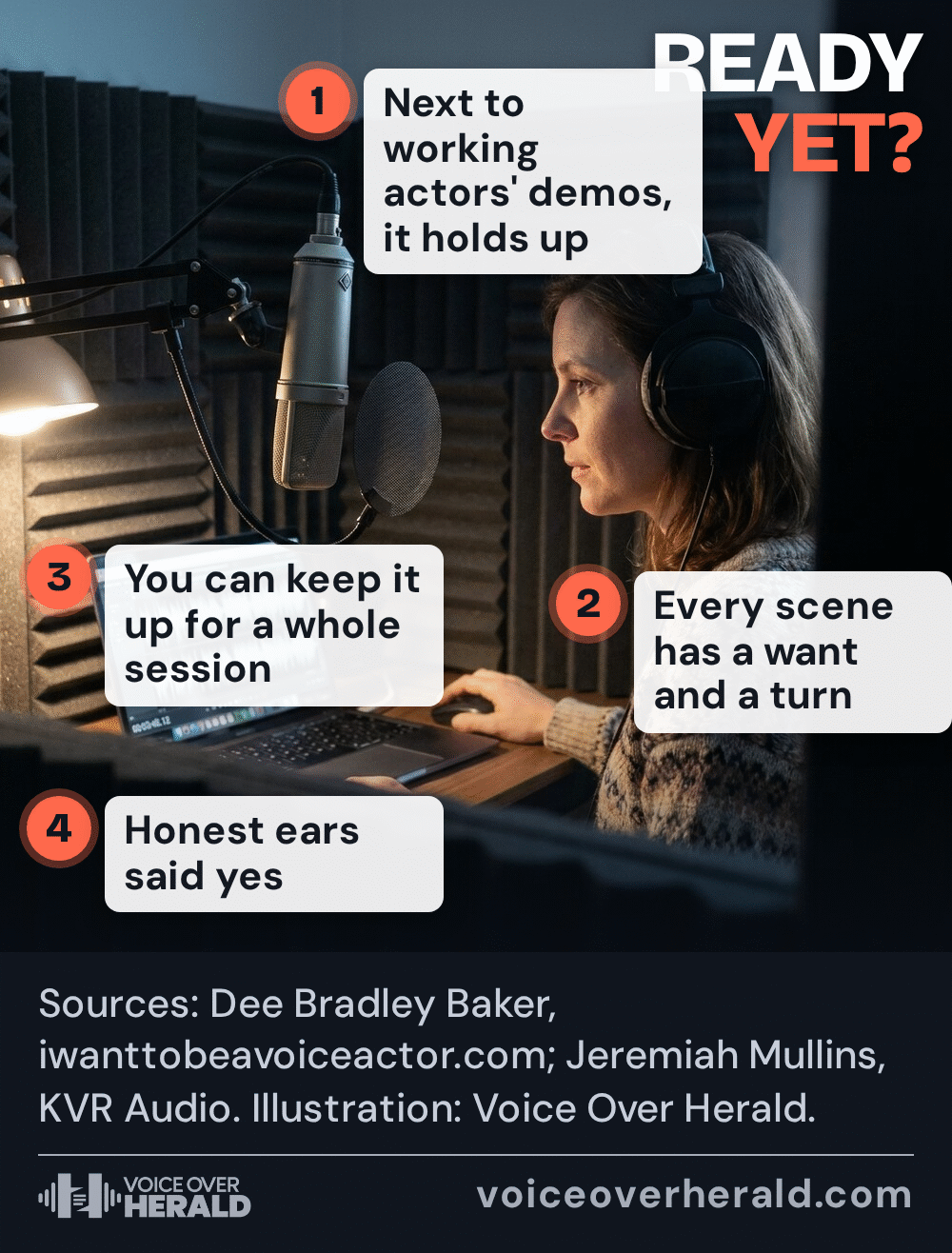
So how do you know? Baker’s suggestion is homework anyone can do tonight: listen to the demos of voice actors who are working now, on their own websites or their agents’ pages, in the area you want to work in. If yours wouldn’t sound at home in that company, you’ve got your answer for now. That’s a to-do list, not bad news, and the same practice tightens your mic technique and helps you take direction.
One kind of work per demo
A first demo usually goes to one kind of buyer, so it should speak to them. Baker writes about animation demos, and in that world range is the point: he wants a run of characters that “vary in status, age, energy, and occupation.” Asked on his site whether commercial demos need the same spread, he said no, and explained why. “The union animation contract counts each character when figuring your pay (for scale) and you’re often asked to voice two or more characters. Not so with commercials.” His answer ended on the part that applies to everyone: “the most important thing for any demo is always to show good acting.”
Impressions get their own home too. “Generally, I’d recommend a separate demo for impressions,” Baker writes, and only if they’re “dead-on fantastic and demonstrate good acting.” His test: can you read the ingredients on a cereal box as that character? If not, it isn’t ready.
Scenes, not a catalogue of voices
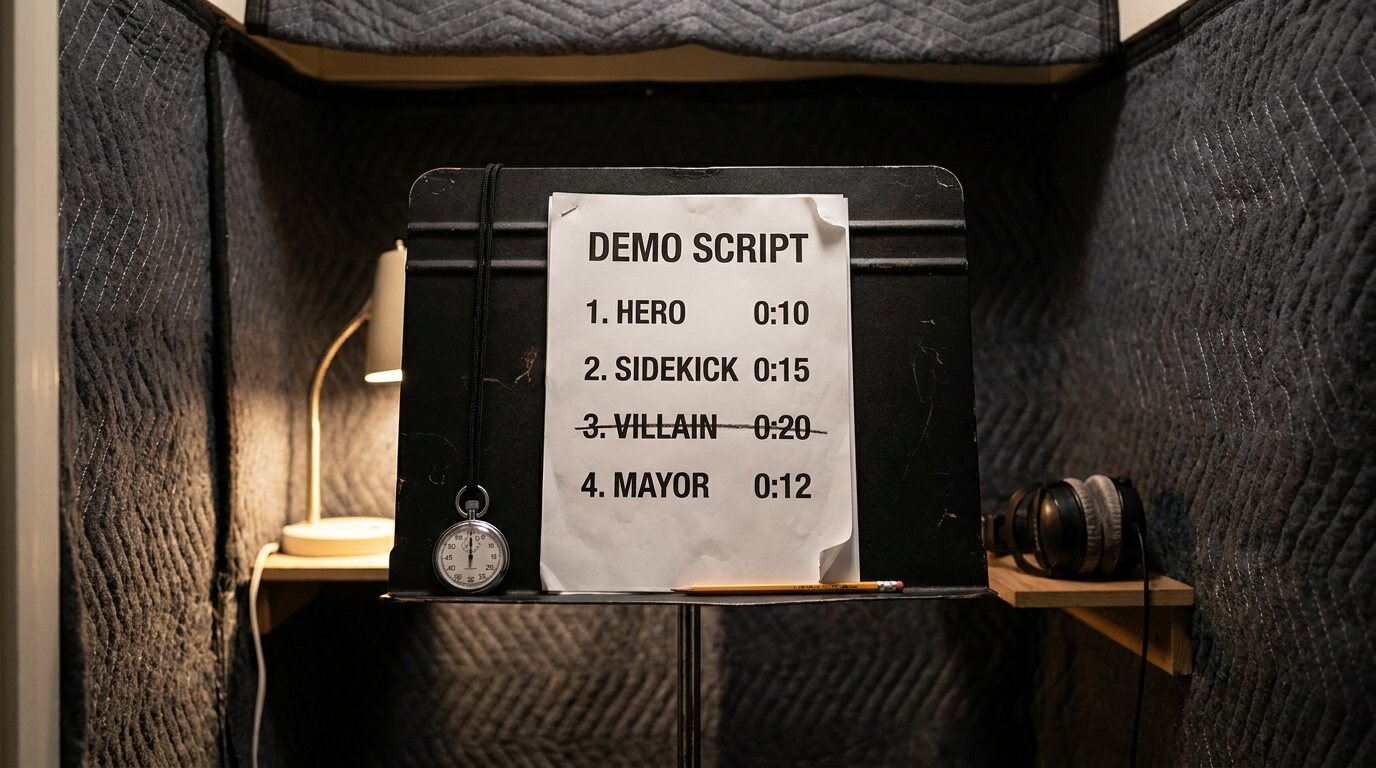
The most useful idea on Baker’s page is that every segment is a tiny scene with something happening in it. “Your demo’s scene segments may be short but they cannot be static or one-note!” He gives examples of what he means: “An evil character goes from seductive to menacing when addressing a princess. A hero begins exhausted and transitions to solid resolve.” Then the kicker: “Each in five to ten seconds!”
The mistake he hears most is the opposite, a character describing itself to nobody. “It’s a common amateur demo mistake to create ‘scenes’ that are just the character voicing its inner monologue, talking on about what it’s doing or merely describing itself.” His fix is to give every line a listener, a want and a turn, because, as he puts it, “a demo is not a catalog of voices you can do.”
Where does the copy come from? You don’t need aired work. Baker would rather hear “freshly produced spots that a potential buyer could easily imagine dropped into their current or future project.” For character demos, he suggests you “Transcribe a scene that you like, rewrite it, change the names, hone it down to make it compact, simple and unique.” Asked whether a commercial demo could use tweaked radio copy, he replied: “It’s what I’d do.”
Sixty seconds, then cut
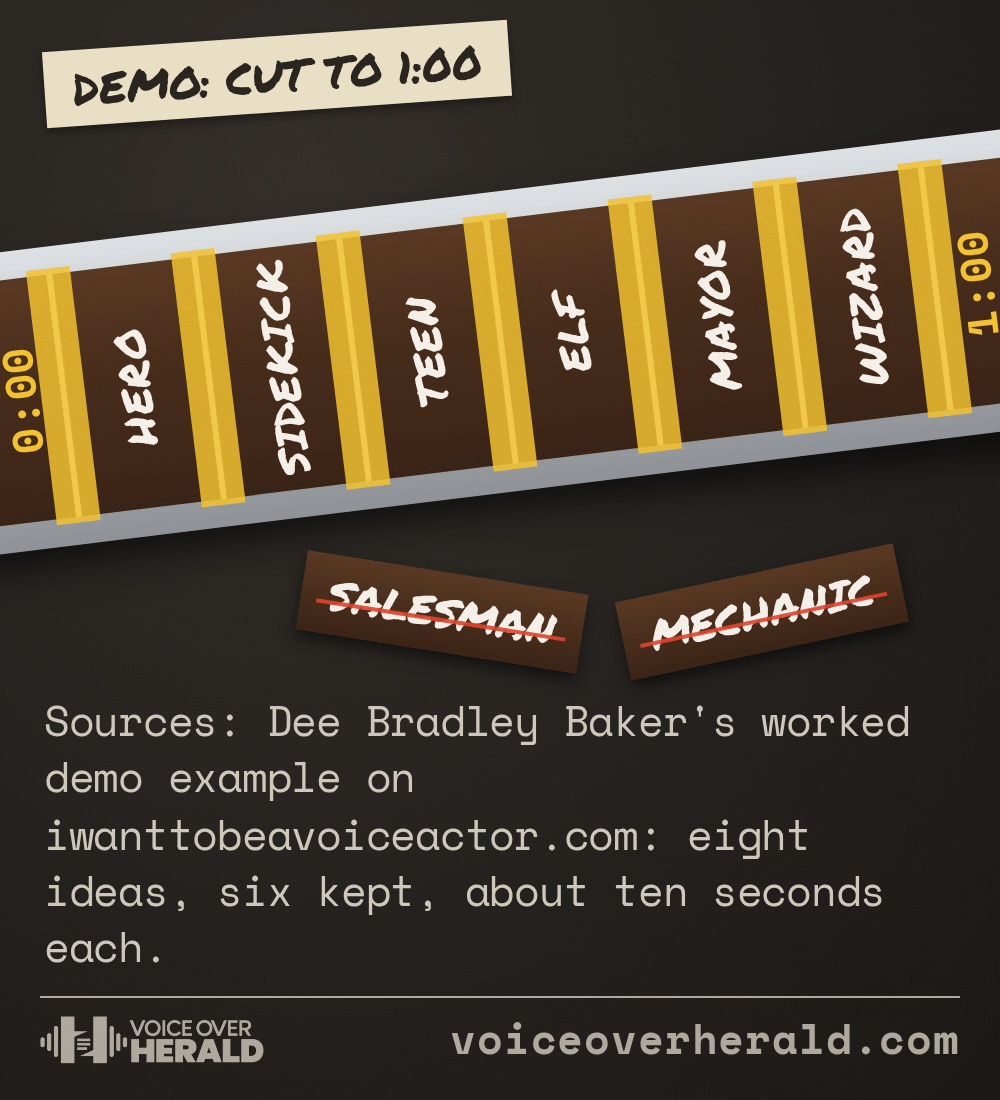
Length is where beginners and pros disagree most. Baker knows beginners want “that three minute+ demo”, and his advice is not to make it. “Let’s shoot for a demo that is 60 seconds or less,” he writes. He adds that “Few can deliver a compelling demo 90 seconds or longer,” and asks for “smash cuts” between segments, each one in sharp contrast with the one before.
On a second page he walks through planning a demo of his own. He starts with eight scene ideas, records, listens, and cuts two. Six bits at about ten seconds each makes “a generous one minute demo, which perhaps could still be trimmed down even further.” His reason for being ruthless is worth pinning above your desk: “A demo is only as good as its weakest segment.”
Narration samples follow different rules
If you want to narrate audiobooks, the “demo” that matters most may be the samples on a narrator profile, and the most practical rules come from the platform side. ACX, Amazon’s audiobook production marketplace, spells out its own advice in a post on samples. Without at least one, it says, you aren’t searchable, and it adds that “40% of projects on ACX are booked without an audition.”
The post is specific about what goes in. Samples should be audiobook material, not your radio spots (“Skip ’em”), and if you haven’t finished a book yet, ACX says “it is ok to use a small portion of a book from your shelf.” Keep music and sound effects out. And don’t make the listener wait: “Don’t slate it much, if at all,” the post says. “If your sample opens with 30 seconds of slating, the rights holder may not listen long enough to get to your actual narration.” Finally, ACX asks that at least one sample shows “the current final audio quality a rights holder can expect to receive from you.”
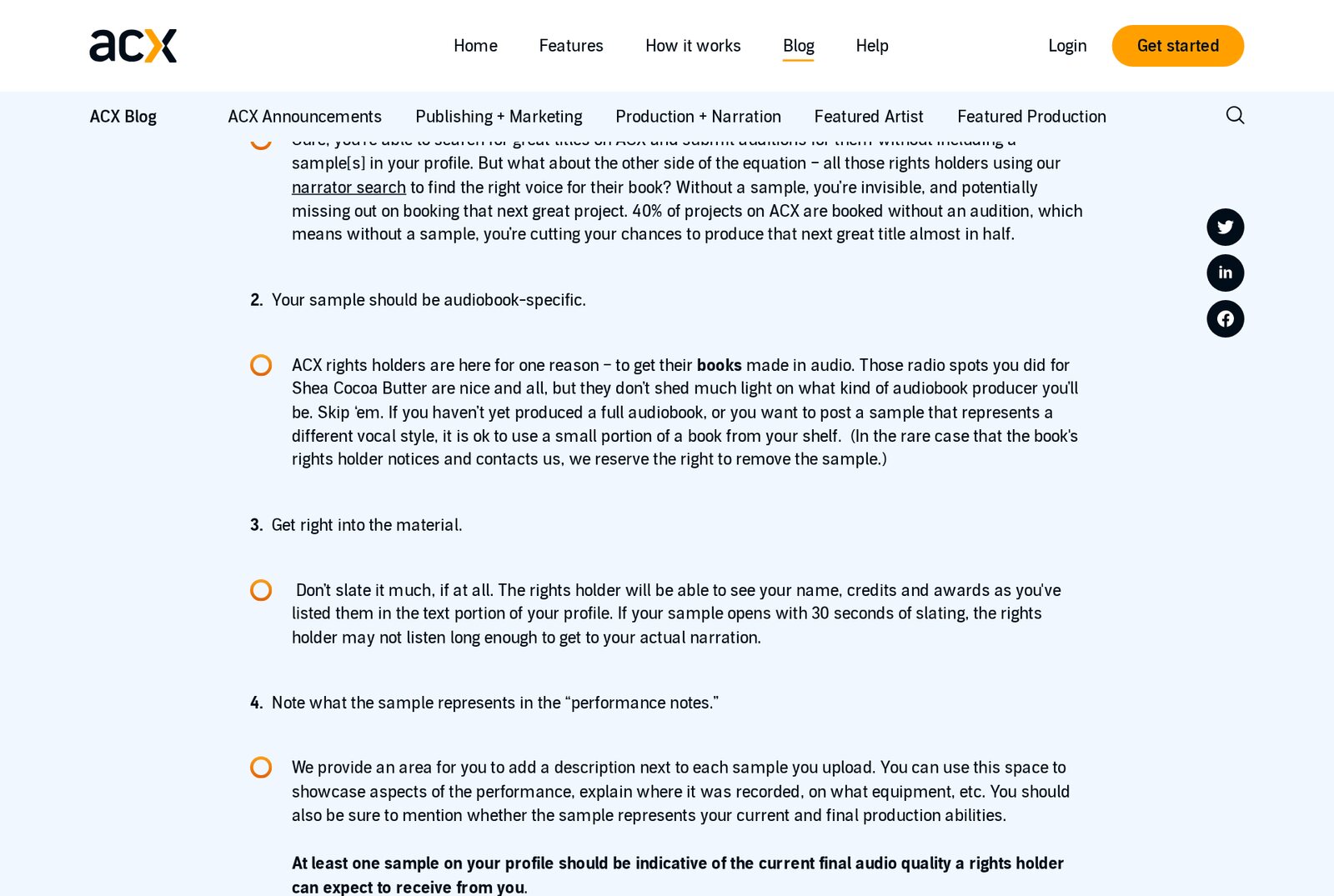
ACX's advice on narrator samples, on the ACX blog. Screenshot taken 19 November 2026. Image: ACX
Home-made or produced?
For commercial and character reels, Baker is firm that a demo “should sound professionally produced, not home made or amateur,” and he doesn’t recommend doing it alone. “I’d advise most anyone to not even attempt self-producing. You need someone to say ‘no’ to you who knows what they’re doing.”
He wants a producer who is picky about whom they work with, not one who will “just take anyone’s money.” Listen to their past demos first, and know what the fee covers; in his own example, a producer may include one re-record session, “while more tinkering may cost me extra.” And he ends with the warning that circles back to readiness: “If you’re not ready, don’t pay hundreds of dollars (or more!) to an engineer/producer for a worthless, non-competitive demo!”

Dee Bradley Baker, in one of the promotional photos on his own website. Image: Dee Bradley Baker
Two of his smaller rules save a lot of grief later. Every voice of your own gender on the demo should be yours, so nobody books you for something you can’t do. And “Only include what you can easily replicate and sustain in a real session (a few hours) without hurting yourself.”
Before you book the session
The order is simple. Train until your reads hold up next to working actors’ demos. Choose one market and write short scenes that suit it. Cut to about a minute. Play rough versions to people who’ll tell you the truth, the way Mullins played his to his father. Then put the finished demo where buyers can find it in one click; Baker prefers a page on your own “yourname.com” site.
And if the honest answer today is “not ready yet”, that’s the most common answer there is. Mullins heard it for years. He kept going until it changed.
Sources: Dee Bradley Baker, “Your Demo” and “Example of Making an Animation Demo” on iwanttobeavoiceactor.com, including his replies to readers there; Jeremiah Mullins in “The Apogee Guide To Voiceover Recording, Part Two” (KVR Audio, 21 Dec 2021); Crispin Freeman, Voice Acting Mastery episode 28; ACX, “Everything You Always Wanted to Know About Samples (But Were Afraid to Ask)”; VO Buzz Weekly on YouTube. Image of Dee Bradley Baker: Dee Bradley Baker.
Lee este artículo en español: Diez segundos por escena: cómo arma un actor de voz principiante un primer demo que valga la pena enviar
Know something about this story, or spotted an error? Tell the newsroom.