
Spain’s Dubbing Actors Take On Amazon’s Lip-Sync Tool. The Fight Is Over the Contract
Amazon’s new lip-sync technology went live on Maxton Hall on September 9. Within ten days, Spain’s largest association of dubbing actors had publicly accused the company of failing to protect the people whose voices it depends on. The two stories are connected, and the connection is the part that matters to anyone who works in dubbing.
What Amazon actually launched
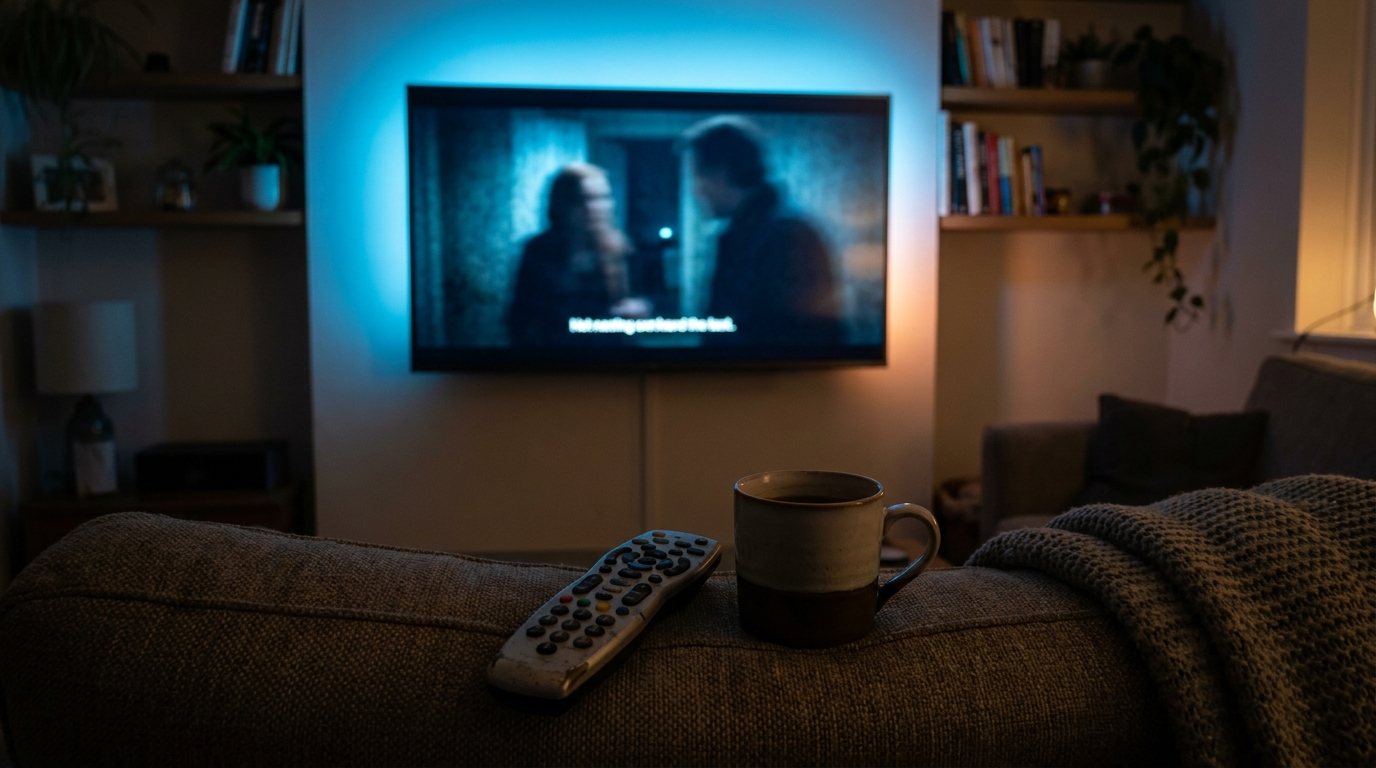
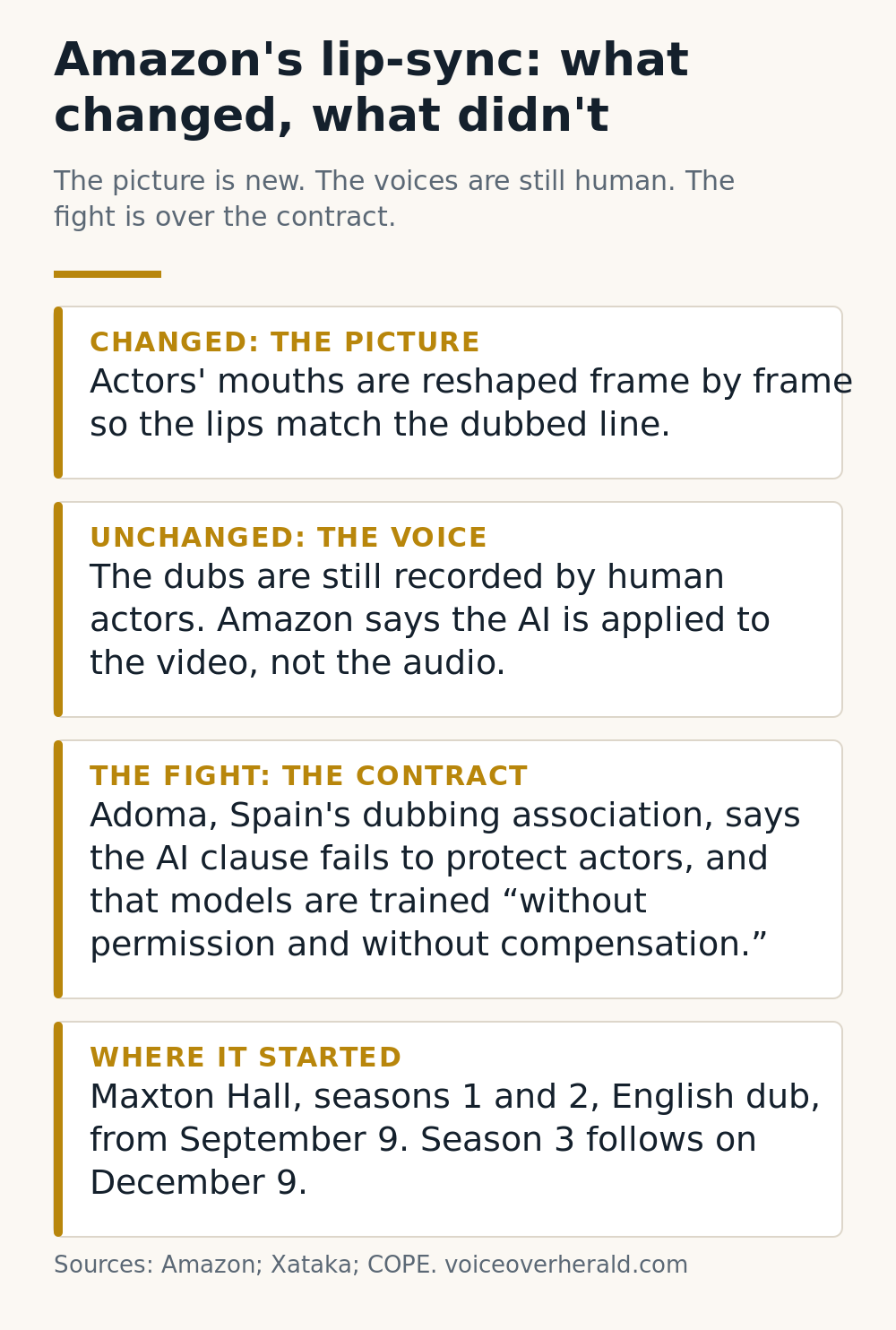
Prime Video’s new feature reshapes an actor’s mouth on screen, frame by frame, so the lips match a dubbed line rather than the original. It launched globally on the English dubs of the first two seasons of Maxton Hall, the German-language series that Amazon says is its most-watched international original, and it will be built into the third and final season when that arrives on December 9. Amazon is careful on one point: the dubbed voices are still performed by human actors. The AI is applied to the picture, not to the audio.
 VoiceEditSuiteClean a session in ninety seconds, not three hours.
Raf Soltanovich, vice president of technology at Prime Video and Amazon MGM Studios, described it this way in the company’s announcement: “With lip-syncing, we’re creating a more seamless and immersive way for customers to enjoy global content. And for creators, we’re making it easier for their stories to reach an even broader and global audience, all done under creative oversight to ensure the integrity of their artistic vision is preserved.” Amazon says “AI and VFX technologies power the process behind the scenes, responsibly applied to deliver a better customer experience.”
We covered the launch itself when it happened. That piece is here. What’s new is the response from the people who record those dubs.
Adoma’s answer
Adoma is the professional association of dubbing actors in Spain, part of the wider PASAV grouping of voice performers. In a post on X reported by Xataka on September 18, the association accused Amazon of not protecting dubbing actors with an adequate AI clause in its contracts. Speaking to the same outlet, Adoma said companies are training AI models “capable of generating voices imitating them, without permission and without compensation.”
The lip-sync feature is the occasion, not the grievance. The grievance is what dubbing actors are being asked to sign. According to Xataka, the underlying dispute is that Amazon has asked actors to cede rights to their voices so they can be used to train AI, and unions and dubbing associations have refused, with the result that some titles are not being dubbed into some languages at all.
“A machine will never give you that”
A week earlier, on September 12, the Valencian station of Spain’s COPE network had interviewed Paco Gisbert, a dubbing actor and Adoma member, about what the technology is doing to his profession. Real voices, he said, “carry a contribution of performance that a little machine will never give you.” When he comes across synthetic dubbing, “I either stop watching that content or I switch to the original version.”
His sharpest line was about where the models came from: “most of the platforms that have used this artificial intelligence did it by stealing the data.”
The COPE report also laid out what Spanish dubbing actors have already done about it on their own. Their rights-assignment contracts now carry a mandatory clause that explicitly forbids using their recordings to train AI models. The report cited two cases that made the clause necessary: the cloned voice of Juan Antonio Bernal, and that of Constantino Romero, the voice of Darth Vader and Clint Eastwood for Spanish audiences, who died in 2013 and whose voice has been reproduced without anyone’s consent. And it noted a gap in the law: Spain’s recent Estatuto del Artista was meant to regulate AI protection for performers, but the relevant article was removed over ambiguous wording, so the contract clause is currently doing the work the statute doesn’t.
Why this is bigger than one series
Two things are true at once. Amazon’s lip-sync feature does not replace a single dubbing actor, and Amazon has said so plainly. And the contracts around that work are where the real fight is, because a voice that has been licensed for training can be reproduced for anything, forever, without another session. The lip-sync launch simply made the question impossible to ignore: if the picture can now be bent to fit any voice in any language, the only thing standing between a dubbing actor and a synthetic replacement is the paperwork.
Spain’s answer so far is a clause and a refusal. Mexico’s is a law: since May, cloning an artist’s voice there requires prior written consent and agreed payment, and dubbing into national languages must be performed by human actors. We look at how that’s going, and who is already dubbing with AI anyway, here. The United States settled the video game version of this argument in 2025, when SAG-AFTRA’s interactive agreement, ratified after an eleven-month strike, tied AI replicas to consent and disclosure.
For anyone recording dubs anywhere, the practical lesson from Spain is the boring one. Read the clause. If there isn’t one, ask why. If your association has a standard clause, use it. The technology will keep improving; the contract is the part you control.
Sources: Amazon (9 September 2026); COPE (Albert Domínguez, 12 September 2026); Xataka (Alejandro Alcolea, 18 September 2026). Spanish quotes translated by the Herald.
Lee este artículo en español: Los actores de doblaje de España enfrentan la sincronización labial de Amazon. La pelea es por el contrato