

The Emmys Gave Both Voice Awards to Movie Stars Again. What That Means for Working Voice Actors
The Emmys have two awards for the voice alone. This month both of them went to movie stars. Julie Andrews, 90, won Outstanding Character Voice-Over Performance for a second year running as Lady Whistledown in Netflix’s Bridgerton, and Octavia Spencer won Outstanding Narrator for Lost Women of Alaska: The Missing. Neither was in the room. Andrews’ statuette was collected on her behalf by Eric Bauza, the working voice actor who is the current Bugs Bunny, Daffy Duck and Marvin the Martian, which is about as neat a picture of the state of the voice categories as anyone could have staged.
None of this is a complaint about the winners. Andrews’ Whistledown is a real performance and Spencer is a serious narrator. But the Creative Arts Emmys on September 5 and 6, and the main ceremony that followed on September 14, closed out a season that tells working voice actors something specific about how television’s biggest award sees their craft, who it rewards, and where the recognition for the people who do this every day actually lives. That is worth reading closely, because awards shape casting, and casting shapes rates.
What was decided
The Television Academy handed out the voice awards at the Creative Arts ceremonies at the Peacock Theater in Los Angeles over the weekend of September 5 and 6, a week before Mariska Hargitay hosted the 78th Primetime Emmys on September 14.
Outstanding Character Voice-Over Performance went to Julie Andrews for Bridgerton: The Waltz. The nominees she beat were Pamela Adlon as Bobby Hill in King of the Hill, Hank Azaria as Gary Chalmers in The Simpsons, Trey Parker as Satan in South Park, Matt Vogel as Kermit the Frog in The Muppet Show, and Steven Yeun as Mark Grayson in Invincible. It was Andrews’ second consecutive win in the category and her fifth nomination for the role, after nominations in 2021, 2022 and 2023. At 90 she is, as Yahoo Entertainment put it the next morning, “the oldest actress to win a Primetime Emmy, besting her own record from last year’s awards.”
Outstanding Narrator went to Octavia Spencer for Lost Women of Alaska: The Missing on Investigation Discovery. The other nominees were David Attenborough, twice, for A Gorilla Story and Ocean with David Attenborough, Jodie Foster for Breakdown: 1975, and Werner Herzog for Ghost Elephants.
Outstanding Animated Program went to South Park for “Sermon on the ‘Mount,” over Bob’s Burgers, Rick and Morty, The Simpsons, Smiling Friends and Star Wars: Visions.
Read the two voice categories together and a pattern is hard to miss. Of the eleven people nominated across them, the ones who make their living primarily in a voice booth were Azaria, Adlon and, in his own way, Vogel, who performs Kermit with his hands as well as his voice. The winners were two Academy Award winners with more than a century of screen work between them.
A category that changed its mind
The character voice award is not old. Until 2014 the Emmys had a single Outstanding Voice-Over Performance award. In 2014 it was split in two, Outstanding Narrator and Outstanding Character Voice-Over Performance, an acknowledgement that reading a documentary and playing a cartoon character are different jobs.
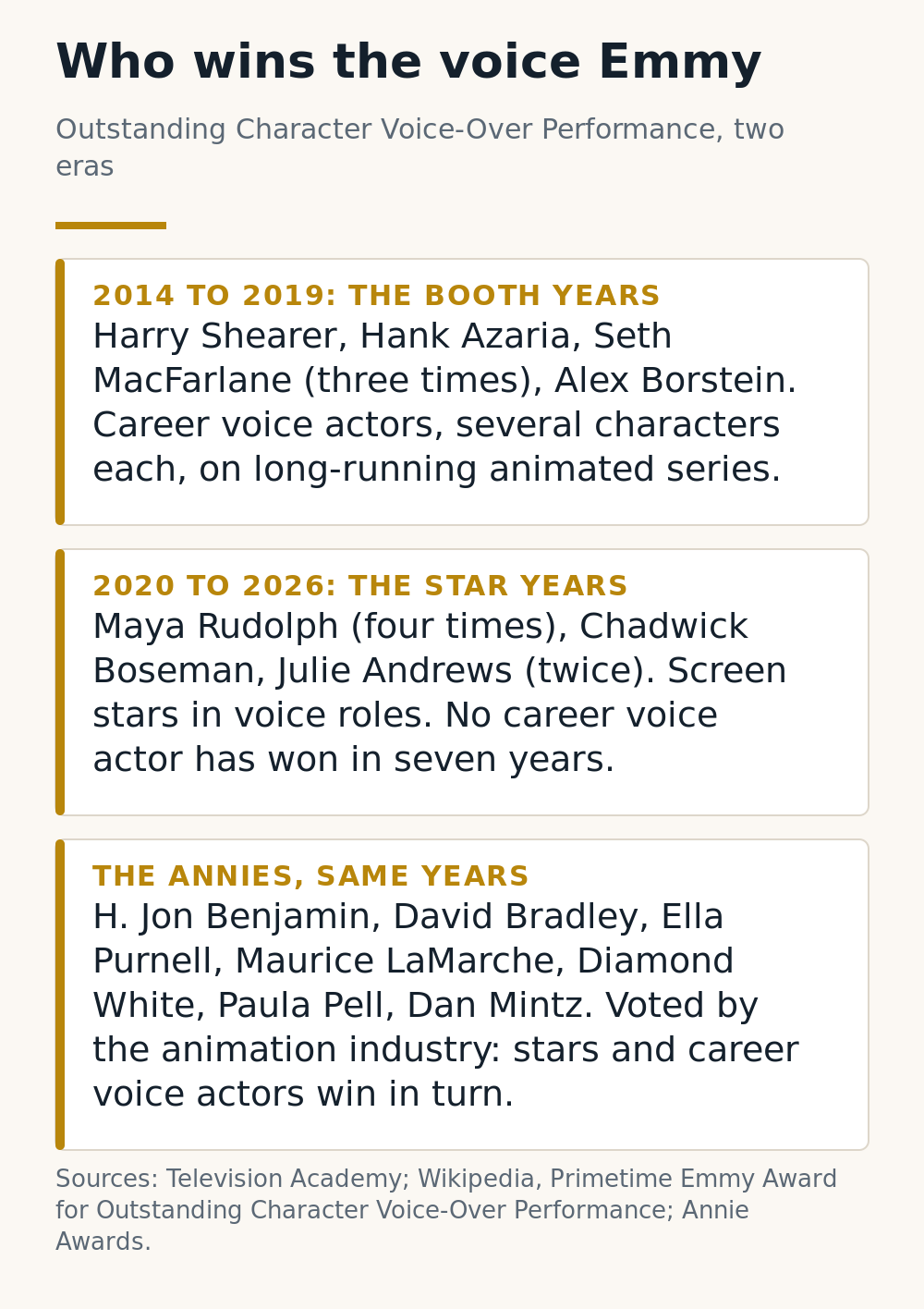
For its first six years the character award behaved like an award for voice actors. Harry Shearer won it in 2014 for three Simpsons characters at once. Hank Azaria took it in 2015 for Moe Szyslak. Seth MacFarlane won in 2016, 2017 and 2019 for the Griffins, and Alex Borstein in 2018 for Lois. These are people whose defining work is done at a microphone, on long-running animated series, playing several parts each.
Then the category changed its mind. From 2020 the winners were Maya Rudolph for Big Mouth, four times, Chadwick Boseman, posthumously, for What If…? in 2022, and Julie Andrews in 2025 and 2026. Rudolph is a gifted voice performer and her Hormone Monstress is a genuine creation, but she came to the category as a Saturday Night Live and film star; Boseman and Andrews were screen icons whose voice roles were, in the arithmetic of their careers, side projects. Seven consecutive years, no winner whose primary trade is voice acting.
The narrator award never went through a working-voice-actor phase at all. Its winners since 2014 are Jeremy Irons, Peter Coyote, Keith David, Meryl Streep, David Attenborough three years running, Sterling K. Brown, Barack Obama three times, Angela Bassett, Obama again, and now Octavia Spencer. Keith David and Peter Coyote are the closest thing on that list to narrators by trade. The rest are film actors, a naturalist and a former president. The narration industry, the thousands of people who read the documentaries, the audiobooks, the museum guides and the training films that never get a screener sent to an Academy member, has never had one of its own win.
Why voters vote this way
The obvious answer is name recognition, and it is not wrong. The Television Academy’s members are working television professionals across every branch. Most of them do not follow voice casting. Handed a ballot with Julie Andrews on it, a voter who has not heard the other five performances has a very easy choice, and the honest truth is that many voters have not heard the other five performances.
The less obvious answer is that the category’s rules make no distinction between a screen star doing a voice role and a voice actor doing a voice role, and nor should they. The award is for the performance. Andrea Romano, the voice director behind Batman: The Animated Series, Animaniacs and Avatar: The Last Airbender, put the working voice actor’s view of celebrity casting as plainly as anyone ever has, in a 2024 interview with Backstage:
“There is a huge demand by producers and studios to use celebrities, [but] I always was of the mind that the best actor for the role should be the one who is cast. And I will fight for the rank-and-file voice actor over the celebrity every time, unless the celebrity is truly qualified to do it.”
“Unless the celebrity is truly qualified to do it” is the clause that matters, and it cuts both ways. It is the argument against stunt casting, and it is also the reason nobody in the profession begrudges Julie Andrews an Emmy. She is qualified. The question the last seven years raise is not whether the stars deserved to win. It is whether the people who do this for a living are getting a fair hearing when a star is on the ballot, and the record says they are not.
The case for Whistledown
It is worth being fair to the performance, because it is easy to file Andrews’ win under celebrity and miss what it actually shows about voice work.
Lady Whistledown is a character who does not appear on screen as Andrews. She is a narrator with an agenda, a gossip columnist whose voice frames every episode, and the writing asks the performer to be arch, warm, cruel and delighted, sometimes in one sentence. Andrews described the character to Parade, at the start of the show, as “a tartar, and a bit of a naughty woman.” As Whistledown, she said, “I can make or break anybody, it seems, if I wish.” That is a character brief, not a narration brief, and it is why the performance sits in the character category rather than the narrator one.
She also does the work the way working voice actors do it: alone, in a booth, away from the production. She told the Today show in 2022 that she had never met the cast:
“Shonda Rhimes and the whole gang, they’re terrific. It’s a joy and I’m thrilled that they asked me. But I’ve never met the company in person. Of course, I see them on the show sometimes, but I do all my own recording far, far away from them.”
And there is the age. Andrews lost her singing voice to throat surgery in the late 1990s, and told AARP The Magazine in 2019 that afterwards “it felt like I’d lost my identity.” At 90 she is still working, still winning, because a voice role asks for judgment, timing and character rather than the instrument she once had. For every voice actor wondering how long a career in this business can last, that is the most encouraging fact of the whole awards season. The Academy did not give the award to a famous name. It gave it to an actress who found, late, that the microphone was the one stage that would always have her.
Where voice actors do win
The people who make their living in the booth are not without honours. They are just in a different room.
The Children’s and Family Emmys, launched in 2022, have an Outstanding Voice Performer award that has behaved from the start like a voice actor’s award. Eric Bauza won the first one for Looney Tunes Cartoons, as Bugs, Daffy, Tweety and Marvin the Martian. Jack Black took the second for Kung Fu Panda: The Dragon Knight. Bauza won again in 2024 for Teen Titans Go! In 2025 the category split in two: John Lithgow won for a single role in Spellbound, and David Errigo Jr. won the multiple-roles award for Hampton J. Pig and Plucky Duck in Tiny Toons Looniversity. Errigo is exactly the kind of performer the Primetime category used to reward and no longer does: several characters, one series, a career built on range. He is also the kind of name most people outside the business have never heard, which is the point.
 VoiceEditSuiteRaw take in. Clean take out.
The Primetime category itself still nominates working voice actors, it just stopped giving them the trophy. Hank Azaria has been nominated twelve times, more than anyone in the category’s history, and his four wins are tied with Dan Castellaneta, Seth MacFarlane and Maya Rudolph at the top of the table. Pamela Adlon, nominated this year for taking Bobby Hill into the revived King of the Hill, is a two-decade veteran of the booth. Matt Vogel’s nomination for Kermit is, quietly, one of the more remarkable on the list: he inherited the most famous frog in the world from Steve Whitmire, who inherited it from Jim Henson, and a nomination for the third performer of a character is an acknowledgement that the performance, not the original creator, is what the audience hears.
The animation industry votes differently
There is a control group for all of this, and it is the Annie Awards. The Annies are given by ASIFA-Hollywood, the animation industry’s own society, and its voice acting categories are decided by people who spend their working lives in and around recording booths. The last seven winners of the television voice acting Annie are H. Jon Benjamin as Bob Belcher, David Bradley as Merlin in Wizards, Ella Purnell as Jinx in Arcane, Maurice LaMarche as Mr. Big in Zootopia+, Diamond White as Moon Girl, Paula Pell for Dream Productions, and, this year, Dan Mintz as Tina Belcher in Bob’s Burgers.
That is a list with famous names on it, and with names only the animation world knows, and the balance is the point. Benjamin, LaMarche and Mintz are career voice performers; Purnell and Bradley are screen actors whose voice work the industry judged on its merits. When the voters are the people who hear voice performances all day, working voice actors win about as often as stars do. When the voters are the wider television industry, they stop winning altogether. Same performances, same years, different rooms. If there were ever a clean demonstration that the Primetime results are about the electorate rather than the work, the two lists side by side are it.
Maurice LaMarche is the neatest illustration. He won the Primetime voice award twice, in 2011 and 2012, for Futurama, in the years before the category split, and he is still winning Annies. His work did not change. The Primetime ballot did.
What this does to the business
Awards are not the point of the job, but they are not nothing either, because they feed a loop that working voice actors feel in their rates.
A celebrity Emmy win in a voice category confirms to producers that celebrity voices are prestige voices. That belief, which Romano described as “a huge demand by producers and studios to use celebrities,” pulls the best-paid roles in animation and narration toward screen actors and away from the people who trained for them. It was visible this month in the other big voice story of September, Greta Gerwig’s casting of Meryl Streep as Aslan in her Narnia film, a choice Gerwig defended on craft grounds and one that, on craft grounds, is hard to argue with. But every Streep or Andrews at the top of the call sheet is a role that did not go to a voice actor, and every Emmy that follows makes the next such casting easier to sign off.
The loop runs like this. A studio casting an animated series or a prestige documentary has a choice between a voice actor who will do the job superbly for scale and a screen star who will do it well for many times scale and bring a press cycle with them. The star’s fee is justified internally as marketing. When the star is then nominated and wins, the marketing case is proven, and the next budget starts from the assumption that the lead voice is a star. Scale roles become supporting roles. Supporting roles become the place where working voice actors live. Over a decade, that moves the ceiling of an entire profession, and it is why an award most voice actors will never be nominated for still matters to their invoices.
There is a second, subtler effect. When the award for character voice performance goes seven years without recognising a career voice actor, it tells a generation of animation and games performers that the ceiling of the profession’s recognition is a nomination. That is a message about status, and status is negotiated into every contract. It is no accident that the fights of the last two years, the eleven-month video game strike that ended in July 2025 with consent and disclosure rules for AI replicas, and the new agreements for dubbing actors in Mexico and Spain, have all been fought by the rank and file Romano was talking about. They are the people with the most to lose from being treated as interchangeable, and the awards, without meaning to, have been reinforcing the idea.
What would change it
None of the fixes are radical, and the Academy has already made one of them.
The first is the one the Children’s and Family Emmys stumbled into in 2025: separating single-role performances from multiple-role performances. A voice actor playing five characters in one episode is doing something a screen star reading a narrator’s script is not, and putting them on the same ballot invites voters to pick the name they know. Two categories would make the comparison honest.
The second is screeners. Voice performances are judged from the episode submitted, and the episode is usually watched, if at all, with the picture on. A voice category could reasonably ask voters to listen to a submitted performance reel. Radio drama awards have always worked this way. It would take a good deal of the name recognition out of the room.
The third is a matter of where the streaming era has moved the work. Steven Yeun’s nomination for Invincible is a screen star’s nomination on paper, but it is for five seasons of a lead role carried entirely by voice, in a long-form animated drama that did not exist as a genre when the category was created. Adult animation on streaming is now where much of the best voice acting on television happens, and its casts mix stars and career voice actors in every episode. A category built around a single submitted episode of a sitcom does not see that work clearly. Recognising a season, or a body of work, would.
The fourth is up to the studios rather than the Academy: submit working voice actors. The Simpsons and King of the Hill do. Many animated series submit their most famous guest star instead, because a nomination for a star is worth more in marketing. The category can only reward the people who are on the ballot.
The picture at the end of the night
Come back to the moment on September 6, because it holds all of this at once. Eric Bauza, three Emmys of his own, the current voice of characters that have been on screen for ninety years, walked up to accept a Primetime Emmy for Julie Andrews, who was at home and had never met her own cast. A working voice actor collecting a movie star’s award for voice acting, on a stage neither of them would have been on a decade ago, in a category that did not exist before 2014.
The profession is more visible than it has ever been. The awards are still catching up to who is in it. Both things were true this month, and for the people who read Voice Over Herald, the second is the one worth watching.
Sources: Television Academy, 2026 nominees and winners, Outstanding Character Voice-Over Performance; Wikipedia, 78th Primetime Creative Arts Emmy Awards, 78th Primetime Emmy Awards, Primetime Emmy Award for Outstanding Character Voice-Over Performance, Primetime Emmy Award for Outstanding Narrator, Children’s and Family Emmy Award for Outstanding Voice Performer; Yahoo Entertainment (September 7, 2026); Time Out, quoting the Today show (June 27, 2022); Parade, as quoted by Classic FM; Backstage, Andrea Romano interview (Rafael Motamayor, July 10, 2024).
Lee este artículo en español: Los Emmy volvieron a darles los dos premios de voz a estrellas de cine. Qué significa para los actores de voz que trabajan