
Atlus Recast a Late Actor’s Role With a Living One. In 2026, That Is a Decision
On September 20, Atlus confirmed something that would have passed without comment ten years ago. In Persona 4 Revival, the ground-up remake of its 2008 role-playing game, the character Ryōtarō Dōjima will be voiced in Japanese by Ryōtarō Okiayu. The original actor, Unshō Ishizuka, died in 2018. A dead man’s role has been recast with a living one.
That sentence used to describe the only option. It now describes a choice. Since Ishizuka died, the technology to rebuild a voice from its recordings has gone from a research demo to a product any studio can license, and the industry has already used it on some of the most famous voices in the world. So when a company with the archive, the money and the commercial motive to clone a beloved performer decides instead to hire another actor, the decision says something. This week’s story is not really about a video game. It is about the rule the voice business is writing, one casting at a time, for what happens to a voice when the person who owned it is gone.
What Atlus announced
The news came through Anime News Network on September 20, in a report by Joanna Cayanan. Persona 4 Revival arrives on PlayStation 5, Xbox Series X|S, PC and Game Pass on February 18, 2027, and on Nintendo Switch 2 on May 20, 2027, with MAPPA producing the animated cutscenes. Dōjima, the detective who takes in the game’s protagonist, was voiced in the original by Ishizuka. Okiayu, a veteran best known to Western audiences as Byakuya Kuchiki in Bleach, takes over.
Three days earlier the same outlet had reported the Naoto Shirogane trailer, which confirmed that Romi Park returns as Naoto in Japanese and that Amber Lee Connors voices her in English. And back on June 16, in a report by Anita Tai, ANN had covered the bigger structural news: the English cast is entirely new. Nazeeh Tarsha replaces Johnny Yong Bosch as the protagonist. Paul Castro Jr. replaces Yuri Lowenthal as Yosuke. Anne Yatco takes Chie from Erin Fitzgerald and Tracey Rooney. Brianna Knickerbocker takes Yukiko from Amanda Winn Lee. Ari Thrash takes Marie from Eden Riegel.
Put those two announcements together and you have, in one game, the two ways the industry replaces a voice. In Japan, the original cast returns and only the actor who died is replaced. In English, everyone is replaced, living or not. Neither decision involved a synthetic voice. Both are worth a closer look.
Who Unshō Ishizuka was
Ishizuka was born on May 16, 1951 and died on August 13, 2018, at 67, of what his agency described as a colon infection caused by an esophageal tumour. To English-speaking audiences who watch anime in Japanese he was one of the most recognisable voices of the last thirty years: Jet Black in Cowboy Bebop, Mr. Satan in Dragon Ball, Zabuza in Naruto, Van Hohenheim in Fullmetal Alchemist: Brotherhood, Bunta Fujiwara in Initial D, and, for twenty-one years, Professor Oak and the narrator of Pokémon.
Professor Oak is the precedent. Pokémon did not stop when Ishizuka died, and it did not synthesise him. Kenyu Horiuchi took over the role in 2018 and has voiced Oak since. The English side of the same franchise tells the same story from a different angle: Stuart Zagnit voiced Oak from 1998 to 2006, James Carter Cathcart from 2006 until 2023, when throat cancer forced him to retire, and other actors have played him in spin-offs. A character can outlive several voices. That has been true since radio, and every audience that has grown up with a long-running show knows it in their bones.
What is new is that the studios now have another option, and the argument is about when, if ever, they should take it.
The other option
The clearest example of a studio taking it is Darth Vader. In 2022, James Earl Jones’ voice was recreated for the Disney+ series Obi-Wan Kenobi using software from the Ukrainian company Respeecher, trained on his archive. Jones was alive, and he agreed. As his Wikipedia biography records it, “during production, Jones signed a deal with Lucasfilm authorizing archival recordings of his voice to be used in the future to artificially generate the voice of Darth Vader,” and “in September 2022, Jones announced that he would retire from the role of voicing Darth Vader with future voice roles for Vader being created by that means.” He died on September 9, 2024, at 93. Vader will not be recast. He was, in effect, licensed.
The other clear example runs the opposite way. Constantino Romero was the Spanish voice of Darth Vader, and of Clint Eastwood, for a generation of Spanish audiences. He died in 2013. Earlier this month, in the middle of Spain’s dubbing actors’ fight with Amazon over AI clauses, the COPE radio network reported that Romero’s voice has been reproduced by synthetic means without anyone’s consent, and cited it as one of the two cases that forced Spanish dubbing contracts to carry a clause forbidding the use of recordings to train AI. Same technology, same kind of legendary voice, no permission.
Those two cases are the poles. Between them sits everything the industry now has to decide, and the Atlus announcement is one data point in that decision: a company that could have cloned chose to cast.
Darth Vader
James Earl Jones signed a deal with Lucasfilm in 2022 letting archival recordings generate Vader’s voice, then retired from the role. He died in 2024. Vader will not be recast.
Constantino Romero
The Spanish voice of Vader and of Clint Eastwood died in 2013. This month COPE reported his voice reproduced by synthetic means with nobody’s consent, one of the two cases behind Spain’s contract clause banning AI training.
Where consent gets complicated
Between the two poles there is a case every documentary maker and every estate lawyer now knows, and it is worth keeping in mind when a studio says it has permission. In 2021 the director Morgan Neville released Roadrunner, his film about Anthony Bourdain, who had died three years earlier. Some of Bourdain’s words in the film, an email he wrote but never read aloud, were spoken by a synthetic recreation of his voice. Neville said afterwards, “There were a few sentences that Tony wrote that he never spoke aloud. With the blessing of his estate and literary agent we used AI technology.”
The blessing turned out to be less settled than that. Ottavia Busia, Bourdain’s former wife and the executor of his estate, wrote on Twitter, “I certainly was NOT the one who said Tony would have been cool with that,” and later told The New Yorker that the idea had been mentioned to her but that she “didn’t realize that it had been used.” The film was not withdrawn. The argument about it never really ended, and it is the reason the phrase “with the consent of the estate” now gets a second look from everyone in the business. Consent from whom, for what, said how, and did the person giving it understand what they were agreeing to? A living actor can answer those questions in a sentence. An estate answers them in a dispute.
That is the backdrop to every recasting decision in 2026. A studio that clones a dead performer takes on the Bourdain question and has to answer it in public. A studio that recasts takes on nothing but the ordinary risk that fans preferred the old voice, which is a risk the industry has managed for eighty years.
Why a studio might clone, and why this one did not
Be honest about the incentive, because it is real. Ishizuka recorded Dōjima across the original game, its expanded edition and the spin-offs. There is a large, clean, character-specific archive of his voice in Atlus’ possession. A synthetic Dōjima built from it would sound, to most players, like the Dōjima they remember. It would cost less than an actor of Okiayu’s standing. It would need no scheduling, no direction sessions, and no pickups.
Against that, four things.
The first is the law in the countries that matter to Atlus. In the United States, SAG-AFTRA’s Interactive Media Agreement, ratified in July 2025 after an eleven-month strike, requires consent and disclosure for any digital replica of a performer, and the NO FAKES Act, which cleared the Senate Judiciary Committee unanimously on June 18, would create, in the words of the law firm Holland & Knight’s summary, “a licensable property right in their own voice and visual likeness” for every person, a right that, according to reports on the bill, would survive the person and pass to their estate. In Mexico, since May, cloning a voice requires a prior written agreement. In the European Union, since August 2, synthetic audio must be marked as such. A synthetic Dōjima would need the consent of Ishizuka’s estate in every market with such rules, disclosure in Europe, and a legal review in each territory the game ships to. A recast needs a contract with one living actor.
The second is the audience. Japanese fans know their voice actors by name in a way Western audiences are only beginning to. Casting Ryōtarō Okiayu, a performer with a thirty-year career of his own, is news that fans receive as respect for the role. A clone of a dead colleague, in a market where one of its best-known voice actors, Kenjirō Tsuda, has been fighting an unauthorised AI imitation of his voice in the Tokyo courts since last November, would be received as something else.
The third is craft, and it is the one voice actors should hold onto. A remake is not a re-release. MAPPA is producing new cutscenes; the script has been revised; the game has new scenes and a new pace. Dōjima has lines Ishizuka never recorded, in contexts he never played. A synthetic voice can generate those lines. It cannot decide how to play them. Okiayu can, and Atlus will get a performance in the recording booth rather than a rendering afterwards.
 VoiceEditSuitePro audio tools built for working voice actors.Auto Clean UpACX Audiobook PrepAudition Director
The fourth is the simplest: the rest of the Japanese cast came back. Romi Park is Naoto again, as she has been since 2008. Recasting one role with a living actor keeps Dōjima inside the same room as everyone else, taking direction from the same people, reacting to the same reads. A clone would have been the one character in the game that could not listen.

Two philosophies of recasting
The English side of Persona 4 Revival is where the more uncomfortable conversation lives, because none of those actors died. Johnny Yong Bosch, Yuri Lowenthal, Erin Fitzgerald, Amanda Winn Lee and Eden Riegel are working performers with long careers, and their roles were recast wholesale. ANN’s June report carries no statement from Atlus or Sega explaining why.
There are ordinary reasons a remake recasts. Contracts from 2008 do not cover a 2027 game. Casting directors change. A new localisation team wants its own ensemble. Studios sometimes want a break from a dub that fans have argued about for fifteen years. None of that is sinister, and every one of the new actors is a working professional who deserves the job on its merits.
But the contrast with the Japanese cast is instructive for anyone who makes a living in English voice work. In Japan, a role tends to belong to its actor until the actor cannot play it. Continuity is the default and a recast is the exception, which is why a change like Dōjima’s is announced, reported and discussed. In the English-language market, a role belongs to the production, and continuity is a courtesy the production may or may not extend. Patricia Summersett has voiced Zelda for a decade, which is a long run by Western standards and unremarkable by Japanese ones. Speaking to Nintendo Everything this year about keeping a famous character over many years, she described the job as bringing something the archive cannot hold: “If you’re doing it right, you bring your present self to them.”
That line is the argument for recasting with a person, made by a person who has held onto a role. A character in a long-running series is not a fixed recording. It is a relationship between an actor and a role that changes as both age, and the audience hears the change whether or not it can name it. What the English recast of Persona 4 costs is that relationship, fifteen years of it, for reasons nobody has stated. What a synthetic Dōjima would have cost is the possibility of ever having it again.
The question is arriving faster than the answers
This is not an abstract discussion in September 2026. On September 9, Mike McFarland died at 56 after a year with brain cancer. He was Master Roshi and Yajirobe in Dragon Ball, Buggy in One Piece, Jean in Attack on Titan, and a director of hundreds of dubs. All of those series are still in production. Every one of those roles will need a decision, and the studios that own them have McFarland’s archive too.
The temptation is obvious and the industry has already shown it can resist it. Anime dubbing has recast around deaths and retirements for decades; every long-running series has done it. The difference in 2026 is that a studio now has to say no to something rather than simply having nothing to say yes to, and that the saying no is not required by law anywhere in the United States yet. It is required by the SAG-AFTRA agreements for covered productions, by Mexico’s copyright law, by the contracts Spanish dubbing actors have written for themselves, and, if it passes, by the NO FAKES Act. For a non-union dub, it is required by nothing but the studio’s judgment and the audience’s tolerance.
Which is why the Atlus decision matters beyond one game. Atlus did not have to recast Dōjima with a human. It chose to, in the one market where the audience would have noticed either way. Every studio facing the same choice this year now has a very public example of a major publisher, with a clean archive and a global release, treating a dead actor’s voice as something to be succeeded rather than reproduced.
- Atlus recast, it did not clone. Ryōtarō Okiayu takes over the late Unshō Ishizuka’s Dōjima in Persona 4 Revival, out February 18, 2027. No synthetic voice.
- Two philosophies in one game. The Japanese cast returns with one replacement; the English cast is entirely new, living actors included, with no explanation given.
- The technology is already in use. Darth Vader’s voice is generated from James Earl Jones’s archive with his consent. Constantino Romero’s was reproduced without anyone’s.
- Consent is becoming law. SAG-AFTRA’s game contract, Mexico’s copyright reform, Spain’s dubbing contracts and the EU’s disclosure rule all require it; the NO FAKES Act would extend it to estates.
- Your archive follows your contract. Non-union actors need a written AI clause in their own terms, and anyone with a recognisable body of work needs a line about their voice in their will.
What it means if you do this for a living
Four practical things follow, none of them comfortable.
Your archive is an asset, and it is not automatically yours. Every session you have ever recorded for a studio sits on that studio’s servers. What can be done with it after you retire, or after you die, is decided by the contract you signed when you recorded it, not by what feels right. The Spanish dubbing actors’ answer was a mandatory clause forbidding AI training. The American answer, under union contracts, is consent and disclosure. If you work non-union, your answer is whatever you write into your own terms, and if you have never written anything, the answer is currently “anything.” The fix is a paragraph, not a lawsuit: a line in your rate sheet and your session agreements that recordings are licensed for the named production only, may not be used to train, fine-tune or generate a synthetic voice, and that any digital replica requires a separate written agreement and a separate fee. Union members have this by contract. Everyone else has it only if they type it.
Estate rights are a real conversation, and it is one to have while you are alive. James Earl Jones decided, on the record, what would happen to Vader. Constantino Romero never got the chance. The NO FAKES Act would give estates a licensable right; Tennessee’s ELVIS Act already protects a voice against unauthorised synthetic use. A working voice actor with a body of recognisable work should have a line in their will about it, in the same way a novelist has a line about their copyrights.
A recast is a vote for the profession. Every time a studio hires a living actor to succeed a dead one, it reinforces the norm that roles pass between people. Every time an audience accepts that, it makes the norm stronger. The people who inherit these roles, Horiuchi as Oak, Okiayu as Dōjima, whoever plays Roshi next, are carrying more than a character.
The English-language market has the weaker norm, and that is on us. A business where living actors can be recast wholesale without explanation is a business where the case against replacing a dead actor with software is harder to make. The strongest argument voice actors have against synthetic succession is that the role is a relationship, not a recording. That argument is only as strong as the industry’s habit of honouring the relationship while the actor is alive.
A voice, succeeded
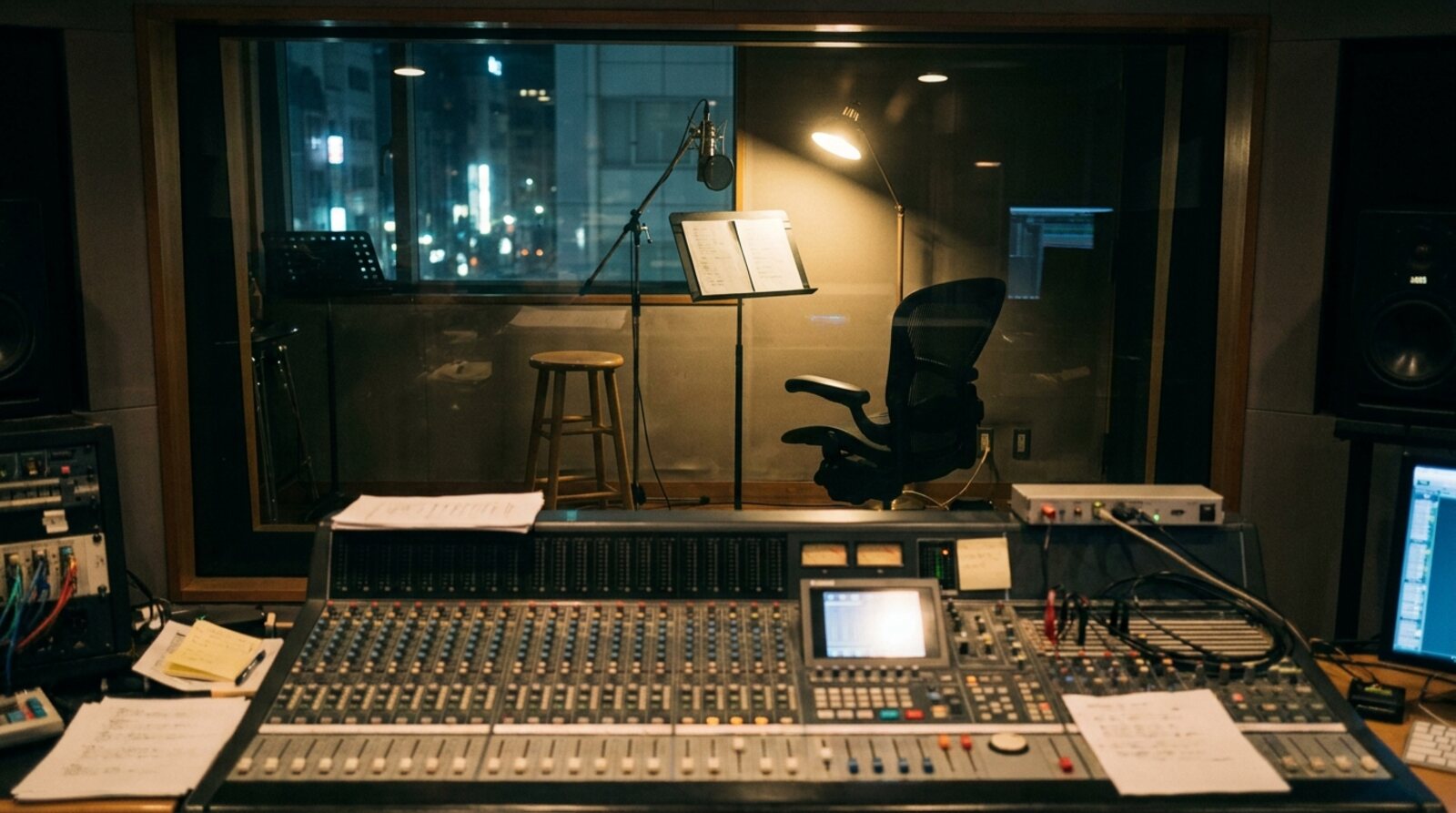
Ryōtarō Okiayu will record Dōjima in a booth in Tokyo sometime in the coming months, with a director on the other side of the glass and Romi Park’s Naoto in his headphones. He will find the character’s weariness and his warmth for himself, in his own instrument, and the players who loved Ishizuka’s version will hear the difference and, if the work is good, come to love his. That is how it has always been done. In 2026, it is also a decision, and this week a major studio made it the right way. Everyone facing the same choice, and there will be many, has been shown how.
Sources: Wikipedia, Roadrunner: A Film About Anthony Bourdain (quoting Morgan Neville, Ottavia Busia and The New Yorker); Anime News Network (Joanna Cayanan, September 20, 2026; September 17, 2026; Anita Tai, June 16, 2026; September 10, 2026); Wikipedia, Unshō Ishizuka, Professor Oak, James Earl Jones; COPE (Albert Domínguez, September 12, 2026), as reported by Voice Over Herald; Nintendo Everything, Patricia Summersett interview (March 14, 2026); SAG-AFTRA 2025 Interactive Media Agreement; Holland & Knight (June 22, 2026); Diario Oficial de la Federación (May 2026); Regulation (EU) 2024/1689, Article 50. Quotations from Spanish-language sources are translated by Voice Over Herald.
Lee este artículo en español: Atlus reasignó el papel de un actor fallecido a uno vivo. En 2026, eso es una decisión