
Ten Years as Zelda: Patricia Summersett on Keeping a Famous Voice Relaxed
The Legend of Zelda turned forty this year, and for a quarter of that time Princess Zelda has had one English voice. Patricia Summersett recorded her first sessions as the character in 2016 without being told who she was playing, and has voiced her through Breath of the Wild, Tears of the Kingdom and everything since. In two interviews this year, one with Nintendo Everything in March and one with Variety on September 11, she said more about the craft of the role than she usually gets to. For working voice actors, it’s a small masterclass in a particular problem: how to keep a famous voice alive for a decade without wearing it out.
Cast without knowing the part
The audition was blind. “The project was secret; I did not know what it was,” she told Variety, “and so, like a lot of video games, it was presented as an RPG fantasy-style game with code names and everything like that.” She landed, in her words to Nintendo Everything, “a role”, and only learned which one at the first session: “I showed up for the first recording session, signed an NDA, and was then informed that the role was Princess Zelda. The adrenaline rush was unreal.” To Variety she reached for a different comparison: “it was like having an adrenaline rush. Like drinking five Red Bulls or something. Skydiving. I knew it was powerful.”
She’s grateful for the blindness. “Looking back, I’m grateful I didn’t know what role I was auditioning for,” she said. Any actor who has walked into a booth knowing the weight of a character will understand why: the audition that won the part was a performance, not an audition for Zelda.
The voice has to stay relaxed
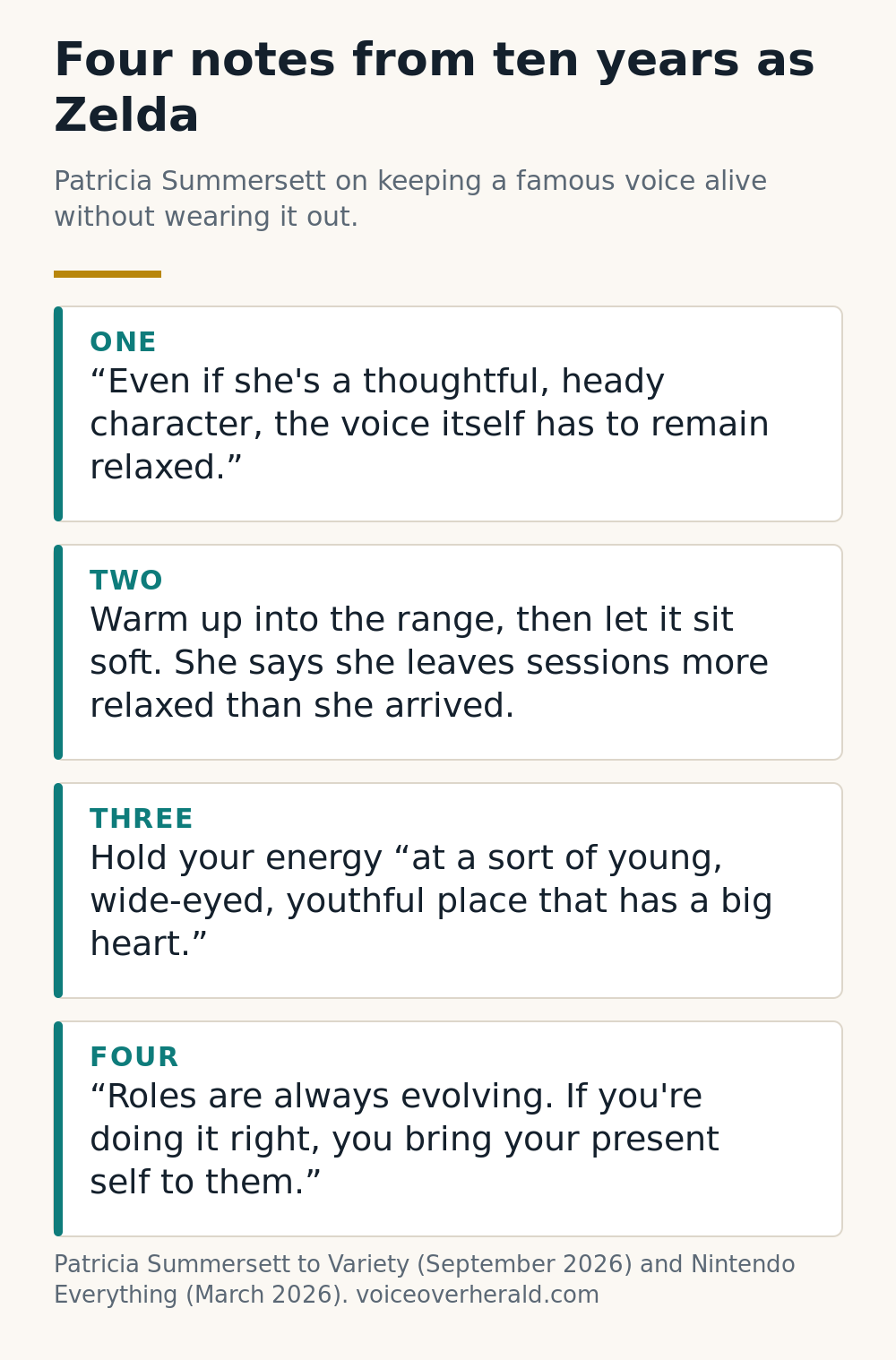
The most useful thing she said is about placement. Zelda is a thoughtful, articulate character, the kind that tempts an actor to tighten up and think out loud. Summersett does the opposite. “Yes, actually, it takes a little warming up for me to get into any range that it’s going to sit at,” she told Variety, “but I always feel a sense of deep relaxation after the recording sessions because it’s soft and you have to be kind of relaxed when you’re hitting that range.” Then the line worth pinning above the mic: “Even if she’s a thoughtful, heady character, the voice itself has to remain relaxed.”
She describes the feeling of the role as “holding your center of energy at a sort of young, wide-eyed, youthful place that has a big heart”, and calls it a pleasant feeling. That is a technical note dressed as a mood: the energy sits forward and light, the throat stays open, the thinking happens in the intention rather than the larynx. It’s why she can record for hours and come out more relaxed than she went in, and why the voice sounds the same in 2026 as it did in 2017.
Bringing your present self
Ten years is long enough for an actor to change, and Summersett doesn’t pretend otherwise. “Roles are always evolving,” she told Nintendo Everything. “If you’re doing it right, you bring your present self to them.” Of her most recent sessions, recording the Zelda Notes, she said: “I got to sit inside her inner thoughts for countless hours.”
 VoiceEditSuiteTrim it, clean it, deliver it. One pass.
She’s specific about what made the original sessions work. “Everyone in the room was deeply invested, meticulous, and kind, everything you hope for in a creative process,” she said of 2016, crediting her director: “Jamie Mortellaro was a wonderful director, and I’m immensely grateful for his support and guidance.” Meticulous and kind is a good description of the rooms that produce performances people still quote a decade later.
Living as a walking NDA
Two projects hang over the anniversary: the Ocarina of Time remake due in November, and the live-action Zelda film set for April 2027. Asked whether she is involved in either, Summersett gave the answer every game actor learns to give. On the remake: “I have no idea for ‘Ocarina of Time.’ I wouldn’t be able to speak to that.” On the film: “I couldn’t answer that one way or another. Of course, I’m a walking NDA, sort of on the nomad land of the world.”
That, too, is part of the job. Video game voice actors routinely cannot confirm work they’ve done, let alone work they might do, and the discipline of not knowing, not saying and not guessing in public is as much a professional skill as breath control.
What the fans give back
Asked what the anniversary means, she went to the audience rather than the résumé. “To hear what the stories mean to other people, to have people come up to me and play the ocarina, play ‘Zelda’s Lullaby,’ all over the world, you see the universal love of this story everywhere,” she told Variety. And the number she keeps coming back to: “I have been part of the franchise for essentially a quarter of it and that is something I never could have predicted in my life.”
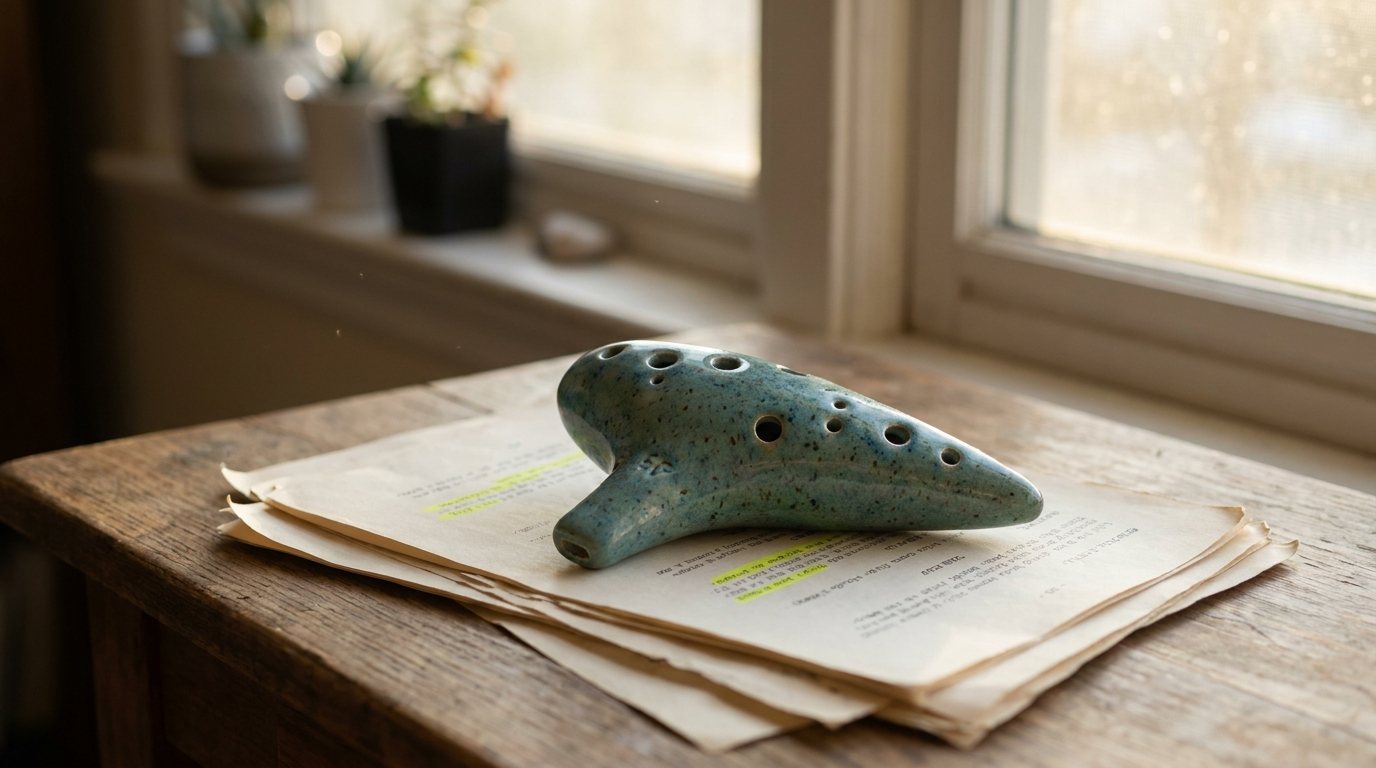
Her own favourites, for the record, are Ocarina of Time first and Twilight Princess second. Neither had a voiced Zelda. The one who eventually gave the princess a voice grew up with her silent.
Sources: Nintendo Everything (14 March 2026); Variety (11 September 2026).
Lee este artículo en español: Diez años como Zelda: Patricia Summersett y el arte de mantener relajada una voz famosa