




Opinion: “It’s a Budget Thing” Isn’t a Reason. It’s a Confession
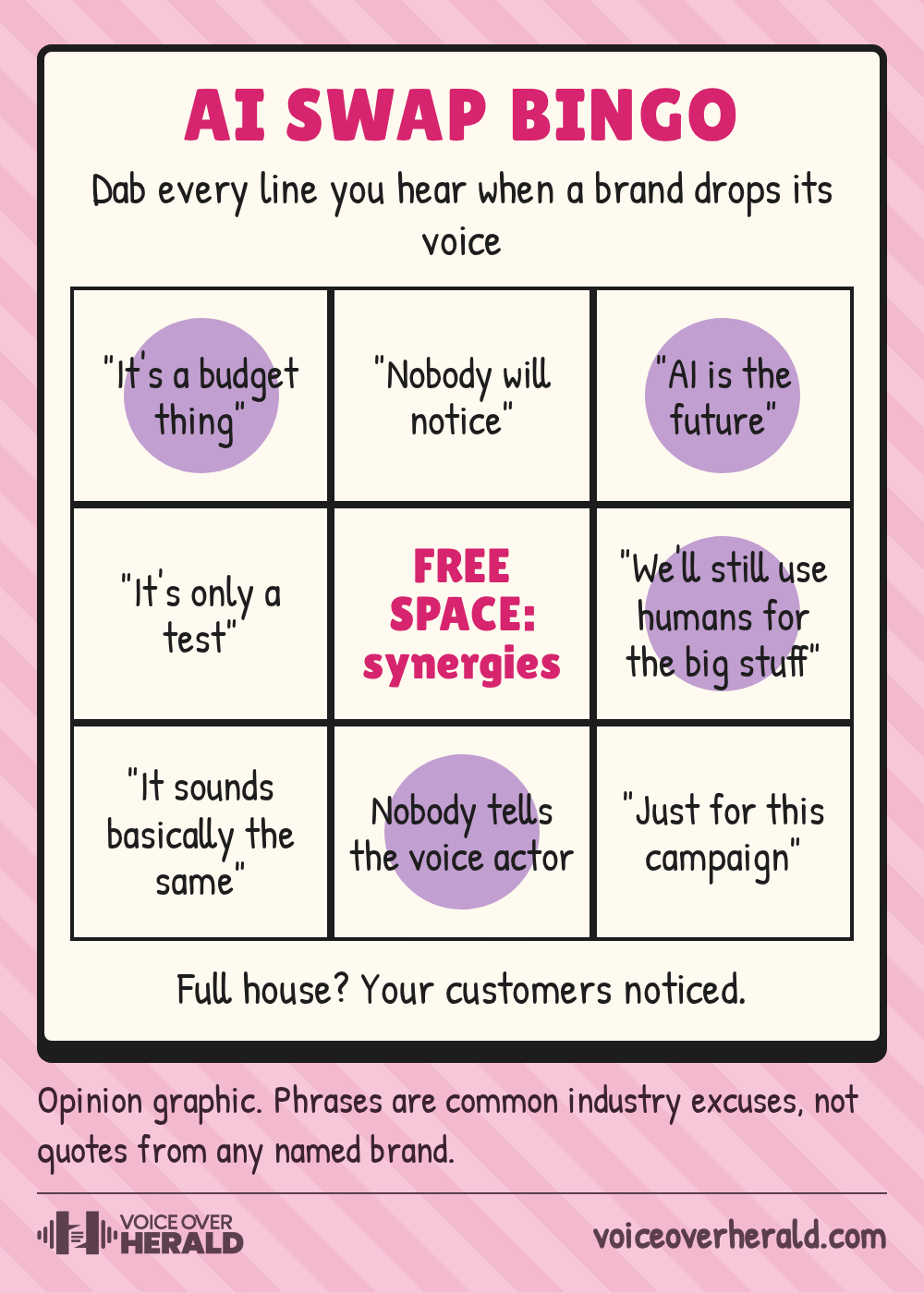
When a brand drops a voice it has trusted for years and hands the job to an AI, the explanation is always the same: it’s a budget thing. It isn’t. It’s a decision about what the brand thinks its customers can hear, and I think it’s the wrong one.
Last week Voice Over Herald reported that Lindy Pellicer, who has voiced Philippine ads for 40 years, lost a job with a long-time client to AI. She found out, told her family, and her son tried to cheer her up with the most reasonable guess anyone could make: it was probably “a budget thing”.
He’s probably right. And that’s exactly what bothers me.
A budget is a list of priorities
Every business has a budget. Every budget is a ranking of what matters. When a big brand decides the voice that’s spoken for it for years is the line it can cut, it isn’t saving money by accident. It’s saying, quite clearly, that the sound of the brand is the least important thing about it.
That’s a bold position for a company that spends real money on its logo. Nobody replaces the logo with whatever an image generator spits out on a Tuesday afternoon. Somebody chose that shade of red. There were meetings. Possibly a mood board. Yet the voice, the thing customers actually hear in their kitchens and cars, is apparently fair game.
Customers notice more than brands think
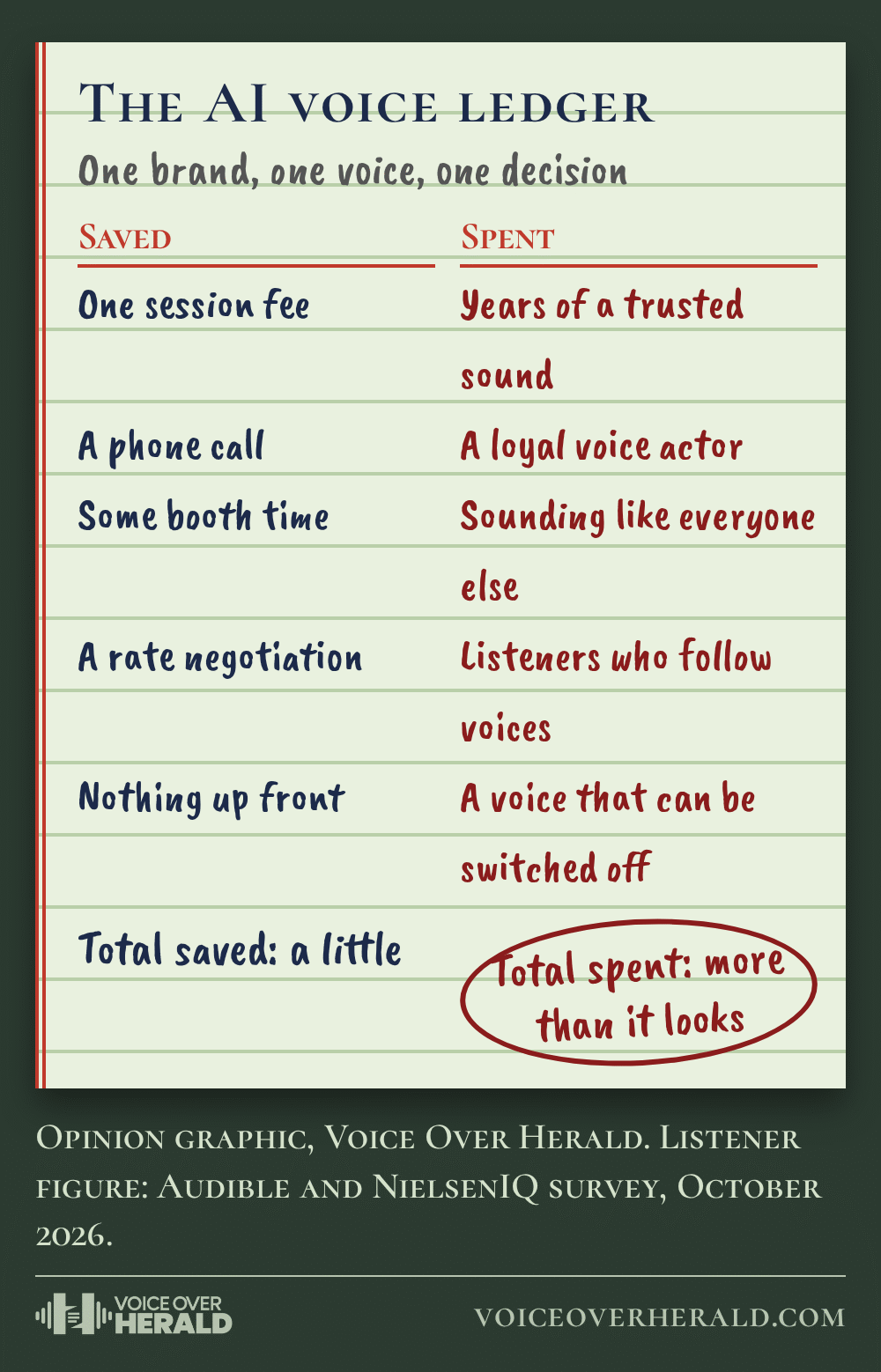
The industry’s own numbers argue against the cut. Audible put out a survey this month, carried out by NielsenIQ across 18,000 listeners in 11 countries. Half said they’d be open to trying an AI-narrated audiobook. That’s the number that got the headlines.
The other number got less attention. Nearly two thirds said they go looking for more books by a narrator they like. People don’t follow a voice because it’s adequate. They follow it because they trust it. A brand that has built 40 years of that trust and swaps it for something that’s merely fine has made a very expensive saving.

“Open to trying” is also doing a lot of work in that first number. I’m open to trying the office coffee. That doesn’t mean I’ll drink it when there’s a café across the road.
The people who know voices are saying it out loud
This month, the VOX Awards in Britain handed out categories with names like Best Human Performance in Gaming and Best Human Performance in an Audiobook. Two years ago nobody would have thought the word “human” needed to be there. Now the people who judge voice work for a living put it in the title, because it matters.
In Japan, the actors’ union published its first rules for AI and voices, and Goku’s voice, Masako Nozawa, said unauthorised use leaves her “disillusioned”. These aren’t people afraid of technology. They’re people who know exactly what a performance is worth, because they’ve spent their lives giving them.

I’m not against AI. I’m against pretending it’s free
Let me be fair. AI voices have real uses. A phone menu that changes every week, a prototype that will never air, a translation draft before the real dub: fine. Nobody’s asking a 40-year veteran to read “press 3 for billing” eleven times a day.
But a campaign for a big brand isn’t a phone menu. When it’s done well, a voice is the reason an ad works. Replacing the person who made it work with a tool that sounds roughly like a person doing it isn’t a budget saving. It’s a bet that your customers won’t notice, and an admission you’d rather they didn’t.
And the bill does arrive, just later. It arrives when the voice sounds like every other brand using the same tool. It arrives when a customer can’t quite say why the ad feels cheaper, but feels it anyway. It arrives when the next service you built on closes, and the voice goes with it.
What should happen instead
If the budget really is tight, say so to the voice actor. Ask what they can do. Most working voice actors would rather negotiate a rate than be replaced in a group chat. A brand that’s been heard through the same voice for years owes that person a phone call, at the very least.
 VoiceEditSuiteSave the take. Lose the noise.Studio Rescue strips hiss, mains hum, fan wash and room noise out of a recording and leaves your voice untouched, with the noise floor measured before and after.See how it worksYour recordings are never used to train AI.
And if you’re a client reading this, try one small thing. Play your last campaign to someone who loves your brand. Then play them the AI version. Watch their face. That’s your budget meeting.
According to PhilNews, Pellicer is staying hopeful. Somewhere out there is a brand that’s about to get a very good voice for its next campaign. I hope it’s paying properly.
This is an opinion piece. Sources: Voice Over Herald reporting on Lindy Pellicer, the Audible and NielsenIQ survey, the VOX Awards and the Japan Actors Union, October 2026, linked above where reported.
Lee este artículo en español: Opinión: "Es un tema de presupuesto" no es una razón. Es una confesión
Know something about this story, or spotted an error? Tell the newsroom.