

Free AI Voices Now Run Offline on a Mac. Only One of Ollama’s New Speech Models Is Licensed for Paid Work
Ollama, one of the most popular free apps for running AI on your own computer, can now talk. Since Saturday, anyone with an Apple Silicon Mac can type one command and hear text read aloud by Phonon, a small text-to-speech model from the AI voice company Gradium, with no internet connection and no bill. Voice actors don’t need to panic about it. They do need to read the licence, and the small print on where the voices come from.
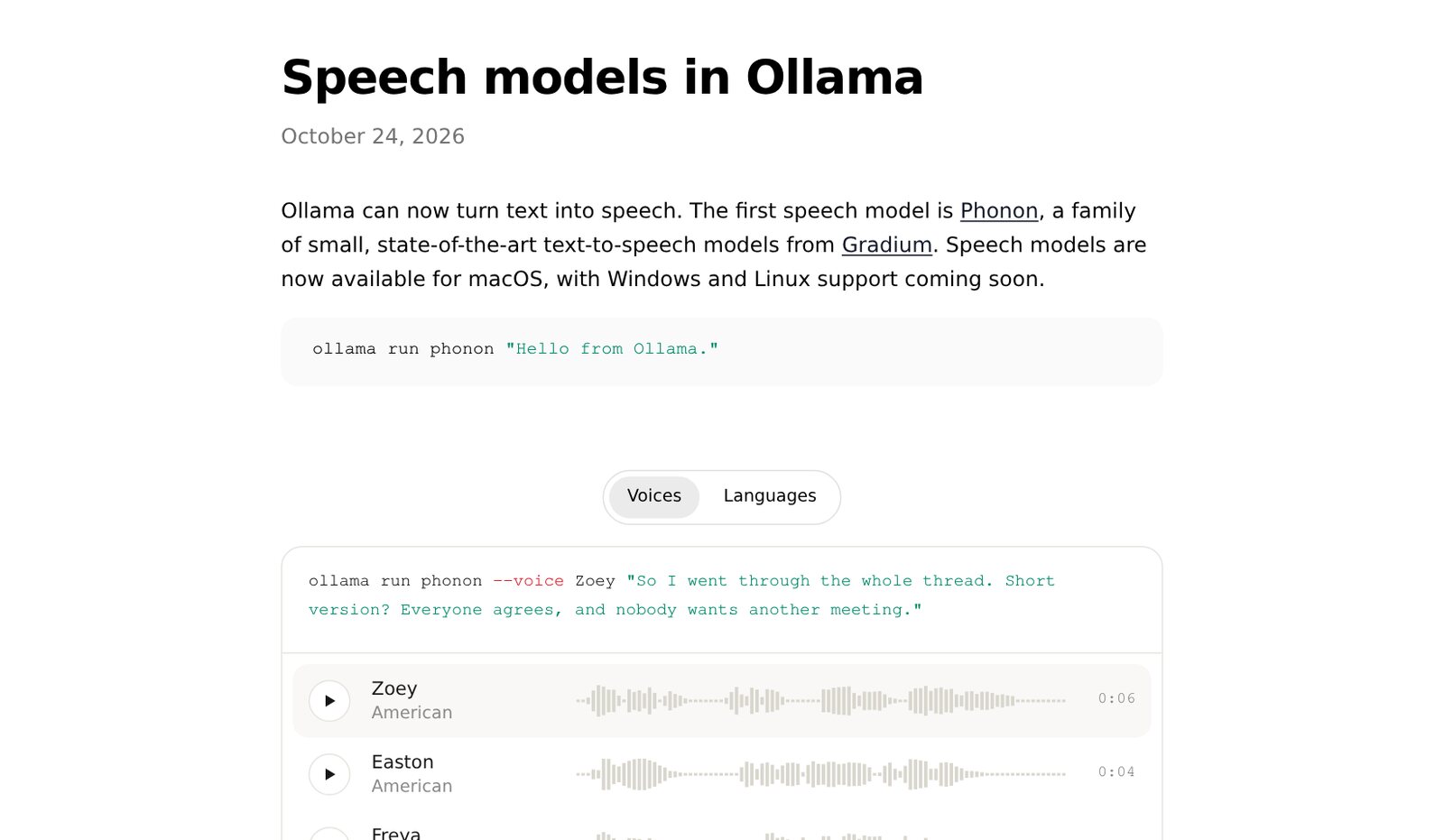
Ollama announced the feature on its blog on Saturday, October 24. “Ollama can now turn text into speech,” the company wrote. “The first speech model is Phonon, a family of small, state-of-the-art text-to-speech models from Gradium. Speech models are now available for macOS, with Windows and Linux support coming soon.”

 VoiceEditSuiteStudio RescueSave the take. Lose the noise.Hiss, hum and room noise out. Your voice untouched.See how it works
Until now, Ollama was mostly a way to run chatbots offline. It has a big following among developers and hobbyists, and 9to5Mac, which reported the update on Monday, calls it “one of the most popular AI projects on GitHub.” Speech is new for it. You download Ollama 0.40.11 or later, pull the Phonon model, and type a line of text. The voice starts talking while the rest of the sentence is still being generated.
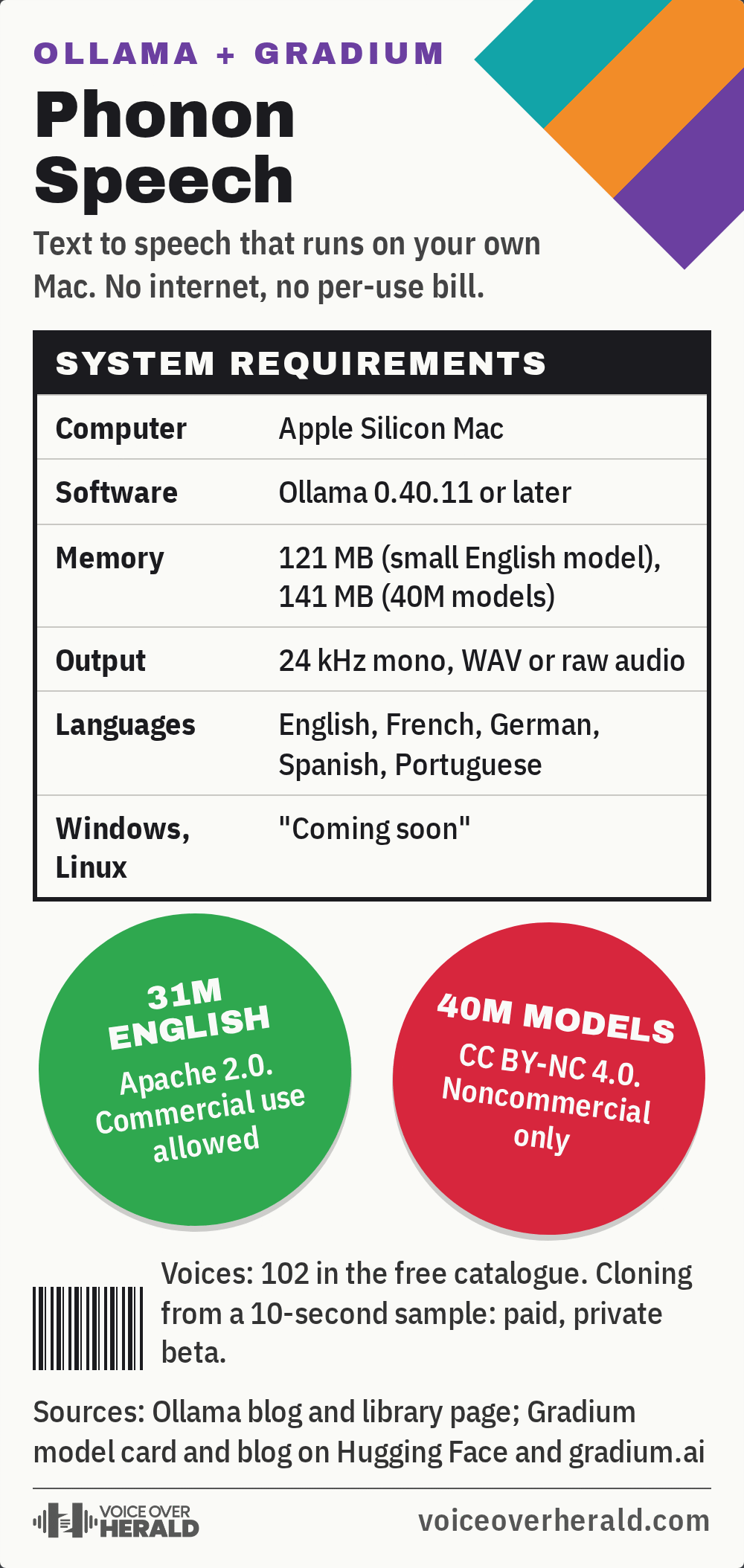
Ollama says that on a MacBook Pro with an M5 Max chip, its version ran 35 percent faster than Gradium’s own software, while matching the reference version’s accuracy. The audio comes out as 24 kHz mono, and the default English model takes about 121 MB of memory. That’s small enough, Gradium’s model card says, “to run in a browser tab, on a phone, or on a laptop CPU.”
One download, about a hundred voices
The model comes with a catalogue. Gradium’s voice page on Hugging Face lists “102 voices for Phonon S (31M): 90 Gradium catalogue voices in 7 locales, plus 12 English character voices.” The everyday voices have friendly first names. Zoey and Easton are American, Freya and Hugh are British, and there are French, German, Spanish, Mexican Spanish and Brazilian Portuguese voices too. Each one is stored as a small file the model reads directly.
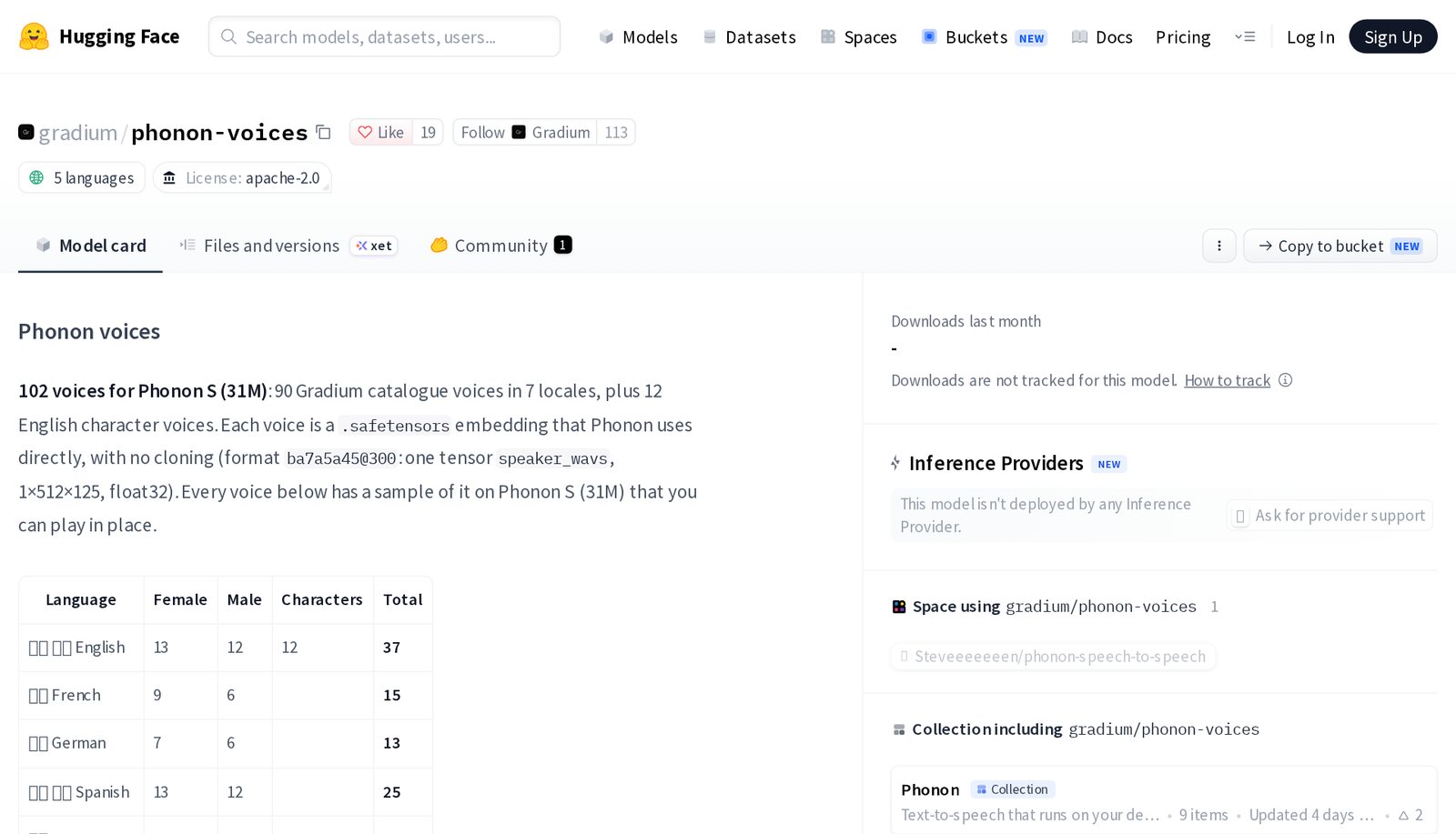
Image: Hugging Face, gradium/phonon-voices, October 27, 2026
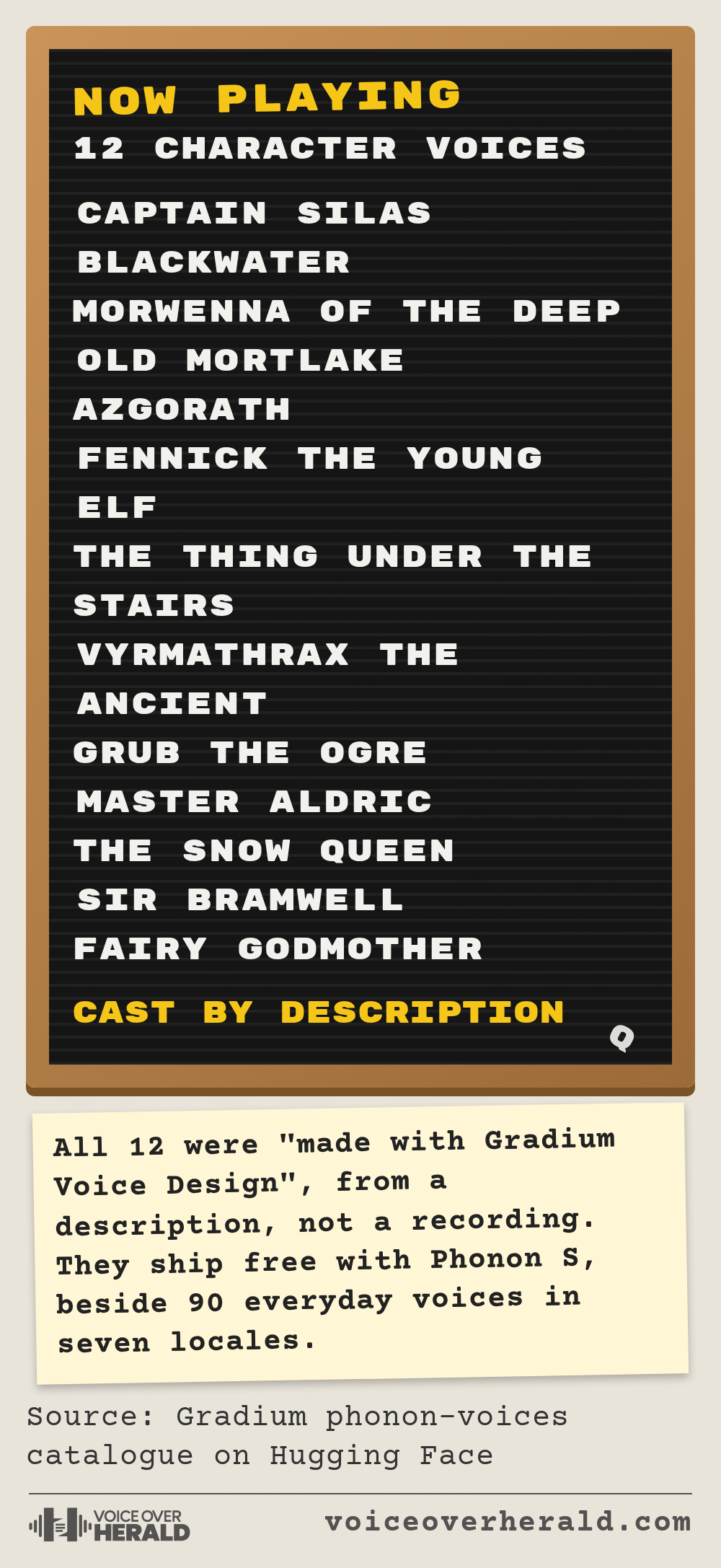
The character voices are the part working actors will raise an eyebrow at. They include Captain Silas Blackwater, Grub the Ogre, The Snow Queen and The Thing Under the Stairs, the kind of parts that game and audiobook actors audition for every week. Gradium says these 12 were “made with Gradium Voice Design,” its tool for building a voice from a description rather than a recording.
Read the licence before you do anything else
Here’s the detail that matters most for anyone who earns money from their voice. Not every Phonon model can be used for paid work. The default model, Phonon 31M English, is released under the Apache 2.0 licence, which “allows commercial use,” its model card says. Gradium’s voice catalogue is under Apache 2.0 too.
The bigger models are different. Ollama’s own library page spells it out: “The 40M English, French, German, Spanish, Portuguese, and multilingual checkpoints are released under CC BY-NC 4.0, which limits use to noncommercial purposes.”
In plain terms, a business can take the small English model, plug it into an app or a training course, and sell it. A company that wants the better English model, or a free French, German, Spanish or Portuguese voice from the same family for an advert or a paid course, can’t simply download it and go. Those models are free for tinkering, not for clients. If you voice in those languages, that’s the line to watch.
Where the voices come from, and where they end up
Phonon isn’t built from scratch. Gradium’s model card says it “builds on Pocket TTS and the Mimi codec, developed by Kyutai.” Neither the model card nor the voice catalogue says who recorded the catalogue voices, or on what terms. The model card does carry a request: “Do not use Phonon to impersonate a real person, to deceive listeners about who is speaking, or to clone a voice without the speaker’s consent.”
The free models are the shop window. Gradium’s paying customers get a version built around one voice. In its launch post for on-device Phonon, the company says partners can bring a voice “chosen from Gradium’s voice catalogue or cloned from any voice with a 10-second sample, or more data if available.” It works, Gradium says, “with any voice: custom, cloned, or synthetic.”

Image: Gradium blog, October 27, 2026
The finished voice then goes out inside the customer’s app. “Once the model is finalized, you receive a self-contained artifact that ships directly inside your app, with no calls to an external endpoint, no runtime network dependency, and no data leaving the user’s hardware,” Gradium writes. It’s sold as “a fixed cost per device and model type, with unlimited generations.” The on-device service is in private beta, and Gradium says “a few spots are open now.”
What it means for working voice actors
The obvious worry is price. A free voice that never sends a bill is hard to undercut, and Gradium pitches Phonon at exactly the places where a cloud voice gets expensive: free apps with lots of users, games with chatty characters, and products that have to work in airplane mode. Some of that work used human voices. A lot of it never did.
The less obvious point is control. Voice Over Herald reported this month that one AI voice company is switching its voices off and deleting the data. A voice that lives on a company’s server can be switched off. A voice that’s been baked into an app and copied onto thousands of phones can’t be called back. If you’re ever asked to license your voice for an AI product, ask a straight question: will my voice run in the cloud, or ship inside other people’s devices? And if it ships, what happens when the deal ends?
There’s also some good news hidden in Gradium’s own fine print. On long text, its model card admits, “prosody does not carry across the whole text,” because the model reads one sentence after another. That’s a narrower way of saying what narrators already know. Holding a mood, a character and a pace across a chapter is the job, and a small model reading line by line doesn’t do it.
So no, a hobbyist’s MacBook isn’t coming for your audiobook contract this week. It’s another sign that basic synthetic speech is turning into a free utility, like spellcheck, and that the questions worth asking are about licences, consent and where a voice ends up. Ollama says Windows and Linux are next. Voice Over Herald will be listening.
Sources: Ollama blog, “Speech models in Ollama” (October 24, 2026); Ollama library page for Phonon; Ollama speech documentation; 9to5Mac, Marcus Mendes (October 26, 2026); Gradium model card for phonon-31m-en and the phonon-voices catalogue on Hugging Face; Gradium blog, “Gradium Phonon: On-Device TTS for Consumer Apps, NPCs, and Offline Products.” Images: Ollama, Hugging Face, Gradium.
Lee este artículo en español: Las voces de IA gratuitas ya funcionan sin conexión en una Mac. Solo uno de los nuevos modelos de Ollama tiene licencia para trabajo pagado
Know something about this story, or spotted an error? Tell the newsroom.