





AI Voice Firms Now Sell Consent. Two of Them Are Also Switching Voices Off
Three AI voice companies launched new voices in early October, and all three used the word consent in the pitch. In the same fortnight, two others said they’re switching voices off. If you’re a working voice actor thinking about licensing your voice, both halves of that news matter.
It’s been a crowded few weeks in AI voice. Microsoft, HeyGen and the customer service company Decagon all released new voice models between 1 and 9 October. Meanwhile Hume told developers its text-to-speech service closes on 13 November, and OpenAI set a date to retire its oldest speech models.
Voice Over Herald read the announcements so you don’t have to. Here’s what each company actually said, what it didn’t say, and what a voice actor should take from it.

Consent is now a selling point
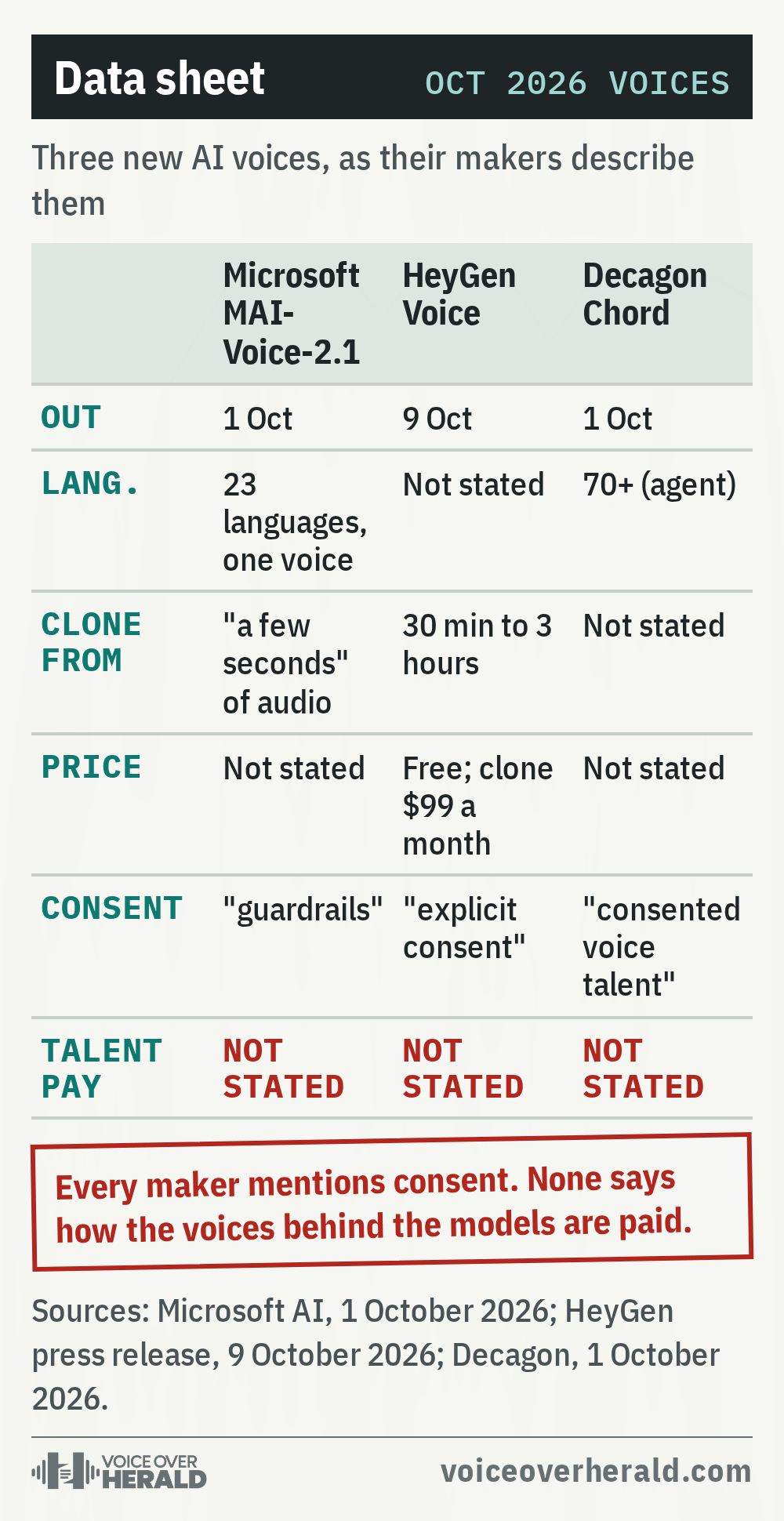
Decagon launched Chord, its first speech model, on 1 October. The company’s blog says “Chord is trained on licensed data and consented voice talent, never on customer-owned data.” It also claims that in a blind test across three voices, “approximately 90% of users couldn’t tell” which was the human. It doesn’t say how many people took the test.

 VoiceEditSuiteNewThe audio editor that learns how you breathe.Learns from numbers, never your audio. Never used to train AI.See how it works
HeyGen followed on 9 October with HeyGen Voice, free inside its platform, plus a Professional Voice Clone add-on at $99 a month. The clone is trained on “30 minutes to three hours of the owner’s speech,” and the company says it “requires the voice owner’s explicit consent.”
Microsoft’s MAI-Voice-2.1 arrived on 1 October. It supports 23 languages and 26 locales, “enabling one single ‘voice’ to use all languages with a truly native accent.” Microsoft says it can clone a voice “using just a few seconds of reference audio,” with “built-in consent guardrails that prevent misuse.”
A year ago, most AI voice launches talked about speed and realism. This round, every one of them mentioned consent. That’s progress, and it’s progress voice actors and their unions pushed for.
What the announcements leave out
Consent is one word. A contract has a lot more in it. None of the three announcements says how the voice talent behind the models were paid, whether they’re paid again when their voice is used, how long the licence runs, or what happens if they want out.
Consent
“Licensed data and consented voice talent.” “Explicit consent.” “Built-in consent guardrails.”
The terms
How the talent were paid, for how long, in which languages, and whether they can withdraw.
That gap matters more with Microsoft’s model. If one voice can speak 23 languages with a native accent, a single recording session could stand in for work that used to go to 23 different voice actors. Consent from the person who recorded it doesn’t answer the question for the other 22.

And then the voices go dark
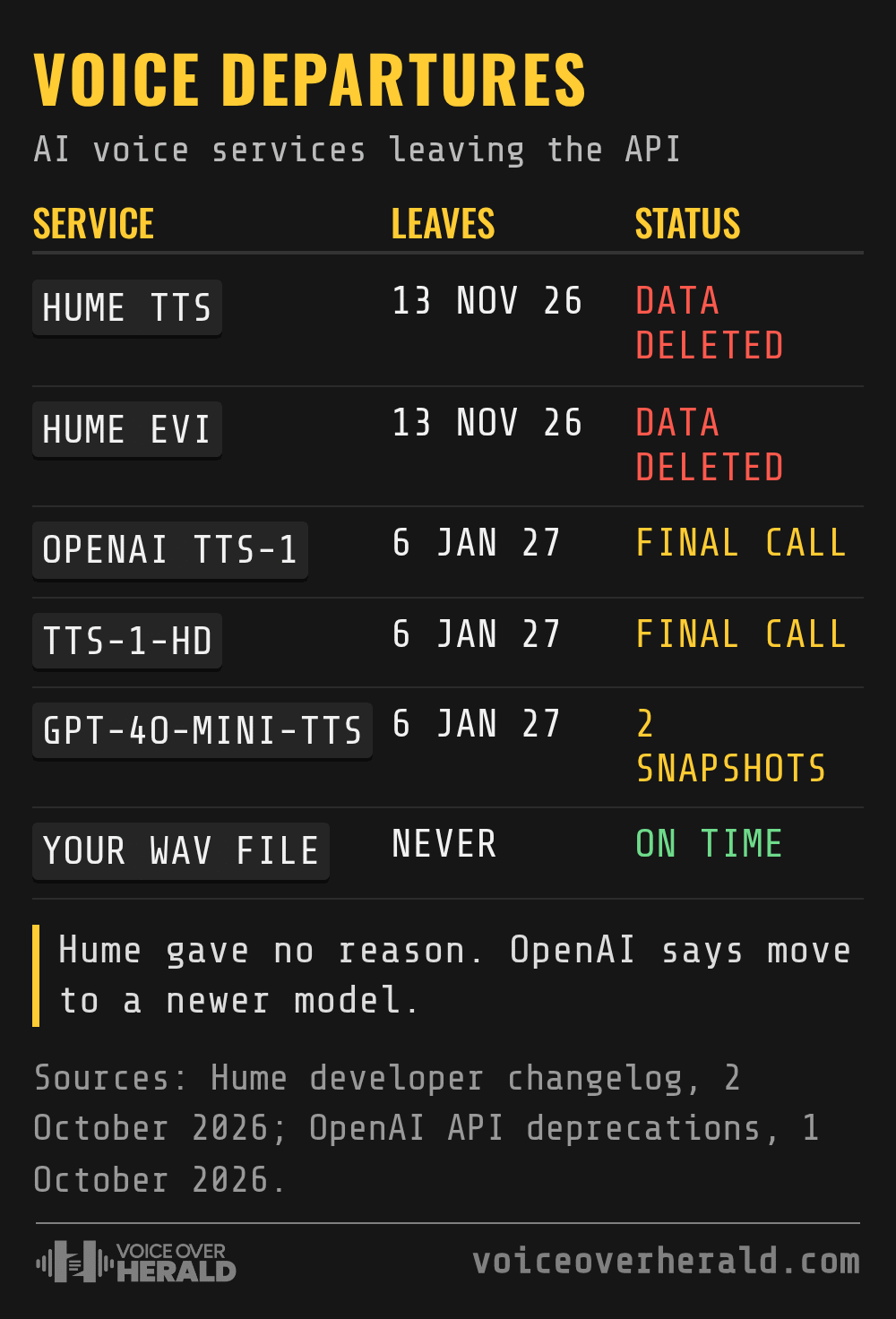
On 2 October, Hume posted a one-paragraph notice: “Hume is sunsetting the TTS and EVI APIs. Access ends November 13, 2026 at 12:01 a.m. EST.” It added: “Any data in your account is permanently deleted after November 13, 2026.” No reason was given.
OpenAI’s deprecation page, dated 1 October, says its tts-1, tts-1-hd and two gpt-4o-mini-tts models “will be removed from the API on January 6, 2027,” and tells developers to move to a newer model.
Companies retire old products all the time. For a voice actor, though, it’s a useful reminder. A synthetic voice lives on someone else’s server, under someone else’s business plan. If a client builds an e-learning course or a phone menu on an AI voice and the service closes, that voice is gone, and so is the consistency the client was paying for.

A human recording sits in a WAV file on the client’s drive. It doesn’t get deprecated.
What this means if you’re asked to license your voice
More of these offers are coming, and some will be worth taking. Before you sign one, get answers in writing to the questions the press releases skip:
- Pay. Is it a one-off fee, or are you paid each time your voice is used?
- Scope. Which products, which clients and which languages can use it?
- Term. How long does the licence run, and can you end it?
- Shutdown. If the service closes or the company is sold, what happens to your voice model and your recordings?
- Deletion. Hume deletes account data after it closes. Make sure your contract says the same about your voice, and when.
The technology will keep improving. The good news in this month’s launches is that the companies now feel they have to say the word consent. The job for voice actors is to make sure the word comes with terms attached.
Sources: Decagon, “Voice 3”, 1 October 2026; HeyGen press release, “HeyGen Launches HeyGen Voice”, PR Newswire, 9 October 2026; Microsoft AI, “Our first streaming transcription model”, 1 October 2026; Hume developer changelog, 2 October 2026; OpenAI API deprecations page, 1 October 2026.
Lee este artículo en español: Las empresas de voces con IA ahora venden consentimiento. Dos también apagan voces
Know something about this story, or spotted an error? Tell the newsroom.