

Mexico’s Lower House Tells Platforms to Pull AI-Altered Voices or Pay. Critics Call It the Anti-Meme Law, and a Cloned Announcer Shows Why It Matters
Mexico already says you cannot clone a voice without written consent. On Tuesday its lower house voted to say what happens next: platforms that are told about a voice, image or recording “modified or altered without authorisation through artificial intelligence” must take it down fast, or face fines that reach into the millions of pesos. The opposition calls it the Anti-Meme Law. A radio announcer in León, whose cloned voice was selling a wine festival for the state government two weeks ago, is the case that shows what the vote is really about.
What the Chamber of Deputies passed
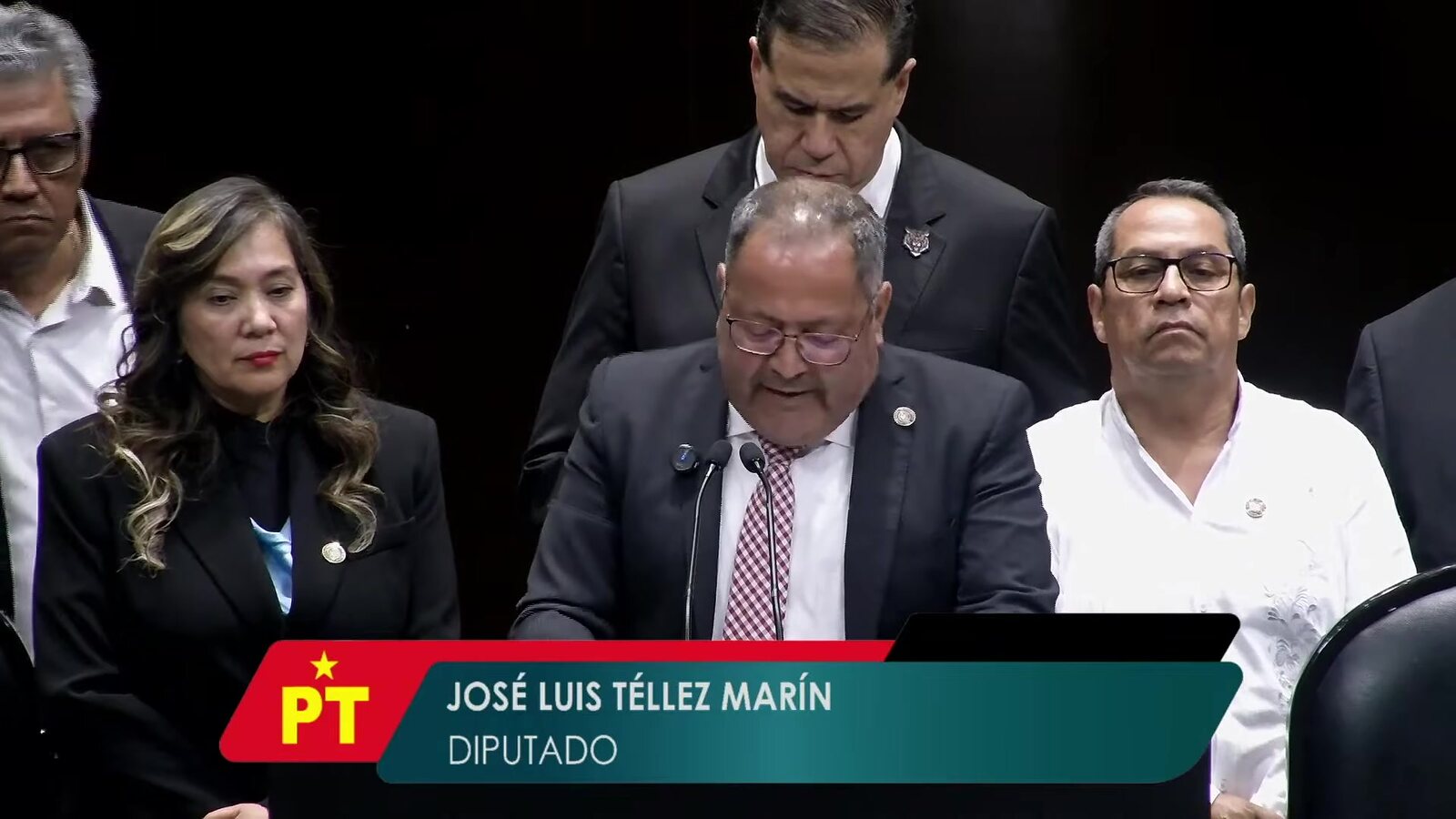
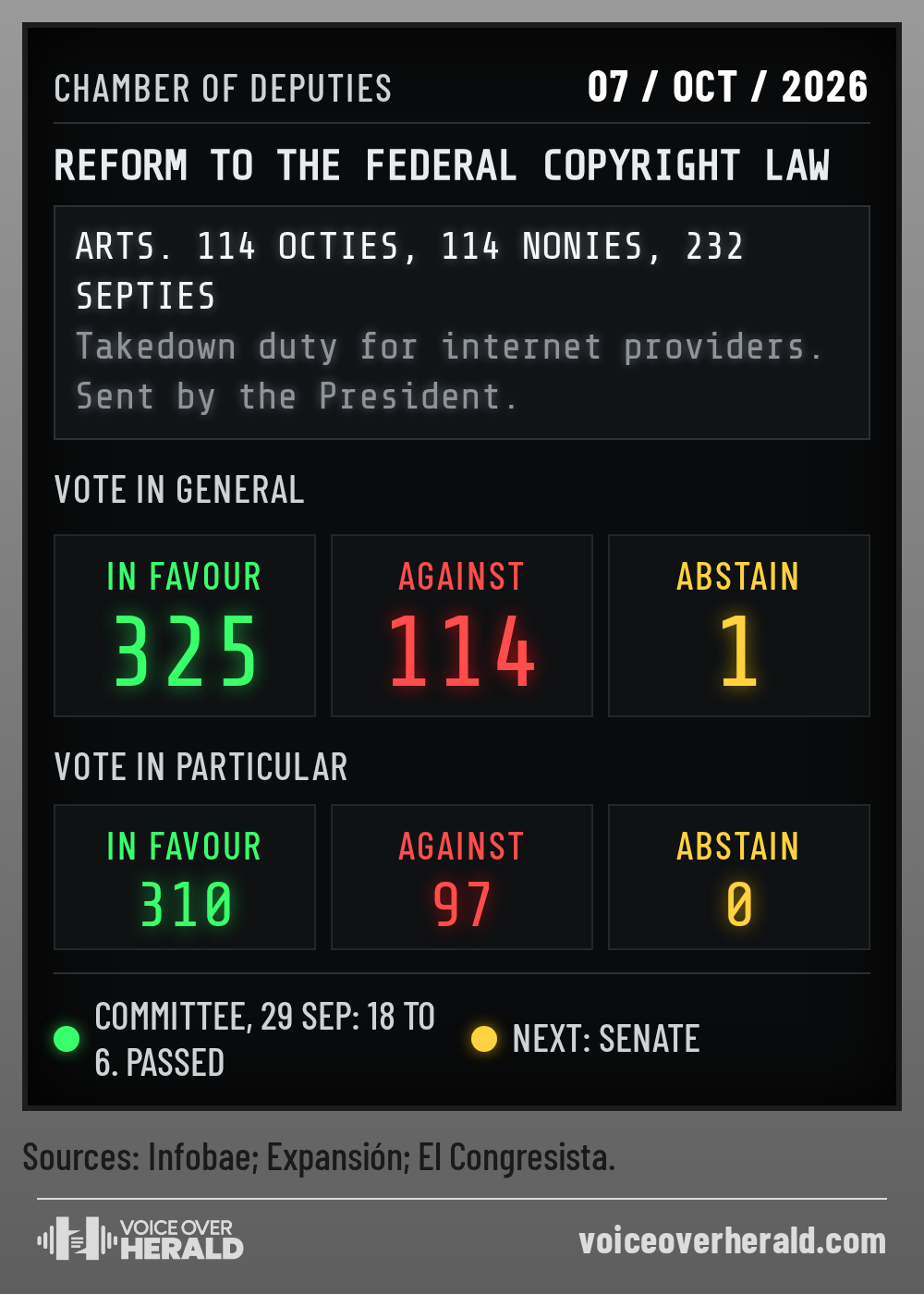
The reform to the Federal Copyright Law, sent by President Claudia Sheinbaum, cleared the Chamber of Deputies on 7 October: 325 votes to 114 with one abstention in general, then 310 to 97 on the detail. It rewrites article 114 Octies and adds articles 114 Nonies and 232 Septies, and it now goes to the Senate.
The core of it is a duty. Once an internet service provider has “certain knowledge of the existence of an alleged infringement,” it must remove the material “expeditiously and effectively,” in the wording Excélsior published from the bill. The material in question includes “works, images, voice, videograms or phonograms modified or altered without authorisation through artificial intelligence or other technological tools,” as Agencia Reforma summarised the text. Providers must publish a policy for cutting off repeat offenders, keep it in their terms of service, and run a notice mechanism.
The fines are set by IMPI, the industrial property institute, in units called UMA: 1,000 to 40,000 of them, which Noroeste worked out as roughly 117,310 to 4.69 million pesos, with a further 100 to 500 UMA for each time a provider keeps ignoring a notice. A provider is not automatically liable for what its users post. Under the new article 114 Nonies it is on the hook only when it knew, took part, had the ability to control the content and drew a direct financial benefit from it.
Why the opposition calls it the Anti-Meme Law
Sheinbaum says no article in the text mentions memes. The nickname stuck because the takedown duty applies to any altered image, and critics think platforms will remove first and ask later. Ariana Rejón Lara of the PRI asked from the rostrum whether this was really Mexico’s main problem. Her colleague Mario Zamora put it bluntly: “They’re taking away our parody, they’re taking away our criticism.” Gloria Núñez of Movimiento Ciudadano argued that “the excessive amount of these fines turns removal into a mechanism of censorship.” Kenia López Rabadán of the PAN accused the government of wanting to force providers to withdraw service “when the Government finds a piece of content inconvenient.”
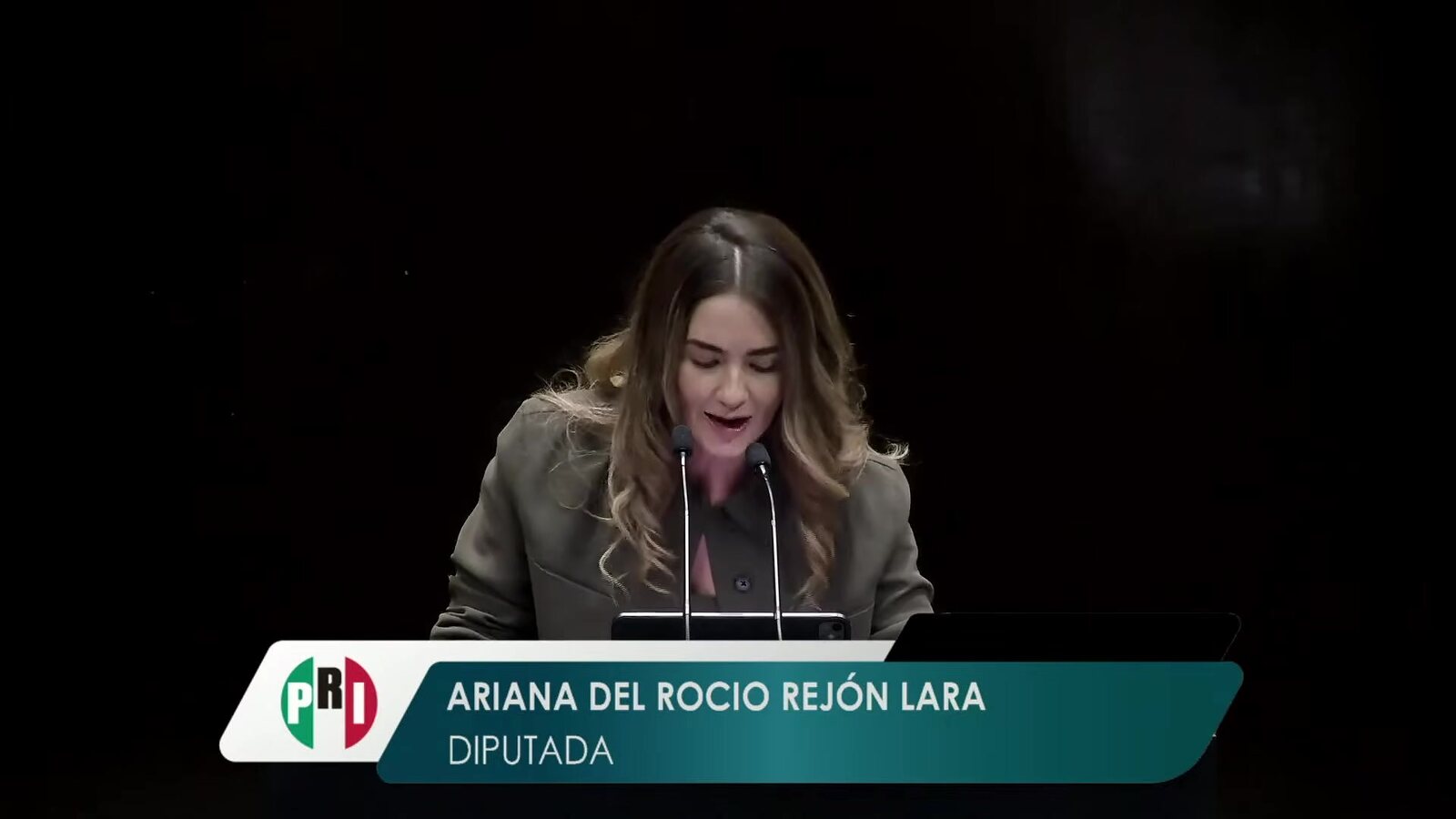
Ariana Rejón Lara of the PRI at the rostrum during the 7 October debate, a frame from the Chamber's live stream. Image: Cámara de Diputados
Morena, which holds the majority, rejected all of it. “We are not imposing a gag,” said Claudia Selene Ávila Flores, who carried the bill, as Expansión reported, insisting the aim was to protect intellectual property, not restrict speech. Raúl Villaseñor, also of Morena, said the reform “guarantees a balance between the protection of those rights and the development of the digital economy.”
 VoiceEditSuiteClean a session in ninety seconds, not three hours.
Sheinbaum had got there first. At her morning press conference on 1 October, when the companion bill on government identity fraud passed the Senate, she said the so-called Anti-Meme Law “doesn’t prohibit any meme. What’s more, it’s the law for defending authors, copyright, that’s the law, and it has nothing to do with memes.” Her examples were AI videos of herself touting fake investments.
Free-speech groups are not reassured. Artículo 19 warned before the committee vote that the reform “introduces responsibilities and sanctions that could lead internet service providers to monitor and restrict the activity of their users,” and that the vague test of whether a provider “contributes to, induces or causes” an infringement “could open the door to excessive surveillance.” On Imagen Radio on 8 October, Fernando Gutiérrez Cortés of Tecnológico de Monterrey’s digital media observatory said the risk was prior censorship of satire unless intent to deceive is defined precisely.
The announcer who proves the point
On 25 September, Diego Carreto, a 26-year-old commercial announcer from León, posted a video with a wine-festival spot playing behind him. “This is my voice for a State Government advert,” he said. “The problem is that I didn’t record it.” The ad for Vendimias Guanajuato 2026 had been running on radio, on social media and on the Visit México platform. “I had no idea this agency existed,” he said of Creorama, the firm the state tourism secretariat had hired. “I’ve never worked with them, never signed with them, never recorded or had any kind of contact with them.”
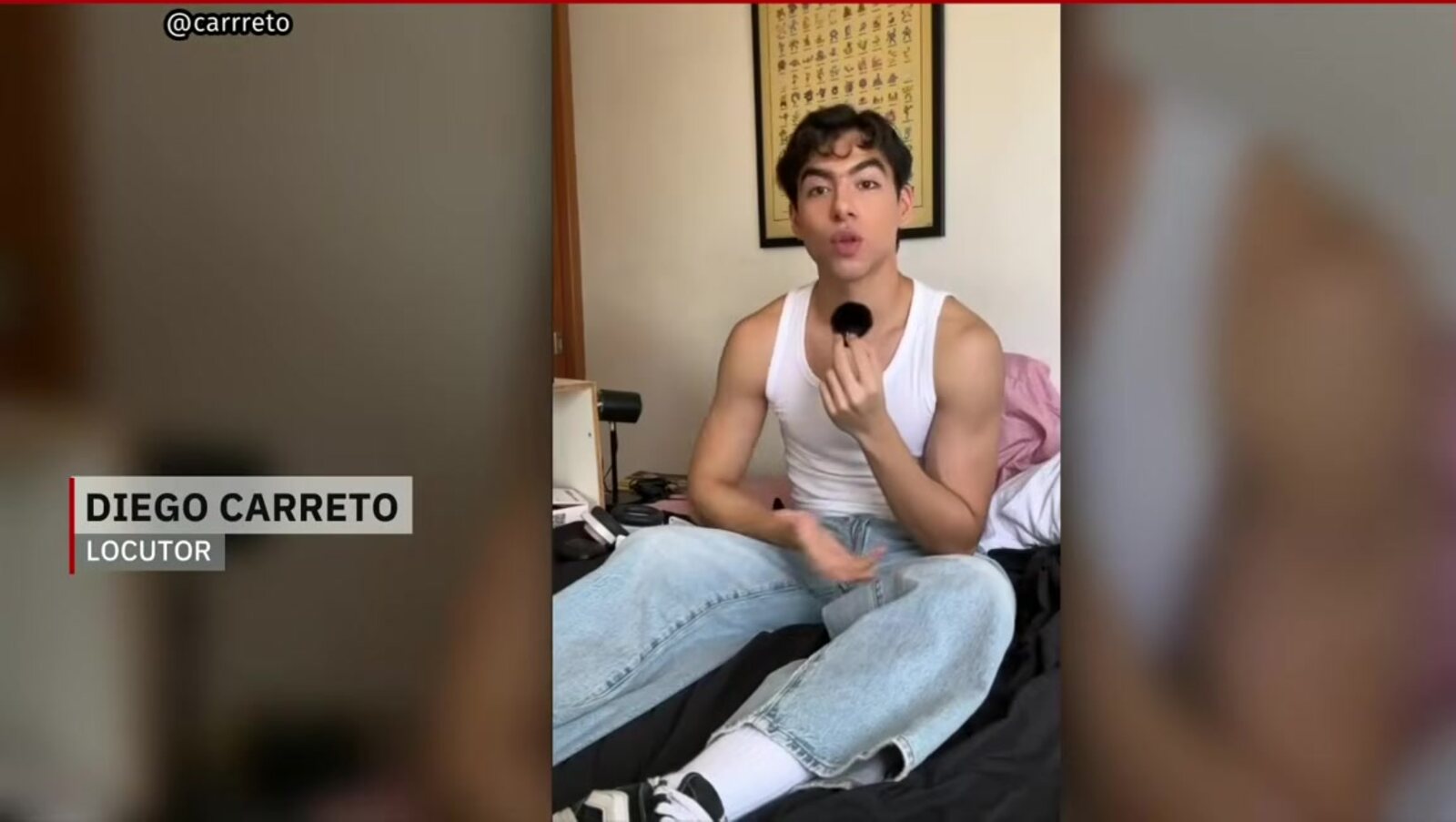
Diego Carreto in the video he posted on 25 September, as shown in Milenio Televisión's report. Image: Milenio
The consent law was already four months old. It did not stop the spot being made, and it did not take the spot down. What did was pressure. Backed by AMELOC, the Mexican association of commercial announcers, Carreto demanded removal, compensation and a finding of who was responsible. On 29 September the tourism secretariat, Secturi, said it “did not authorise the cloning or the use of voices through artificial intelligence to produce this material,” ordered Creorama to document its permissions or “suspend and replace the material immediately,” and promised to write AI-voice checks into its supplier contracts.
That is the gap the new reform is meant to close: the days between a performer hearing their own cloned voice and the moment a platform acts. Whether the duty is written carefully enough to catch a cloned announcer without also catching a cartoon of a governor is the whole Senate argument.
Three laws in one year
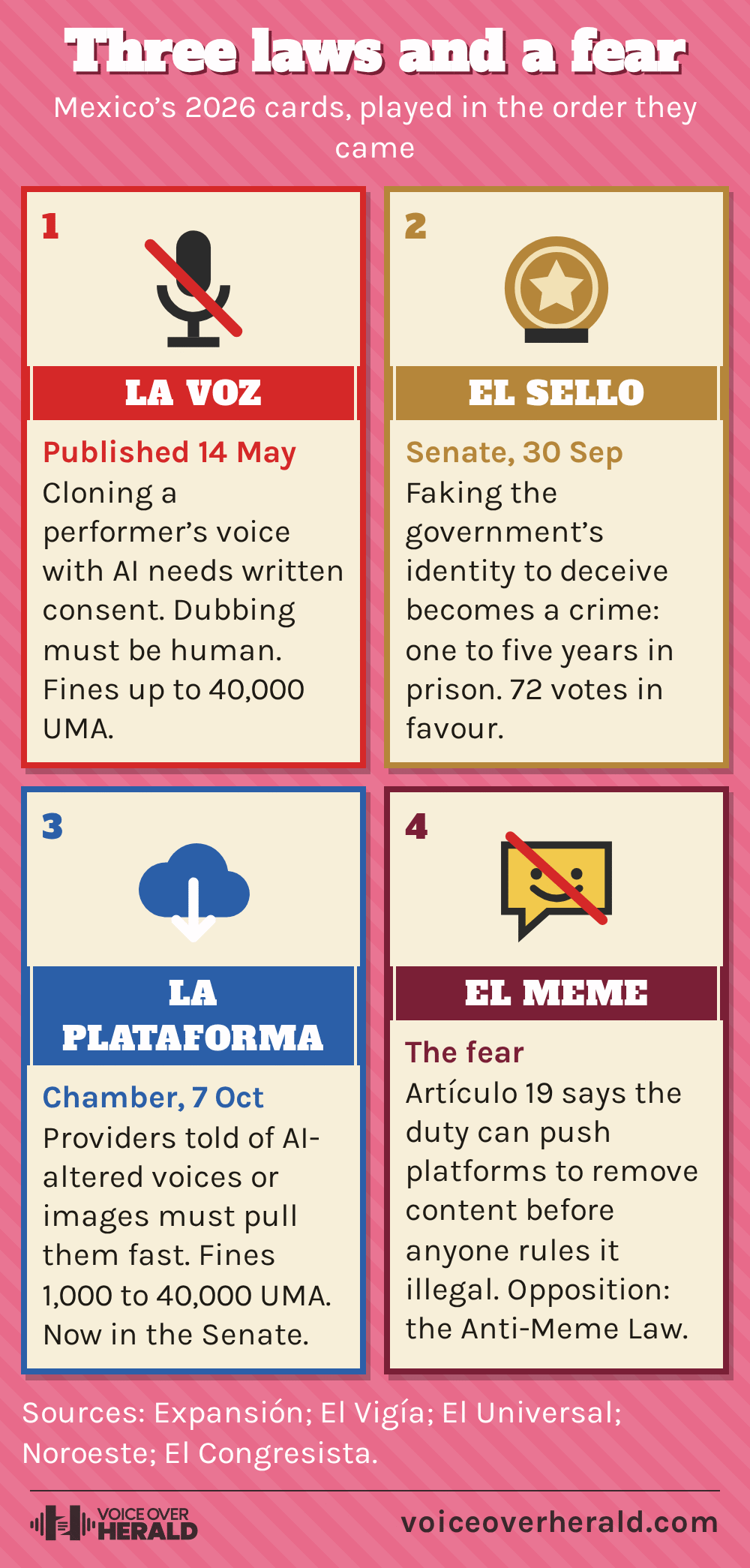
Mexico’s dubbing and announcing professions have had an unusual year. In February the culture secretary announced the consent initiative had been drafted with the profession itself, and when the Chamber passed it in April, the dubbing actress Liliana Barba of the Mexican association of announcers told IMER that it “means they have to ask our permission to use my voice, they can’t just steal it like that.” That law was published on 14 May. Voice Over Herald covered what it does and does not do, including the broadcaster already dubbing with AI, in September.
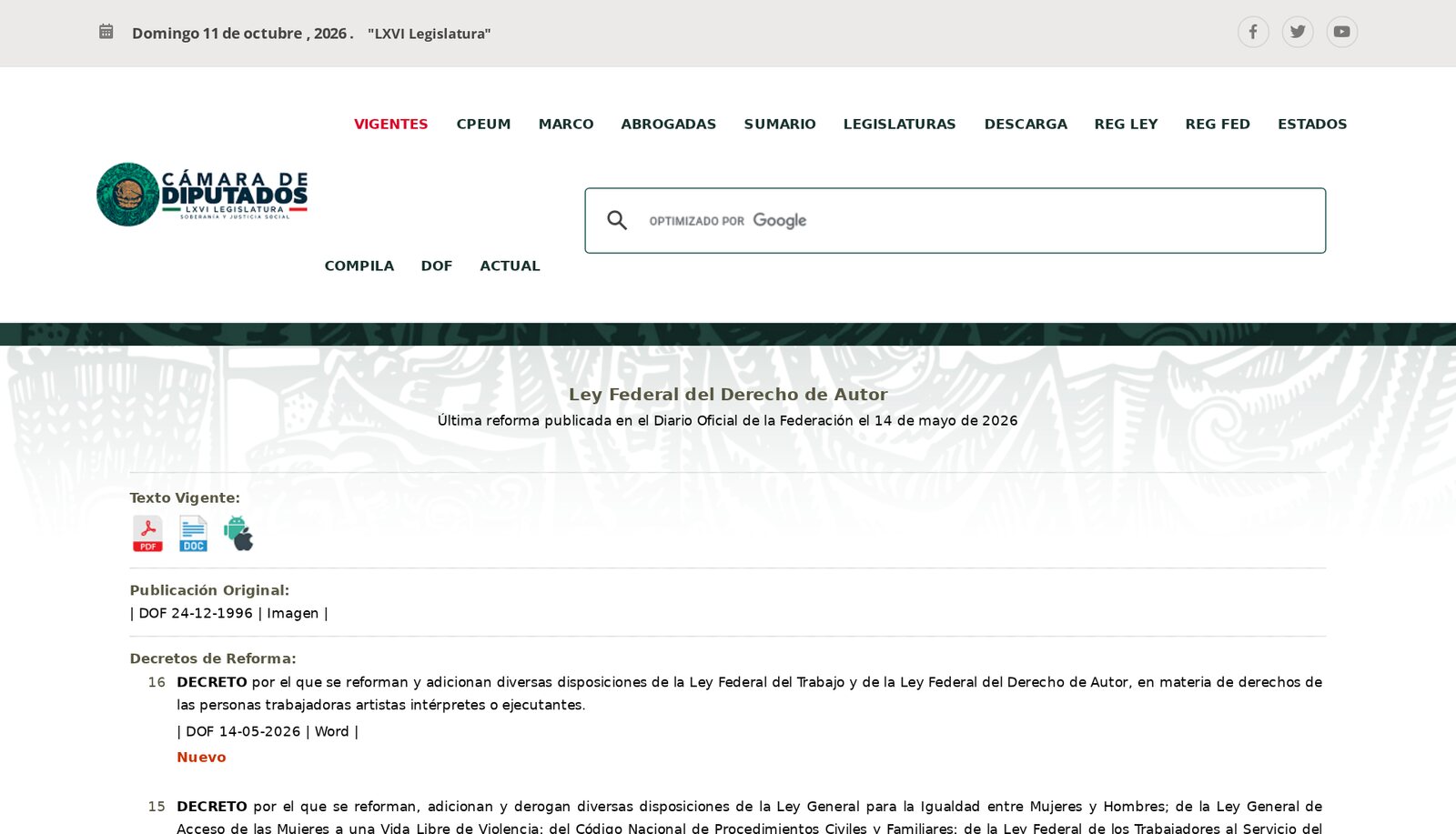
The Chamber of Deputies' page for the Federal Copyright Law, showing the reform published on 14 May 2026. Screenshot taken 11 October 2026. Image: Cámara de Diputados
Then came the autumn package. On 30 September the Senate passed, with 72 votes in favour, a reform to the Federal Criminal Code and the industrial property law that makes imitating the government’s institutional identity to deceive people a crime, with one to five years in prison. And on 7 October the Chamber passed the platform duty described here. All of it is sold as one fight against digital fraud and piracy; all of it lands on the same platforms that host a dubbing actor’s demo reel and a politician’s parody account alike.
For performers outside Mexico, the lesson is the order of operations. A consent right is the first law. A takedown duty is the second, and it is the one that decides whether the first can be enforced in a week or in a court case. Mexico is about to find out how far it can push the second before the memes push back.
Sources: Expansión; Infobae; Agencia Reforma via Noroeste and El Vigía; La Razón; Excélsior; El Universal; El Congresista; Imagen Radio; Periódico AM; Periódico Correo; Radionotas; IMER Noticias. Quotations from Spanish-language sources are translated by Voice Over Herald. Images: Milenio.
Lee este artículo en español: La Cámara de Diputados de México obliga a las plataformas a retirar voces alteradas con IA o pagar. Los críticos la llaman Ley Antimemes, y un locutor clonado muestra por qué importa
Know something about this story, or spotted an error? Tell the newsroom.