


Netflix Told Him It Had Trained AI on His Voice. Now Jason Momoa’s German Voice Is Suing
Matti Klemm, the German voice of Jason Momoa and Mahershala Ali, says Netflix trained AI systems on his voice without asking him or paying him. He found out the simple way: he asked Netflix what it does with his data. Now he’s suing, with a civil rights group paying for the fight.
Germany’s long row over dubbing contracts has reached the courts. On Tuesday the Verband Deutscher Sprecher:innen (VDS), the association of German voice artists, announced that its member Matti Klemm will file a lawsuit against Netflix. He’s claiming a breach of his personality rights, his copyright and his data protection rights.
Klemm is one of the most recognisable voices in German dubbing. He speaks for Momoa and Ali on screen, and since taking over the role he’s also the voice of Benjamin Blümchen, the talking elephant of one of Germany’s best loved children’s audio series.
Hear the voice: from 3:14, Matti Klemm sits in as a recording of him as Benjamin Blümchen plays. Video: Benjamin Blümchen TV, on YouTube
The case rests on one document. According to the VDS, Netflix answered a data access request from Klemm, and the answer shows the company “had already, in the past and without Klemm’s knowledge and consent, trained AI systems with his personal voice recordings.” His lawyer says he was never consulted and never paid.
He didn’t sign the clause. His voice went in anyway
The detail that makes this case sharper than most is the order of events. Since early 2026, voice actors working on Netflix originals in Germany have been asked to sign new rights agreements, which the VDS calls the AOR, with clauses that allow their recordings to be used for AI training. Plenty signed. Plenty refused.
Klemm refused. The Gesellschaft für Freiheitsrechte (GFF), the Berlin civil rights group backing his case, says he never signed the new AI training clauses in his contract with the German dubbing studio. But, it says, Netflix had already used his voice data for AI training “without any contractual basis and without his knowledge or consent.” He learned that only after he requested information about how his data was being used.

Matti Klemm. Image: Gesellschaft für Freiheitsrechte
Netflix’s answer to the news agency dpa was short. The company said it takes the current discussions seriously and pointed to an agreement it reached last year with the actors’ union BFFS on AI, which it says strengthens protections for voice actors. “Netflix’s use of AI is in accordance with applicable law,” the company said.
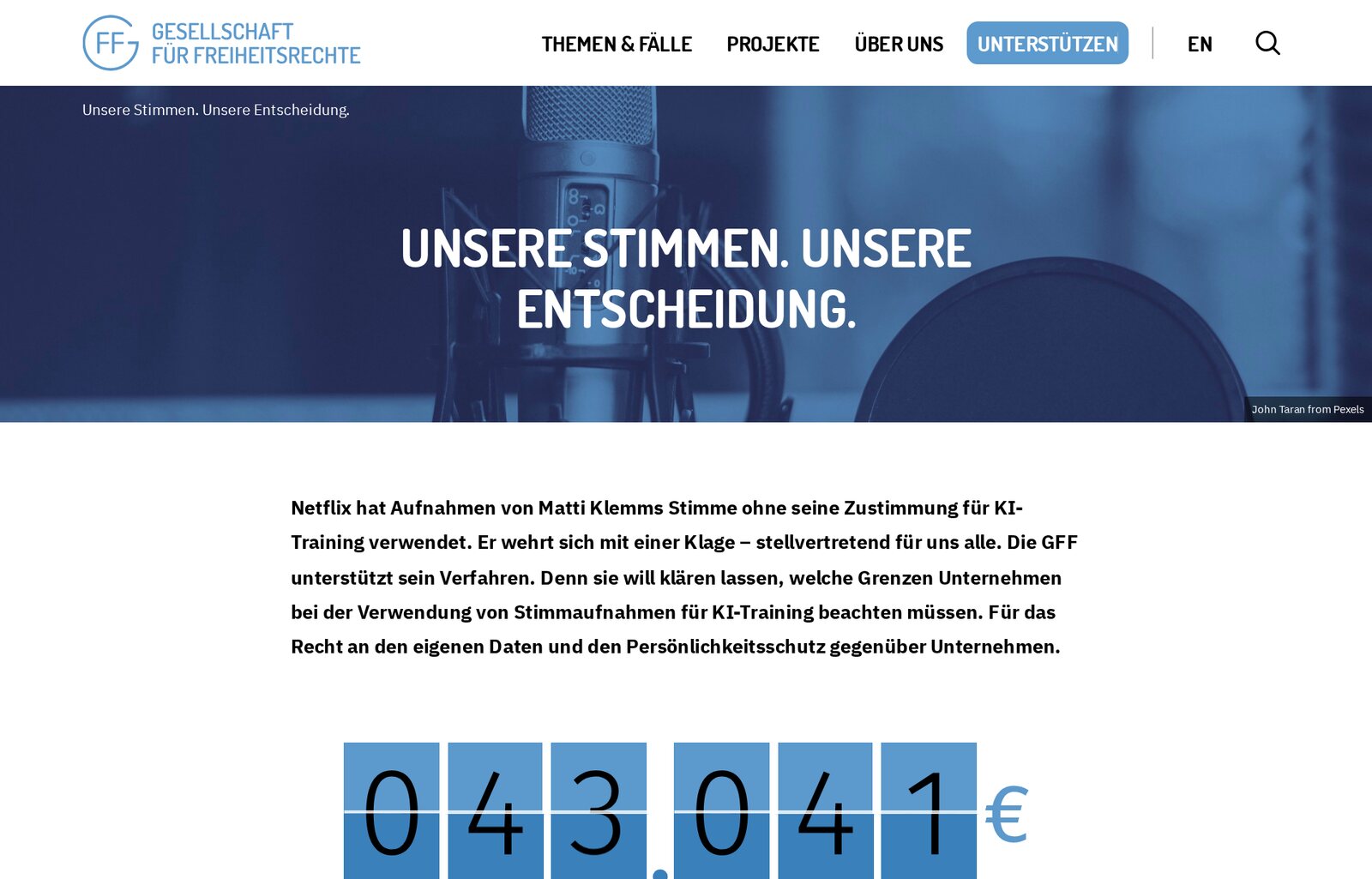
Klemm’s own words on the GFF campaign page are blunter. “Netflix is training an AI with my voice and I fear that it’s meant to take over my work,” he says. “I won’t put up with that!”
What the lawsuit asks for
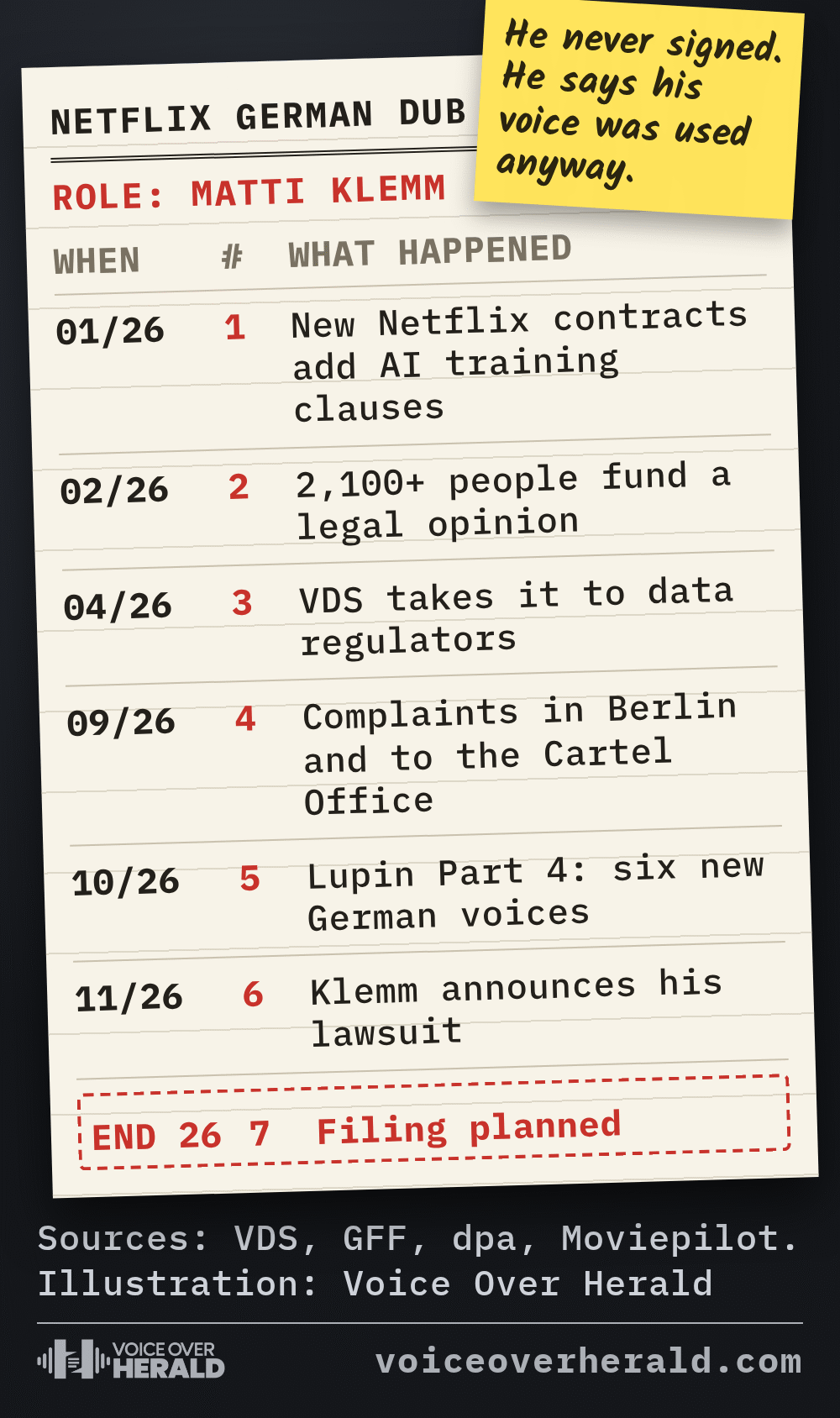
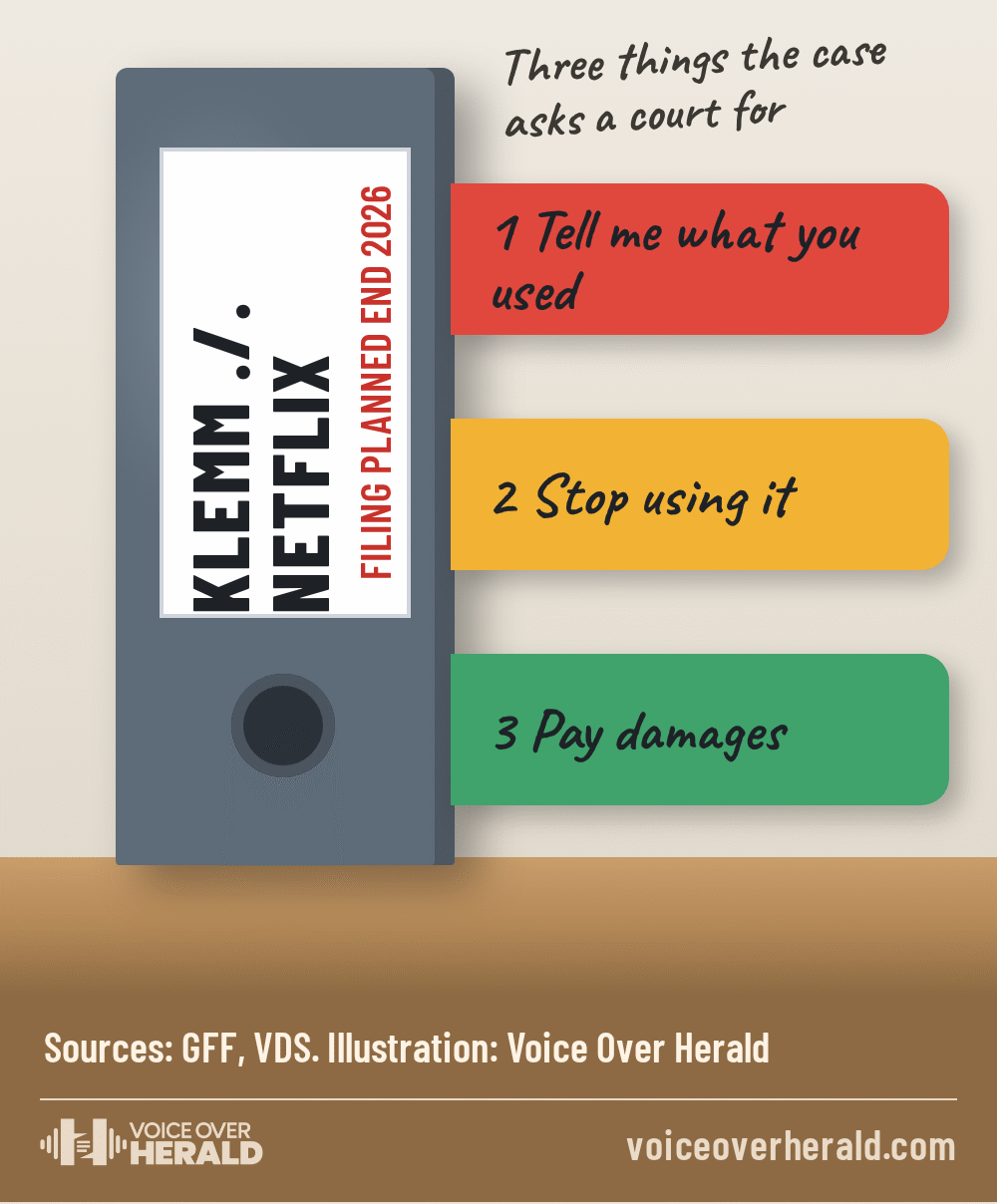
The GFF says it plans to file the case with Klemm at the end of 2026 and has set out three things it wants a court to decide. First, disclosure: Netflix should reveal how much of Klemm’s voice data it used and which AI systems were trained on it. The GFF says Netflix’s reply so far “confirms the use” but doesn’t explain enough about what actually happened to his data. Second, an order stopping Netflix from using his voice data to train its AI systems in future. Third, a ruling that he’s entitled to damages, which the group hopes other affected voice actors could build on.
It won’t be cheap. The GFF warns that a case taken through every level of the courts can cost a six figure sum, and it has opened a crowdfunding campaign at Unser Werk, unser Recht to pay for this case and further strategic suits.
Dr. Jonas Kahl, the copyright and media lawyer at Spirit Legal who represents Klemm, put the case in two sentences. “Netflix confirmed to our client itself that it uses his voice to train its own systems. He was never asked, and he wasn’t paid either,” he said in the VDS statement. “We will take the case all the way to the court of last resort if necessary.”
A fight that started at the start of the year
The lawsuit is the latest step in a dispute the VDS has been pushing for months. In February, the GFF says, more than 2,100 people backed a fundraising campaign by German dubbing artists to pay for a first legal opinion. In April the VDS said it had asked Spirit Legal to take the matter to the data protection authorities, arguing that voice recordings which let a speaker be recognised and copied are biometric data under the GDPR, and that consent given when the alternative is losing the role is neither free nor informed.
 VoiceEditSuiteNewIt edits like you would, and it gets better every file.Learns from numbers, never your audio. Never used to train AI.See how it works
By early September Klemm and other voice actors had filed a complaint with Berlin’s data protection commissioner, and the VDS had asked the Federal Cartel Office to look at whether Netflix is abusing its market position. “From our experience, many voice actors feel forced for economic reasons to sign the AOR agreement, including the consent to AI training,” the association said at the time.
Viewers have started to hear the effect. In late October the German film site Moviepilot reported that six German voices in Lupin Part 4 had changed, with Anne Helm, the German voice of Ludivine Sagnier’s Claire, among those replaced. Helm is one of the dubbing artists who have publicly backed Klemm. “We’re not only fighting for ourselves, but also for recognition of the work of all other creatives,” she says on the GFF campaign page.

Anne Helm, one of the dubbing artists backing Klemm. Image: Ben Gross, via GFF
Why a German case matters outside Germany
The VDS doesn’t see this as a single grievance. “For years, many corporations have used copyright-protected works and personal data to train their AI systems without asking the people behind them,” the association’s chair, Anna-Sophia Lumpe, said. The lawsuit, she said, is meant to settle whether they were allowed to.
Klemm says the same. “We urgently need a precedent because this affects the entire creative industry,” he said, adding in the VDS statement that he’s happy to stand out in the rain for everyone, and hopes enough people chip in for a good umbrella.
For working voice actors anywhere, the most useful part of this story may be how it began. Klemm didn’t need a leak or a whistleblower. He used the right of access that European data protection law gives every person, asked a company what it does with his recordings, and got an answer in writing. Anyone whose recordings are handled under European data protection law can ask the same question.
The case also lands as voice actors elsewhere win contract language on the same question. In the United States, SAG-AFTRA members have just ratified a TV animation deal under which a digital replica needs the performer’s consent before it can dub them. And at a roundtable in Seoul last month, Netflix said each dubbed language takes 50 to 60 people and called AI a tool. Klemm’s lawsuit asks a different question: what happened to the recordings made before anyone was asked at all.
The VDS says it represents about 700 voice artists in Germany, Austria and Switzerland, a large share of whom regularly dub Netflix originals. Netflix had not commented on the planned lawsuit itself beyond its statement to dpa when this article was published.
Sources: Verband Deutscher Sprecher:innen statement, 3 November 2026; Gesellschaft für Freiheitsrechte campaign page; dpa via Yahoo, 3 November 2026; VDS statements of 17 April and 3 September 2026; Moviepilot, 26 October 2026. Quotations from German sources are translated by Voice Over Herald. Image: screenshot of the GFF campaign page, 4 November 2026.
Lee este artículo en español: Netflix le confirmó que entrenó IA con su voz. Ahora la voz alemana de Jason Momoa la demanda
Know something about this story, or spotted an error? Tell the newsroom.