
Amazon Polly Can Now Clone a Voice From a Few Minutes of Audio. The Speaker’s Consent Is a Box the Customer Ticks
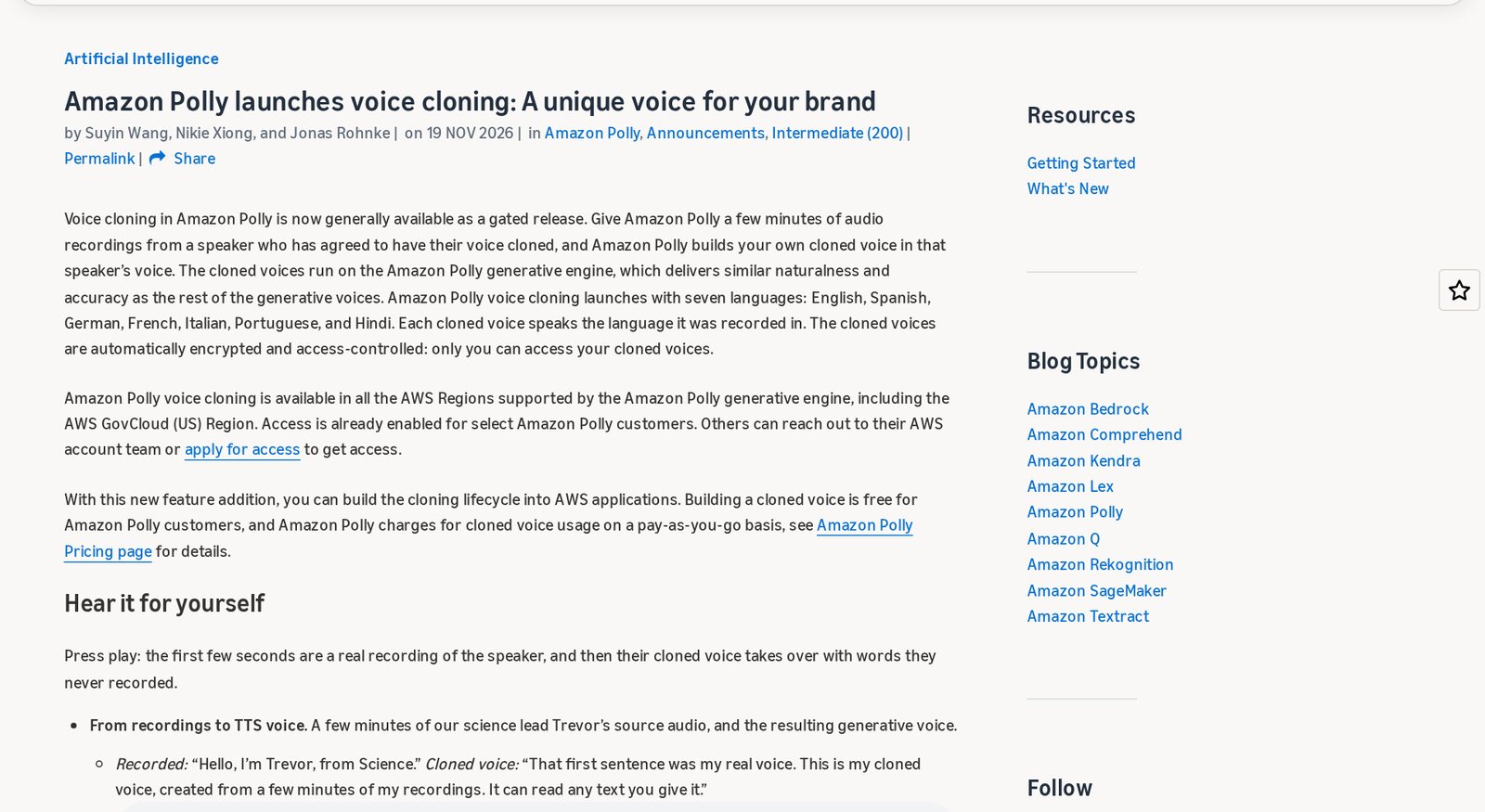
Amazon Polly, the text-to-speech service inside Amazon Web Services, can now build a custom voice from a few minutes of one person’s recordings. AWS is selling it as a brand voice for phone lines, apps, shop announcements and courses, the bread-and-butter work of a lot of voice actors. The consent check is a box the customer ticks.
AWS announced the feature on 19 November in a post on its machine learning blog, written by Suyin Wang, Nikie Xiong and Jonas Rohnke of the Polly team. It’s “generally available as a gated release”, which means AWS switches it on account by account. Some Polly customers already have it, and others can apply.
The pitch is simple. “Give Amazon Polly a few minutes of audio recordings from a speaker who has agreed to have their voice cloned, and Amazon Polly builds your own cloned voice in that speaker’s voice,” the post says. Building the voice is free, and customers pay for what it reads, as they do with Polly’s other voices.
You can hear it before you read on
The AWS announcement opens with audio. Each clip starts with a few seconds of a real person, then hands over to the clone reading words that person never said. In the first, the team’s science lead, Trevor, says “Hello, I’m Trevor, from Science,” and then his cloned voice carries on: “That first sentence was my real voice. This is my cloned voice, created from a few minutes of my recordings. It can read any text you give it.”
Other clips put cloned voices into jobs voice actors know well: a support line reading an order number and a delivery window, a course narrator explaining how a neural network learns, and a grumpy character guarding a bridge in a game. It’s worth five minutes of your time with headphones on.
From AWS's announcement, 19 November 2026. Screenshot: Amazon Web Services blog
The work AWS is aiming at
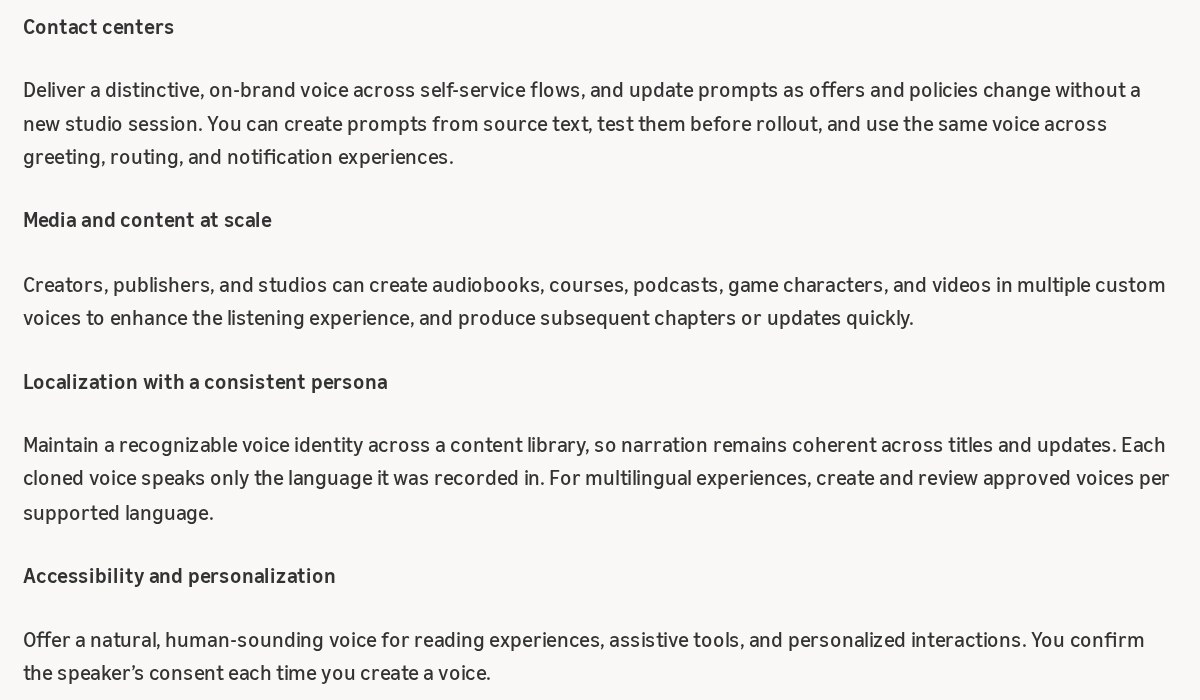
The post is plain about where the voice is meant to go. One brand voice can run across “your interactive voice response (IVR) system, cascaded voice agents, mobile app, in-store announcements, advertising, and connected devices,” it says. And then the line every phone line and e-learning narrator will notice: “Rather than relying on a generic stock voice or re-booking a recording session each time a script changes, you can generate on-brand audio on demand.”

That’s the update work. The new promotion on the hold message, the changed opening hours, the revised module in a compliance course. For many working voice actors those small pickups are steady income, and they’re exactly what this tool is built to remove.
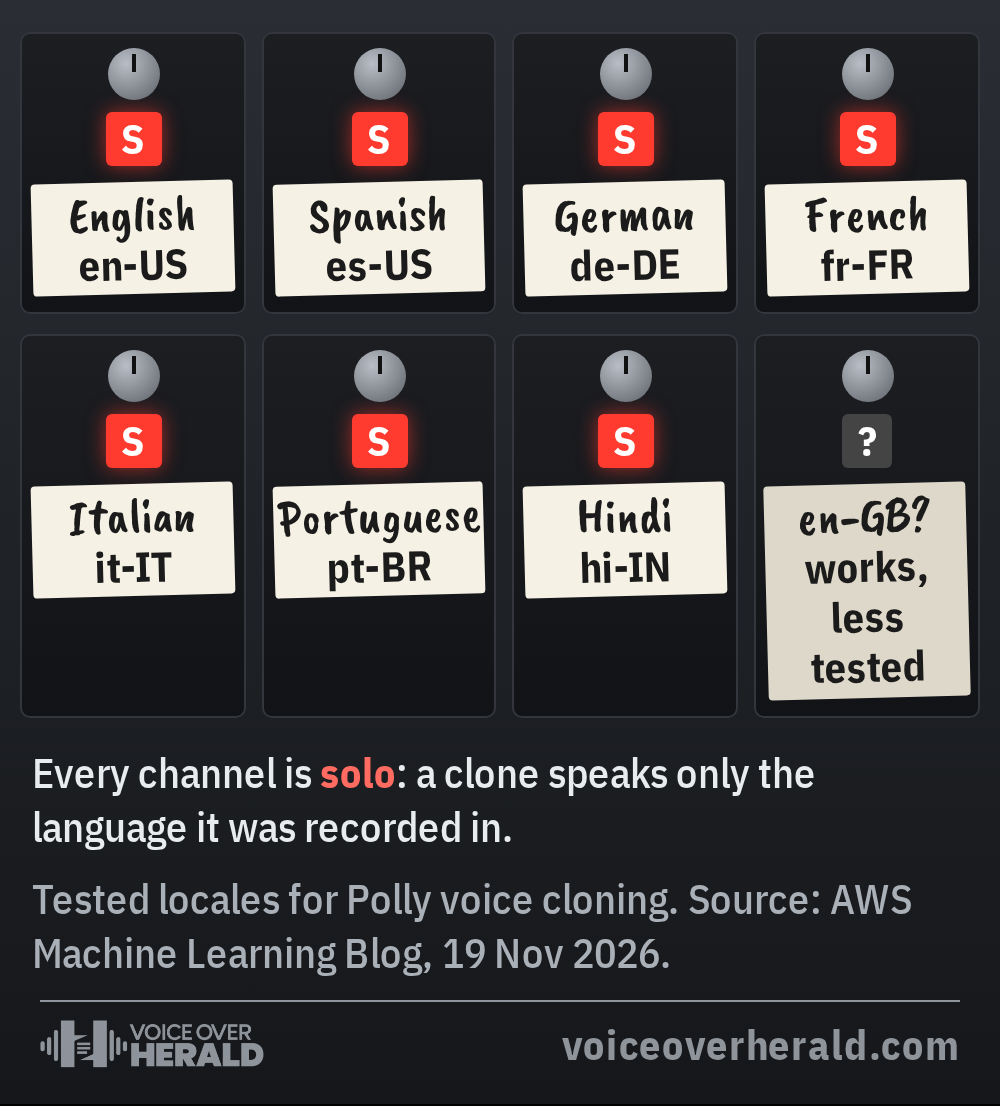
AWS also lists audiobooks, courses, podcasts, game characters and videos, and “subsequent chapters or updates” produced quickly. Each cloned voice speaks only the language it was recorded in, and seven languages are supported at launch, each tested with one particular accent.
What the recording session looks like
AWS doesn’t ask for a studio: a USB microphone or a phone app that records WAV will do, it says, though the clone learns everything in the room. Even a meeting app’s noise filter ends up in the voice, because “the clone learns those changes too.” The rest of the recipe fits on one picture.
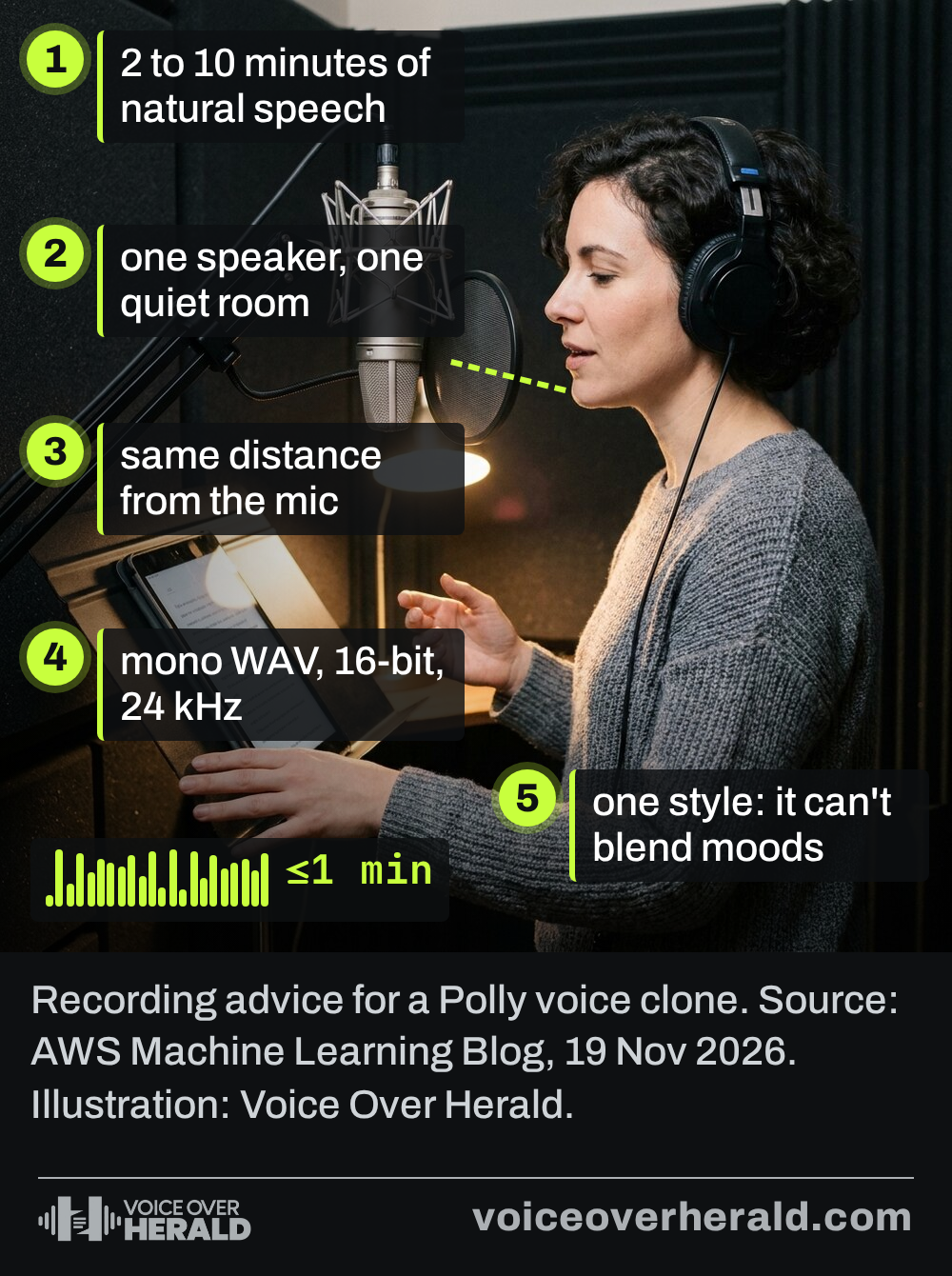
One detail matters for performers. “The cloned voice takes its style from the recordings and can’t blend several, so upbeat, sad, and angry takes won’t give you a voice that can do all three,” AWS writes. A clone is one read, frozen. If a client wants range, it needs separate voices, and that means separate sessions.
Consent is a box the customer ticks
This is the part working voice actors should read twice. When a customer creates a voice, it sets one value in the request, TermsAccepted=True, which AWS describes as “your confirmation that you have the speaker’s consent.” The post describes no step in which the speaker records a consent statement or confirms who they are. The responsibility sits with the business doing the cloning.
The customer confirms
A customer ticks the terms, confirming it has “all rights and consents necessary to create and use the cloned voice.” Use is also subject to AWS’s service terms, its Biometric Notice and Consent Terms and its responsible AI and acceptable use policies.
The customer should
Keep a record of each speaker’s consent, delete the voice if the speaker withdraws it, tell listeners when they’re hearing a synthetic voice “where that’s appropriate”, and limit who can use it.
There are real protections in the design. “Amazon Polly adds a watermark to text-to-speech audio generated with the cloned voice,” the post says. A cloned voice is locked to the account that made it. Polly deletes its copy of the recordings once the voice is built, doesn’t use them to train its models, and removes the voice data immediately when the customer deletes the voice.
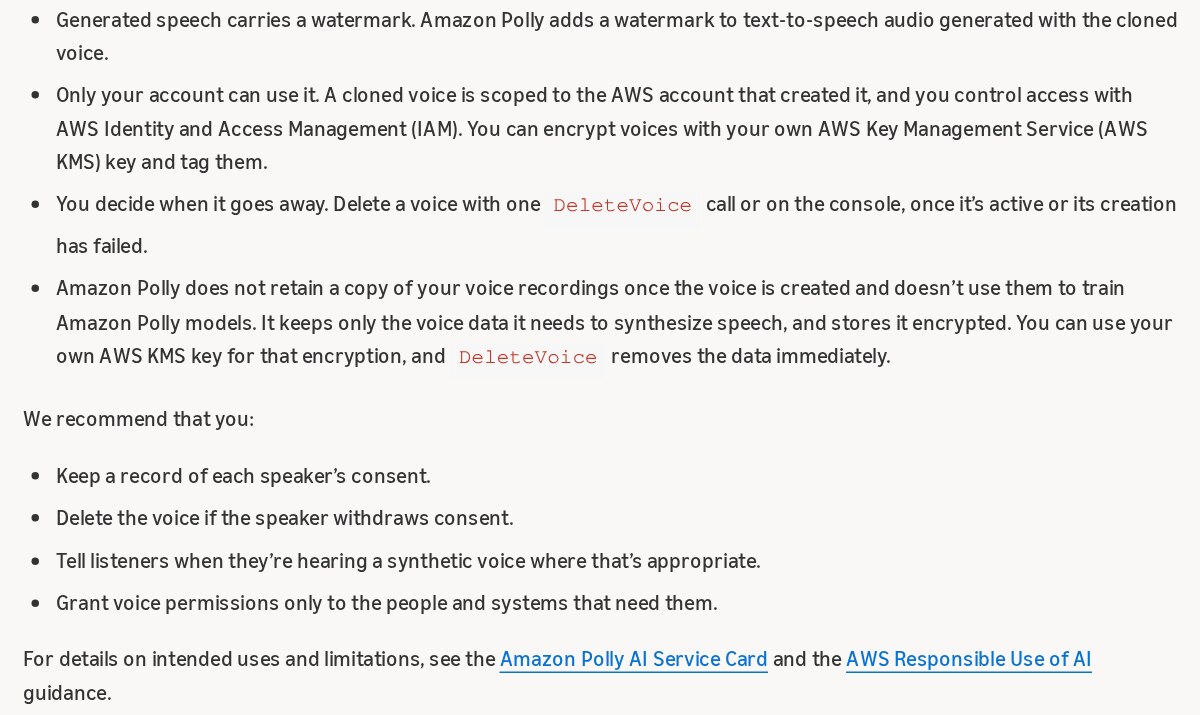
AWS's consent rules for cloned voices, 19 November 2026. Screenshot: Amazon Web Services blog
And one line will matter in contracts. A voice exists only in one account and one AWS region, so serving another region means building it again from the same recordings, and AWS tells customers to “make sure the speaker’s consent covers every copy.”
What to ask before you sign
None of this stops a voice actor from saying yes. Some will, and some will be paid well for it. But the consent here is whatever you signed, so the paperwork is where your protection lives. Before you record clone material for a client, it’s fair to ask:
- Which tool and which account will hold the voice, and how many copies, in which regions?
- What can it read, for how long, and is it paid per use, per year or once?
- Will listeners be told it’s synthetic?
- How do you withdraw consent, and who confirms the voice was deleted?
Unions are pushing the same questions. Voice Over Herald has reported recently on SAG-AFTRA’s chief and his test for a voice replica, and on Audible putting a virtual voice beside narrators’ samples.
Proving which recordings are yours
Polly marks what the clone says. The other half of the problem is proving which recordings are really the actor’s. The Voice Realm says it’s the world’s first voiceover marketplace to protect voice actors’ demos with an invisible watermark: once a voice actor switches on Voice Lock, their demos carry a mark and a dated certificate that anyone can check online. It doesn’t detect clones. It shows which recordings came from you, and when, which is handy if you ever need to show a client what you did and didn’t record.

 VoiceEditSuiteNewYour breath. Your pace. Your edit.Learns from numbers, never your audio. Never used to train AI.See how it works
Amazon has made cloning a feature you can request from an account team. The session that feeds it is still a human being reading in a quiet room, and that session is worth pricing like it’s the last one you’ll be asked for.
Sources: Suyin Wang, Nikie Xiong and Jonas Rohnke, “Amazon Polly launches voice cloning: A unique voice for your brand”, AWS Machine Learning Blog, 19 November 2026; Unite.AI, “Amazon Polly Adds Gated Voice Cloning for Custom Brand Voices”, 19 November 2026. Main image and screenshots: Amazon Web Services blog, taken 21 November 2026.
Lee este artículo en español: Amazon Polly ya clona una voz con unos minutos de audio. El consentimiento del hablante es una casilla que marca el cliente
Know something about this story, or spotted an error? Tell the newsroom.