

Equity Warns Voice Actors Off a Game Casting That Wants Their Voices for AI Training, Forever
Britain’s performers’ union has told its members to “proceed with extreme caution” over a video game casting that wants their voices for AI training and asks them to sign away every right in the performance. Equity can’t name the game or the studio. The full terms only arrive under a non-disclosure agreement, and that’s part of the problem.
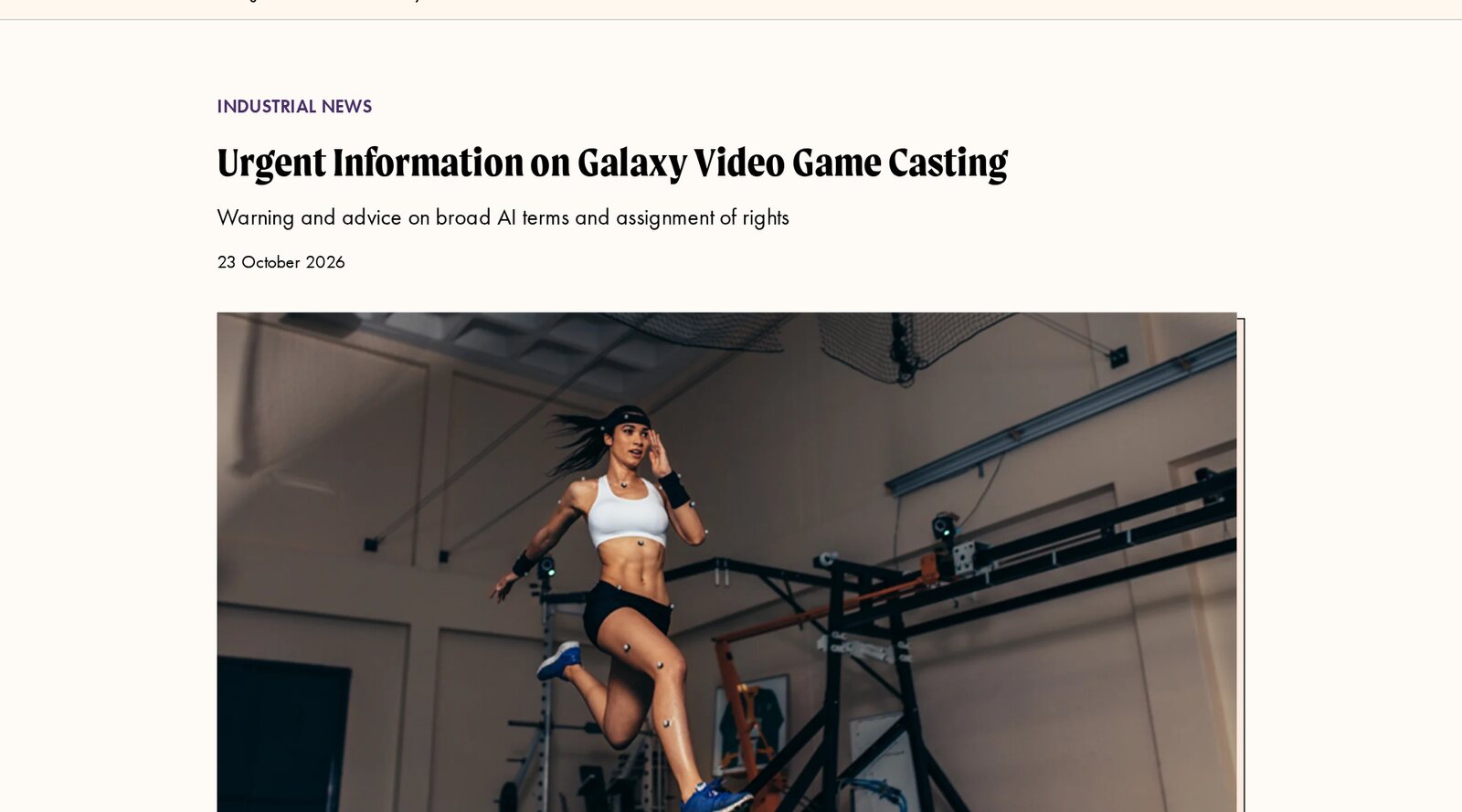
The warning went up on Equity’s website on Friday, October 23, under the title “Urgent Information on Galaxy Video Game Casting.” The union says it was made aware of a casting that “explicitly outlines the use of AI and a full assignment of rights to the end client,” meaning the publisher of the game. Agents and performers were sent the basic details. Everything else, the actual contract, comes later and under an NDA.
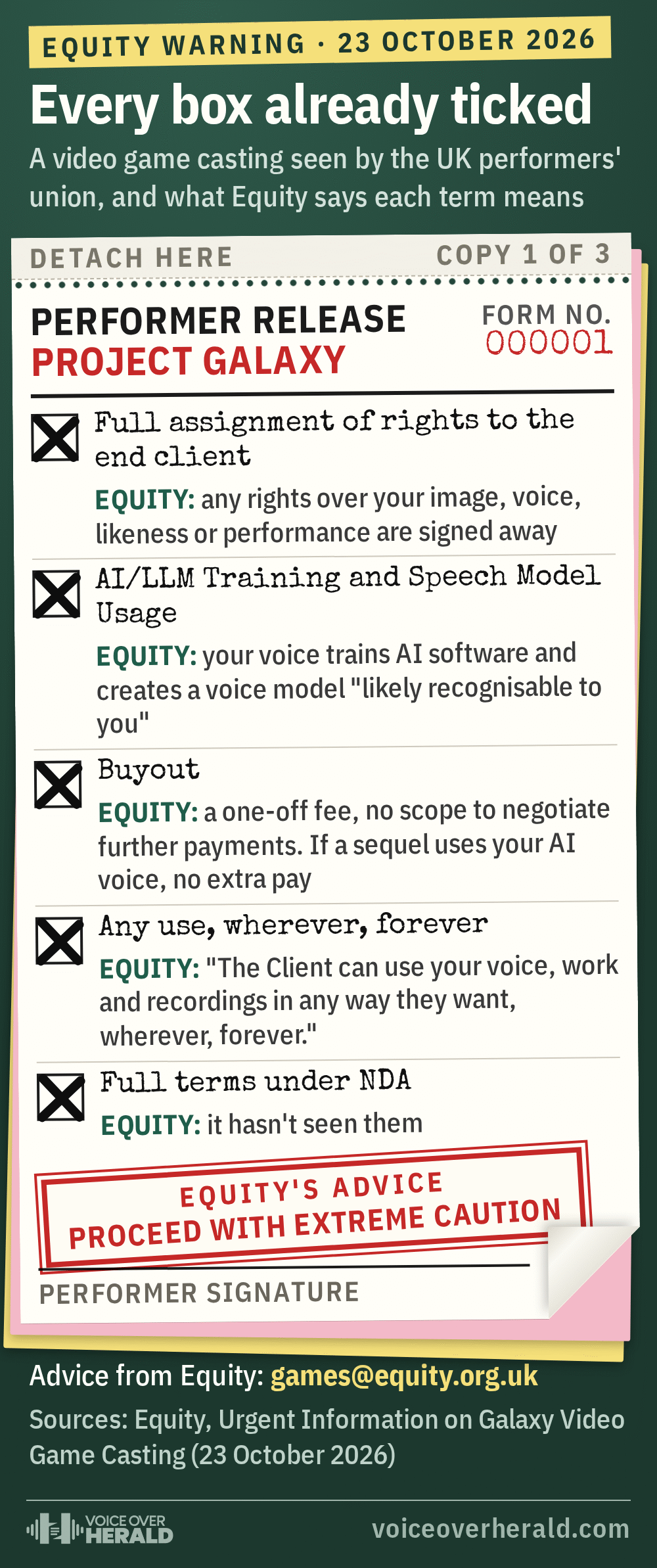
That leaves Equity in an odd spot. It’s warning people about terms it hasn’t read in full. “Equity have not seen these detailed terms and the advice in this post is based on the information available to us at the minute,” the notice says. “We are also unable to name the game or studio due to this NDA.” It adds that the detailed breakdown “may differ from what is advised here.” So the union did the next best thing. It took the three phrases in the casting and explained, in plain English, what each one would mean for the person in the booth.
Three phrases, and what they’d cost you
The first is a full assignment of rights. In Equity’s words, that means “any rights a performer has over their image, voice, likeness or performance is signed away.” Once it’s done, it’s done. “Performers would have no rights in future to consent to any other use of this work,” the union writes.
 VoiceEditSuiteAuto Clean Up now learns you.Your breath, your pace and every fix you make, so each file comes back sounding like you edited it yourself.See how it worksLearns from numbers, never your audio. Never used to train AI.
The second is the one that will make most voice actors put their coffee down. The casting mentions “AI/LLM Training and Speech Model Usage.” Equity spells it out: “Your voice would be used to train large language model / AI software and create a voice model, likely recognisable to you.” The risk, it says, is that you’d have no legal ownership of that AI voice. “Sessions for which you may have been paid for your studio time can be replaced with using your AI voice.”
The third is a buyout, a single fee for the work and every use of it. Voice actors know buyouts from commercial work. Here it’s attached to a voice model. Equity’s example is a sequel. If one gets made and your AI voice is used in it, the union says, “you’d receive no additional payment.”
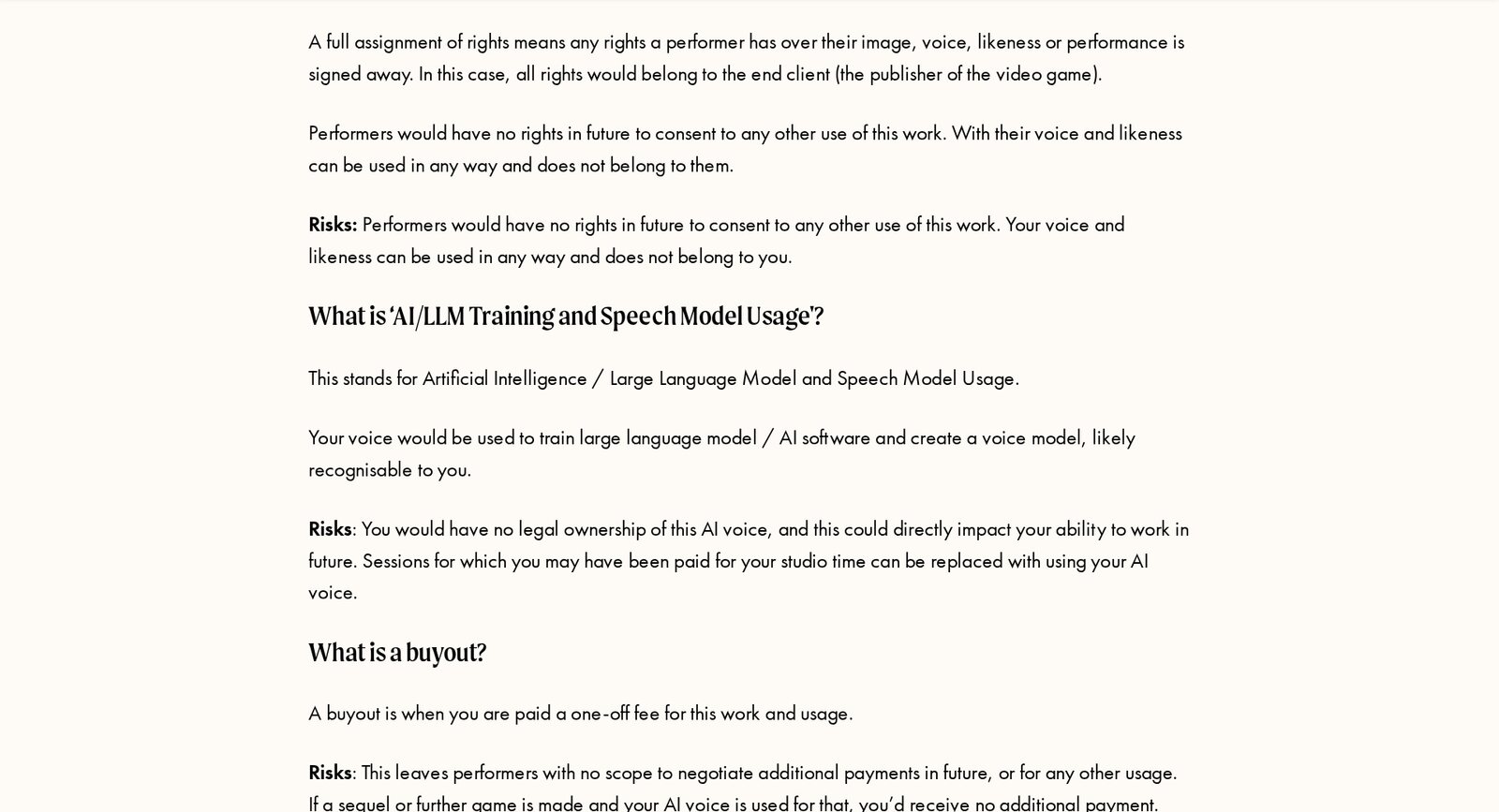
Image: Equity, October 23, 2026
“Wherever, forever”
Put the three together and the reach is wide. “The Client can use your voice, work and recordings in any way they want, wherever, forever,” Equity writes. That could include film or TV adaptations of the game, or later games in the series, with no new fee for any of them.
It isn’t only about money. The notice warns that a voice “recognisable to you as an individual” could be made to say things you never said, “or even express views you don’t hold and could have refused to say or perform in studio.” Your likeness, it says, “would be forever attached to this project in a way that you cannot stop or influence.”
For a working voice actor, that’s the bit that stings. Saying no to a line in the booth is one of the few bits of control you have on a job. A model that can read anything takes that away for good, and nobody has to call you to ask.
Why Equity says it’s bigger than one game
The union is careful not to tell anyone what to do. “It is up to each performer as an individual to decide if any project is right for them,” it says, though it wants performers and agents to know the risks before they go any further.
But it’s blunt about what happens if enough people sign. Agreeing to terms like these with no room to negotiate, Equity says, “weakens the industry’s resistance to AI.” It stresses this isn’t a blanket refusal: “Equity’s position on AI is not one of refusal, but ensuring performers are entitled to fair compensation for such work and importantly, control and consent.” The terms it has seen in this casting, it says, “do not offer this.”
It’s the same fight unions are having everywhere this autumn. In the United States, SAG-AFTRA’s members have until Thursday to vote on an animation deal that would need a performer’s consent before a digital replica dubs them into another language. In Japan, the actors’ union published its first rules on AI voices earlier this month. What’s different about Galaxy is that it sits outside any of that. It’s a casting call, it’s live, and it asks for everything up front.
The survey that landed a day earlier
The day before the warning, on Thursday, October 22, Equity published a survey of more than 2,100 of its members, from actors and comedians to dancers, designers and stage managers. A “whopping” 91% support bringing in personality rights to tackle AI exploitation, the union reports. Among members who’ve already had their voice or likeness digitally captured, only 13% feel confident it will be used in places and ways they’ll be told about and are happy with.
General secretary Paul W Fleming said members welcome the government’s “positive overtones” on personality rights, both as a legal safeguard and as a base for collective bargaining. “It’s time for the government to move at speed on their introduction,” he said. In the meantime, he says, the union is “holding engagers of entertainers, audio artists, and others to account through the courts and growing unionisation.”
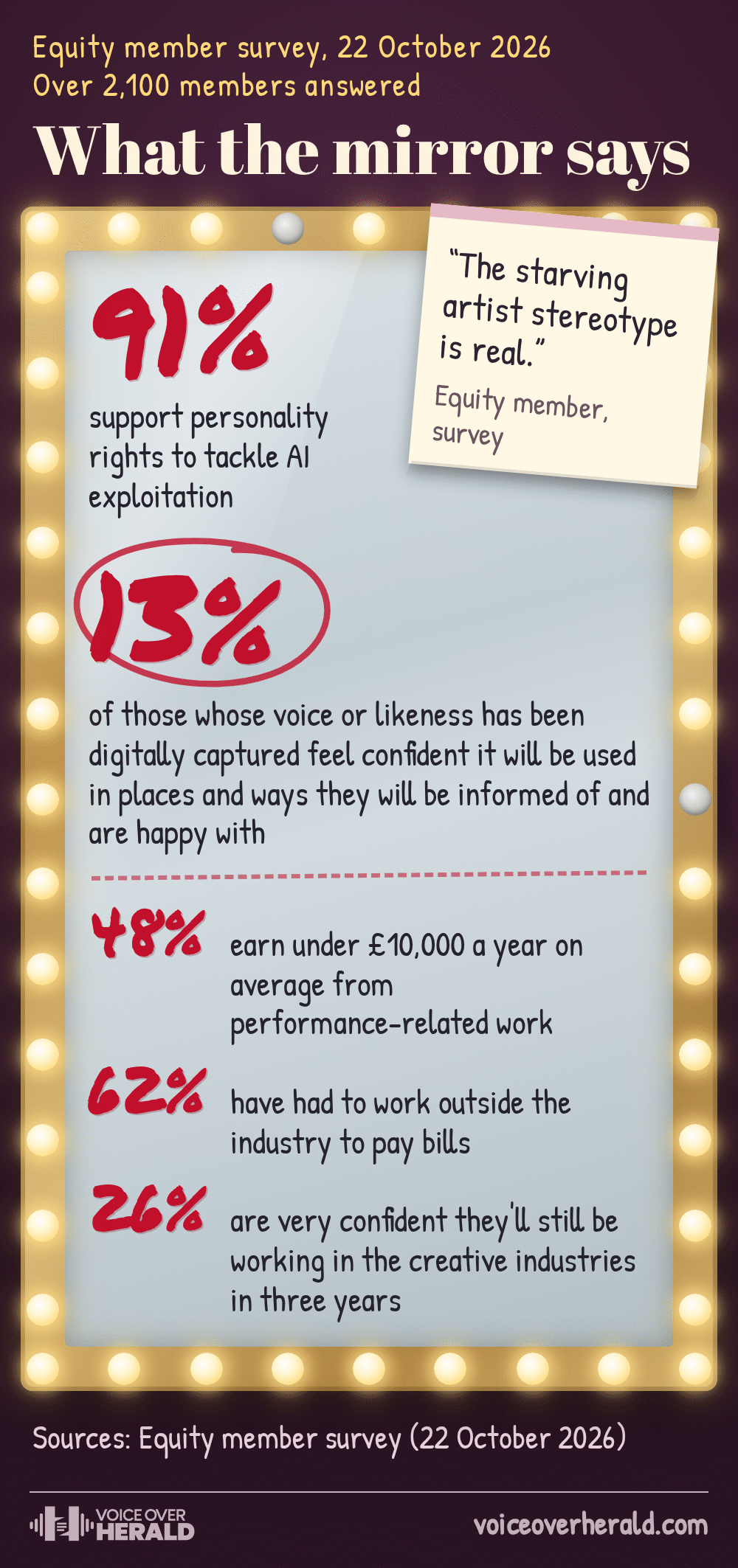
The rest of the survey explains why a big one-off fee can look tempting. Fleming called the results “stark,” with “a majority having to supplement their earnings from the creative industries with work elsewhere in order to pay the bills.” One member put it more simply: “I just hate having to choose between my career that I love and keeping a roof over my head.”
If this casting lands in your inbox
Equity’s advice is practical, and it’s worth keeping even if this particular job never reaches you.
- Read the words. Look for “assignment of rights,” “AI/LLM Training and Speech Model Usage” and “buyout” in any casting or contract.
- An NDA isn’t a gag on advice. “Performers are entitled to seek advice on contracts, even under an NDA, from a professional body including your trade union.”
- Talk to your agent first. The union wants performers and agents to know the risks “before going further with this project.”
- Ask the union. Equity’s games team takes questions at games@equity.org.uk, and its AI Toolkit and video games rate card are on its website.
That second point matters most. A lot of voice actors assume that once they’ve signed an NDA they can’t show the contract to anyone. Equity says that’s not so when the person you’re showing is your union or another professional body. If a casting wants your voice forever, it’s worth one email to find out what forever means.
Sources: Equity, “Urgent Information on Galaxy Video Game Casting” (October 23, 2026); Equity, “Equity survey shows precarity of creative workforce” (October 22, 2026); Voice Over Herald reporting on SAG-AFTRA and the Japan Actors Union. Hero image: Equity’s website.
Lee este artículo en español: Equity advierte a los actores de voz sobre un casting de videojuego que quiere sus voces para entrenar IA, para siempre
Know something about this story, or spotted an error? Tell the newsroom.