
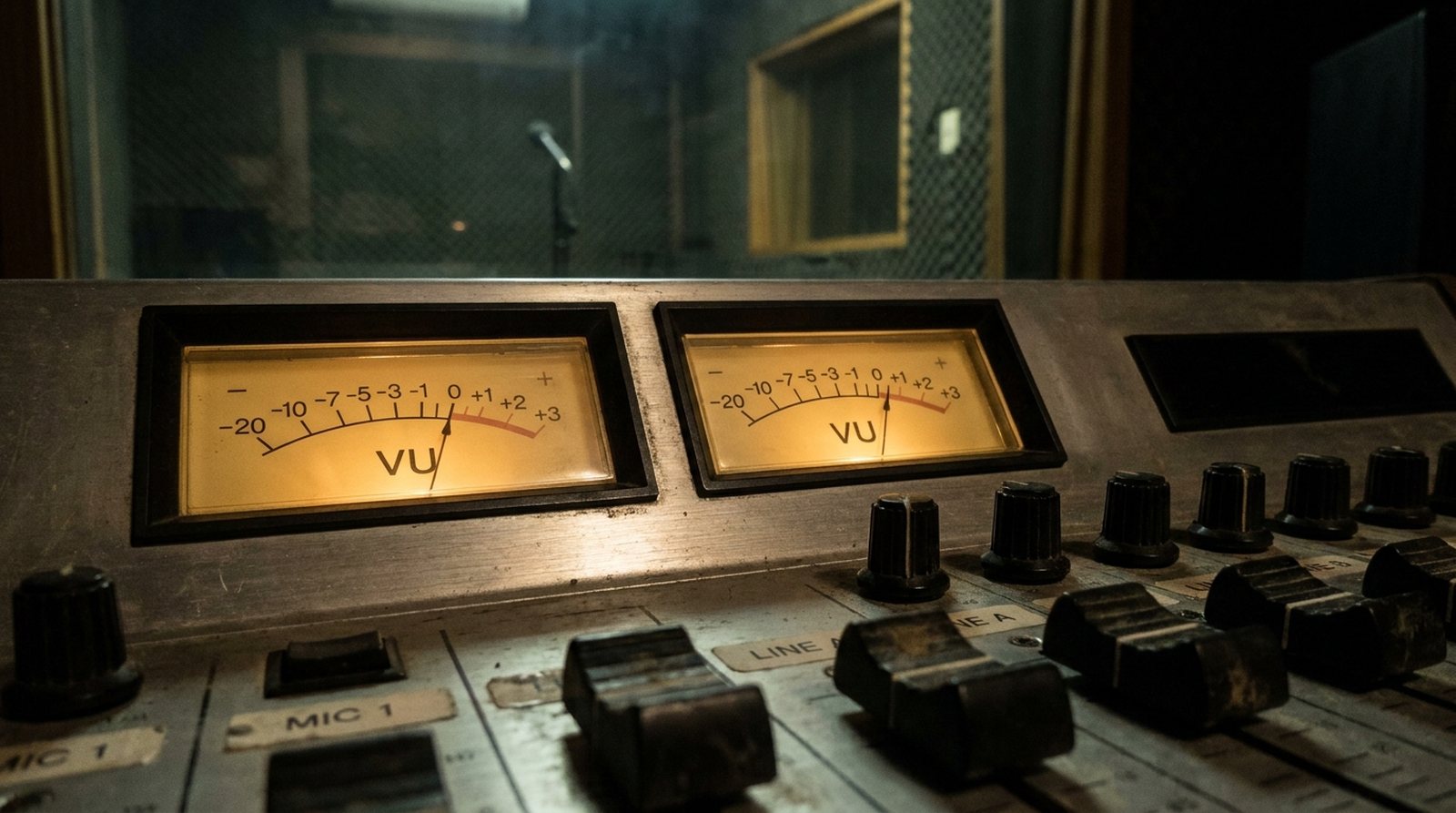
Minus 23, Minus 24, Minus 16: The Loudness Numbers in Your Briefs, and Who Wrote Them
Every few months a brief lands with a number in it: deliver at -23, master to -16, peaks under -3. Those numbers aren’t the client being fussy. Each one comes from a body that publishes it, for a reason you can read, and once you know who wrote which number, a delivery spec stops looking like a riddle. Here’s the reference card, sourced line by line.
This is a bookmark piece. It covers the targets a working voice actor is most likely to be asked for, from audiobooks to broadcast commercials, streaming drama and podcast ads, and it quotes the documents themselves so you can check the wording before you argue with an engineer. Specs change, so the date each was read is in the Sources line.
Loudness took over from the peak meter
For decades, levels were set by peaks. The trouble is that two files can peak at exactly the same point and sound wildly different in volume, because one is a quiet read with one loud word and the other is squeezed flat and loud all the way through.
 VoiceEditSuiteThe Cold ReadPractise the skill that books work.A fresh script and brief every take, timer hidden.See how it works
The European Broadcasting Union spells out why it changed course in its loudness recommendation, R 128. It says peak normalisation “has led to considerable loudness differences between programmes and between broadcast channels”, and that “the resulting loudness inconsistencies between programmes and between channels are the cause of the most viewer/listener complaints.” So instead of peaks, broadcasters now measure the average loudness of the whole programme, using a method defined by the International Telecommunication Union in a standard called ITU-R BS.1770.
That’s where the units come from. LUFS and LKFS are the same thing with two names: the EBU’s own document notes that “LUFS” is equivalent to “LKFS”, and that it prefers LUFS for naming reasons. One loudness unit is one decibel, so a file measuring -20 that needs to hit -23 comes down 3 dB. Free TV Australia’s guidance puts it simply: “the steps between LKFS units are equal to 1dB intervals.”
Audiobooks: ACX counts in RMS, not LUFS
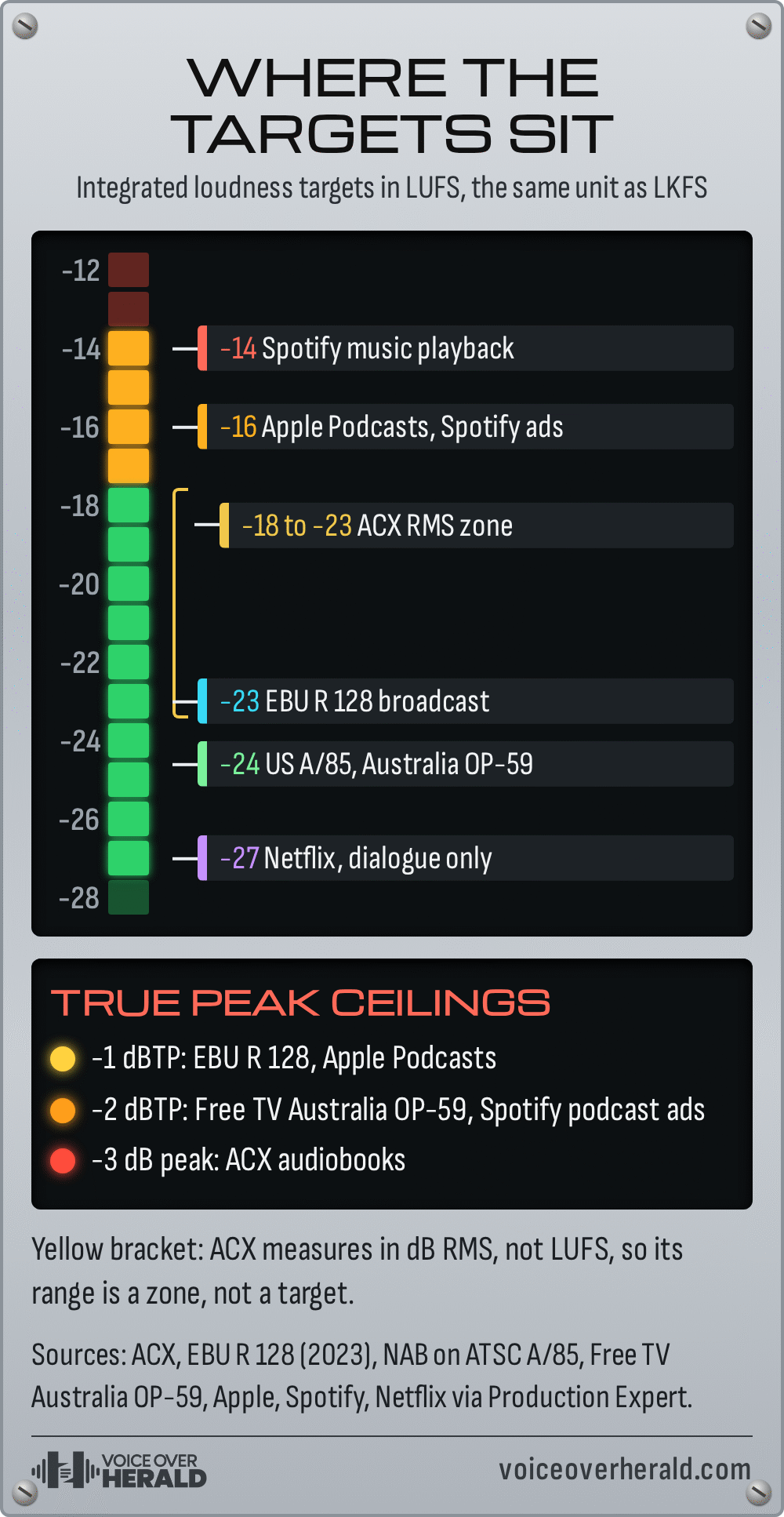
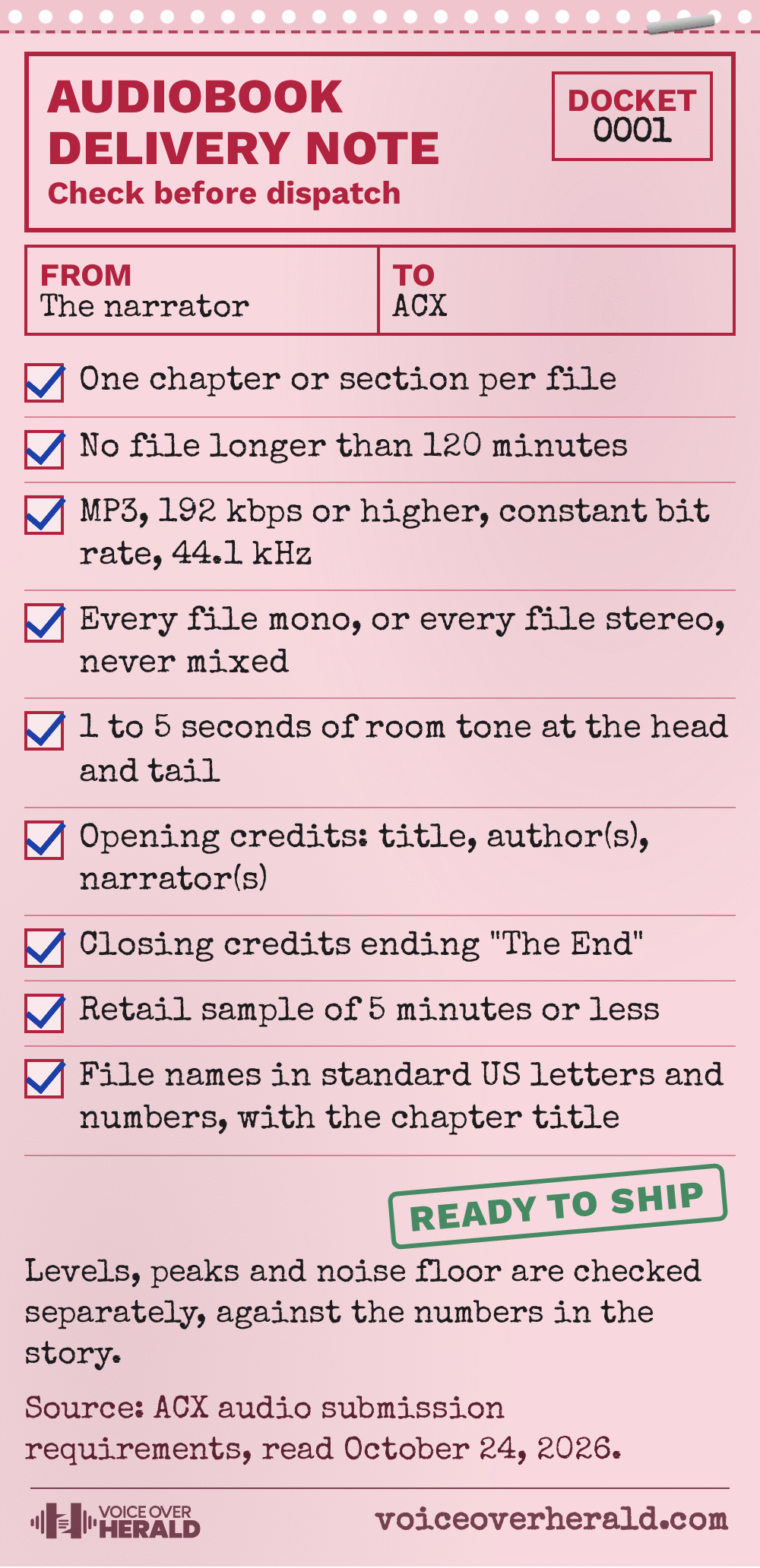
The one spec almost every narrator meets first doesn’t use LUFS at all. ACX, Amazon’s Audiobook Creation Exchange, asks for volume between -23dB and -18dB RMS in every file. RMS is a plain average of the signal, without the hearing curve and gating that LUFS uses, so an RMS reading and a LUFS reading of the same chapter won’t match. Measure ACX files with an RMS meter or ACX’s own audio analysis tool, not a broadcast loudness meter. ACX explains the point of the range: “By keeping all files within this range, listeners won’t have to constantly adjust the volume of their playback device.”
The ceiling is stricter than broadcast. “Each file must have peak values no higher than -3dB to avoid distortion,” ACX says, adding that the headroom “is also needed to ensure the files are successfully encoded.”
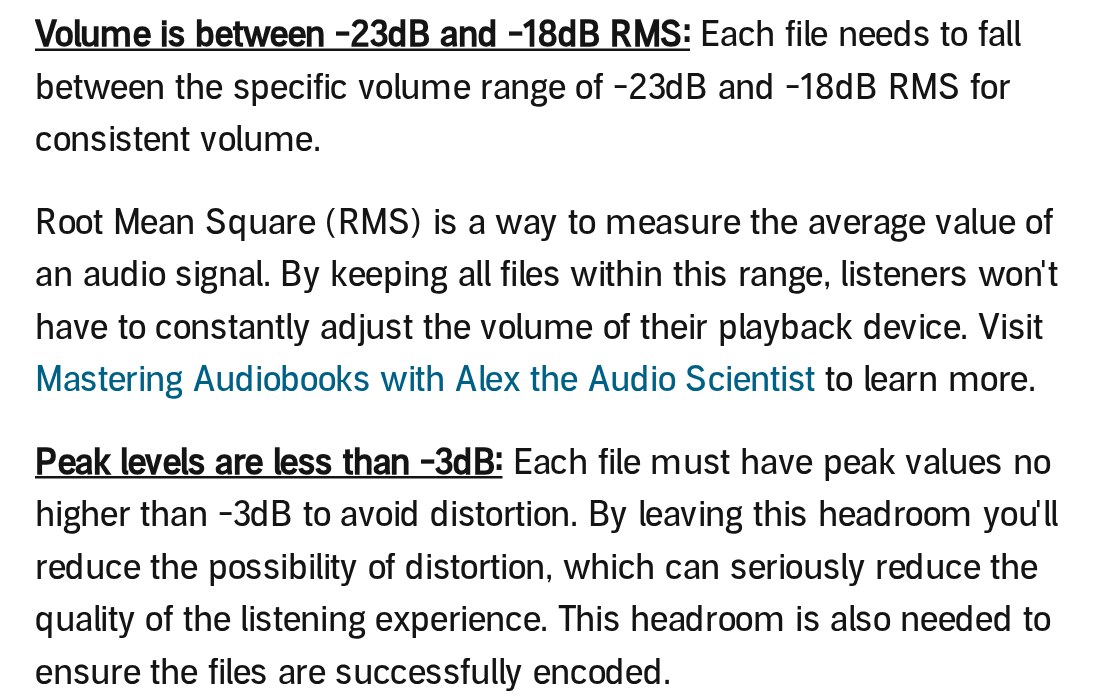
ACX audio submission requirements. Screenshot: ACX, October 24, 2026
The third number is the one that sends most first audiobooks back. “Each file must have a noise floor no higher than -60dB RMS to avoid background noise distractions,” the requirements say. Voice Over Herald built a listening test for exactly this, so you can hear what -60 dB actually sounds like next to -50 and -40 before you trust your booth.
Levels are only half of an ACX submission. The rest is housekeeping, and it’s checked just as carefully. ACX also states that an audiobook “must be narrated by a human unless otherwise authorized”, which is worth knowing if a rights holder ever suggests a shortcut.
Broadcast: -23 in Europe, -24 in the US and Australia
If your voice is going to air on television or radio, the number depends on where. In Europe, including the UK, broadcasters work to EBU R 128, last revised in November 2023. It says programme loudness “shall be normalised to a Target Level of -23.0 LUFS”, with a true peak no higher than -1 dBTP. Adverts and promos count as programmes too, with their own supplement.
There’s a tolerance of plus or minus 1 LU, but only where hitting the target “is not achievable practically (for example, live programmes).” The EBU is blunt about that wiggle room: “A broadcaster should ensure that a deviation from the Target Level towards the limits of the tolerance does not become standard practice.”
EBU R 128, November 2023 edition. Image: European Broadcasting Union
In the United States, the reference is the ATSC’s recommended practice A/85, and the law behind it is the CALM Act, which targets loud commercials. The National Association of Broadcasters’ best practices note says A/85 recommends -24 LKFS for stations using a fixed setting, and that “Most major networks have chosen to operate with a fixed target loudness of -24 LKFS, as recommended by A/85.” For short items like commercials and promos, the full mix is measured over its whole length. For long programmes, A/85 measures an anchor element, and the NAB explains that “The anchor element is usually dialog, which the listener would tend to focus on when setting the volume control.”
Australia also uses -24. Free TV Australia’s operational practice OP-59 sets a target of -24 LKFS, a permitted deviation that “shall generally not exceed +/- 1 loudness unit”, and a true peak that mustn’t exceed -2 dBTP. It has a line every voice actor who’s ever been asked to “make it louder” will enjoy: “It is undesirable and not creatively responsible to simply use aggressive compression on the final mix to reach -24LKFS compliance.”
Streaming drama listens to the dialogue
Netflix measures differently again. In 2018 it moved to a target of -27 LKFS measured on dialogue only, rather than on the full mix. Explaining the change to Production Expert, Netflix said that when it measured titles that met its earlier full-programme spec, “dialog levels clustered around -27 LKFS.”
The reason matters for anyone voicing animation, documentary narration or dubbing that ends up on a streamer. Under the old method, Netflix said, “a title could pass the spec with subaudible dialog on many devices, so long as it contained loud FX and Music content to balance it out.” It added that “Many Re-Recording Mixers asked for dialog based measurement to simplify their workflow and to ensure loudness consistency for the audience.” The number the mixer aims for is now set by the voices, which is a nice change.
If a dubbing studio sends you a spec sheet for a streaming job, that sheet is the one to follow, whatever any public number says.
Podcasts and audio ads sit louder
Podcast targets are higher. Apple Podcasts asks that audio be prepared so “the overall loudness remains around -16 dB LKFS, with a +/- 1 dB tolerance, and that the true-peak value doesn’t exceed -1 dB FS.” It also warns against chasing volume: “content that is heavily compressed and amplified might be too loud, will lack the dynamic range, and can introduce distortion.” Apple says it recommends doing this before encoding, because compression algorithms “might clip the signal if the recommended true-peak value is not respected.”
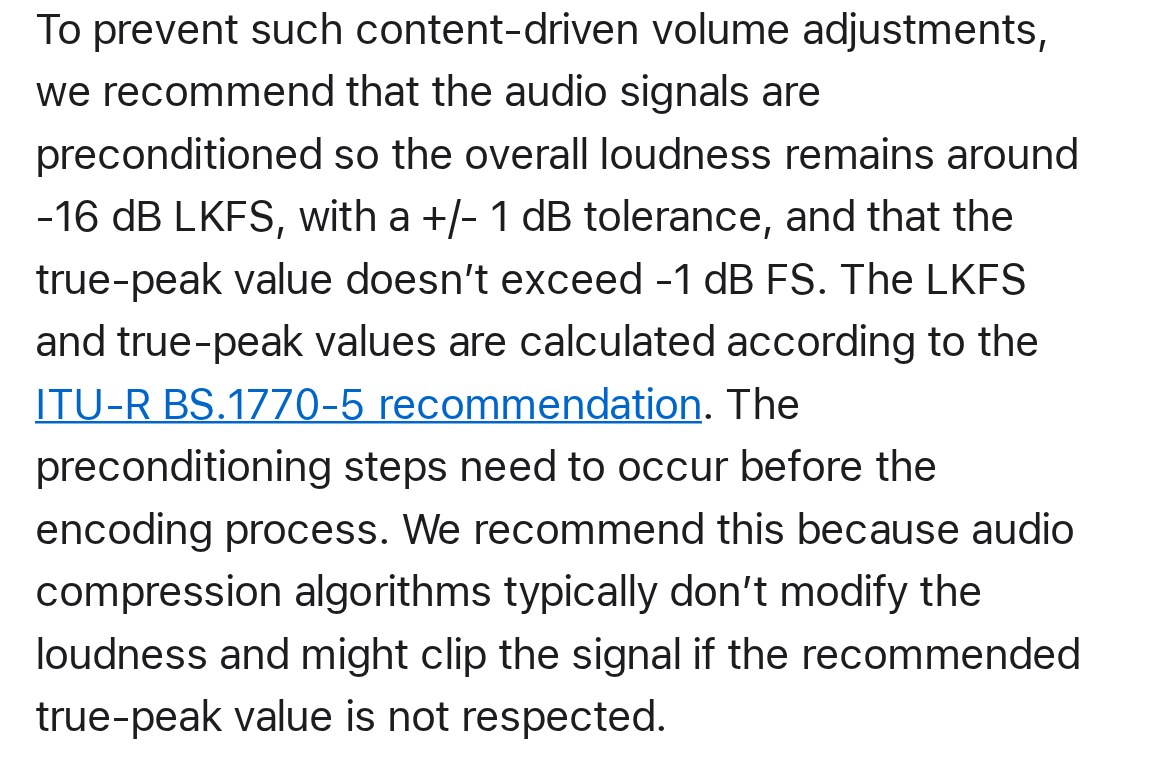
Apple Podcasts audio requirements. Screenshot: Apple, October 24, 2026
If you voice podcast ads, Spotify’s advertising team publishes the house spec for its podcast ad slots. It asks for an integrated loudness of -16 LUFS within 1.5 either way and a true peak limit of -2.0 dBTP, as a 44.1 kHz MP3 at 192 kbps, with a maximum of 30 seconds for pre-rolls and 60 for mid-rolls. It also asks producers to “Leave 0.5 sec of silence at top and tail of bounce.” Its reasoning is one any ad voice will recognise: “If listeners feel the need to adjust their volume for an ad, they’re more likely to skip or feel interrupted.”
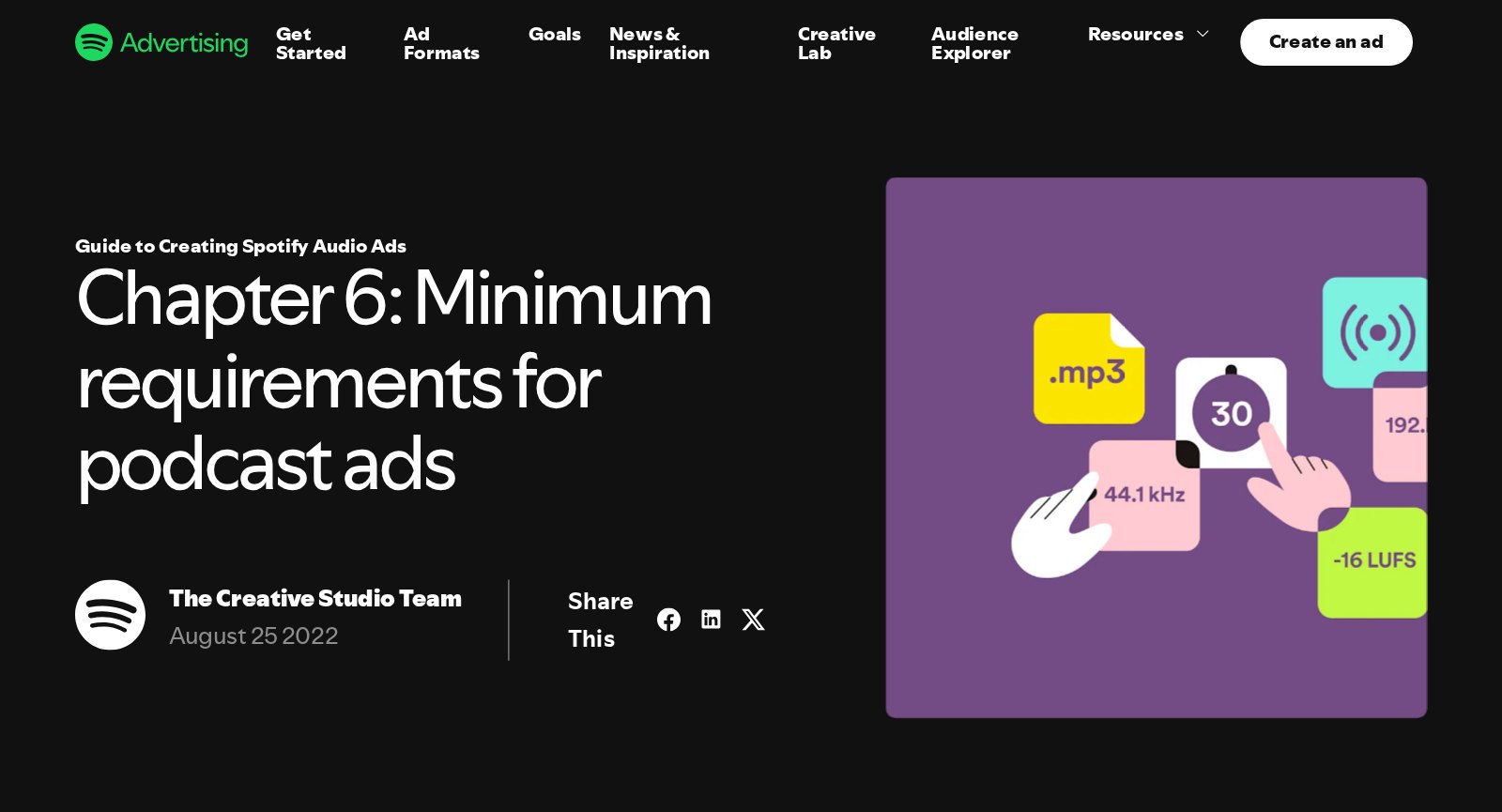
Spotify Advertising, minimum requirements for podcast ads. Screenshot: Spotify, October 24, 2026
The other Spotify number you’ll see quoted is -14. That’s the level Spotify normalises music to for Premium listeners on its Normal setting, with -11 for “Loud” and -19 for “Quiet”. It’s a playback target for songs, not a delivery spec for voice work, so if a client asks for -14 on a corporate narration, it’s worth asking where the file is going.
When the brief doesn’t give a number
Plenty of briefs say nothing about loudness, often because the producer will mix your voice under music and master the whole thing to the platform’s target. The safest move is a short, friendly question about where the audio will be heard and whether they want it raw or finished. One line in your reply can save a revision round.
- Ask where it’s going. Audiobook, broadcast, streaming, podcast or ad: each has its own body and number.
- Use the right meter. ACX is dB RMS; broadcast, streaming and podcasts are LUFS or LKFS, measured to ITU-R BS.1770.
- Check true peak, not just peak. Ceilings run from -1 dBTP (EBU, Apple) to -2 dBTP (OP-59, Spotify ads), and ACX wants peaks under -3 dB.
- Keep an unprocessed master. If the spec changes, you can make a new version without re-recording.
- Follow the client’s sheet over any article. This one included. A house spec always wins.
Loudness numbers look like engineering, but they’re really a promise that nobody will have to reach for the volume knob. Hit the number the job asks for, keep the dynamics that make a read sound human, and let the meter do the arguing.
Sources: ACX, Audio Submission Requirements; European Broadcasting Union, EBU R 128 (November 2023); National Association of Broadcasters, CALM Act best practices on ATSC A/85; Free TV Australia, OP-59 Issue 4 (October 2018); Production Expert, Netflix’s response on its loudness delivery spec (September 2018); Apple Podcasts for Creators, Audio requirements; Spotify Advertising, Minimum requirements for podcast ads; Spotify for Artists, Loudness normalization. All read October 24, 2026. Screenshots taken October 24, 2026.
Lee este artículo en español: Menos 23, menos 24, menos 16: los números de sonoridad de tus encargos y quién los escribió
Know something about this story, or spotted an error? Tell the newsroom.