



Netflix Says One Dubbed Language Takes 50 to 60 People. AI, It Says, Is Only a Tool
Netflix says one dubbed version of a show takes 50 to 60 people, and it dubs into 36 languages. Its localisation chief said so in Seoul on Thursday, at a roundtable built around Korean hits. Asked about AI, Netflix called it a tool for the people doing the work, not a replacement for them.
Catherine Letarte, Netflix’s senior director of global content localisation, was speaking at the Global Localization Roundtable that Netflix held with the Korea Creative Content Agency, KOCCA, at the Four Seasons Hotel in Seoul on 15 October.
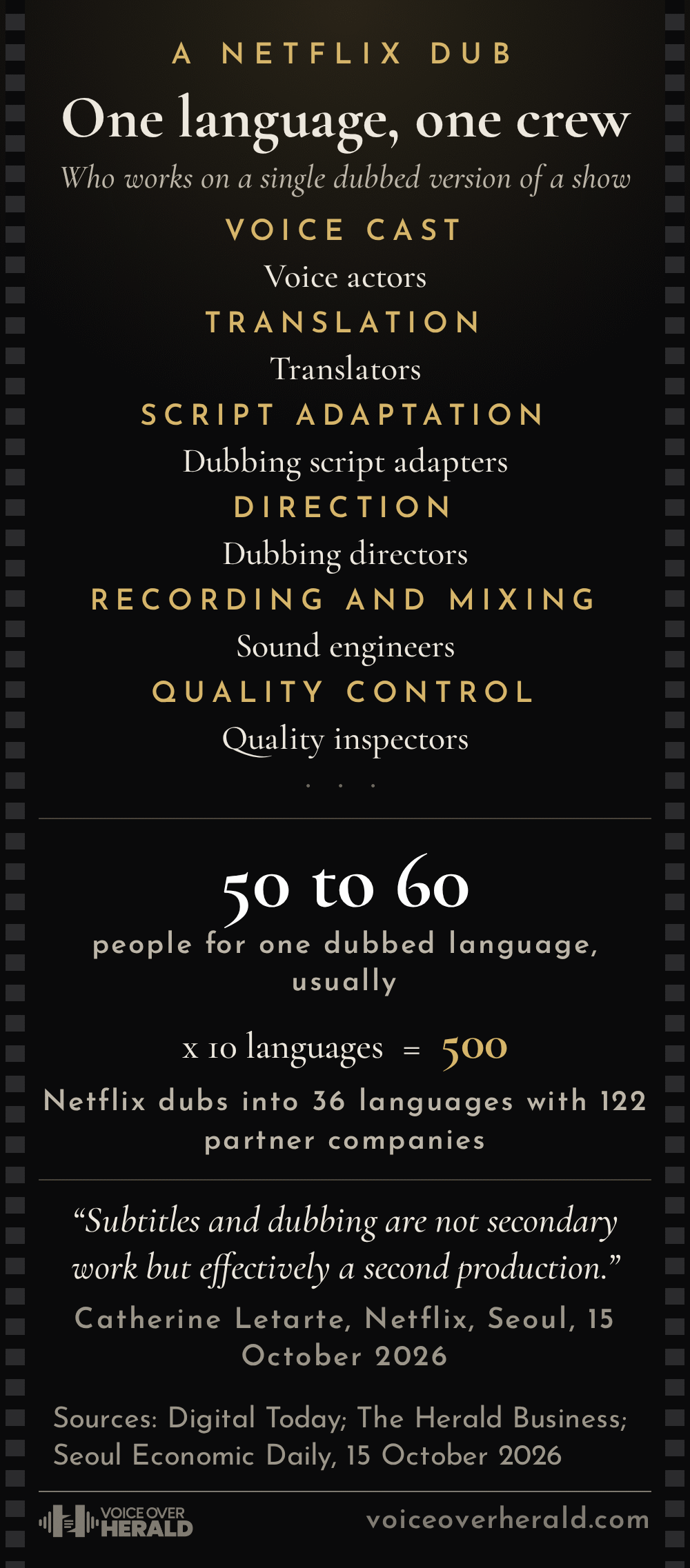
“It usually takes 50 to 60 people to produce a single dubbed version. If you dub into 10 languages, that means 500 people take part,” she said, as reported by Digital Today.
Who those 50 to 60 people are
Letarte listed them: voice actors, translators, dubbing script adapters, directors, sound engineers and quality inspectors. “Typically 50 to 60 people are involved in producing a dub for a single language, bringing expertise in translation, performance, recording, mixing and quality control to capture the essence of the original,” she said, according to The Herald Business.
Netflix says it can now dub into 36 languages and subtitle in 33. To do it, it works with 122 partner companies across its regions: the United States and Canada; Europe, the Middle East and Africa; Asia-Pacific; and Latin America.
Letarte’s main point was about status. “Subtitles and dubbing are not secondary work but effectively a second production,” she said. “Subtitles must capture the core of the dialogue within the time a viewer can read, and dubbing must convey the original’s meaning and emotion through the voice actor’s performance.”
A Mexican Physical: 100 and an Italian one
Her case study was Physical: 100, the Korean fitness competition that now has local versions. Netflix says the Mexican version drew 2.5 million views in its first week and reached number four on its global top 10 for non-English series. The Italian version made the top 10 in 27 countries.
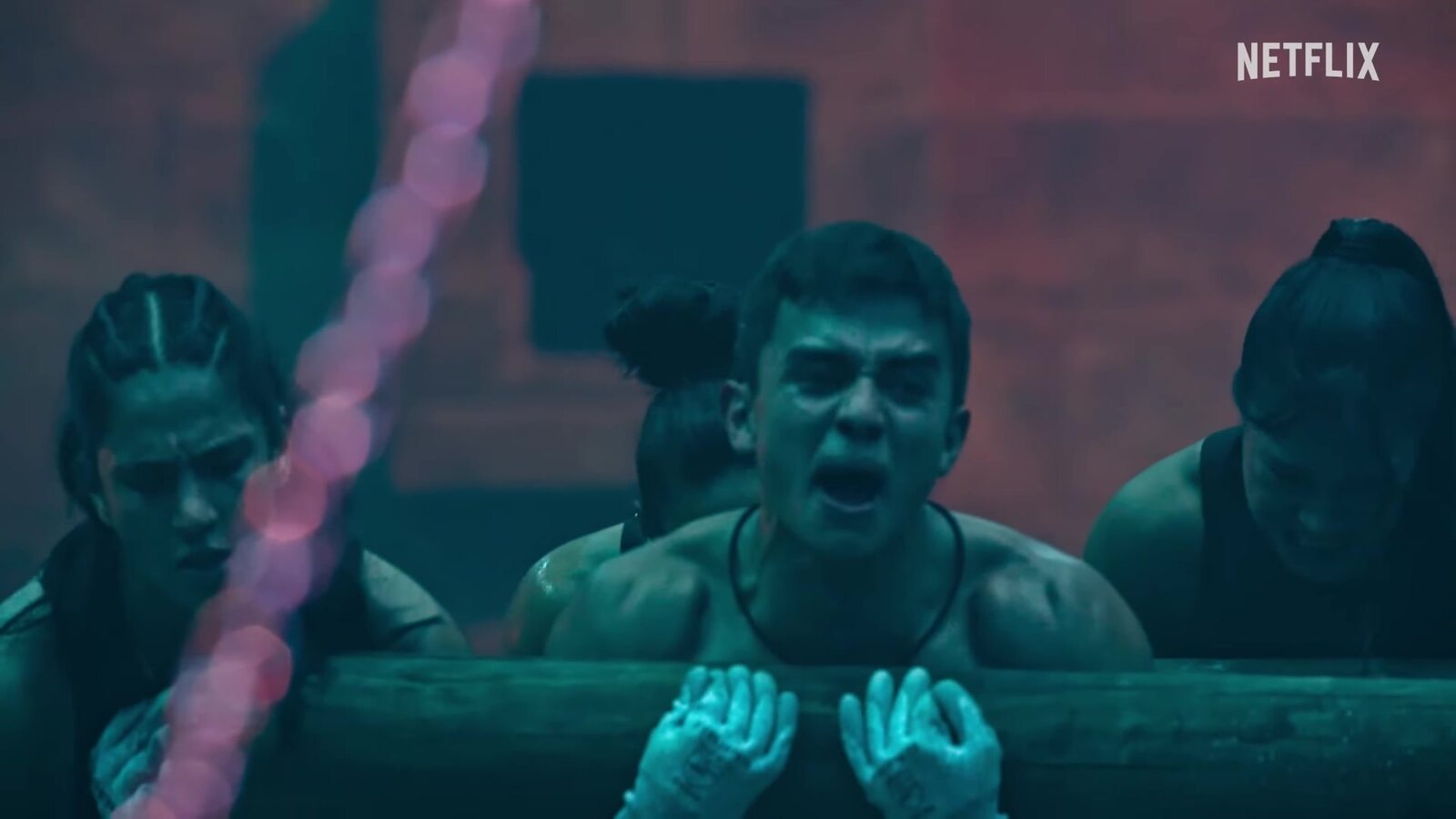
Physical: 100 Mexico, from the official trailer. Image: Netflix
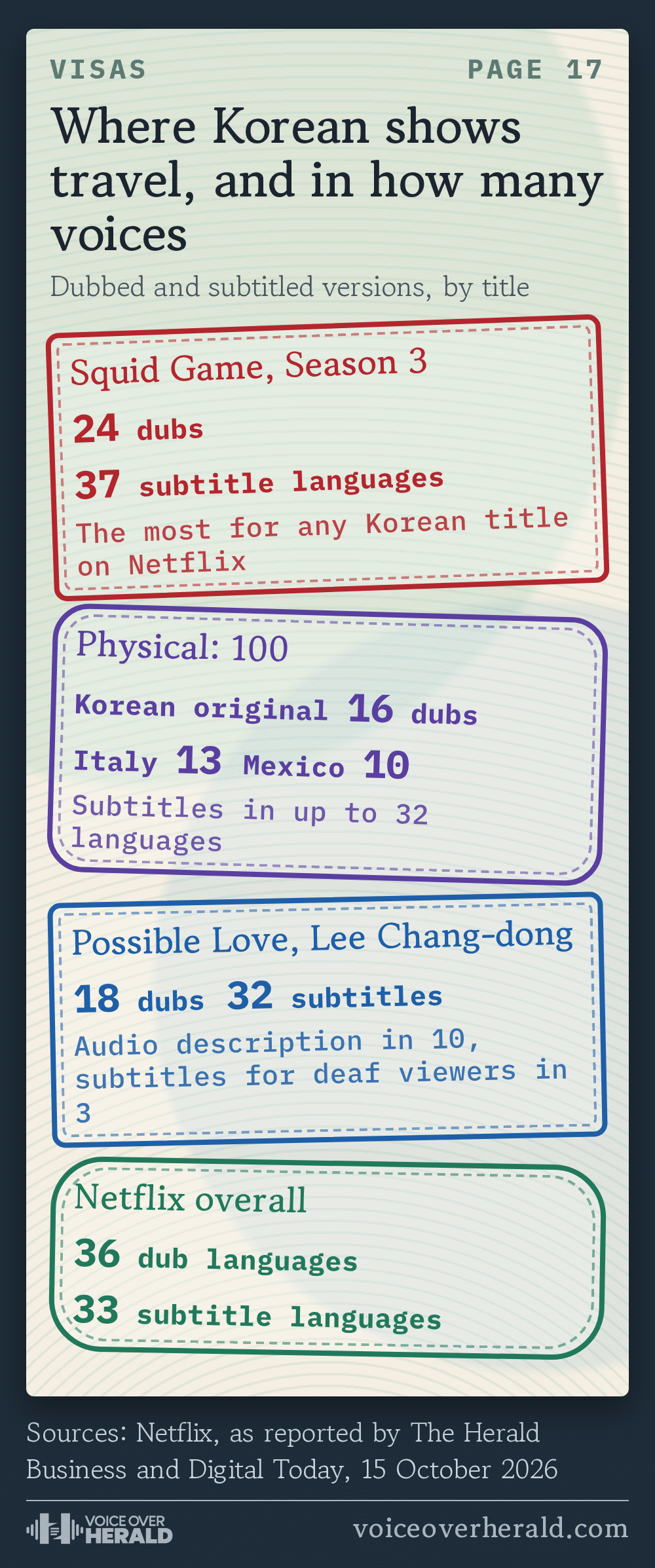
The dubs travel with them. The Korean original was dubbed into 16 languages, the Italian version into 13 and the Mexican version into 10, with subtitles in up to 32 languages. “Behind that global expansion is localization work that allows viewers in each country to enjoy the content in their native language,” Letarte said.
Squid Game Season 3 is the biggest job yet for a Korean title on the service, with 24 dubbed versions and 37 subtitle languages. Next up is Lee Chang-dong’s film Possible Love, due on 6 November, according to Digital Today: 18 dubs, subtitles in 32 languages, audio description in 10 for blind and partially sighted viewers, and subtitles in three for deaf and hard of hearing viewers.
How do you dub “oppa”?
The roundtable’s favourite example was one small Korean word. “Oppa” can mean an older brother, a boyfriend or a close older male friend, and English has no single word for it. Translator Darcy Paquet, who wrote the English subtitles for Possible Love, said a scene where a character is surprised to hear a wife call her husband by his name could mislead viewers if translated literally. After talking it over with Lee Chang-dong and the production team, he left “oppa” in the English subtitles as it is.

Possible Love, from the official trailer. Image: Netflix
Dubbing can’t lean on a subtitle trick like that. John DeMita, Netflix’s senior manager for global English production, said words with no English equivalent need the relationship between the characters to come through in word choice and in the voice acting. DeMita is a voice actor himself and has directed Netflix’s English dubs of shows such as Dark and Elite, so he was talking about his own trade.
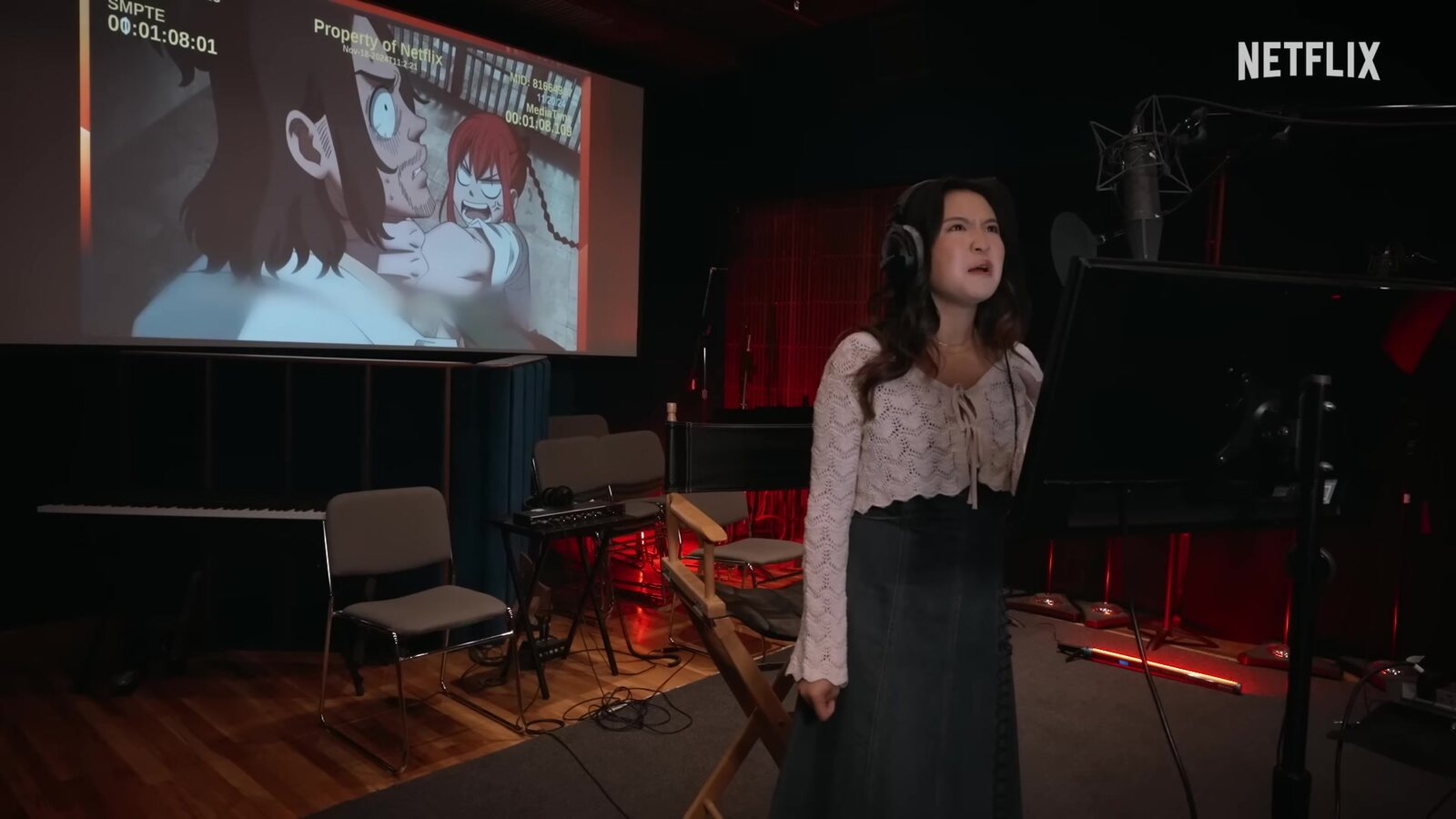
Netflix gave another example from the series Scandal, where a music director, a lyric adapter and voice actors worked together to translate and record its foreign-language lyrics. Korean lettering that appears on screen was redrawn for other languages too.
Dub countries and subtitle countries
France, Germany, Italy
Markets where Netflix says audiences lean towards hearing a show in a local voice cast.
Sweden, the Netherlands, the UK
Markets where Netflix says audiences lean towards the original voices with subtitles.
Netflix said it shapes its approach around those habits. Sander van der Poel, its content localisation director for Europe, the Middle East and Africa, said language and viewing habits vary widely from country to country. “It is important to consider and deliver even the choice between subtitles and dubbing,” he said.
He and Jenny Ross, who runs content localisation for the United States and Canada, said Korean shows have become an ordinary choice for viewers in Europe and North America. Some viewers pick subtitles because they want to hear the Korean actors. Others pick the dub so they can follow the story while doing something else, according to the Seoul Economic Daily. Netflix says 80 percent of its members worldwide have watched Korean content, and more than 200 Korean titles have reached its global top 10.

Park Sung-hoon listens to Squid Game's dubs in a Netflix video. Image: Netflix
Where AI fits, according to Netflix
Questions came up about AI translation and AI dubbing. Letarte’s answer was short. “AI can assist with the work, but it is only a tool that supports specialists,” she said. “Localization is an art that requires human emotion and creativity,” she added, and said AI can’t replace that.

 VoiceEditSuiteNewYour breath. Your pace. Your edit.Learns from numbers, never your audio. Never used to train AI.See how it works
Digital Today summed up the company’s position the same way: AI could support creators and professionals but would not replace them, with human experts most needed for delicate emotional expression.
KOCCA framed it as an industry to build. “For K-content to keep growing in the global market, it needs an ecosystem of localization specialists that helps it cross language and cultural barriers, alongside strong creative capabilities,” said Koo Kyung-bon, head of the agency’s content infrastructure division, in the Seoul Economic Daily. The agency and Netflix have run a production academy together since 2024, and the roundtable sat alongside a two-day localisation workshop on 15 and 16 October.
What it means if you voice for a living
For dubbing actors, the headline number is a reminder of where the work sits. Netflix does its localisation with 122 partner companies across its regions, so much of that work happens at those partners, not inside Netflix.
The figures are Netflix’s own, and it didn’t say how many of the 50 to 60 are actors, how many roles a typical dub has or what the work pays. Still, it’s now on the record, from the person who runs Netflix’s localisation, that AI is “only a tool that supports specialists.” That’s a line dubbing actors can quote back the next time a contract asks for their voice data.
Sources: Digital Today (Seulgi Son), 15 October 2026; The Herald Business (Cha Min-ju), 15 October 2026; Seoul Economic Daily (Yeon Seung), 15 October 2026; Netflix newsroom, 17 June 2024; USC School of Dramatic Arts faculty page for John DeMita. Quotations come from the English editions of Korean reports, which were translated from Korean, so wording may differ slightly from what was said in the room. Images: Netflix.
Lee este artículo en español: Netflix dice que doblar a un idioma requiere de 50 a 60 personas. La IA, asegura, es solo una herramienta
Know something about this story, or spotted an error? Tell the newsroom.