

Your Room Is Louder Than Your Microphone: How to Read a Mic Spec Sheet for Voice Work
Every microphone box is covered in numbers, and most of them were written for engineers recording drum kits. A voice actor in a spare room needs to read about four of them. Here’s what self-noise, sensitivity, gain and pickup pattern actually mean for a voice read, using the makers’ own spec sheets for four mics you’ll see in home booths everywhere, and why the quietest number on the box often matters less than the room it goes into.
This is a reference piece, not a shopping list. Every figure is quoted from the maker, read on October 27, 2026. Prices are left out on purpose: they change by country and by week.
Self-noise: the hiss a mic makes when nobody’s talking
Every condenser microphone has electronics inside, and electronics hiss. The spec that measures it is called self-noise or equivalent noise level, and Neumann, the German studio mic maker, calls it the one to read first. “Self-noise is perhaps the most useful specification,” its home studio guide says. “Nobody wants a noisy recording, and there’s only so much noise we will tolerate before we feel it distracts from the music.”
The figure is usually printed in dB-A. Neumann explains that the A “stands for A-weighting, which is a method to simulate human perception”, and it adds a warning worth remembering when you compare boxes: A-weighting “happens to be the measurement method that results in the lowest figures.” So compare A-weighted numbers with A-weighted numbers, and lower is quieter.
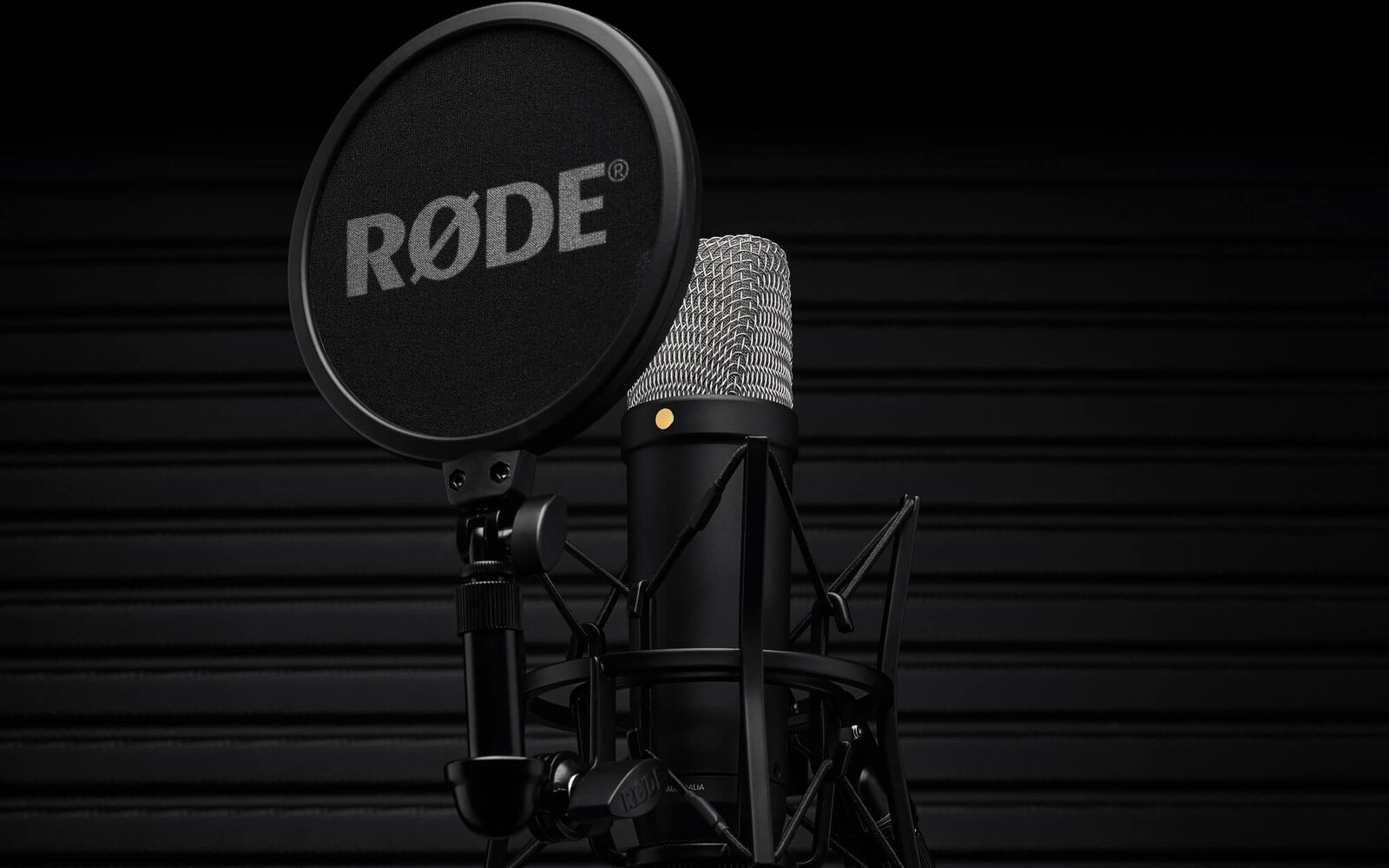
The RØDE NT1 5th Generation, which RØDE lists at 4dBA self-noise. Image: RØDE
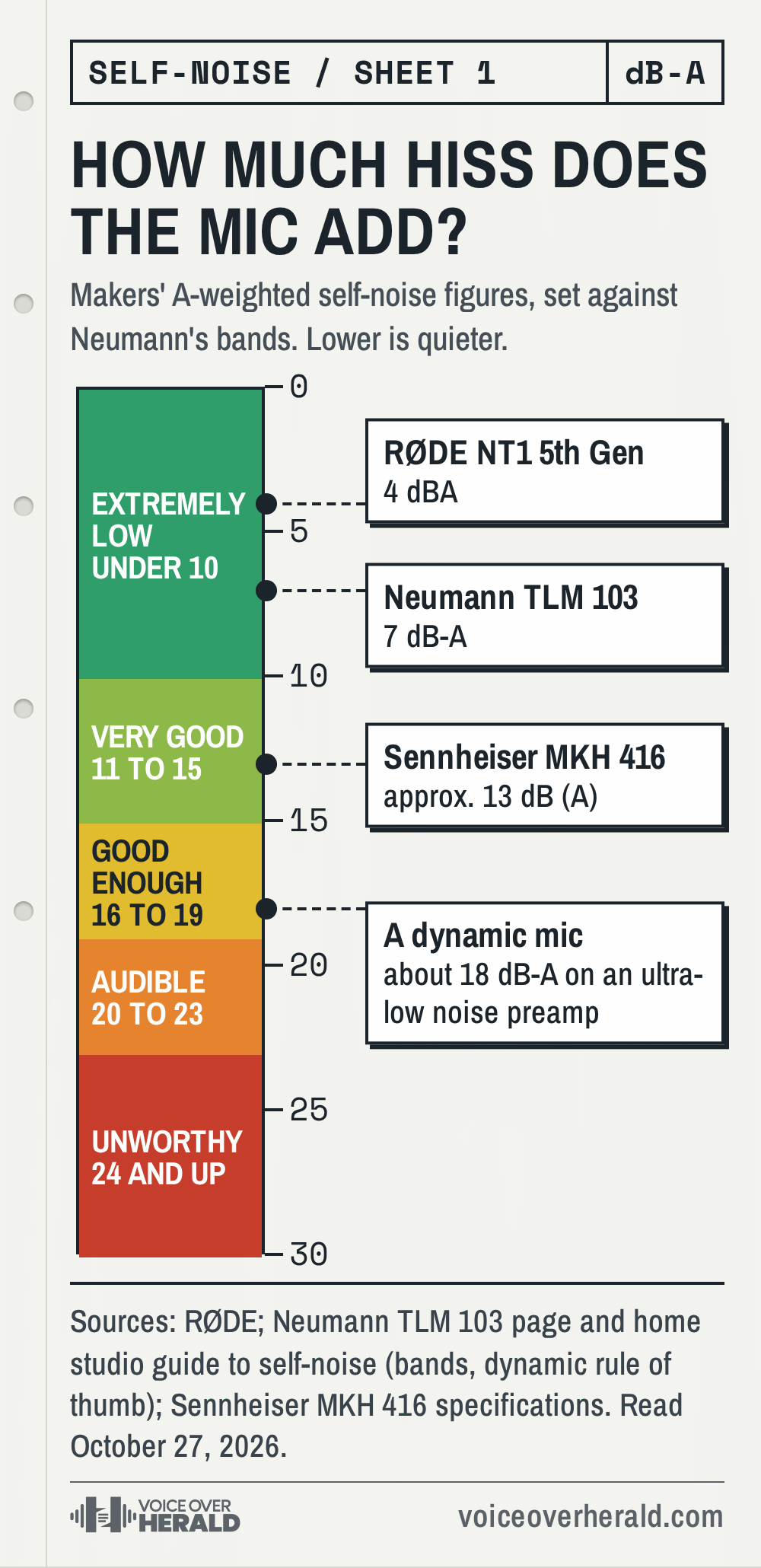
Here’s what the makers print for four mics that turn up in voiceover booths all the time. RØDE lists the NT1 5th Generation at 4dBA and calls it “the world’s quietest studio condenser microphone”. Neumann lists the TLM 103 at 7 dB-A, “among the quietest microphones available.” Sennheiser’s data sheet gives its MKH 416 short shotgun an A-weighted figure of “approx. 13 dB”. The fourth, Shure’s SM7B, has no self-noise figure at all, and that’s not an oversight. It’s a dynamic microphone, and as Neumann puts it, “Self-noise is rarely specified for dynamic microphones. That’s because their noise performance is largely dependent on the microphone preamp used.”
Neumann’s guide sorts the numbers into bands, from “extremely low noise” under 10 dB-A to figures it calls “unworthy of a studio microphone” at 24 and above. For a dynamic mic it offers a rule of thumb rather than a spec: on “an ultra-low noise preamp”, it says, dynamics “reach self-noise figures of about 18 dB-A.”
Why a 4 and a 7 sound the same in a spare bedroom
This is the part the box doesn’t tell you. A mic’s self-noise is measured in a soundproof container, and your booth isn’t one. Neumann says so in plain words about its own quietest band: “The exact figure is unimportant, as even a very quiet recording room will contribute quite a bit more ambient noise than 10 dB-A.”
Once a mic is that quiet, the fridge, the laptop fan and the traffic are louder than it is. Going from 7 to 4 won’t fix a room that hums. Treating the room and turning things off will.
The number a client actually checks is a different one. For audiobooks, ACX says each file “must have a noise floor no higher than -60dB RMS to avoid background noise distractions.” That’s measured on the finished file, in decibels below full scale, so it counts everything at once: the mic’s hiss, the preamp’s hiss and the room. It isn’t the same scale as a self-noise figure, and you can’t subtract one from the other. Voice Over Herald’s listening test of the -60 dB noise floor lets you hear what that line sounds like.
Where a quiet mic really earns its keep is distance. Neumann’s guide spells out the trade: “While a relatively noisy mic must be placed very close to the source to achieve an acceptable signal-to-noise ratio, a low noise mic gives you much greater freedom of placement.” For a narrator who sits back for an intimate read, that freedom is the real point of a low number.
Sensitivity: how loudly the mic talks back
Sensitivity says how much signal a mic sends down the cable for a given sound. It’s printed in millivolts per pascal (mV/Pa) or in dBV, and here bigger is hotter. Neumann lists the TLM 103 at 23 mV/Pa, which it also writes as -32.5 dBV. Sennheiser gives the MKH 416 as “25 mV/PA”. Shure’s user guide lists the SM7B at -59 dBV/Pa, or 1.12 mV.
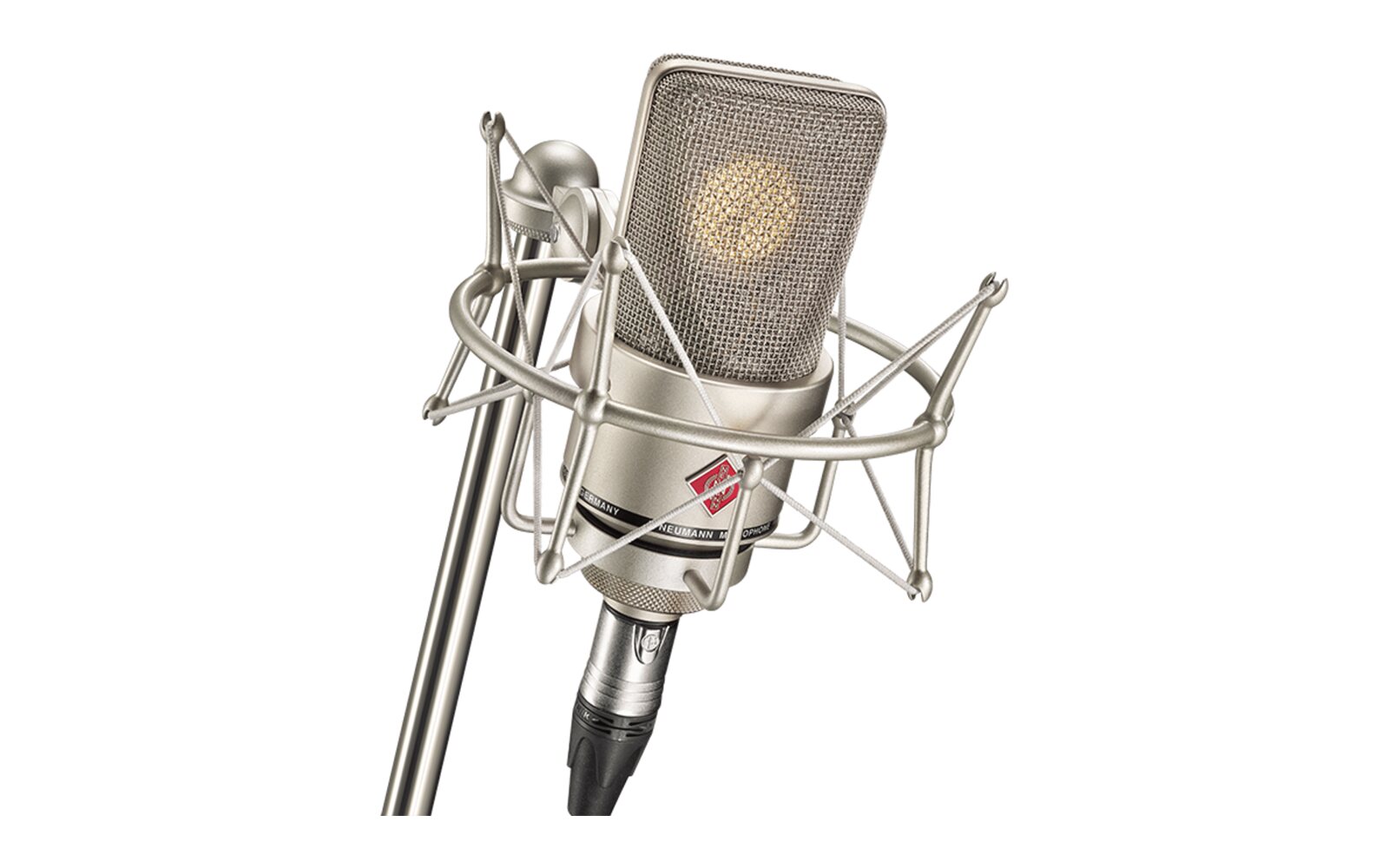
The Neumann TLM 103: 7 dB-A self-noise and 23 mV/Pa sensitivity, per Neumann. Image: Neumann
Put those side by side and the gap is big. The TLM 103 sends out about 20 times the voltage of the SM7B for the same voice, a difference of 26.5 dB. That’s why Neumann can claim its high sensitivity “ensures ultra low noise even with budget preamps and audio interfaces”: a hot mic needs less help from the preamp, and the preamp is where a lot of home studio hiss is born.
The SM7B and the 60 dB question
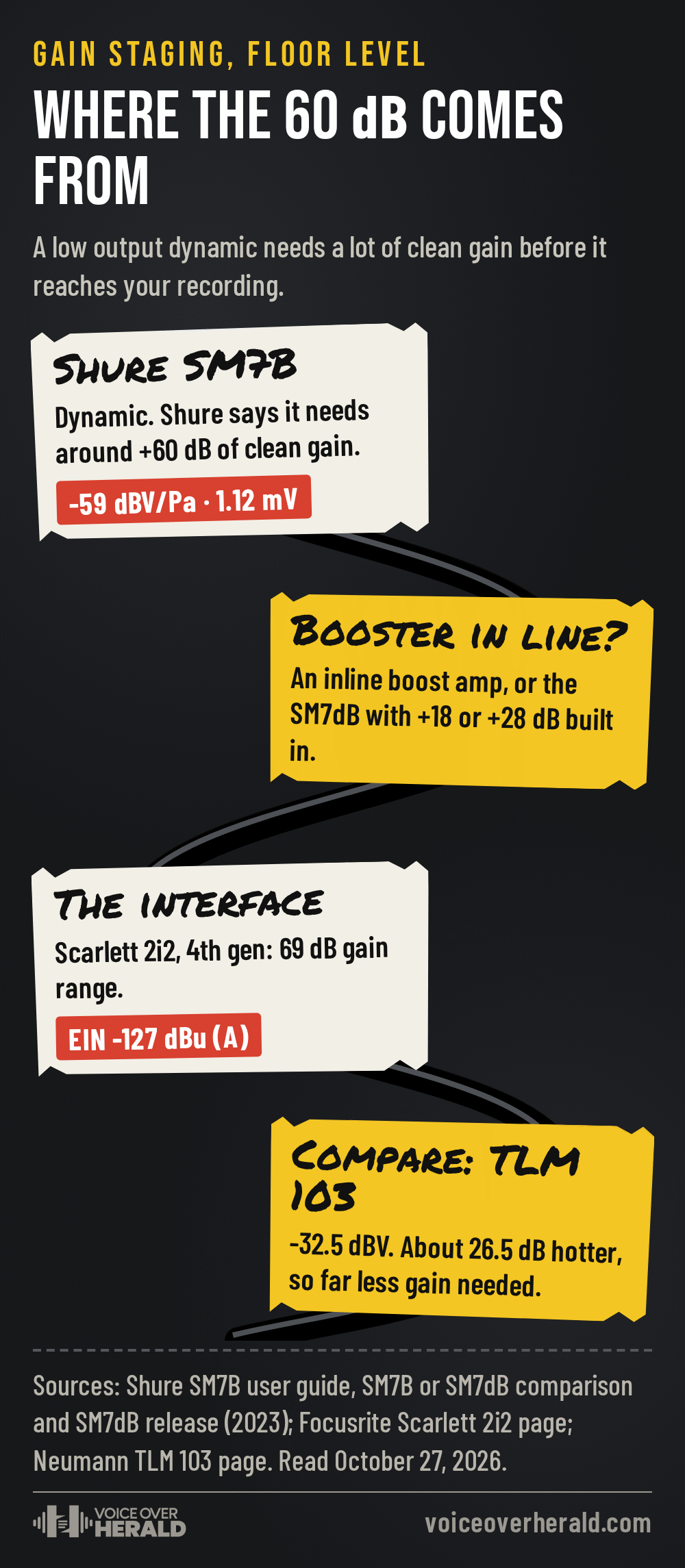
The SM7B is the clearest example of a quiet mic that can still give you a noisy file. Shure’s own user guide is blunt about it: “The SM7B has a sensitivity rating at -59 dB and requires more gain than what most entry-level or mid-tier preamplifiers can deliver. Use an inline boost amplifier or stronger preamp if your preamp does not have more than 60 dB of gain.”
 VoiceEditSuiteNewAuto Clean Up now learns you.Learns from numbers, never your audio. Never used to train AI.See how it works
Shure’s comparison page puts it even more simply: the “SM7B requires around +60dB of clean gain”. The key word is clean. When Shure launched the SM7dB in 2023, a version with a preamp built in, it said the extra “+18 or +28 decibels (dB) of clean gain” frees users “from the hiss and noise introduced by many audio interfaces when their preamps are driven to the levels necessary to provide enough gain for the SM7B.” Eduardo Valdes, the company’s Associate Vice President of Global Marketing and Product Management, said at the time: “The SM7dB removes the need to buy an additional preamp, making it even easier to achieve the remarkable Shure sound.”
None of that makes the SM7B a bad voiceover mic. Shure describes its response as “appropriate for music and speech in all professional audio applications.” It just means the mic and the box it plugs into have to be chosen together.
Your interface is part of the microphone
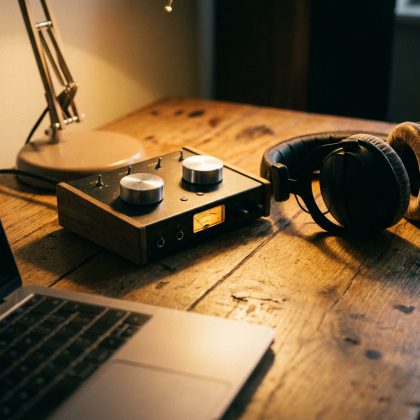
Two lines on an interface spec sheet tell you whether it can drive a quiet, low output mic. The first is the gain range. Focusrite, for example, promises “a huge 69dB gain range to get the best from every microphone” on the fourth generation Scarlett 2i2. On paper that clears Shure’s 60 dB mark, though how much hiss you hear near the top of the knob is exactly what the second line is about.
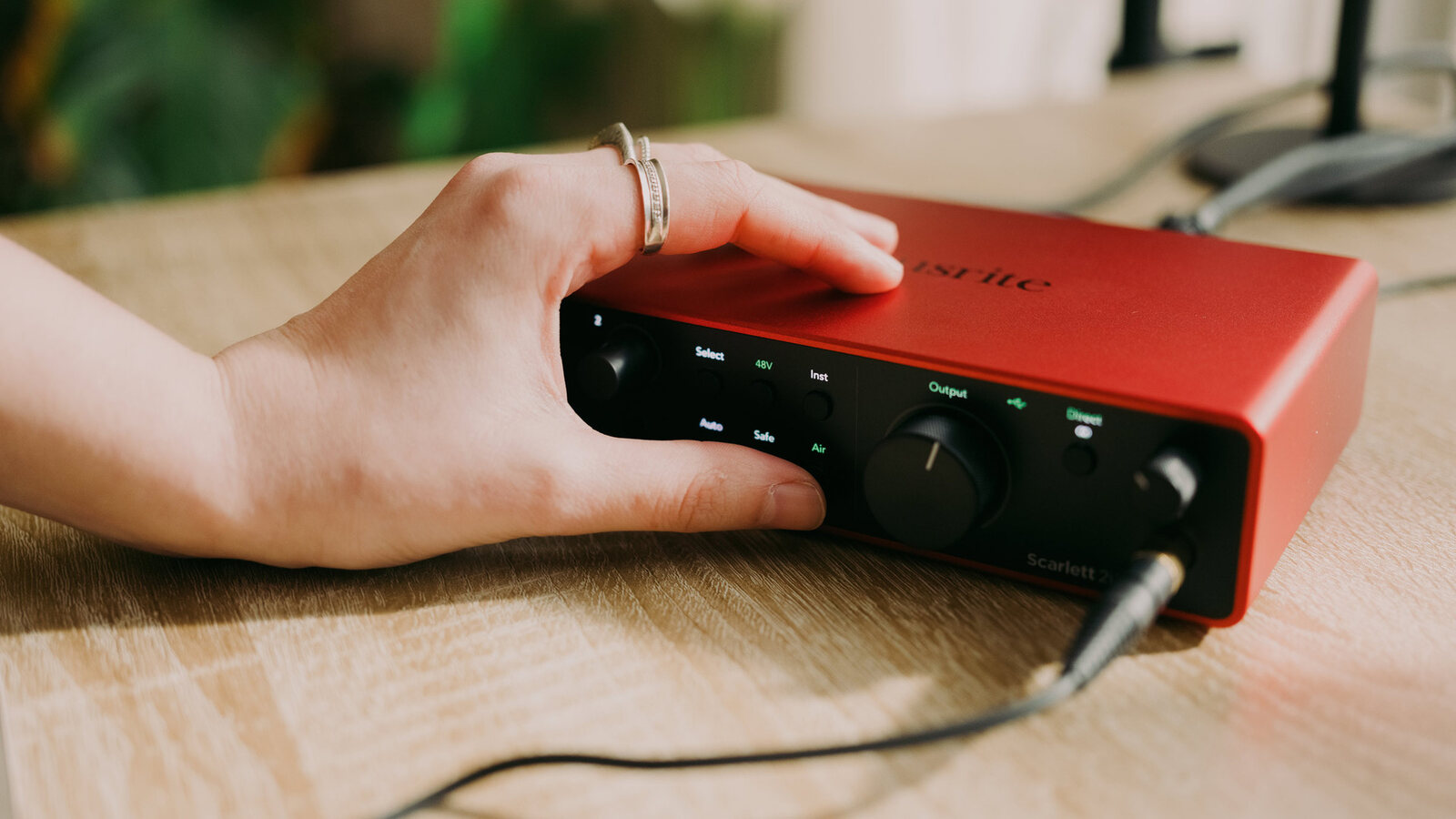
The fourth generation Focusrite Scarlett 2i2, listed with a 69dB gain range. Image: Focusrite
That second line is EIN, equivalent input noise. It’s the preamp’s own hiss, and like self-noise, the quieter the better, which here means a more negative number. Focusrite lists the 2i2 at “-127dBu (A-Weighted)”. When you compare interfaces, compare EIN figures measured the same way, A-weighted against A-weighted.
The rule of thumb: a hot condenser asks little of the preamp, and a low output dynamic like the SM7B asks a lot, so pair it with plenty of clean gain or an inline booster.
Pattern and distance: what the mic chooses to ignore
The pickup pattern decides how much of the room the mic hears. The TLM 103, the NT1 and the SM7B are all cardioid, which means they hear most from the front and least from directly behind. Shure says the SM7B’s pattern is “uniform with frequency and symmetrical about axis, to provide maximum rejection and minimum coloration of off-axis sound.” The MKH 416 is narrower still: Sennheiser lists its pattern as “super-cardioid/lobar”, the shape of a shotgun.
Pattern and distance work together. Shure’s guide tells SM7B users to “speak directly into the mic, 1 to 6 inches (2.54 to 15 cm) away to block off-axis noise,” adding: “For a warmer bass response, move closer to the microphone. For less bass, move the microphone away from you.” That change in bass with distance is the proximity effect, worth hearing for yourself before you settle on a working distance.
- Self-noise, A-weighted. Under 10 dB-A is extremely low; past that point, your room is the louder problem.
- Sensitivity. A higher mV/Pa or a less negative dBV means less work for the preamp.
- Gain needed. For a dynamic, check the maker’s guidance; Shure’s is about 60 dB of clean gain for the SM7B.
- Interface gain and EIN. Enough range to reach that gain, and a quiet preamp when it gets there.
- Pattern. Cardioid hears mostly the front; a shotgun like the MKH 416 is narrower still.
One last tip from the spec sheets themselves. Neumann’s guide works out a mic’s best case signal-to-noise ratio as 94 dB minus its self-noise, so 87 dB for a 7 dB-A mic, and then immediately adds that “the actual signal-to-noise ratio in use, of course, depends on the sound pressure level of your sound source.” In booth terms, the mic sets the ceiling, and your room, distance and preamp decide how close you get. Buy the mic that suits your voice, then spend the change on the room.
Sources: Neumann, What is self-noise (or equivalent noise level)? and TLM 103 product page; RØDE, NT1 5th Generation product page; Sennheiser, MKH 416 specifications; Shure, SM7B user guide, SM7B or SM7dB: which microphone is right for you? and SM7dB launch release (September 27, 2023); Focusrite, Scarlett 2i2 (4th generation) product page; ACX, Audio Submission Requirements. All read October 27, 2026. Images: Shure (main image), RØDE, Neumann, Focusrite.
Lee este artículo en español: Tu cuarto suena más fuerte que tu micrófono: cómo leer la ficha técnica de un micrófono para locución
Know something about this story, or spotted an error? Tell the newsroom.