
Find the Rain in the Voice: How the First Five Narrators in Audiobook’s Hall of Fame Do the Work
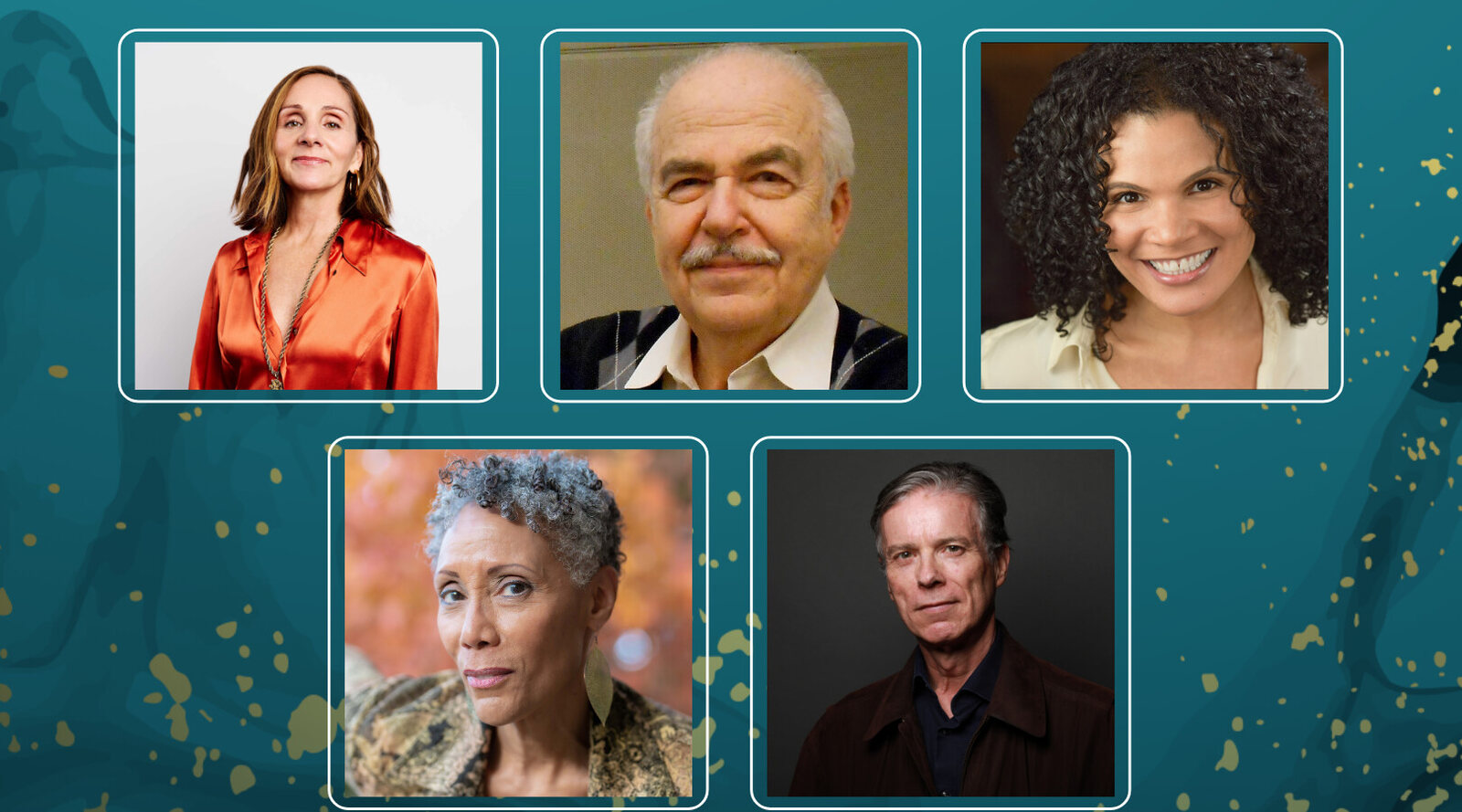
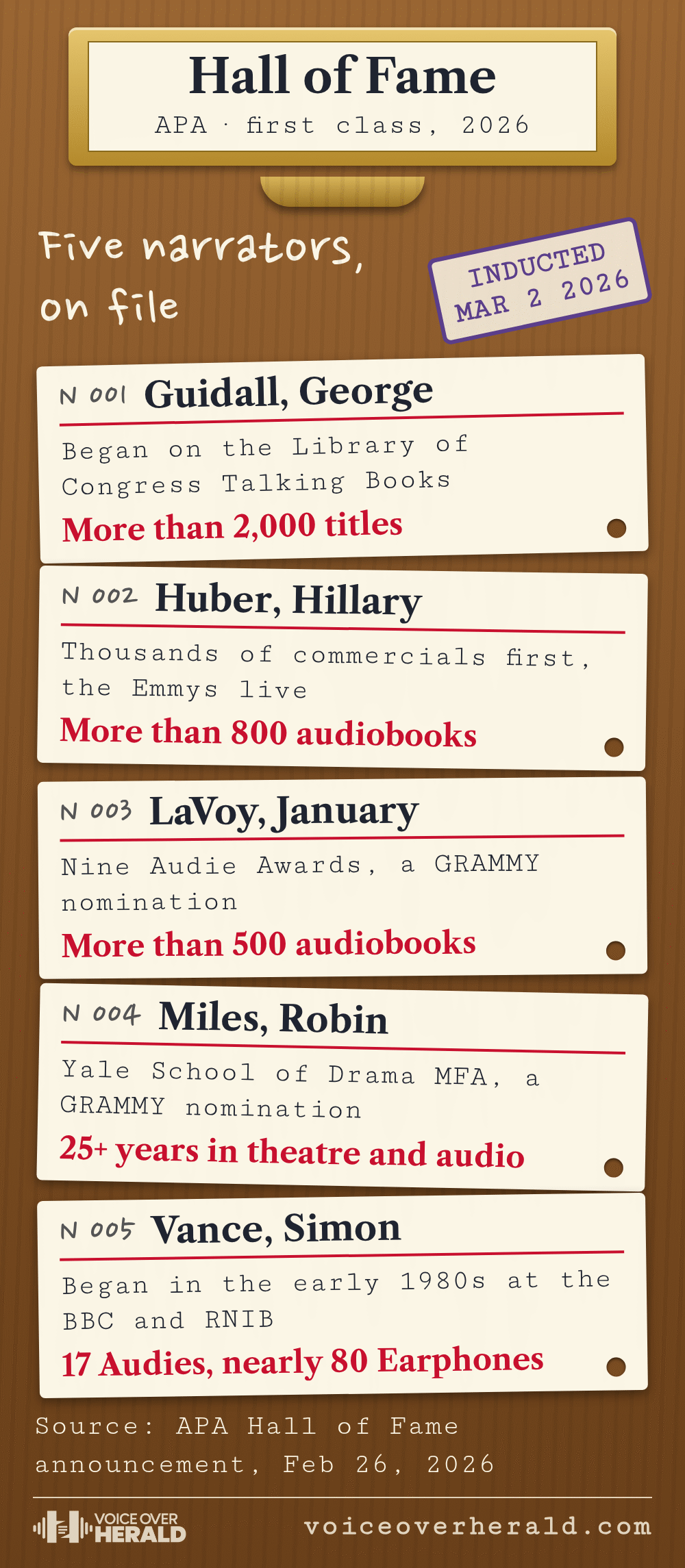
The Audio Publishers Association’s new Hall of Fame opened with five narrators: George Guidall, Hillary Huber, January LaVoy, Robin Miles and Simon Vance. Between them they’ve recorded thousands of books. Here’s how each of them says the work actually gets done, in their own words, and what a narrator with a home booth and a first royalty share deal can take from it.
On February 26, 2026, the Audio Publishers Association named the first five members of its Hall of Fame, and it honoured them at the 31st Audie Awards on March 2 at Pier Sixty in New York. The APA says the new honour “recognizes those whose exceptional work has shaped the art of narration, expanded the reach of audiobooks, and helped propel the industry forward.”
Dan Zitt, who chairs the APA’s Hall of Fame Committee, said the board wanted to honour “the narrators and leaders whose artistry, dedication, and vision shaped modern audiobook publishing.” The useful part, if you narrate for a living or want to, is that all five have spent years explaining their methods to interviewers. They don’t agree on everything. One says he couldn’t record at home; another can’t believe she gets to do it from her own studio. One reads every book first, one likes to discover it at the microphone.
So this is the first story in Voice Over Herald’s new Audiobook Voiceover News section: five careers, read for the habits you can borrow on Monday morning.
George Guidall wants someone on the other side of the glass
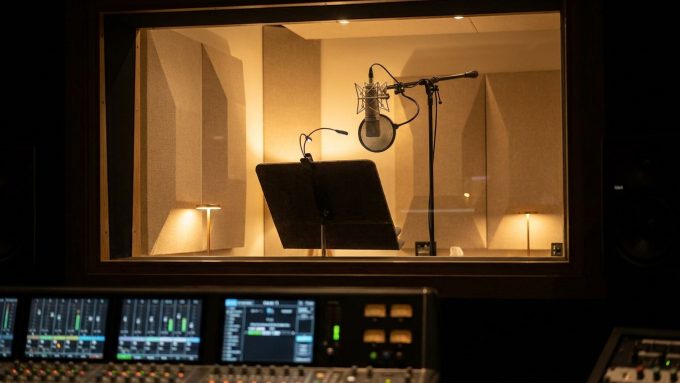
Guidall started in the Library of Congress’s Talking Books program, then became the voice of Tony Hillerman’s Navajo mysteries at Recorded Books. Plenty of today’s narrators work alone in a padded closet. He’s told Publishers Weekly he can’t: “I need someone on the other side of the glass to talk to. If I did it at home, I fear I would be a prisoner.”
 VoiceEditSuiteNewThe audio editor that learns how you breathe.Learns from numbers, never your audio. Never used to train AI.See how it works
His big idea is that narration is talking to somebody, not performing at them. “Not every actor is cut out for narrating a book,” he told the Connecticut Critics Circle. “There are some fine actors who come to the mike and somehow don’t grasp the art of talking to somebody as much as they understand performing for people.”
He keeps the pace up on long books and fixes things afterwards. “With a book that’s over 700 pages, the pace is important,” he said in a New York Times interview reprinted by Gulf News. “So I’d rather keep up the speed and go back to correct. Once in a while, I fall off the sled and roll down the hill.”
And in the same piece, the line every narrator should pin above the mic: “There’s a rhythm to speech in terms of what’s implied. If it’s raining in the book, there’s got to be something about the voice that evokes the rain.”
Hillary Huber left commercials for The Bell Jar
Huber’s way in will sound familiar to a lot of commercial voice actors. “After 20 years of commercial VO, I saw the writing on the wall,” she told AudioFile when it named her a 2025 Golden Voice. She wasn’t using her acting skills, she said, “So I took a stab at audiobooks,” and she sent the publisher Blackstone a copy of The Bell Jar with a sample of herself reading a bit of it.
That’s a lesson on its own: she didn’t send a general demo, she sent a publisher a real book and a real read. Before online pronunciation guides, she said, “I used to call embassies when I needed to learn how to pronounce foreign words.”
On stamina, she’s the encouraging one. “It’s interesting that the more I work, the more I can do. My vocal muscles build up, and I can work longer,” she told the magazine in an earlier profile. “My head goes before my throat goes, and I make absurd mistakes.” Her own site, hillaryhuber.com, describes her workplace as “a 4×4 padded room. Er…booth.”
January LaVoy reads it as a reader first
LaVoy, who has nine Audie Awards and a stage career that won her the 2023 Helen Hayes Award, starts every book the way a listener would. “I like to read the whole book as a reader. I want listeners to have the experience I had when I read it for the first time,” she told Publishers Weekly. “Then, when I go back through and make notes, I try to remember how I felt.”
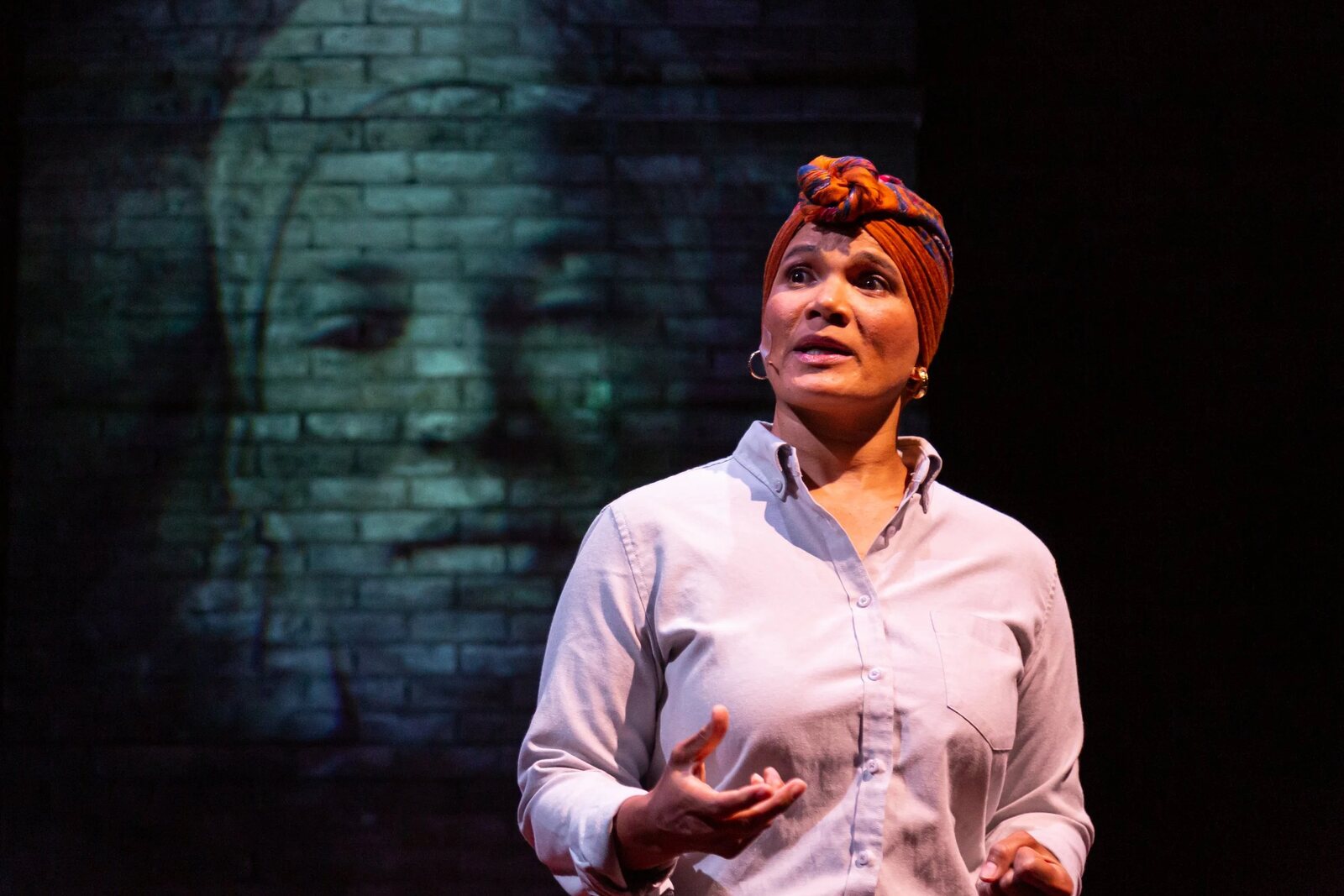
January LaVoy on stage. Image: januarylavoy.com
Her markup is practical. She told Mental Floss she flags dialogue tags like “she whispered” before she reaches them: “If I don’t know he whispered it until after I say the line then I’ve wasted time. So if I can mark them so my eye sees them coming up, I don’t have to go back and say the line again.”
She guards her voice the night before a session, too. “The microphone is like a microscope: It hears everything,” she said. “So if my voice is tired I’m not going to have the elasticity I need.” And one tip from AudioFile that costs about two dollars: “Lip balm! It’s the only thing I won’t enter the booth without.” Her first book ran 20 hours, she said, and after eight hours of recording her lips were “cracked and bloody.” Her site is januarylavoy.com.
Robin Miles builds the body before the voice
Miles trained at Yale and the Yale School of Drama, teaches acting at Pace University and runs her own studio, Voxpertise. Her prep starts with a single read. “I get enough time to read the book through once as my rehearsal,” she told Bustle. “And I make all kinds of notes about what I observe and voices, and you know subtext. And then, you’re on, kid.”
Those notes are about bodies as much as sounds. “I write down everything that’s described about a character,” she said, “so that I know they’re tall and barrel-chested, and you know, they were shot in the shoulder years ago. So I’m trying to figure out how that person sits, and how they stand, and what’s physically going on for them.”
She’s also the one telling narrators to stay humble. Book Riot asked what makes the craft work, and she named one thing: “The instinct to know when to get out of the way and just play it the way the author wrote it.” And when she records, she isn’t talking to a microphone. “I always have a person sitting there with me. I never forget, and I imagine that person listening a foot and a half away, and then I care about whether or not they get what I’m saying,” she told AudioFile. Her faculty page at Pace University lists her teaching.
Simon Vance plays chess against himself
Vance began narrating in the early 1980s while working at the BBC, recording for the Royal National Institute of Blind People’s Talking Book Service. Four decades on, he’s the one who talks most plainly about the physical side. “Stamina is very important; reading seven to eight hours a day takes a lot of strength,” he told Library Journal.
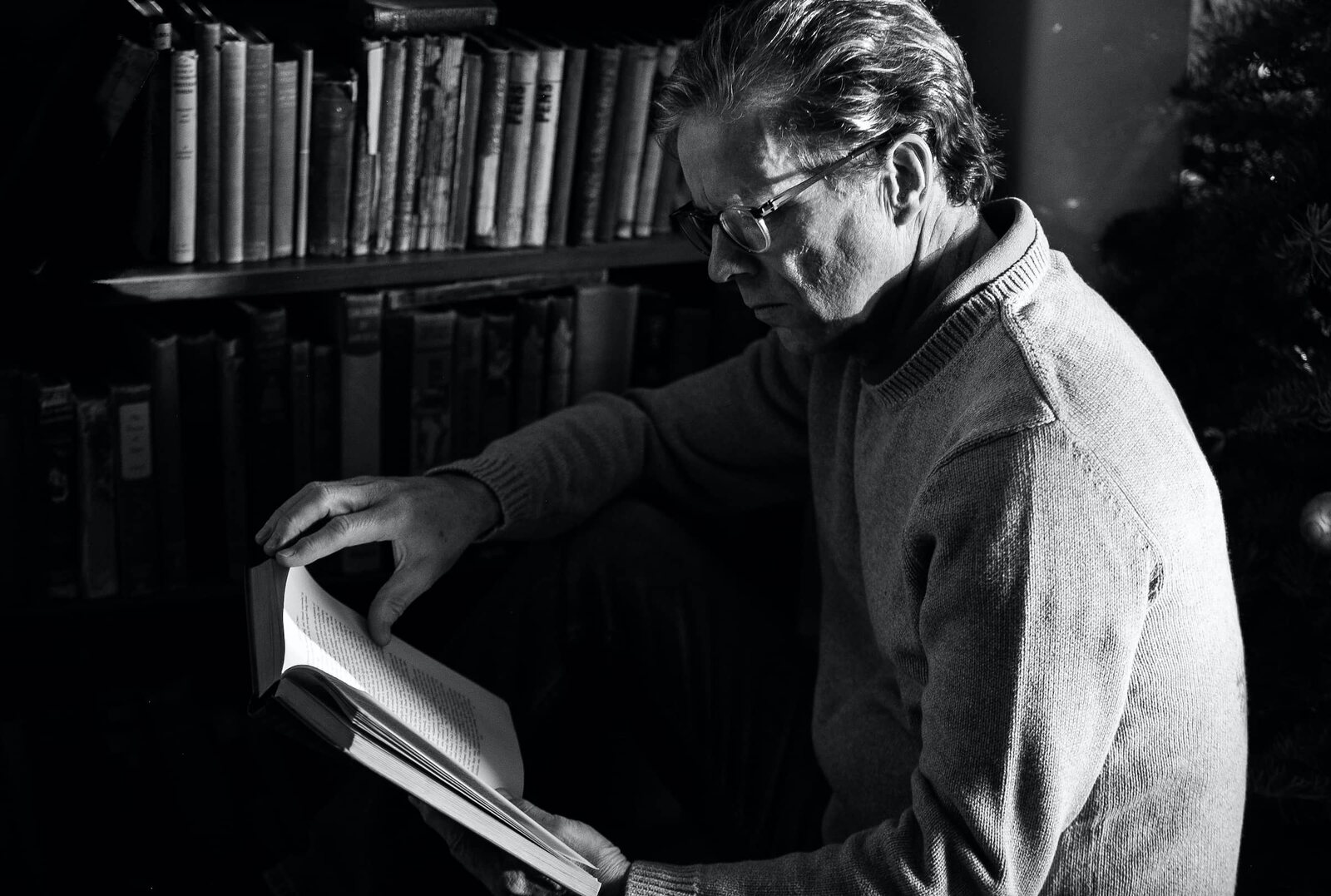
Simon Vance. Image: simonvance.com
He doesn’t always read ahead. “I love the immediacy of discovery,” he said in the same interview, naming Dickens and Trollope as authors whose books he doesn’t need to read through first. Nonfiction is different: for one title he kept 20 pages of name pronunciations, and for another he met the author in London to get the names right. For dialogue, he borrows from the stage. “While I’m reading one person, I picture the other person listening,” he told AudioFile. “It’s like playing chess against myself.”
In January 2025 the Eaton fire took his Altadena home and the studio he’d built in 2020. His home and studio, he wrote on the fundraising page a friend set up, were lost: “not only that the house (originally built in 1905!) but also my recently built studio (2020) were little more than ashes.” The APA says he “returned to the studio within days.” His advice to beginners, on simonvance.com, is short and honest: “It’s the least well paid job in Voice-Over. It’s a marathon, not a sprint.”
What carries over to your next booking
Put the five side by side and the common ground is clear. All of them prepare in a way that suits the book, and none of them wings pronunciation: Huber rang embassies, Vance kept pages of names, LaVoy marks what’s coming before her eye gets there. All of them picture a real listener, whether that’s Miles’s person a foot and a half away or Guidall’s someone on the other side of the glass.
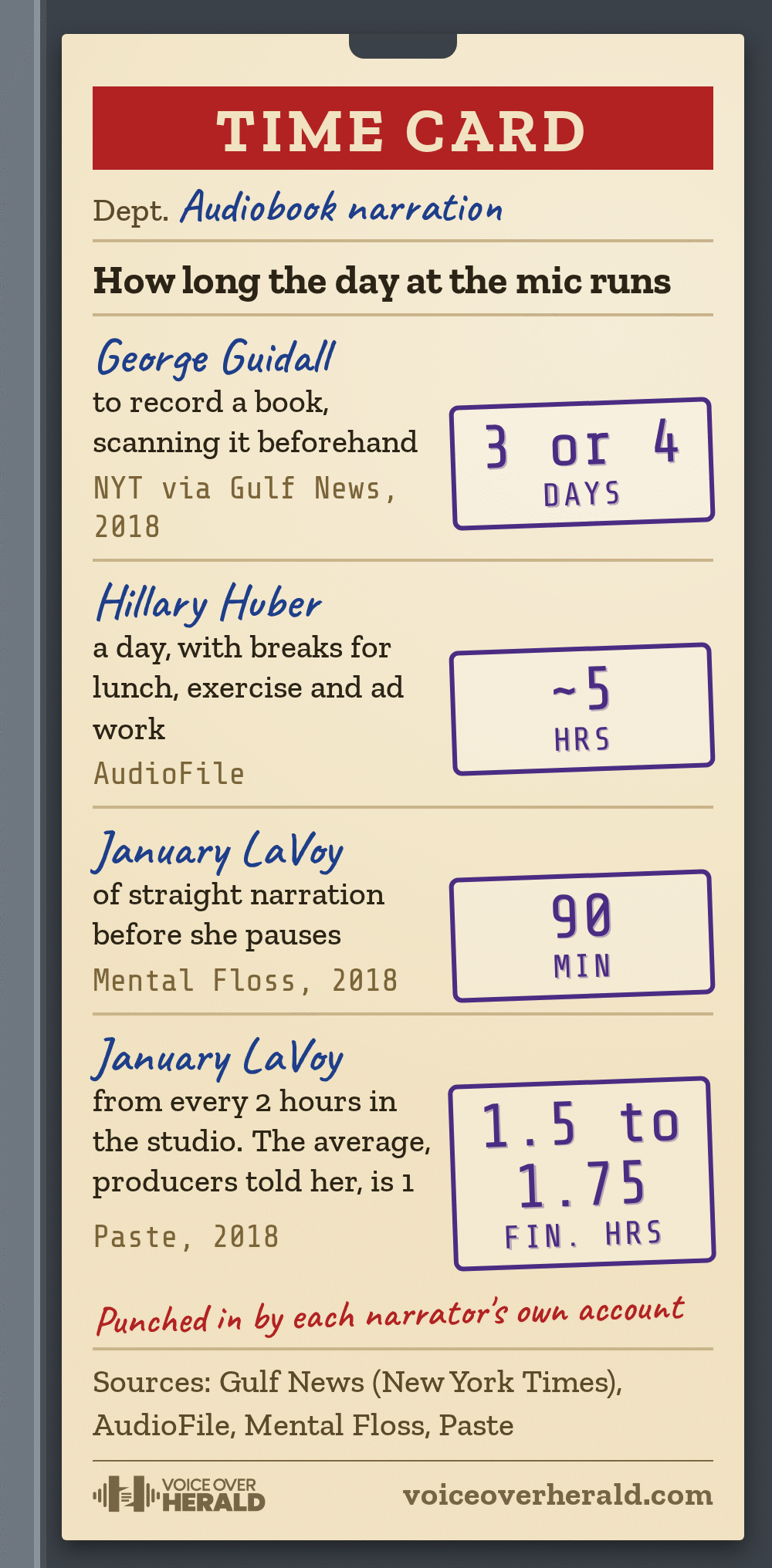
They also treat the voice like an athlete treats a hamstring. Seven to eight hours a day is Vance’s number for a working day, and Huber says the capacity builds the more you do. LaVoy skips nights out before sessions.
And none of them got here with a general reel. Huber sent a publisher a book she loved. LaVoy and Miles came from the stage and still talk like actors about who a character is before what they sound like. If you’re starting out on your own, with no director on the other side of the glass, that might be the most useful habit of all: find out who’s speaking, then let the voice follow.
Sources: Audio Publishers Association (Hall of Fame announcement, February 26, 2026, and 2026 Audie Awards winners release); Publishers Weekly (interviews with George Guidall, May 2014, and January LaVoy, February 2014); Connecticut Critics Circle (George Guidall, December 2017); Gulf News, reprinting a New York Times interview with George Guidall (September 2018); AudioFile (narrator pages for Hillary Huber and Simon Vance, “5 Questions with January LaVoy” and “The Download: In Conversation with Robin Miles”, read via the Internet Archive); Mental Floss (“Secrets of Audiobook Narrators”, May 2018); Bustle (Robin Miles, May 2018); Book Riot (Robin Miles, January 2017); Library Journal (“Behind the Mike: Simon Vance”, November 2008); simonvance.com; hillaryhuber.com; januarylavoy.com; Simon Vance’s fundraising page on GoFundMe. Images: Audio Publishers Association, januarylavoy.com, simonvance.com.
Lee este artículo en español: Que la voz evoque la lluvia: así trabajan los cinco primeros narradores del Salón de la Fama del audiolibro
Know something about this story, or spotted an error? Tell the newsroom.