

Voice123 Is Selling AI Auditions to Voice Actors. One Actor Posted the Email
The email went out at half past six in the morning with the subject line “Create AI voices with a $15 monthly plan”. Three days later one of the voice actors who got it published the whole thing on Facebook, with a reply that a lot of the profession clearly recognised. Voice123 has built the most careful consent terms of any major casting platform, and it has just discovered that careful terms and a welcome pitch are two different problems.
What the email actually says
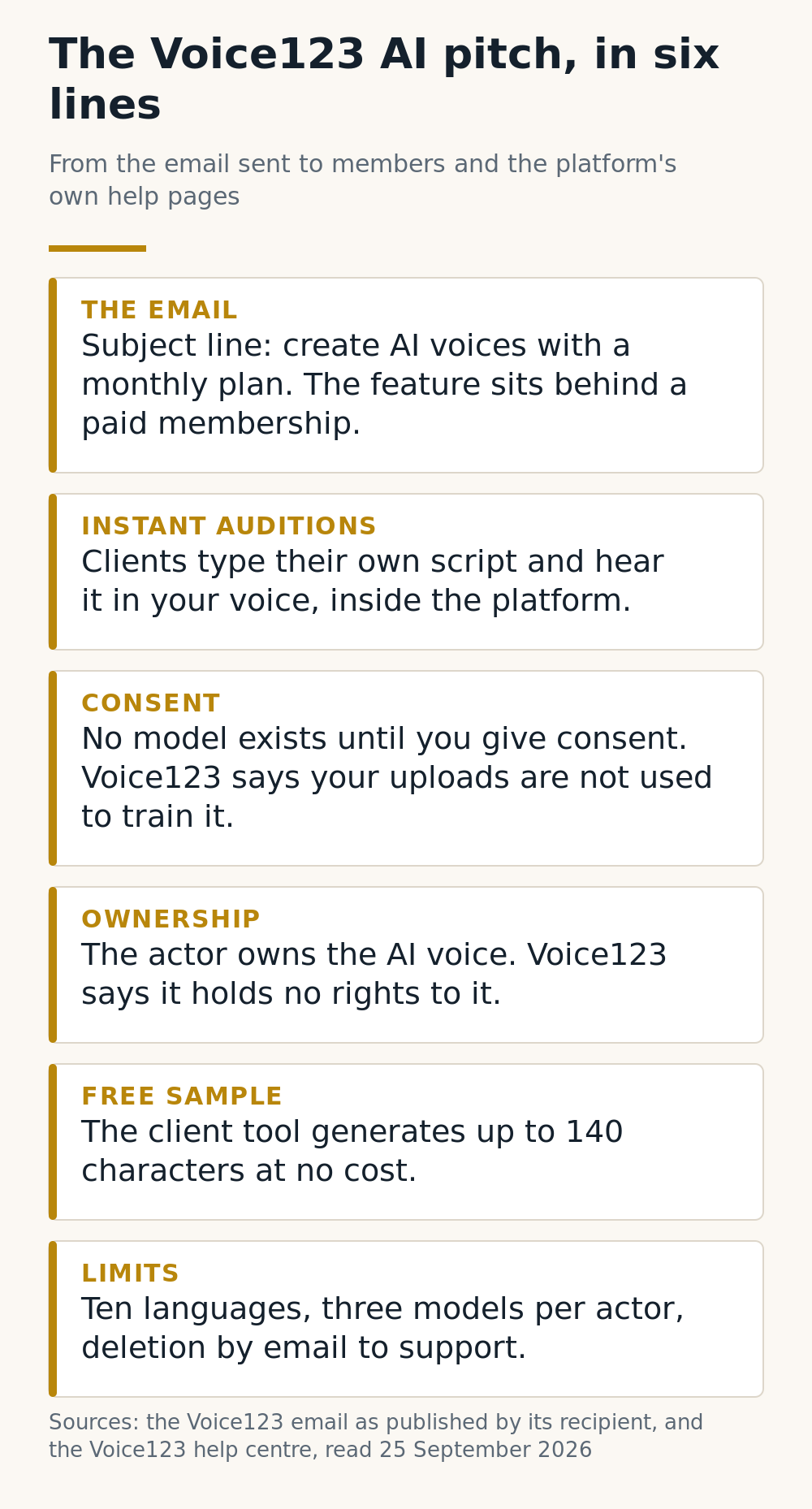
The message, published in a screenshot by its recipient, opens with a statement of principle. “At Voice123, we believe that the future of AI in voice over should be built on transparency, trust, ownership, and control.” Then the offer: “That’s why a Voice123 membership, including our Starter $15 monthly plan, allows you to:” followed by five numbered promises.
Create and manage your own AI voice models. “Allow clients to generate short script snippets during Instant Auditions.” Share access with clients you choose to. Negotiate usage terms, payment, and license length. Monitor what clients generate with your AI voice. The button at the bottom reads “SETUP YOUR AI VOICE”.
Note the second one, because it is the whole story. Voice123’s help pages call the same feature “Custom Script Auditions: Clients can listen to their custom script, voiced by your AI Voice model”. In the email it is “Instant Auditions”. Either way, a client types their copy, presses play, and hears you read it. You are not in the room. You did not audition.
The reply
The actor who published the email is Jonathan Fortin, who has booked game work through the platform, including the adventure game Willy Morgan and the Curse of Bone Town and a reprise of the role in Whirlight this year. His post opens: “Yeesh. Any other voice actors get this email from Voice123?”
He is not impressed by the framing. “But it’s bizarre that they seem to think any voice actor would be excited by this,” he wrote, before doing the voice himself: “Wow, that’s so cool! They can listen to a robot do a bad imitation of my voice, making completely different acting choices than I would make, and will decide whether to hire me based on *that*!”
Then the part that reads like a mission statement for the job. “Voice over isn’t about having a cool sounding voice. It’s about analyzing the script and being able read between the lines well enough to understand what the writers/directors intend with the copy. It’s about finding the human in copy that might very well seem robotic. It’s about making distinctive, well thought out choices that make your take on the copy unique. That’s the opposite of what AI does.”
The comments went the same way. “I received a similar email (I still have a basic membership), and you have expressed my reaction far more eloquently than I ever could,” wrote Heather Orosco. Fortin’s answer, on the membership fee: “wow I’m totally gonna pay $15 a month to get less work”. Another commenter, Edward Violahands, was blunter: “Booo corporate cheapskates trying to get you excited about your exploitation and diminishing the quality of your ‘product’.”
The training question, and what Voice123 says
Fortin’s post also carries an inference worth separating from the facts, because it is the thing most people will assume. “What this email suggests to me is, anytime you’ve uploaded your voice to V123 to send auditions to clients, V123 has probably been feeding it to AI as training data.”
He says “suggests” and “probably”, and he is reading the email rather than reporting from inside the company. Voice123’s published answer is a flat denial. Its FAQ asks “Will my audio be used to train the Voice123 AI voice model?” and answers: “No, the Voice123 AI model was trained using open-source licensed data.” On consent it is equally direct: “Can an AI voice be created without my consent? No! You will have to give your consent to create an AI Voice from your audio samples.”
Both things are true at once, and the gap between them is the actual news. A platform can have clean terms and still send an email that makes a decade of uploads feel retroactively unsafe. That is a trust problem, not a contract problem, and no FAQ fixes it.
The guarantees
Consent required before a model exists. Your uploads are not training data. Full ownership stays with the actor. Downloads blocked until you approve terms and payment. Advance payment on AI projects. Your rates, your call on every job.
The open questions
A free client generator up to 140 characters. Unlimited generations inside the platform. The feature sits behind a paid membership. Deletion by email to support, not a button. Three models per actor. No published rate floor for AI work.
The terms really are better than most
It is worth being fair here, because plenty of platforms have done worse. On ownership, the same FAQ says: “Does Voice123 own any rights to my AI voice? No, we do not and will not,” adding that “You will always have complete ownership of your AI voice.” There is a real lock on the output too. “Generated audios are only for casting purposes, and users will not be able to download these audios unless you, as the AI voice owner, accept the project terms and payment.”
Behind that sits the Voice Authenticity Initiative, launched on March 4, 2024. Chief executive Rolf Veldman described it as a system that “automatically generates Voice Credentials, a unique digital signature or metadata for every piece of audio uploaded to Voice123”, so actors “always own, access, and verify their datasets and audio files”. The signatures follow the C2PA standard. Paid members also get file matching against their stored audio using what the company calls its VoiceID algorithm.
The company has form for tightening rules after trouble, too. Its text to speech policy, written “after reviewing our policy with the help of NAVA and our community of voice actors”, now requires corporate email accounts, contracts handed over in advance, payment through the platform, and bans clients who “use auditions/samples of any voice actor without proper remuneration for its use”. Perpetual buyouts for all cases are no longer allowed. Those rules exist because the abuse happened first, which tells you what version of the AI guardrails we are currently on.
The 140 character line
Here is the sentence that is not in the email and not in the talent documentation. It is on the page Voice123 wrote for clients: “On Voice123 you can use our free AI voice generator to test your custom script (up to 140 characters). Then you can purchase the voice over directly from the voice actor.”
 VoiceEditSuiteTrim it, clean it, deliver it. One pass.
Free. Up to 140 characters. In your voice. And, per the email, the privilege of offering that starts at fifteen dollars a month of your own money.
A hundred and forty characters is not a rounding error in this business. It is a tag line. It is a radio endorsement. It is the entire spoken content of a great many fifteen second pre-rolls, phone greetings, app prompts and IVR menus. The floor of the voiceover market has always been short copy, and short copy is exactly what fits inside that limit. The download gate still applies, and a client cannot legitimately walk off with the file. But the gate protects the file, not the idea, and Fortin’s objection is not about theft. It is about being judged on a performance he did not give.
About that Arc Raiders line
The email has one more detail, and it is the strangest thing in it. To show the demand, Voice123 lists the “genre-specific terms” clients are searching for. The first one is “Arc Raiders AI voice”.
ARC Raiders is the extraction shooter that shipped with AI generated voice lines and took heavy criticism for it. By March, developer Embark Studios had re-recorded a number of them with human performers. Chief executive Patrick Söderlund explained why, in words quoted by Push Square: “We re-recorded some of the lines post-launch and made them with real voices.” On the comparison, he did not hedge.
Söderlund also set out how his studio pays for what it does use: “We pay our actors for all time spent with us in the booth and continue to bring many of them back,” and “For select usage, we also pay them for the approval to license their voices through text-to-speech for lines that aren’t as essential to the immersion.”
So the demand signal in the pitch is search traffic generated by a game whose own studio concluded the AI version was worse and paid humans to redo it. That is not a small thing to put at the top of a marketing email to voice actors. It suggests the list was assembled by whoever watches the search logs rather than by anyone who followed the story, and it is precisely the kind of detail that makes the profession feel talked at rather than talked to.
Three things to check before you switch it on
First, deletion. The FAQ says you can remove a model: “Can I delete my AI voice if I no longer want it on my profile? Yes, just let our Customer Success team know via help@voice123.com”. That is a genuine route out. But it is an email to a human queue, not a switch on your dashboard, and the same page warns elsewhere that “our support team is human. So, team members may take longer than usual to reply to these requests.” Ask for written confirmation when it is done.
Second, your sample is the whole product. Voice123 asks for “a clean voiceover of up to 60 seconds without any background music or sound effects” and says plainly that “the sample quality directly impacts the quality of the AI-generated audio.” One style per model, three models maximum, ten languages supported. Whatever you upload becomes how you sound to every client who never books you.
Third, set your AI rate before you have an AI enquiry. The platform gives you the final say and publishes no floor. That freedom is worth something only if you decided your number in advance, with usage bands written down. Deciding it mid negotiation, against a client who has already heard the read and thinks the work is done, is how the number comes out low.
The honest read
Fortin’s position is not unusual. Voice actor Kabir Singh, reviewing the platform in May, drew a similar line. “Personally, I have never cloned my voice, and I do not currently plan on cloning my voice,” he wrote, while allowing that AI has uses for scratch reads and producer brainstorming. On money he was blunt: “If a company wants to train or clone a voice, I believe the compensation has to be premium.” He also gave the company credit, saying Voice123 “has made a real effort to keep consent, ownership, and voice protection in the conversation.”
That is the fairest summary available. The terms are not a trick. The incentive is just pointing somewhere the terms do not reach, and the email pointed at it in public.
The decision is not really about whether AI cloning is acceptable. It is about who your clients are. If your work is long form, character or narrative, anything where the performance is the product, a model on your profile is a shop window with almost no downside, because nobody replaces a forty minute narration with a generated sample. If your work is short corporate copy, phone systems, e-learning and tags, your model competes with you in the same search, on the same profile, at a price you have not set yet, and you are paying a monthly fee for the privilege. Same button, two completely different bets.
Voice123 did the paperwork honestly. What it has not yet done is explain to the people it is selling this to why they should want it, in language that survives contact with a working voice actor’s inbox at half past six in the morning.
Sources: the Voice123 email as published in a screenshot by its recipient, Jonathan Fortin on Facebook, public post, read September 25, 2026; Voice123 Help Center, Introducing AI Voices for voice actors; What’s included with the AI Tools provided by Voice123; FAQ: Everything you need to know about Voice123’s AI Voices; What languages does Voice123 AI Voices support; How is my voice protected; Voice123, Voice Authenticity Initiative; Voice123, TTS projects; Voice123, AI Voices and how to use them in your AV projects; Push Square, Stephen Tailby, March 16, 2026; Kabir Singh, May 7, 2026. Voice123 wording is quoted from the company’s own published pages. Voice123 was not asked for comment before publication.
Lee este artículo en español: Voice123 les vende audiciones con IA a los actores de voz. Un actor publicó el correo
Know something about this story, or spotted an error? Tell the newsroom.