
YouTube Will Dub Live Streams as They Happen. English and Spanish Go First
YouTube is going to translate live streams while they are happening. At its Made on YouTube event on September 23, the company said it will begin piloting live auto dubbing in early 2027, in English and Spanish first. In a keynote stuffed with AI announcements, that is the line that matters most to anyone who makes a living putting a voice on somebody else’s words.
- Live dubbing is coming. A pilot starts early in 2027, translating a creator’s speech as they talk.
- English and Spanish go first. Those are the two launch languages named so far.
- Recorded video already has it. Auto dubbing opened to every channel in 27 languages in February.
- Lip sync is in testing. YouTube is trialling matching mouth movements to the translated audio.
- Voice protection is moving too. Likeness Detection is now being tested on speaking voices, not just faces.
What YouTube actually announced
The detail sits in a YouTube blog piece written by Barbara Macdonald, who works in product management on YouTube Live. She sets out the reason plainly: “more than 40% of live watch time comes from viewers outside a creator’s home country”, and language keeps a lot of those viewers from joining in. The fix, as YouTube describes it, is a tool that automatically translates “your speech in real time, so viewers can listen along in their preferred language as you speak.”
TechCrunch, reporting the same day, described the feature as one that will “translate creators’ speech into other languages in real time” and put it alongside a run of other AI tools: an assistant that gives feedback on drafts, automated thumbnail selection, AI tagging for shopping links. Chief executive Neal Mohan framed the whole package as building “from the ground up by creators and the communities that fuel them.”
Two trade outlets confirm the launch pair. Social Media Today reports the pilot will run “in English and Spanish early next year”, and Dataconomy says the same, describing a tool “for real-time translation of creator speech, starting with English and Spanish.”
Two years from a small test to a live product
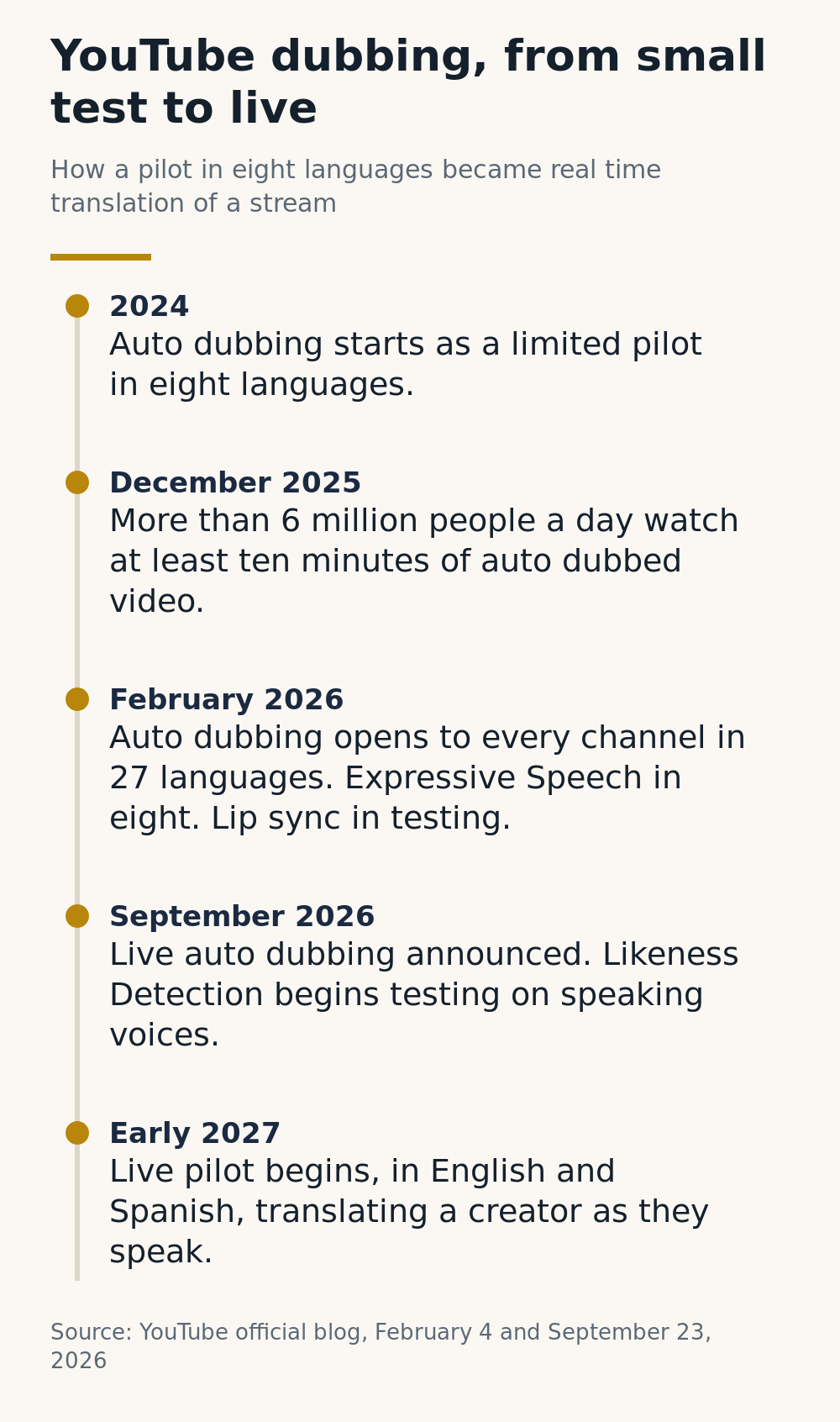
This did not come out of nowhere. Auto dubbing began as a limited pilot in eight languages in 2024. On February 4 this year, YouTube product manager Chandralekha Motati wrote that it was opening to every channel in 27 languages, with “Expressive Speech for all YouTube channels in 8 languages (English, French, German, Hindi, Indonesian, Italian, Portuguese and Spanish)” to keep some of the original performance intact.
The same piece gives a number worth sitting with. “In December, YouTube averaged more than 6 million daily viewers who watched at least 10 minutes of auto dubbed content.” That was nine months ago, when the feature was newer and narrower. Motati also confirmed a lip sync trial, matching a speaker’s mouth to the translated track, and told creators that a dubbed version “might be able to help with discovery in other languages” without hurting the original.
The work this touches first
Nobody is about to auto dub a feature film. What’s under pressure is the layer below that, and it always has been: explainer videos, product walkthroughs, tutorials, sponsor reads, corporate channels that want the same twelve minutes in eleven markets. That work has been quietly paying rent for a lot of voice actors for a decade, and it is exactly the work a platform-native tool takes first, because it is bundled free with the upload.
 VoiceEditSuiteClean a session in ninety seconds, not three hours.
Live is a different animal, though, and it is worth being precise about why. A live stream has never been dubbed by a human at this scale, because you cannot book a booth for a Tuesday night gaming session. This is not a tool replacing a job that existed. It is a tool creating a market that did not exist, then filling it with synthetic voices before anyone else can get near it. That distinction matters when you are deciding whether to be angry or to be strategic.
There is a second-order effect that is easier to miss. Once an audience gets used to hearing a stream in their own language, the expectation carries over to recorded video, and then to anything else that channel makes. A client who has watched a machine do it for free on Tuesday is a harder sell on Wednesday. The argument for a human is still the right one, but it gets made against a rising baseline of what people will accept.
The announcement voice people should read twice
Buried in the same set of announcements is something that cuts the other way. Social Media Today reports that YouTube is “testing speaking voice detection as a new addition to its likeness detection process.” Likeness Detection is the system YouTube has been building out through 2026, first for politicians and journalists, then for celebrities, then for creators in the Partner Program. Until now it has looked at faces. Adding the speaking voice means a performer could, in principle, be told when something on the platform sounds like them.
That is not a small thing. A working voice actor’s most realistic AI problem is not a studio licensing their voice on a proper contract. It is a cloned read turning up in an advertisement they never saw, on a platform too big to search by hand. A detection tool that scans for a voice is the first piece of infrastructure that makes that problem findable. Whether it is any good, and whether it reaches people who are not famous, is the question to ask when the test widens.
It is also fair to note the mood among the people YouTube is building all this for. TechCrunch found creators wary of the AI tools generally, with the worry that “just one AI-generated mistake could harm their credibility.” A machine mispronouncing a sponsor’s name in front of a live audience is not a hypothetical.
What to do before 2027
Three practical things. First, if you take localization work, look at your contracts now for language about synthetic reproduction and derivative language versions, because the client who used to buy eleven language versions may soon buy one and press a button. Second, if you are a performer with a public catalogue of your own, get familiar with how likeness detection enrolment works on the platforms you are on, so you are in the queue when voice matching opens up.
Third, and least obvious: watch the live space rather than writing it off. Real time translation of a stream is going to be strange and lossy for a long while, and the creators who care about how they sound are going to notice. There is an emerging niche in live language hosting, simultaneous read, and cleaning up what a machine does badly. Someone is going to build a business on that. It may as well be a voice person.
Sources: YouTube Blog, September 23, 2026; YouTube Blog, Neal Mohan, September 23, 2026; YouTube Blog, February 4, 2026; TechCrunch; Social Media Today; Dataconomy.
Lee este artículo en español: YouTube doblará las transmisiones en vivo mientras hablas. Empieza con inglés y español
Know something about this story, or spotted an error? Tell the newsroom.