





ACX Changed How Narrators Get Paid. Here’s What to Do Before December 31
If you narrate audiobooks on a royalty share deal, there is a decision waiting for you in your ACX inbox, and a date attached to it. Audible has replaced the royalty model that has paid indie audiobooks since ACX launched, the old model ends on December 31, and titles under a royalty share agreement can’t move across without the narrator’s say-so. Here’s what changed, in ACX’s own words, and what to do about it.
The numbers everyone quotes
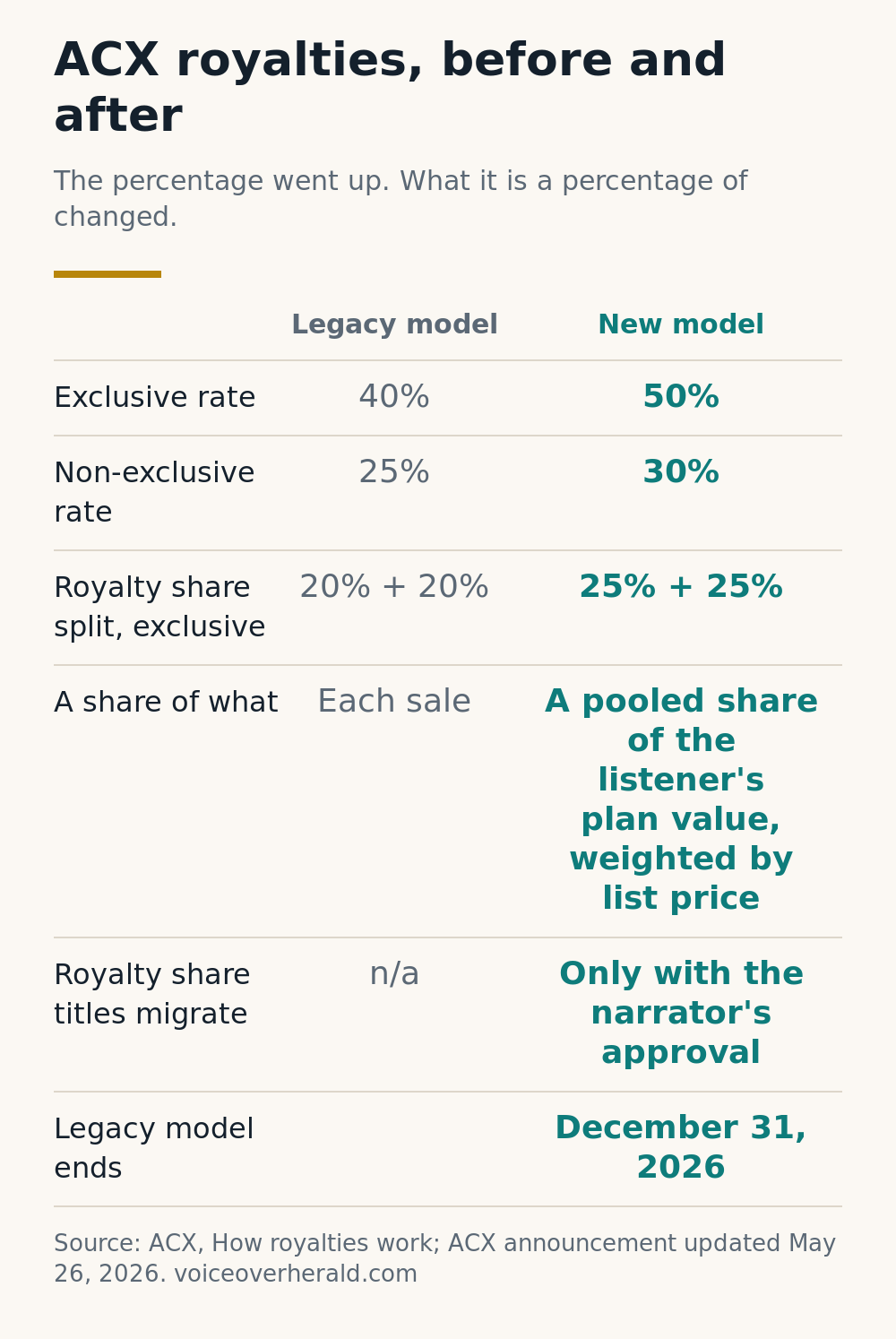
For more than a decade, an ACX title earned a flat share of each sale: 40% of the retail price if the rights holder distributed exclusively through Audible, Amazon and Apple, 25% if they didn’t. The new model, which opened to all creators on May 26, 2026, pays 50% exclusive and 30% non-exclusive. ACX’s help page states it directly: from that date, “newly claimed DIY titles, new marketplace offers sent to producers, new users, and existing titles enrolled in the new royalty model” earn the higher rates, while existing titles that are not enrolled “continue to earn a 40% royalty rate for exclusive distribution and a 25% royalty rate for non-exclusive distribution until year-end, at which time the legacy model will be discontinued.”
So far, so good: the percentage went up. The catch is what it’s a percentage of.
What the percentage is now a share of
Under the old model, a sale was a sale. A member spent a credit on your title, the title’s price set the royalty, and you got your cut. The new model is pooled. Audible takes each member’s monthly plan value, adds the value of any extra credits they bought, and divides that pot among every title that member engaged with in the month, weighted by each title’s list price. ACX’s description: “Member Value is then divided up and divided proportionally among each title the member engaged with, based on the a la carte price of those titles.”
Three consequences follow for narrators.
- Engagement now matters, not just the sale. A title a member buys and never opens is worth less than it used to be. A title a member actually listens to, in a month when they also listen to two other titles, shares that member’s value three ways.
- Price weighting cuts both ways. Longer titles with higher list prices take a bigger slice of a member’s pot when they share the month with cheaper ones. Short titles do worse in the same situation.
- Your income becomes harder to predict from sales alone. The same number of credits spent can pay out differently depending on what else those listeners did that month.
Royalty share: the split, and who has to click
If you narrated on a Royalty Share deal, the rights holder’s royalty is split equally with you. Under the legacy model that meant 20% each of an exclusive title’s price; under the new model it’s 25% each. ACX spells it out: on an exclusive royalty share title, the rights holder “will receive 40% (legacy royalty rate) or 50% (new royalty rate)” and the producer receives “an equal share, resulting in 20% (legacy royalty rate) or 25% (new royalty rate) royalties for the producer.”

 VoiceEditSuitePro audio tools built for working voice actors.Auto Clean UpACX Audiobook PrepAudition Director
The part that lands on your desk: a rights holder cannot move a royalty share title to the new model on their own. ACX’s announcement says narrators and producers on a royalty share agreement “will receive a notification to approve the new royalty terms on ACX.” Until you approve, that title sits on the legacy terms, and the legacy terms end at the close of the year.
Royalty Share Plus deals work the same way on the back end, with the difference that the producer was also paid a smaller upfront fee by the rights holder; ACX’s page notes that for union eligibility that fee must be at least $100 per finished hour.
Exclusivity is not the trap it was
One reason narrators hesitated over exclusive royalty share deals was the old seven-year exclusivity lock. That ended in 2021. ACX’s contract page now allows a one-time request to switch between exclusive and non-exclusive distribution once a title has been on sale for at least 90 days, processed within 30 days. That decision belongs to the rights holder, not the narrator, but it changes the conversation: a rights holder can try exclusive for the higher rate and reconsider with real data.
What to do before December 31
- Open ACX and look for the notifications. Each royalty share title you’ve narrated needs its own approval. If you have a back catalogue of them, there may be a dozen waiting.
- Read the new terms before you click. The percentage is higher. The basis is different. For a title that sells well but gets listened to less, the new model may not be an increase in practice; for a title people finish, it likely is.
- Talk to the rights holders you work with. Some don’t know the migration needs you. A short message now avoids a title going dark in January because nobody clicked.
- Decide how you feel about future royalty share offers. With a pooled model, the question to ask a rights holder isn’t only “how many will it sell” but “will people finish it.” Genre, length and the author’s existing audience matter more than they did.
- Diarise December 31. ACX has said the legacy model is discontinued at year-end. It has not spelled out on its help pages what happens to a title that never enrols. Don’t be the one who finds out.
None of this is a reason to leave the platform. It’s a reason to read the email. Fifty per cent of a fairly divided pool can be a better deal than forty per cent of a sale; it depends on the book, the listener and the month, which is why the decision has been handed to you.
Sources: ACX, How royalties work; ACX, A New Royalty Model and More Opportunities to Earn (updated 26 May 2026); ACX, Manage your ACX contract.
Lee este artículo en español: ACX cambió cómo cobran los narradores. Qué hacer antes del 31 de diciembre