Opinion: CAA’s Boss Wants Congress to Stop AI Clones. The Voice on Your Hold Message Needs That Law More Than Tom Hanks Does
The boss of Creative Artists Agency wants Congress to pass a law against AI clones, and he’s right. But if Washington wants to know who that law is really for, it should stop picturing Tom Hanks and start picturing the person who voices your dentist’s hold message.
On Saturday, Bryan Lourd, the chief executive of Creative Artists Agency, made his case in a New York Times opinion essay. He wants lawmakers to pass the NO FAKES Act, which would set federal protections against unauthorised digital replicas of a person’s voice or likeness. TheWrap summed up the framework in three words: control, consent and compensation. You get to say yes or no to a copy of yourself, and if it’s used commercially, somebody negotiates and pays.
“Hollywood is not afraid of new technology,” Lourd writes. Good. Neither are voice actors. We were recording on laptops in wardrobes while the rest of the world was still learning to unmute.
The famous face is the easy case
Lourd’s examples, as TheWrap reported them, include the one you’d expect: a dental advertisement with a younger, AI-generated Tom Hanks. Then a content creator whose likeness turned up selling erectile dysfunction supplements, which is surely nobody’s dream brand deal. And then the one that should have been the headline: voice actors who found that recordings they made for research purposes had been turned into commercial voice clones.
 VoiceEditSuiteNewIt edits like you would, and it gets better every file.Learns from numbers, never your audio. Never used to train AI.See how it works
Here’s the thing about Tom Hanks. If a fake Tom Hanks sells you a crown and a polish, millions of people notice, a newsroom calls his people, and a lawyer has a very good week. The fake is easy to spot because the face is famous.
Now try that with a voice nobody can put a face to. The woman who reads your bank’s opening hours. The man who explains the fire exits in your company’s compliance course. The narrator of the safety video you skipped at 1.5x speed. Their voices are everywhere and their names are nowhere. When a clone of one of them turns up, who notices? Mostly, they do, if they’re lucky enough to hear it.
That’s why “famous or not” isn’t a nice extra in this debate. It’s the whole debate.
The consent is a tick box
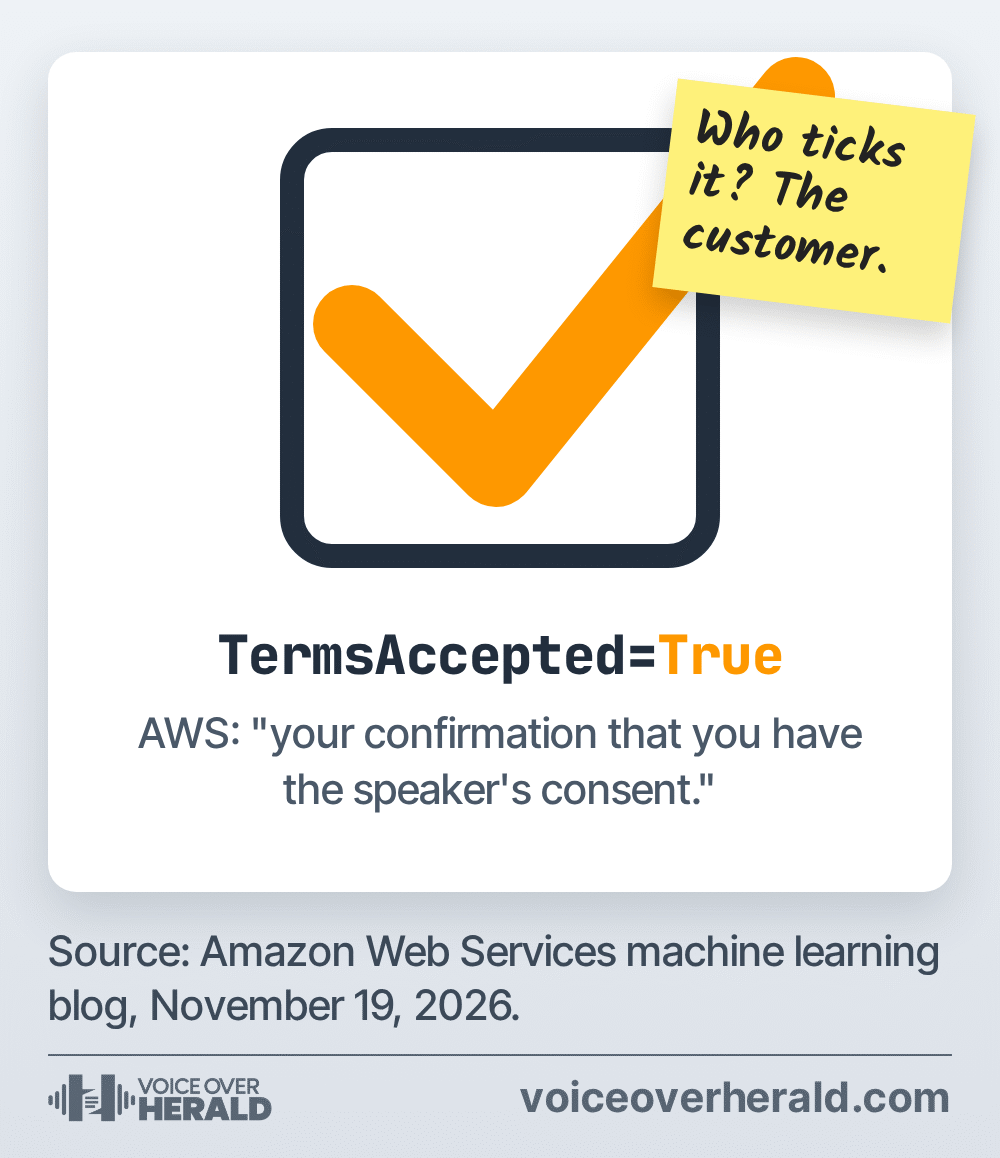
Look at what happened in the same week. On 19 November, as Voice Over Herald reported, Amazon Polly started letting customers build a cloned voice from a few minutes of one person’s recordings. AWS was refreshingly honest about what it’s for. “Rather than relying on a generic stock voice or re-booking a recording session each time a script changes, you can generate on-brand audio on demand,” its announcement said.
Re-booking a recording session is, for a lot of working voice actors, called “a job”.
And the consent? The customer sets one value, TermsAccepted=True, which AWS describes as “your confirmation that you have the speaker’s consent.” To be fair to AWS, it adds a watermark and tells customers to keep records. But the speaker’s protection is, in the end, a business promising it asked nicely. Every voice actor has a story about a client who promised something nicely.
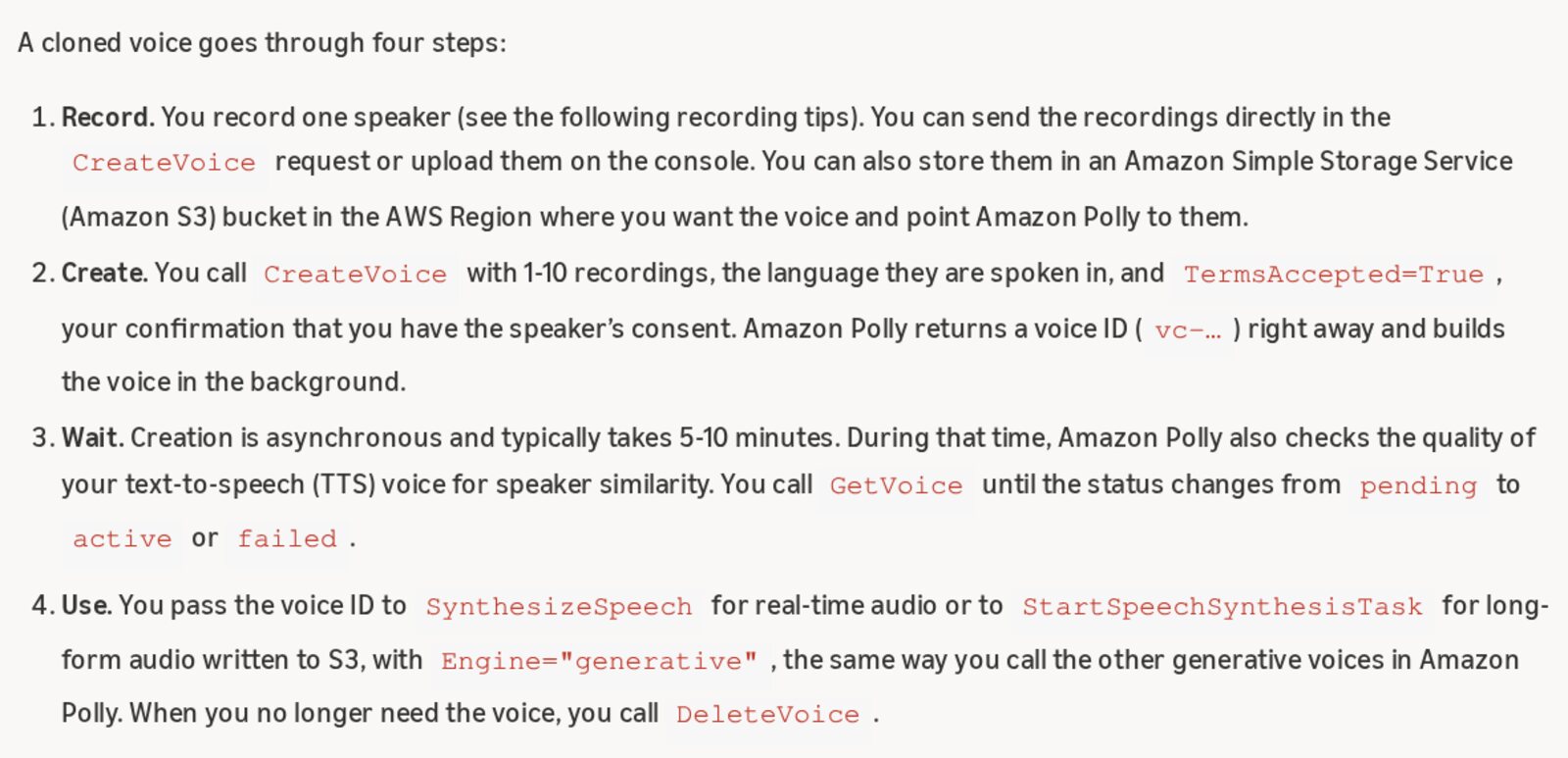
Screenshot: Amazon Web Services machine learning blog, November 19, 2026
“I was not even ASKED”
Then there’s the week before. Voicemod advertised a free “Cyn voice changer from Murder Drones,” and the actor who actually voices Cyn, Allanah Fitzgerald, found out the way the rest of us did, by scrolling. “I did not approve this, I was not even ASKED,” she wrote on X, in a story Voice Over Herald covered on 16 November. Voicemod’s own library page didn’t name Cyn, the show or her. Only the advert did.
Fitzgerald has a fan base that knows her name, and it still took a social media storm to get anyone to ask the question. A voice actor without one gets a shrug.
Nobody in this column is a villain, by the way. Amazon built consent language into its product, Voicemod says its voices are licensed, and Lourd is pushing for exactly the right thing. The problem is the gap between all those good intentions and the person whose voice is being copied. A federal law is how you close a gap like that.
Let’s be honest about who’s backing it
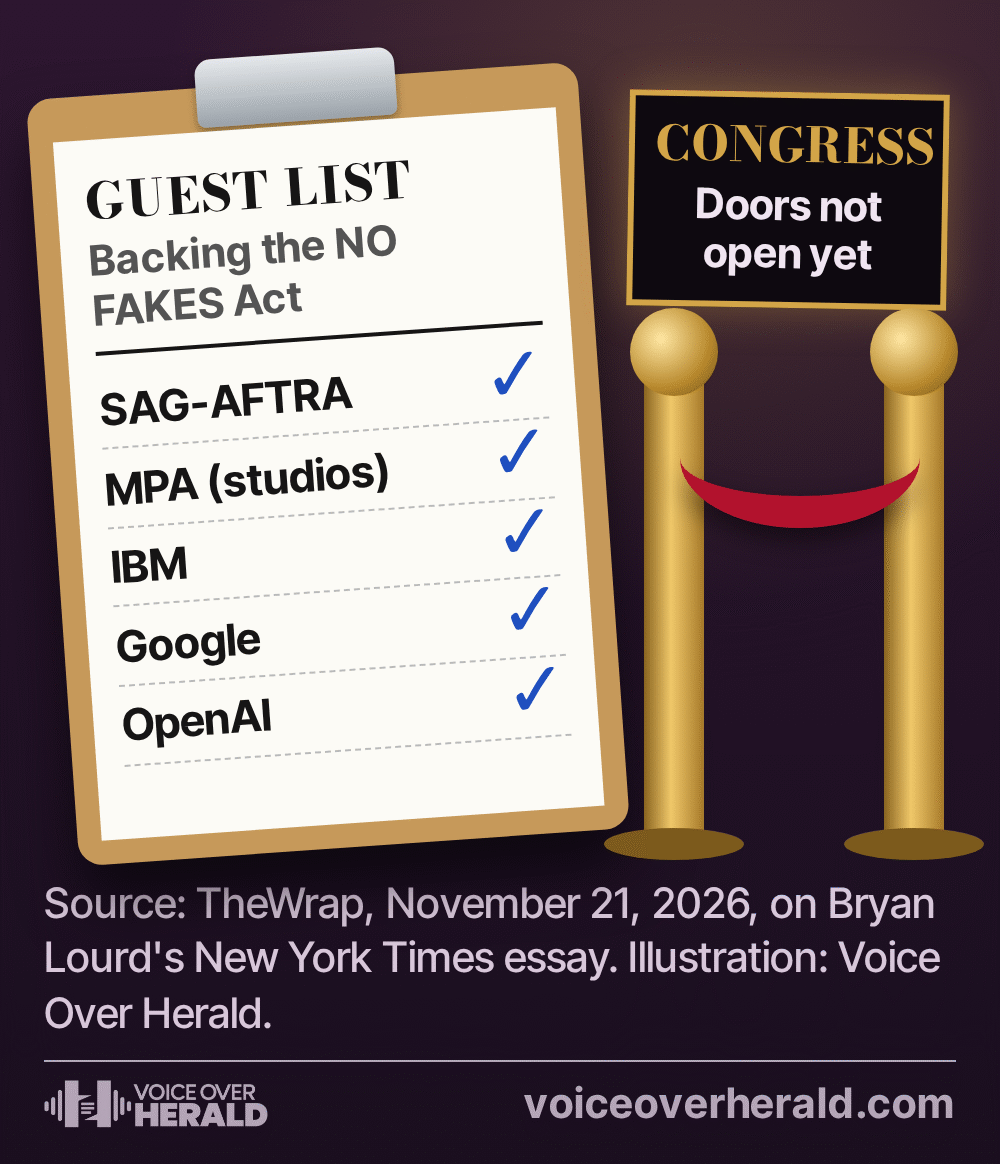
The bill has, Lourd notes, support from SAG-AFTRA, the Motion Picture Association, IBM, Google and OpenAI. When a performers’ union, the studios and three of the companies building the technology all want the same law, you’d think it would be through Congress before lunch. And yet here we are, with an agency boss writing essays to get it moving.
States aren’t waiting. As Voice Over Herald reported after a California judge let the former NPR host David Greene take his voice case against Google forward, California’s likeness law will count a digital replica as your voice from 1 January 2027. “A radio host reaches the audience through the voice,” the judge wrote. So does a hold message. So does every narrator, announcer and character actor who has ever worked.
But a voice actor in Ohio recording for a client in Texas, for a platform based in Washington State, shouldn’t need a map and a lawyer to find out which rules apply. One floor, nationwide, is the point.
Until Congress gets around to it
Laws are slow, and clones are fast. So in the meantime, the paperwork is your protection. Before you record anything a client might train on, read the usage, the term and the AI clauses. Our guide to the four clauses that decide what happens to your voice after the session is a good place to start, and it’s shorter than most hold queues.
And keep proof of what’s yours. When a voice turns up somewhere its owner never agreed to, the first fight is often over which recordings are really theirs, and since when. The Voice Realm’s Voice Lock is built for that moment. Once a voice actor switches it on, their demos carry an invisible watermark and a dated certificate anyone can check online. The Voice Realm says it’s the world’s first voiceover marketplace to protect voice actors’ demos with an invisible watermark. It won’t detect a clone, but it gives you proof of which recordings came from you.
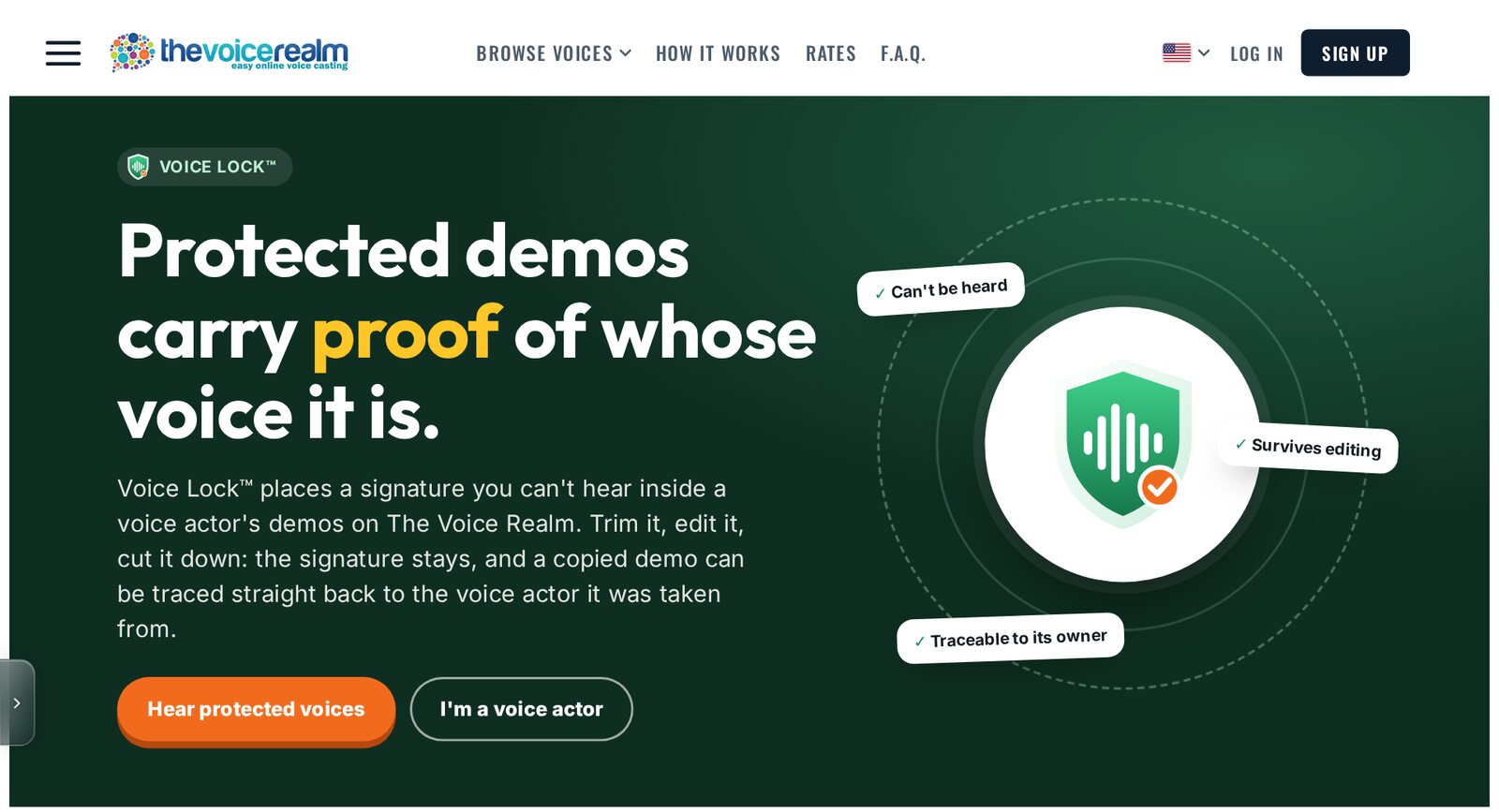
Screenshot: The Voice Realm, November 23, 2026
So yes, Mr Lourd, pass the law. Just put a working voice actor at the front of the press conference, not Tom Hanks. He’ll understand. He’s done voice work too.
This is an opinion piece. Sources: TheWrap, November 21, 2026, on Bryan Lourd’s New York Times opinion essay of the same day; Amazon Web Services machine learning blog, November 19, 2026; Voicemod and Allanah Fitzgerald on X, November 14 and 15, 2026; Santa Clara County Superior Court order in Greene v. Google, October 23, 2026; earlier Voice Over Herald reporting. Hero image: Architect of the Capitol, public domain, via Wikimedia Commons.
Lee este artículo en español: Opinión: El jefe de CAA quiere que el Congreso frene los clones con IA. La voz de tu mensaje en espera necesita esa ley más que Tom Hanks
Know something about this story, or spotted an error? Tell the newsroom.