
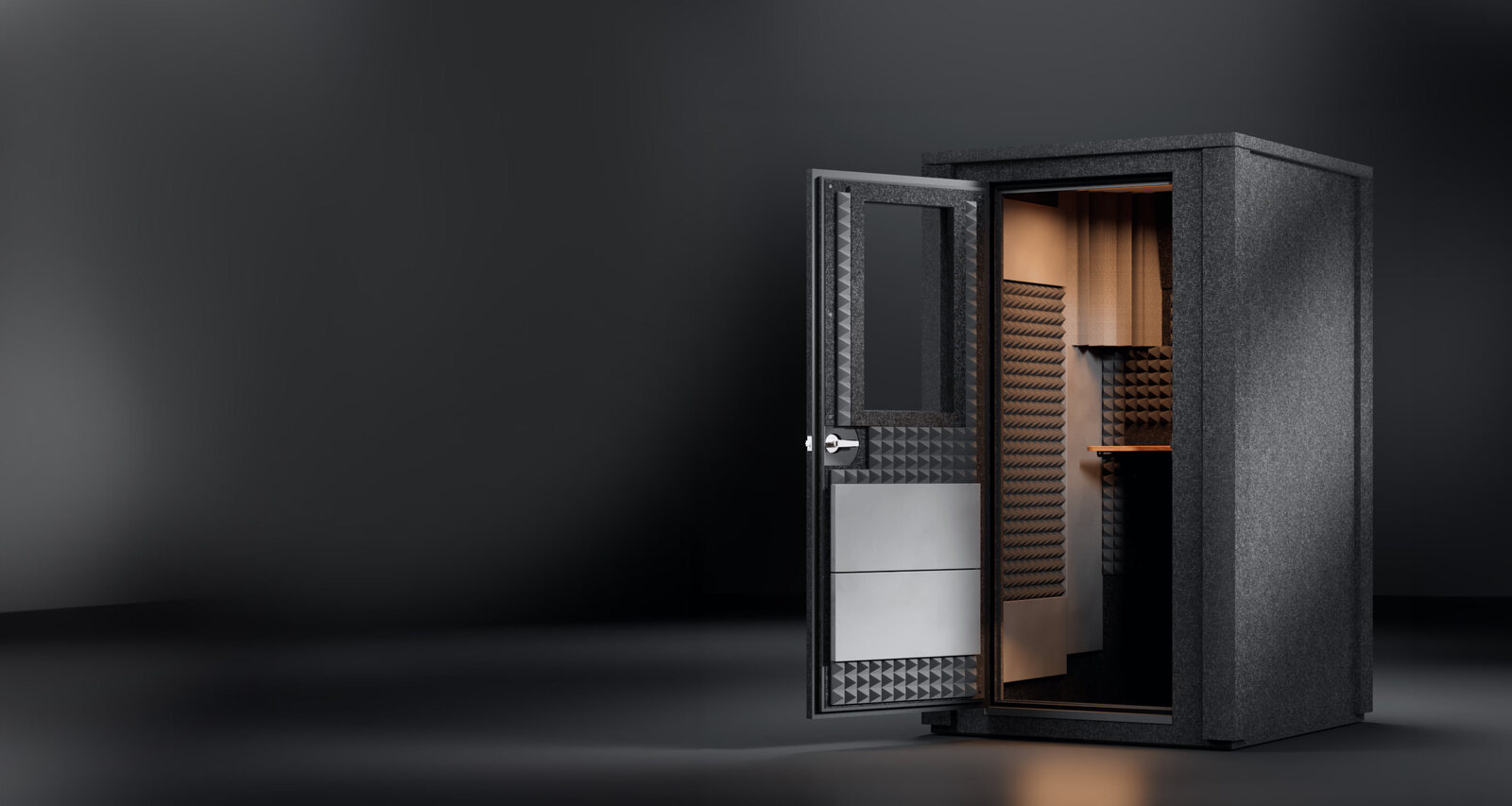
Foam Won’t Stop Your Neighbor’s Dog: What the Makers’ Own Lab Sheets Say About Treating a Voice Booth
Foam is the first thing most voice actors buy for a home booth, and the makers’ own test sheets show exactly what it does and what it doesn’t. It tames echo. It does very little about the bus outside. Here’s how to read absorption and isolation figures from Auralex, Primacoustic and WhisperRoom, what ACX actually measures, and where to spend first.
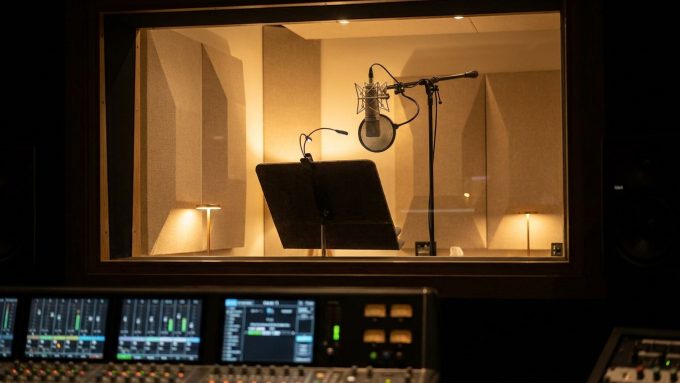
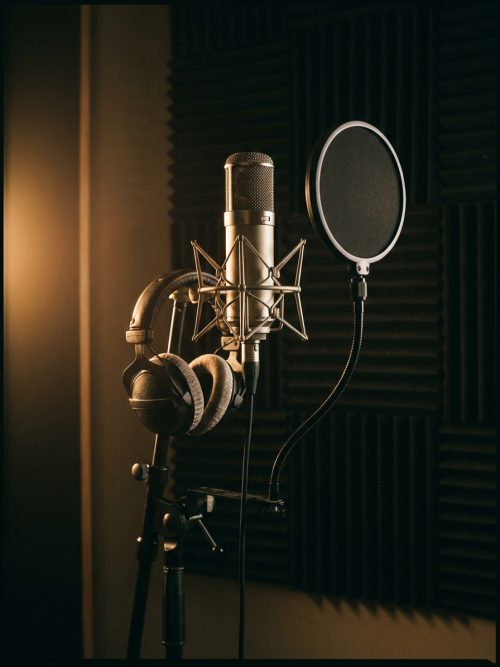
Every home booth starts with the same picture: a wall of grey wedges, a mic in the middle, and the hope that the neighbor’s dog is now somebody else’s problem. Then the first audition goes out with a faint bark under the second paragraph.
The wedges weren’t faulty. They were doing a different job. Acoustic treatment comes in two kinds that often get lumped together: material that soaks up your own voice inside the room, and construction that stops outside sound getting in. They’re measured with different tests, and one can’t stand in for the other.
For audiobook work the stakes are written down. ACX’s audio submission requirements say: “Each file must have a noise floor no higher than -60dB RMS to avoid background noise distractions.” That noise floor counts everything the mic hears when you’re not talking: hiss from the gear, the fridge two rooms away, traffic, and the room itself.
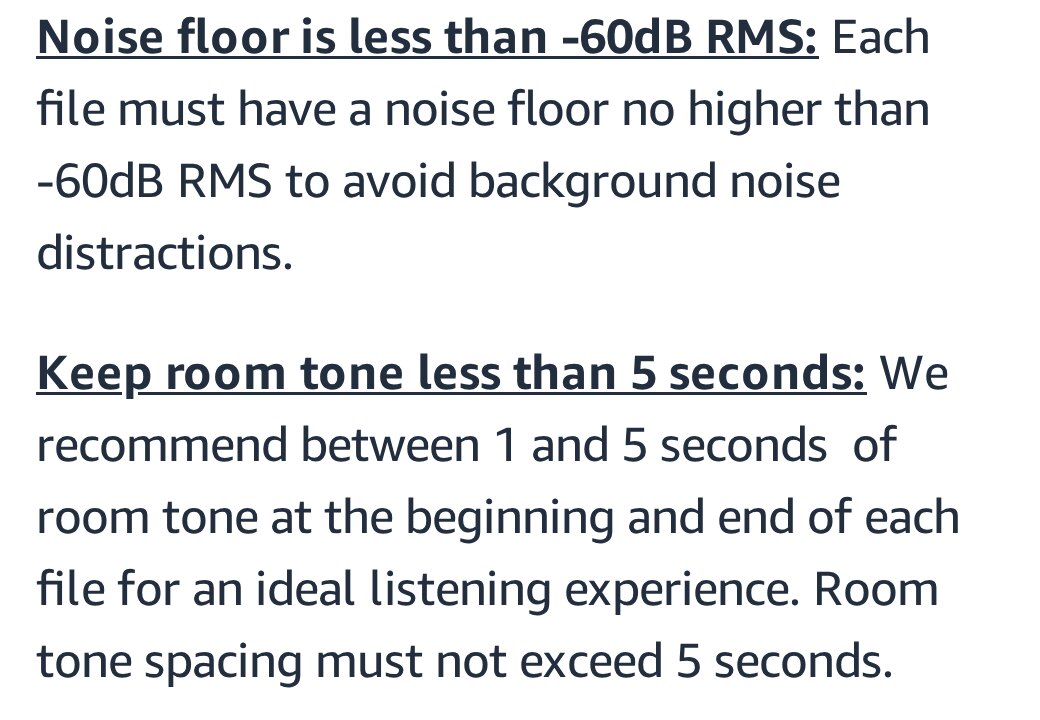
ACX's audio submission requirements. Screenshot: ACX, 18 November 2026
Two jobs, two numbers
The number on foam and panel listings is NRC, the Noise Reduction Coefficient. Despite the name, it doesn’t measure noise reduction in the way a voice actor means it. Auralex, one of the best known foam makers, describes NRC on its performance data page as “a single number average of a foam’s absorption in what was determined long ago to be the most important range.” The lab test behind it, ASTM C423, covers 125Hz to 4000Hz, but Auralex explains that “only the coefficients from 250Hz to 2000Hz are used” when the NRC is worked out. A coefficient of 1.00 means nearly all the sound hitting it at that pitch is soaked up; 0.10 means most of it bounces back.
The number for keeping sound out is different. Auralex’s own page calls STC, Sound Transmission Class, “a numerical rating of how effective a material is at blocking the transmission of sound through itself,” and says it “generally applies to hard materials like rubberized sound barriers, concrete, brick and drywall.” Booth makers also quote plain decibels of noise reduction, measured from one side of a wall to the other.
WhisperRoom, which builds isolation booths, sums up the split on its guide to how sound isolation works: “STC and NRC are not interchangeable. A great NRC does not stop noise coming in. A great STC does not make a room sound good inside.”
Treatment (NRC)
Soft, porous material on the inside. Cuts echo and the boxy sound of a small room. Does almost nothing to stop sound passing through a wall.
Soundproofing (STC, dB)
Mass, sealed gaps and separate walls. Keeps traffic and neighbors out. On its own, it can still leave a room sounding hollow.
What the foam sheet really says
Auralex publishes its lab figures for every foam it sells, and they’re worth reading slowly. Its 2″ Studiofoam Wedges carry an NRC of 0.80, a solid number. Look along the row, though, and the picture changes with pitch. At 500Hz the 2″ wedges score 0.91, and at 1000Hz they score 1.05. At 125Hz, the low end where room rumble and the boom of a small space live, they score 0.11.
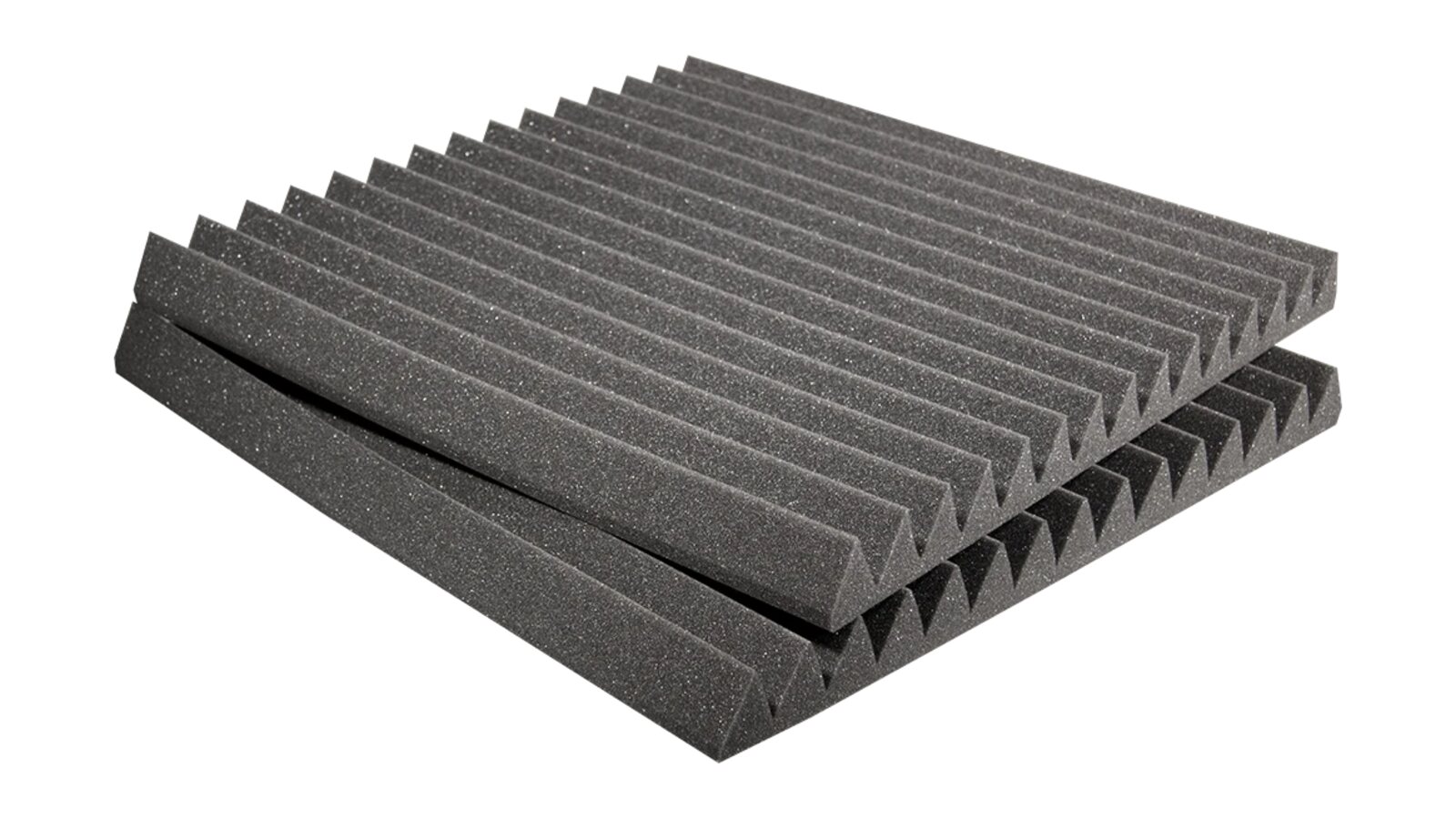
Auralex 2" Studiofoam Wedges. Image: Auralex
Thickness helps. The same table lists the 4″ version at 0.31 at 125Hz, and the 1″ version at 0.10 with an overall NRC of just 0.50. Thin foam is very good at the hiss and sparkle of a voice, and close to useless at the bottom.
None of that makes foam a bad buy. A small booth with bare walls rings, and foam deals with that well. What the 125Hz column tells you is that one NRC figure averages away the part of the spectrum thin foam doesn’t touch.
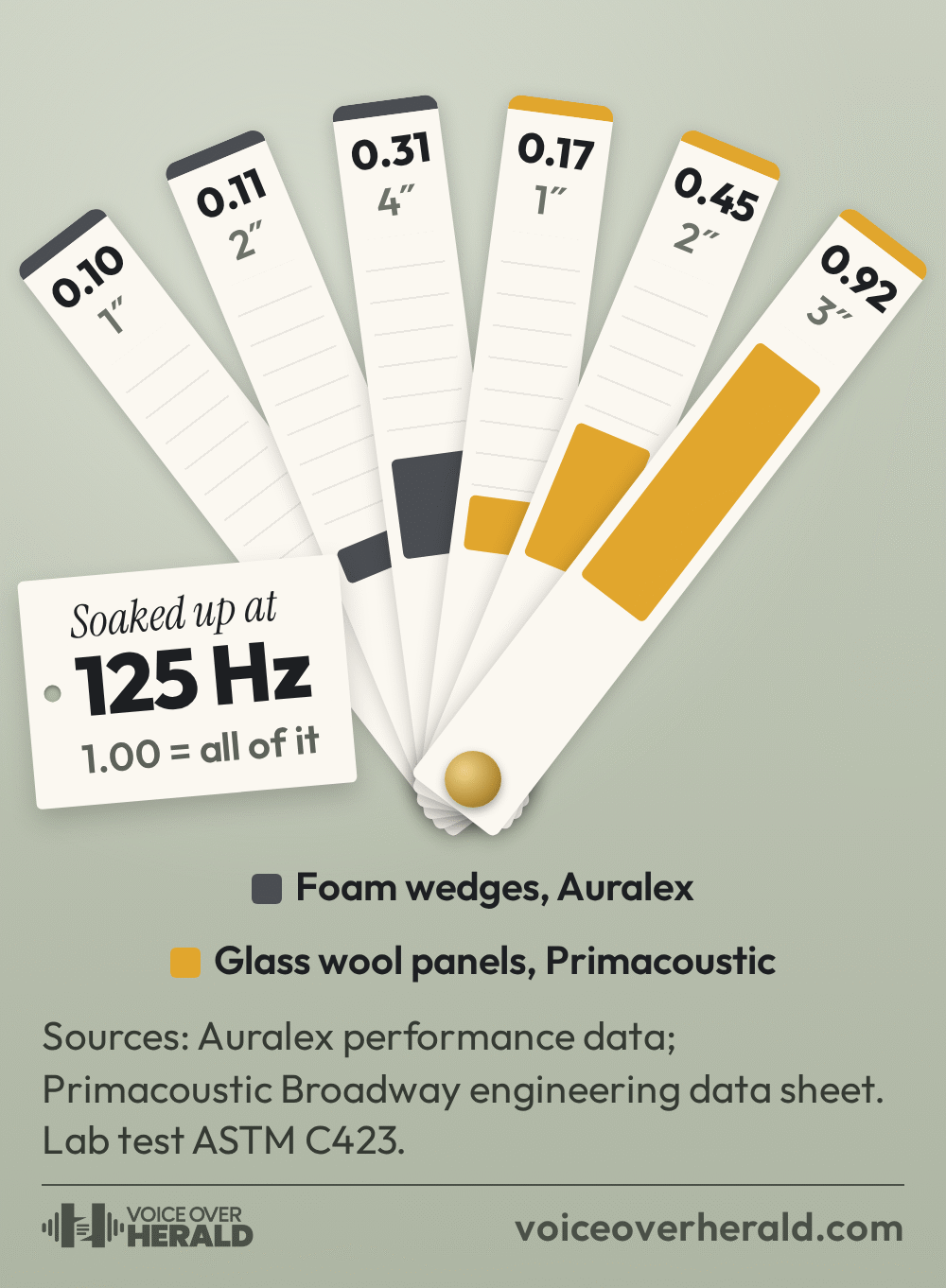
Same thickness, different stuff
Mineral and glass wool panels are the other common choice, and their sheets show why engineers reach for them. Primacoustic’s Broadway panels are made, in the company’s words, “from a high-density (6pcf/96 kg/m3) glass wool,” and its engineering data sheet credits the testing to Riverbank Acoustical Laboratories under the same ASTM C423 method.
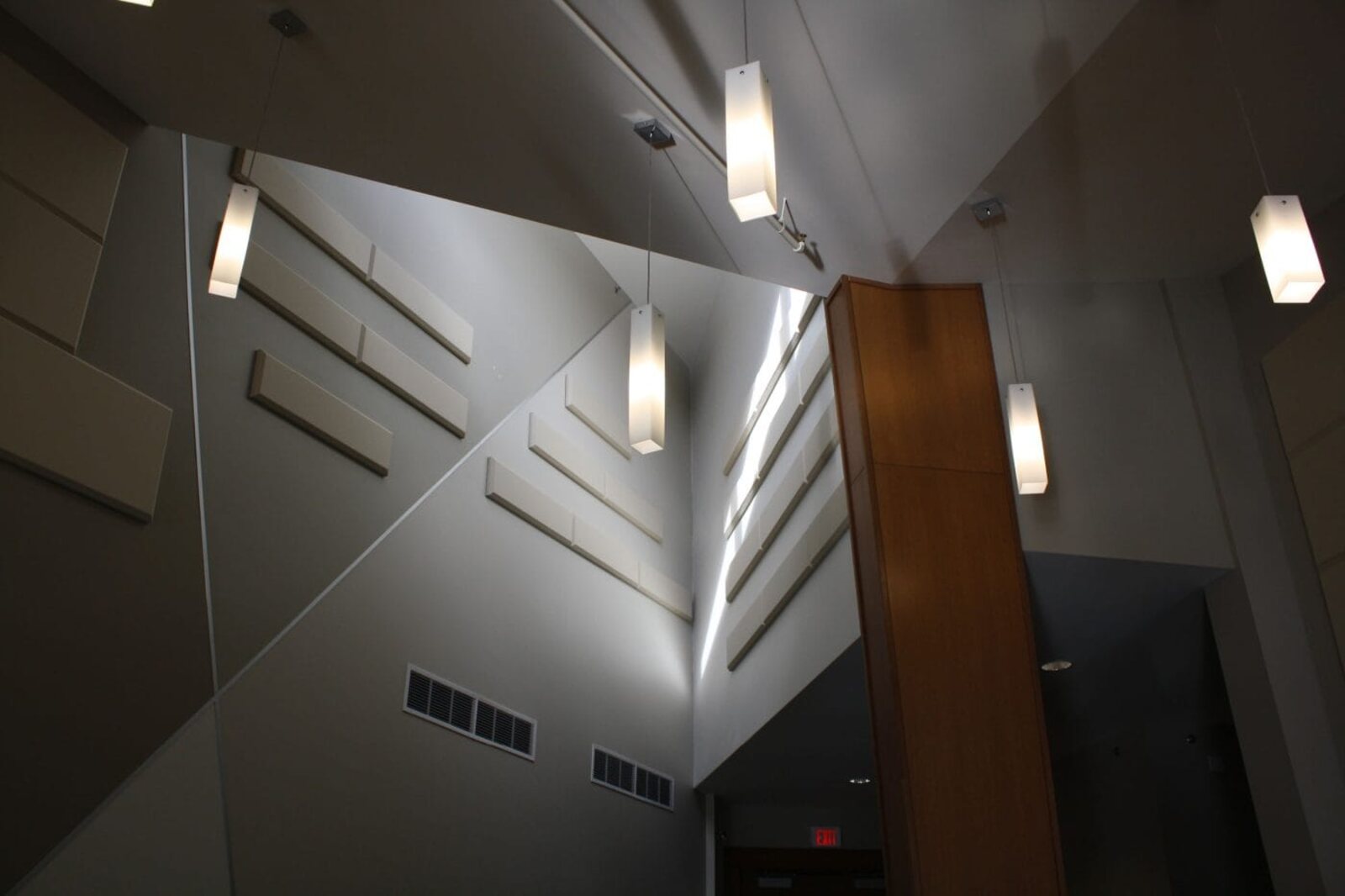
Primacoustic Broadway panels on the walls of a tall room. Image: Primacoustic
Primacoustic’s 2″ panel scores 0.45 at 125Hz, against 0.11 for Auralex’s 2″ wedges, and its NRC is 1.00. The 3″ panel reaches 0.92 at 125Hz. The 1″ panel, at 0.17 in that bottom band, behaves a lot more like foam. The lesson for a buyer is that depth and density matter more than the shape on the front.
Two cautions keep the comparison fair. These are each maker’s own published results, not one side by side test, and how a panel is mounted changes its score. Primacoustic’s sheet also lists a 2″ panel across a room corner with a 17″ air gap at 0.68 at 125Hz, but notes those corner figures are “typical performance based on quarter wavelength calculations,” so they’re worked out rather than measured.
Blocking sound is a different trade
If the problem is a sound from outside the room, the absorption column won’t fix it. WhisperRoom’s guide puts it bluntly: “Absorption does not equal isolation. Acoustic foam can improve the sound inside a room, but it does very little to stop a lawnmower, traffic, HVAC system, or neighbor from being picked up by a microphone.”
Auralex, which sells both kinds of product, says much the same: “Virtually every material filters out some of the sound that travels through it, but dense materials are much better at this than are spongy materials.” Its Sheetblok barrier, a dense vinyl sheet built for blocking rather than absorbing, carries an STC of 27 on that page, and its transmission loss climbs from 17 dB at 125Hz to 38 dB at 4000Hz.
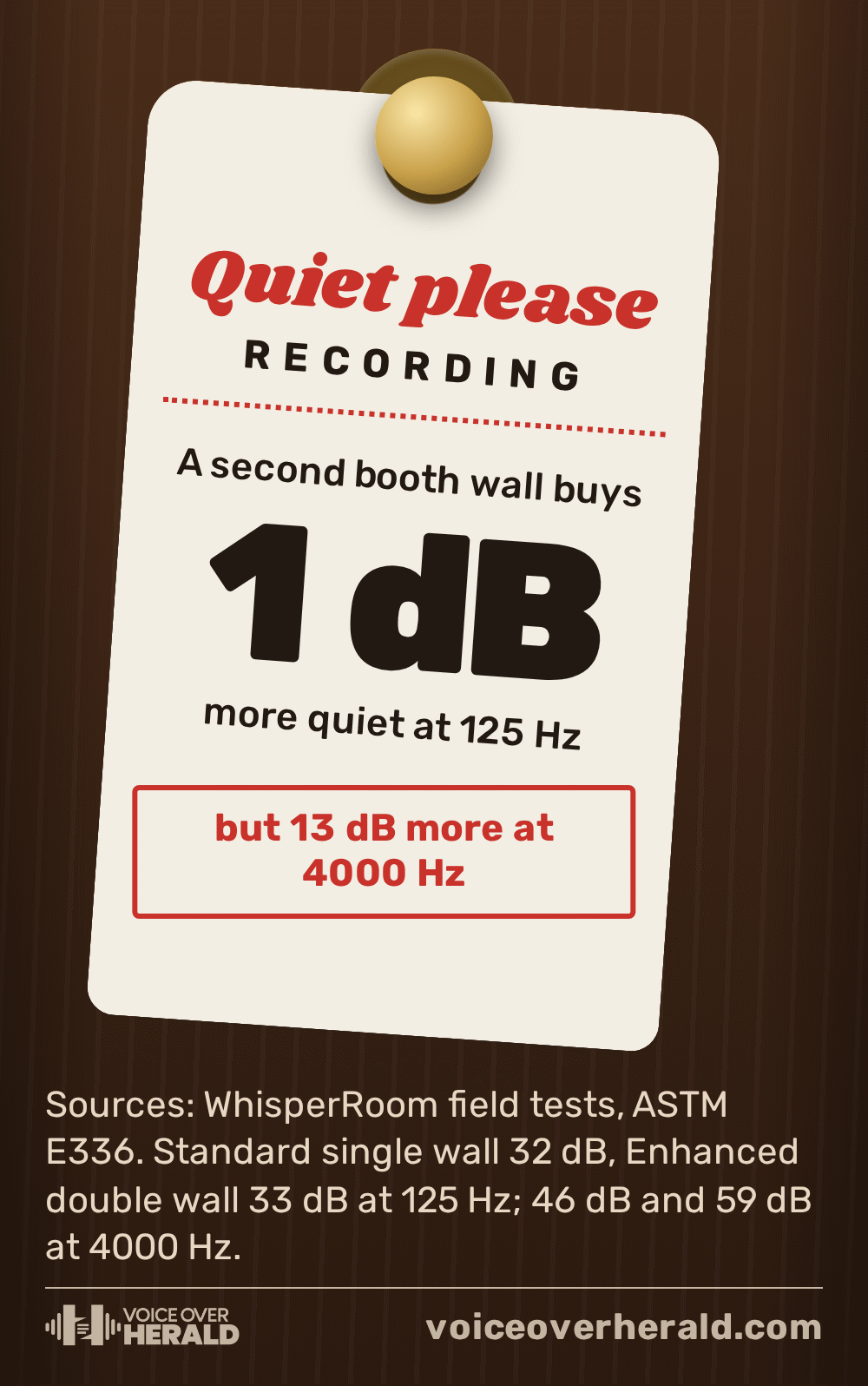
Booth makers quote their isolation in decibels from field tests. WhisperRoom says its single wall Standard booths reduce sound by about 32 to 46 dB and its double wall Enhanced booths by about 33 to 59 dB, measured under ASTM E336. The low end is the hard part again, and WhisperRoom’s own summary is that “lower frequencies are harder to isolate.” It also warns that a published range “should be treated as measured performance rather than a guarantee for every room.”
The other half of isolation is sealing. “A heavy wall loses much of its value if sound can escape through gaps around a door, window, vent, or cable opening,” the guide says. For a closet booth, that means the door gap and the cable route matter as much as what’s hanging on the walls.
Even the official advice blurs the line
The two jobs get mixed up even in good faith. ACX’s 2021 studio setup post, A Studio of One’s Own, tells new producers to “Block out external noise and dampen vibrations by covering your walls and ceiling with acoustic panels, egg-crate mattress covers, carpets, or even thick moving blankets, duvet covers, or curtains.” The makers’ own figures say those materials do the second part of that sentence far better than the first.

 VoiceEditSuiteNewYour breath. Your pace. Your edit.Learns from numbers, never your audio. Never used to train AI.See how it works
The same post gets other things right. It warns that a chosen room “is not as quiet as you think,” that thick curtains help with many noises “but not construction sounds like jackhammers,” and that fabric can overdo it: leave “a bit of space between each panel so the sound of your voice can be diffused a little and won’t sound flat (sometimes fabric absorbs sounds almost too well).”
And sometimes the noise isn’t the room at all. In an older ACX post, producer Peter A. Rohan describes spending everything on the walls first: “I found that out the hard way, after exhausting all my energies in soundproofing and absorption only to find that it was the cheap mic that I was using that was generating most of my noise floor.”
A buying order that follows the data
- Find the noise first. Record a minute of silence in your booth and measure it against ACX’s -60dB line. Then unplug things one at a time. If the hiss stays the same with the door shut and the room quiet, the gear may be the culprit, as it was for Rohan.
- If the noise comes from outside, fix isolation. Seal the gaps, add mass, close off the path the sound takes. Foam on the wall won’t do this.
- If your voice sounds boxy or ringy, add absorption. Compare the 125Hz and 250Hz columns, not only the NRC. Thicker and denser reaches lower.
- Read the small print on the sheet. Look for the test standard (ASTM C423 for absorption, E336 or STC for isolation), the lab, and the mounting the figures were taken with.
- Stop before it sounds dead. ACX’s own warning about fabric that absorbs “almost too well” applies to foam and panels too.
Echo is an absorption problem. A barking dog is an isolation problem. A hiss that never changes might not be the room at all.
Sources: Auralex performance data (absorption coefficients, NRC and STC tables); Primacoustic Broadway Acoustic Panels engineering data sheet; WhisperRoom, “How Sound Isolation Works” and voice over booth page; ACX, “What are the ACX audio submission requirements?”; ACX blog, “A Studio of One’s Own” (2021) and “Creating Your Studio Space” (2013). Product images: WhisperRoom, Auralex, Primacoustic. Screenshot: ACX, 18 November 2026.
Lee este artículo en español: La espuma no detiene al perro del vecino: lo que dicen las hojas de laboratorio sobre tratar una cabina de locución
Know something about this story, or spotted an error? Tell the newsroom.