


Before You Sign: The Four Clauses That Decide What Happens to Your Voice After the Session
A voice job ends when you send the files. The contract doesn’t. Usage, term, exclusivity and AI language decide where your voice turns up next year, and whether you’re paid when it does. Here’s what to look for, with the wording unions and voice actors’ groups now publish for you to use.
Paul Lehrman and Linnea Sage are working voice actors. Both recorded voice jobs for a client. According to a summary of the case by the law firm Loeb & Loeb, “They were told their recordings would be used solely for internal and academic research.”
The two say their voices were later cloned and sold by the AI voice company Lovo, and they sued. In July 2025 Judge J. Paul Oetken of the federal court in Manhattan threw out most of their copyright and trademark claims, but let the breach of contract claims go ahead, along with claims under New York’s right of publicity and consumer protection laws. Steve Cohen of Pollock Cohen, the actors’ law firm, called it “a spectacular victory for the plaintiffs.” Lehrman said: “This is a powerful and affirming decision.”
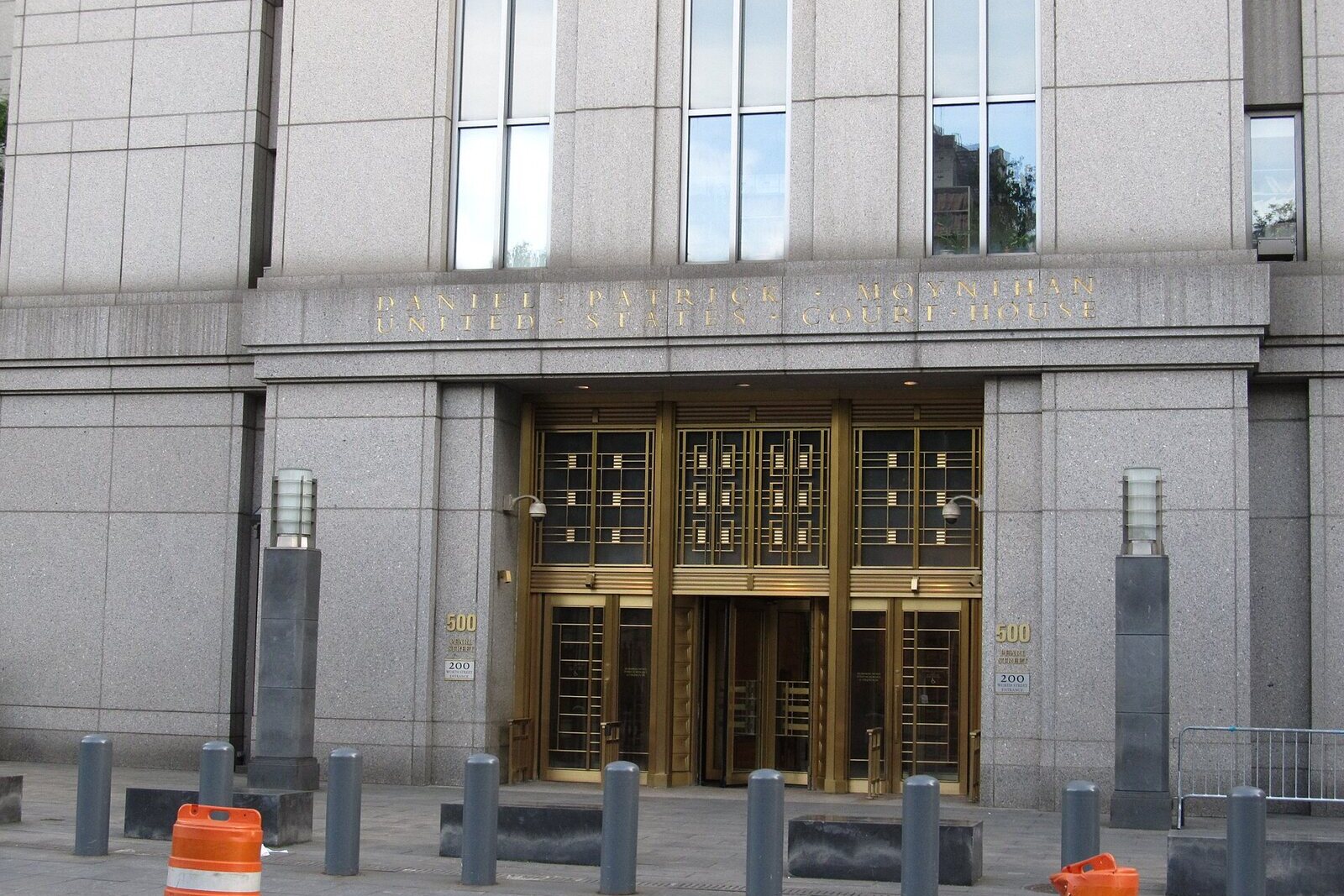
Image: Ken Lund, CC BY-SA 2.0, via Wikimedia Commons
Notice which claims survived. The contract claims did. When the law is still catching up with cloning, the words you agreed to are often the strongest thing you’ve got. So it pays to read them before the session, not after you hear yourself in an ad you never recorded.
What is the recording actually for?
Every voice job has a scope: radio, TV, online video, an internal training course, a phone system. The fee depends on it, and so does everything else in the deal. The National Association of Voice Actors (NAVA), the US group set up to look after voice performers, puts it bluntly in its guidance on synthetic voices: “The contract must define specifically which medium your character will be used in.”
Vague scope is where trouble starts. “All media now known or hereafter devised” is a common phrase in boilerplate, and it covers technology that hasn’t been invented yet, including whatever a voice model can do in five years. If the brief says “explainer video for our website”, ask for the contract to say that too. A client who only needs a website video rarely minds writing it down.
If a client does want broader use later, that’s fine. It’s a new conversation and a new fee. Lawyers at Lewis Silkin, writing about the UK actors’ union Equity’s guidance, say performers should keep “the right to be paid for further exploitation of their voice or image.”
How long, and where?
Term and territory are the two dials that decide how much a usage fee should be. A regional radio spot for 13 weeks and a global online campaign for two years are different jobs, even if the script is the same 30 seconds.
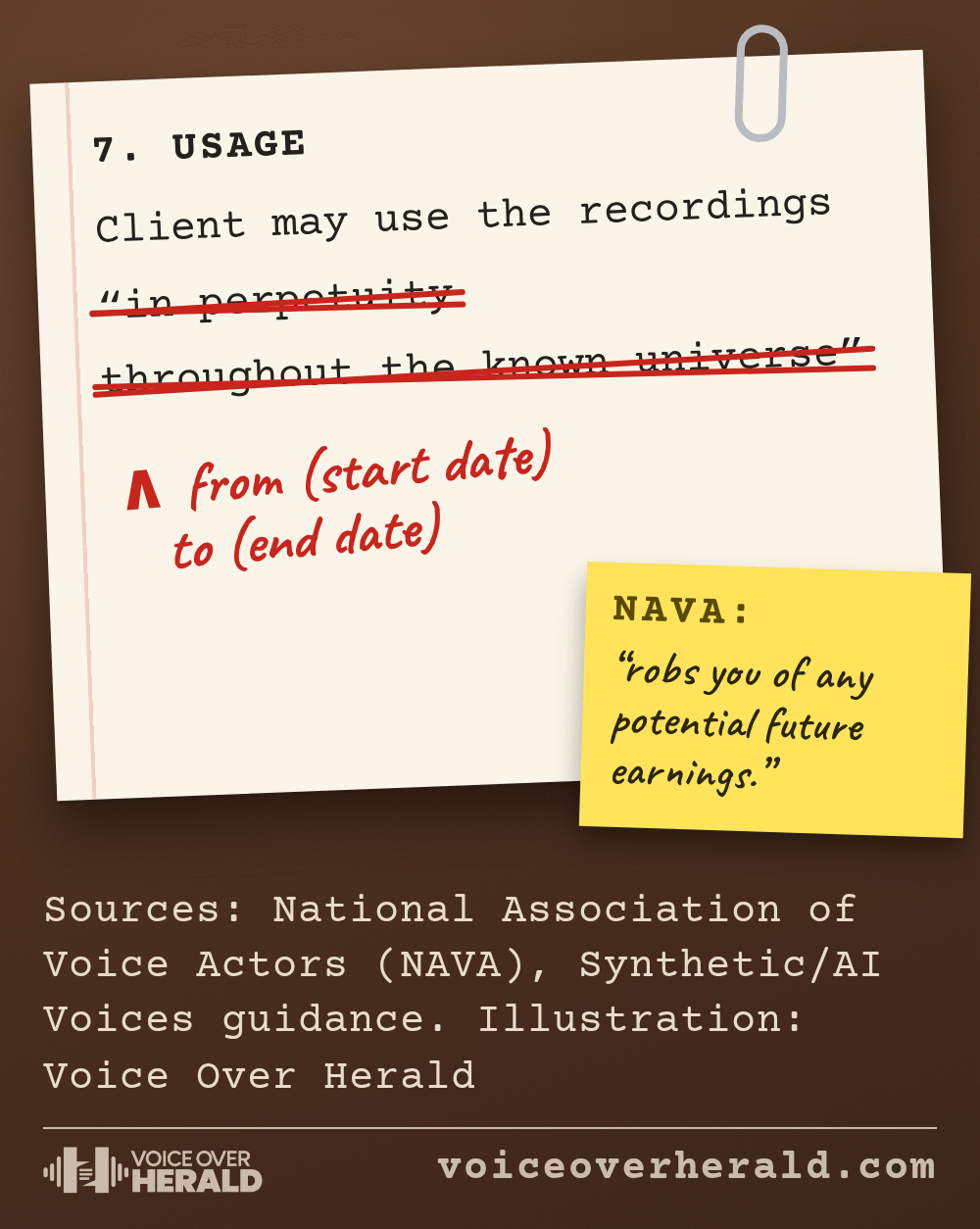
NAVA’s advice is simple: “Make sure you stipulate a specific start and end date for the usage.” An end date gives you a renewal conversation, which is often where repeat income comes from. Without one, a single session fee can end up covering a campaign that runs for a decade.
Watch for the words “in perpetuity”, “irrevocable” and “buyout” sitting together. A buyout isn’t wrong in itself. Plenty of non-broadcast work is priced that way and both sides are happy. The point is to know you’re selling forever, and to price it like forever, rather than finding out from a line on page four.
Exclusive to whom, and for how long?
Exclusivity means you agree not to voice for a client’s competitors. It comes up most in advertising, where a brand doesn’t want the same voice selling a rival’s product next week.
NAVA lists “Clearly denoted exclusivity” among the things every performer contract should have, and adds: “Also understand if the contract makes you exclusive to a specific company.” The questions to ask are the same as for usage: exclusive in which category, in which countries, and until when? “Exclusive to the client” with no category and no end date can stop you taking work in a whole sector, for a fee that was set for one job.
Exclusivity is a separate thing from usage, and it’s normal to price it separately. If a brand wants you off the market, that is worth something to them, so it should be worth something to you.
The AI clause, in plain words
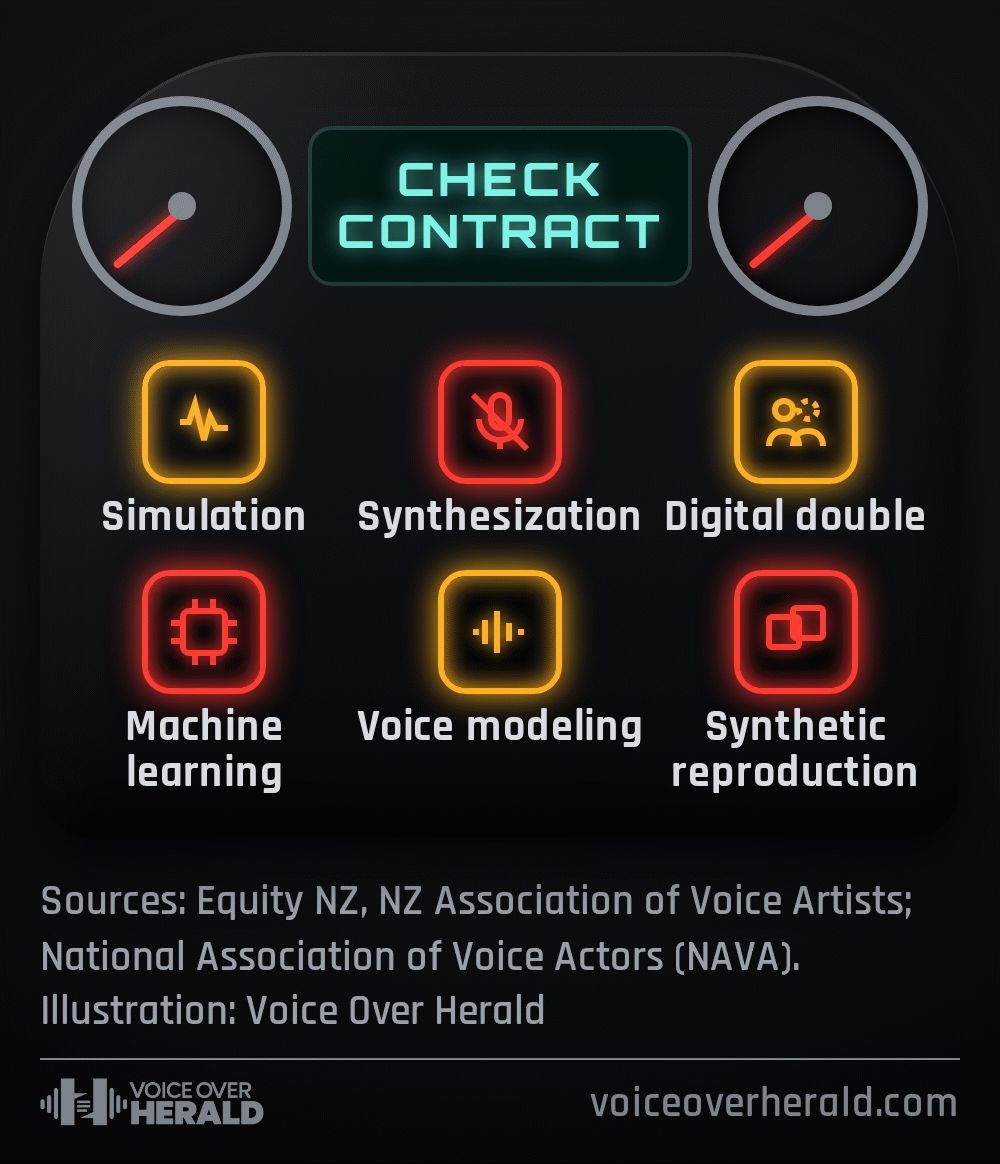
This is the newest clause and the one changing fastest. It might be labelled AI, synthetic media, machine learning or digital replica, or it might be hidden inside the usage clause with no label at all.
NAVA publishes a free AI rider, now at version 4.5, dated April 2026, that you can attach to a client’s agreement. It says it “is intended to replace and supersede any conflicting language in that Agreement.” Its first clause stops the client using your files for anything outside the agreed job, “including but not limited to creation of synthetic or ‘cloned’ voices or for machine learning or AI training.”
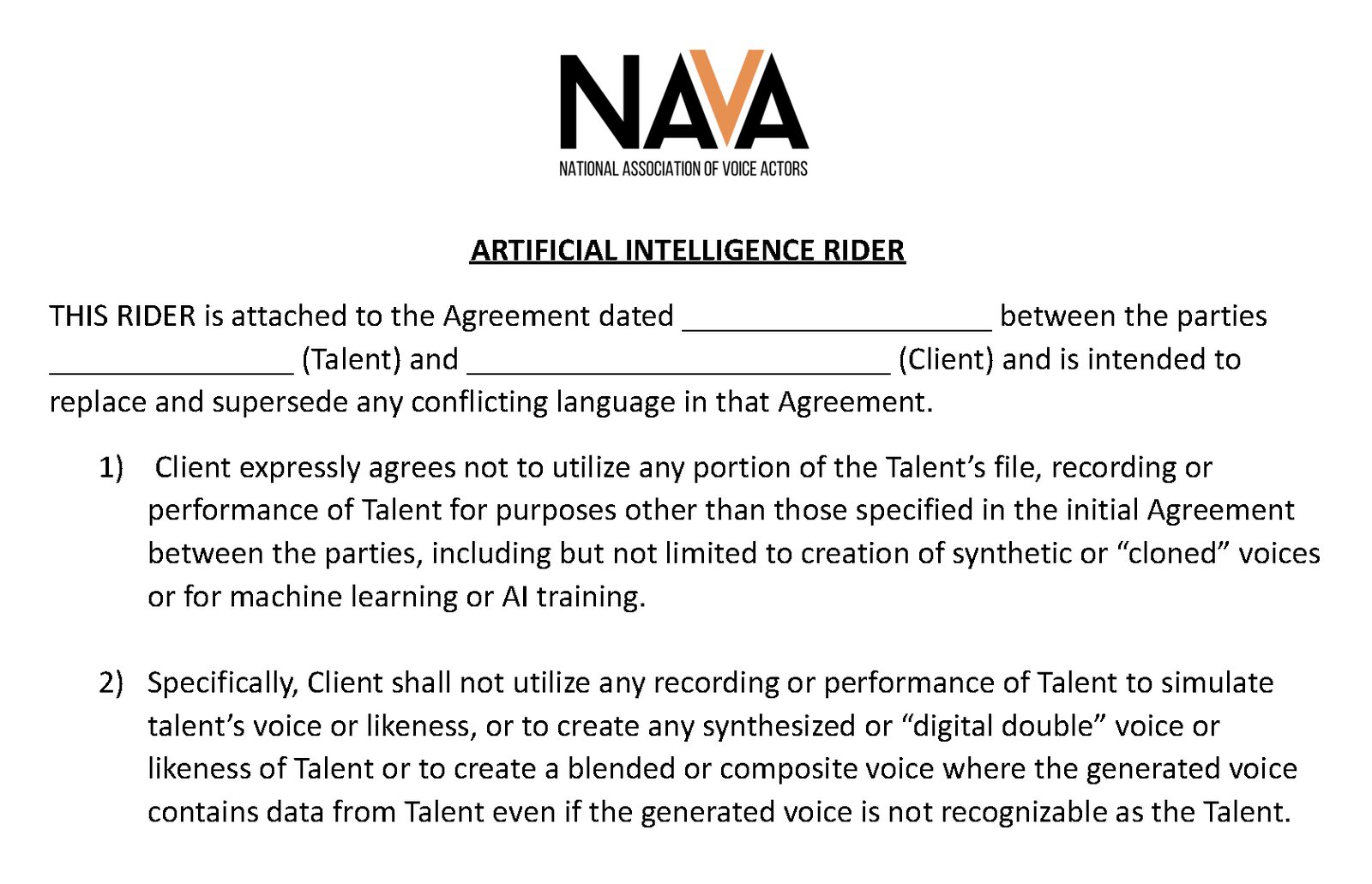
Image: National Association of Voice Actors (NAVA), AI Rider version 4.5
The second clause goes further than many people expect. It bars the client from creating “a blended or composite voice where the generated voice contains data from Talent even if the generated voice is not recognizable as the Talent.” That closes a gap: a voice built from a dozen actors may sound like none of them, but it still used their work. Later clauses stop the client selling your files on for AI use without your knowledge and consent, and ask them to keep the files safe, with encryption if they’re stored in the cloud. NAVA’s guidance puts the storage question this way: “Is anyone able to access it and create their own new version of a digital you?”
What if the AI wording is already in the contract you’ve been sent? NAVA’s experience is that it’s often there by default, not by design: “Many times they may not realize it’s even in there as their attorneys are trying to include this language ‘just in case’.” Asking to strike it, or to add the rider, is a normal request. For union members, the advice from NAVA and from the New Zealand voice actors’ association at Equity NZ is the same: take the job, report the language, and, in the NZ guidance‘s words, “let Equity be the enforcer.” It also suggests keeping a record of “requests for additional voice samples or unusual contract terms.”
What the unions have now written down
In the US, the SAG-AFTRA Commercials Contracts that took effect in 2025 set rules for digital replicas. According to a January 2026 alert from the advertising law firm Davis+Gilbert, producers need consent that is “clear and conspicuous”, based on “a reasonably specific description of the intended use of the Digital Replica,” given in a rider or “in a separate writing that is signed by Performer.” The rider is “a standardized consent form jointly drafted by SAG-AFTRA and the Joint Policy Committee (JPC).” The firm also notes that the minimum pay for each commercial that features a performance created with a performer’s digital replica is “1.5 times the applicable scale session fee,” plus use and holding fees.
 VoiceEditSuiteAuto Clean Up now learns how you breathe.A 30-second setup teaches it your breath, and you can teach it any breath it misses.See how it worksLearns from numbers, never your audio. Never used to train AI.
In the UK, Equity released an AI toolkit in 2023. Lewis Silkin describes it as including “sample AI clauses for performance cloning and digitisation” and “a template letter for content takedown.” Dr Mathilde Pavis, the intellectual property expert who worked on it, told Euronews: “The Equity toolkit is a very good, but temporary, solution to protect performers until the UK Government reforms the law.”
In Australia, the Arts Law Centre of Australia wrote the AAVA Voice Actor Generative AI Agreement, which Equity NZ describes as a replacement for the earlier AI rider, “specifically designed for Australian laws,” and “Free to use, share with clients, and adapt.” Its list of basics starts with a “Clear ability for the performer to consent to AI use.”
None of these need a union card to read, and the NAVA rider and the Australian agreement are written to be handed straight to a client.
Your check before you sign
Keep it quick. Many contracts for everyday voice work are short, and the parts that matter fit on one sticky note. Read it once for money and once for these.
- What is it for? The medium and the project are named, not “all media”.
- Until when? There’s a start date and an end date, or you’ve priced it as a buyout on purpose.
- Where? The territory matches the brief: one country, one region, or the world.
- Exclusive? If so, which category, which countries, and for how long, with a fee for it.
- AI? No training, cloning or synthetic use without separate, written consent and pay. Attach a rider if the contract is silent.
- Your files? Who keeps them, how they’re stored, and whether they can be sold or passed on.
One last thing. None of this is legal advice, and a contract that’s worth a lot of money is worth an hour of a lawyer’s or your union’s time. But most of what goes wrong with voice contracts goes wrong because nobody read page four. Now you know what’s usually on it.
Sources: National Association of Voice Actors (NAVA), Synthetic/AI Voices guidance and AI Rider version 4.5 (April 2026); Loeb & Loeb, summary of Lehrman v. Lovo, Inc. (July 2025); Pollock Cohen LLP news release (14 July 2025); Davis+Gilbert alerts on the 2025 SAG-AFTRA Commercials Contract (11 June 2025 and 20 January 2026); Lewis Silkin on Equity’s AI toolkit (18 July 2023); Euronews (8 June 2023); Equity NZ, NZ Association of Voice Artists, AI resources (updated 16 June 2025). Hero image: Blogtrepreneur (howtostartablogonline.net), CC BY 2.0, via Wikimedia Commons.
Lee este artículo en español: Antes de firmar: las cuatro cláusulas que deciden qué pasa con tu voz después de la sesión
Know something about this story, or spotted an error? Tell the newsroom.