





The Cold Email Is the Audition: How Working Voice Actors Pitch Clients Who’ve Never Heard of Them
Somewhere right now, a producer who’s never heard of you is deciding whether to open your email. Cold outreach is still how plenty of working voice actors find new clients, and most of it lands with a thud. Here’s what coaches, working voices, a 12-million-email study and the regulators in three countries say about writing the pitch that gets a reply, and staying on the right side of the law while you do it.
The photo at the top of this page is the Dead Letter Office in Washington, where the US Post Office sent mail it couldn’t deliver. Most voice over pitches meet a quieter version of the same fate. The ones that get answered tend to have a few things in common, and none of them cost money.
Your email is already auditioning
Astoria Redhead, who writes about the voiceover business in the newsletter The Actor’s Index, puts it in five words: “The email is the audition.” The point is that a client reads your pitch the way they’d listen to a read. “When a senior decision maker opens an email from a voice actor, they are not evaluating a product spec,” Redhead writes. “They are forming an impression of a human being whose voice they may someday put in front of their client, their audience, their boss.”
Stiff and nervous reads as stiff and nervous. Warm, short and specific reads like someone who’ll be easy to direct.
Papy S, a New York voice actor who teaches the business side of VO, says to be clear about what the email is for. A 2023 post on marketing emails lists the goals: catch a potential client’s attention, make them aware you exist, and “Get them to take action by visiting your website or listening to your demos.” Nobody books a stranger straight from a first email. You’re trying to earn one click.
Write to fewer people, and write to each of them
There’s a long-running argument in voice over marketing about volume versus care. Paul Schmidt of the training company Such A Voice comes down nearer the volume end. “My view is that scale at some point out-performs deep personalization,” Schmidt wrote in 2021, adding that “Sales is a numbers game, folks.” That doesn’t mean mail merge to the world. “Let me be clear: All email should be personalized,” the same piece says, and “Targeting the right people in the first place is one of the best forms of personalization.”
Paul Schmidt, Such A Voice
“The more people you reach out in a real, human, non-creepy, to-the-point way, the more success you will have.”
Astoria Redhead, The Actor’s Index
“A boring, templated, sequence-blasted email tells them exactly what they need to know.”
Both views agree the list matters more than the wording. An e-learning studio that hires narrators every month beats a car dealer who made one radio spot in 2019. Pick producers and in-house video teams whose work sounds like your demo, and you have a real reason to be in their inbox.
Schmidt’s own line on research is a relief for anyone who’s spent an evening on one prospect: “You don’t need to know their mother’s maiden name to get their business.” One genuine, specific sentence about their work is enough.
The small stuff that gets you opened
A widely cited study of outreach email is a 2019 analysis of 12 million messages by Brian Dean at Backlinko. It wasn’t about voice actors, but the pattern is hard to ignore. It found that “only 8.5% of all outreach emails receive a response,” that “Emails with personalized subject lines boost response rate by 30.5%,” and that messages with a personalized body “received 32.7% more replies than those that weren’t personalized.” Subject lines between 36 and 50 characters did best.

 VoiceEditSuiteNewAuto Clean Up now learns how you breathe.Learns from numbers, never your audio. Never used to train AI.See how it works
Papy S has a simple recipe for that subject line: your name, what you do (“VO, Voice-Over Talent, Voice Actor, etc…”), and the client’s company name, so it’s clear the message “is intended specifically for them.” Think “Alex Moreno, voice actor, for” and then their company’s name. Lauren Mazzoleni, writing for Such A Voice, adds the unglamorous bit: “Make sure you have the correct spelling of their first and last name, and their exact job title when addressing them.”
Then keep the body short. Introduce yourself, say what you voice, offer around three credits at most (Papy S says “I’d say keep the number around 3”), and give one clickable link straight to your demos. Not an MP3. As Papy S puts it, “Attachments can land you in spam, lead to your message bouncing, or just make the recipient uneasy opening a cold email from a stranger with files attached.” The same post also warns off timid openers like “If it’s not too much trouble.” You’re offering something useful. Sound like it.
The rules travel with your email
Most VO marketing advice skips this part. A cold pitch is commercial email, and your client’s country has rules about it. This isn’t legal advice, but the regulators publish the basics plainly.
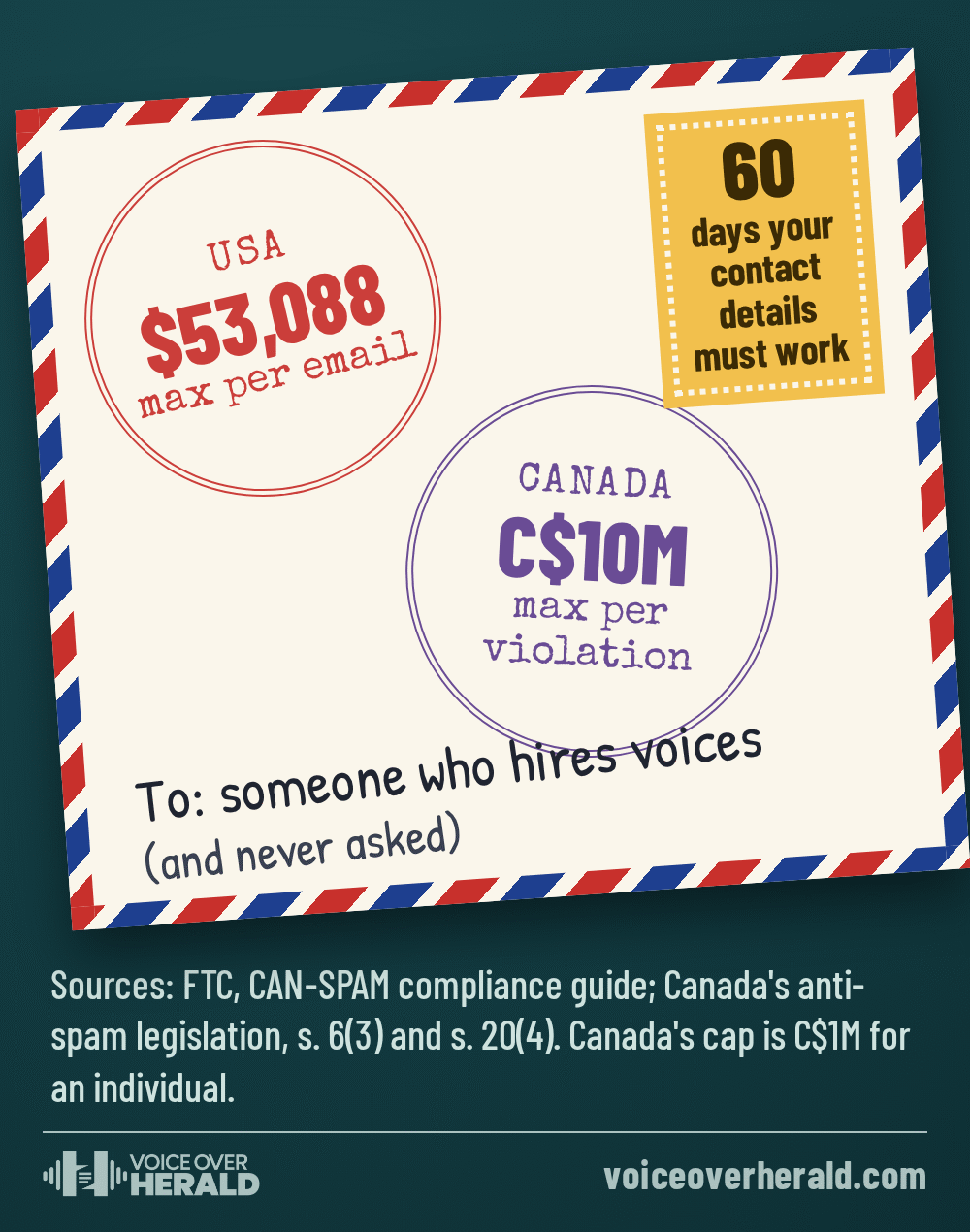
In the United States, the Federal Trade Commission’s CAN-SPAM compliance guide is clear that pitching a company doesn’t get you off the hook: “The law makes no exception for business-to-business email.” The guide says the subject line “must accurately reflect the content of the message,” that “Your message must include your valid physical postal address,” and that it needs a clear way for people to opt out. For a sole trader, that usually means a business address or a PO box in your signature, plus a friendly line like “If you’d rather not hear from me again, just say so and I won’t write again.”
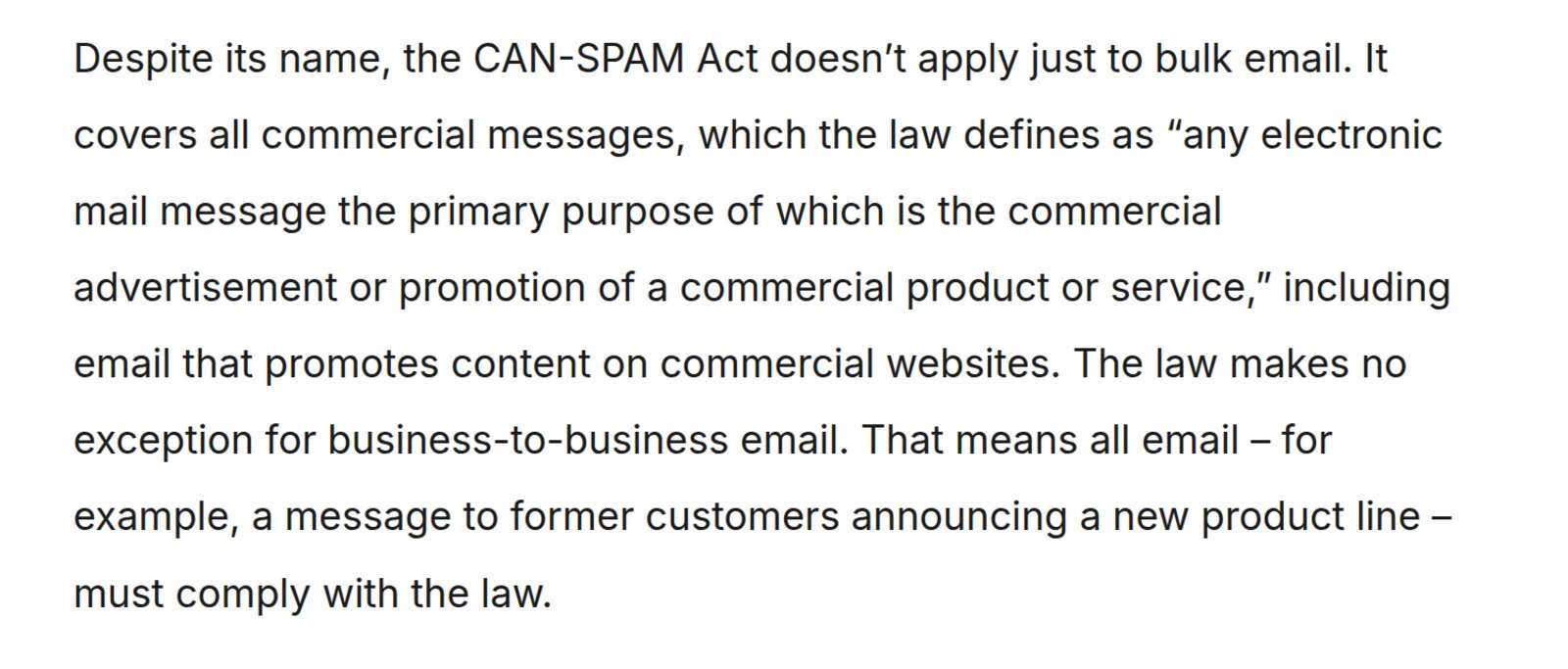
Image: Federal Trade Commission, ftc.gov, October 29, 2026
The United Kingdom splits it by who you’re writing to. The Information Commissioner’s Office says “You can email or text any corporate body,” meaning companies, limited liability partnerships and government bodies. But “Sole traders and some partnerships are treated as individuals,” and individuals generally need to have agreed first. So the corporate video team at a large firm is fair game, while the freelance producer working under their own name is a different case. Either way, the ICO says “You must not disguise or conceal your identity,” and you must give a valid contact address so people can unsubscribe. It also recommends keeping a “do not email or text” list of businesses that ask you to stop. The page notes this guidance is under review after the Data (Use and Access) Act, so check it again before a big UK push.
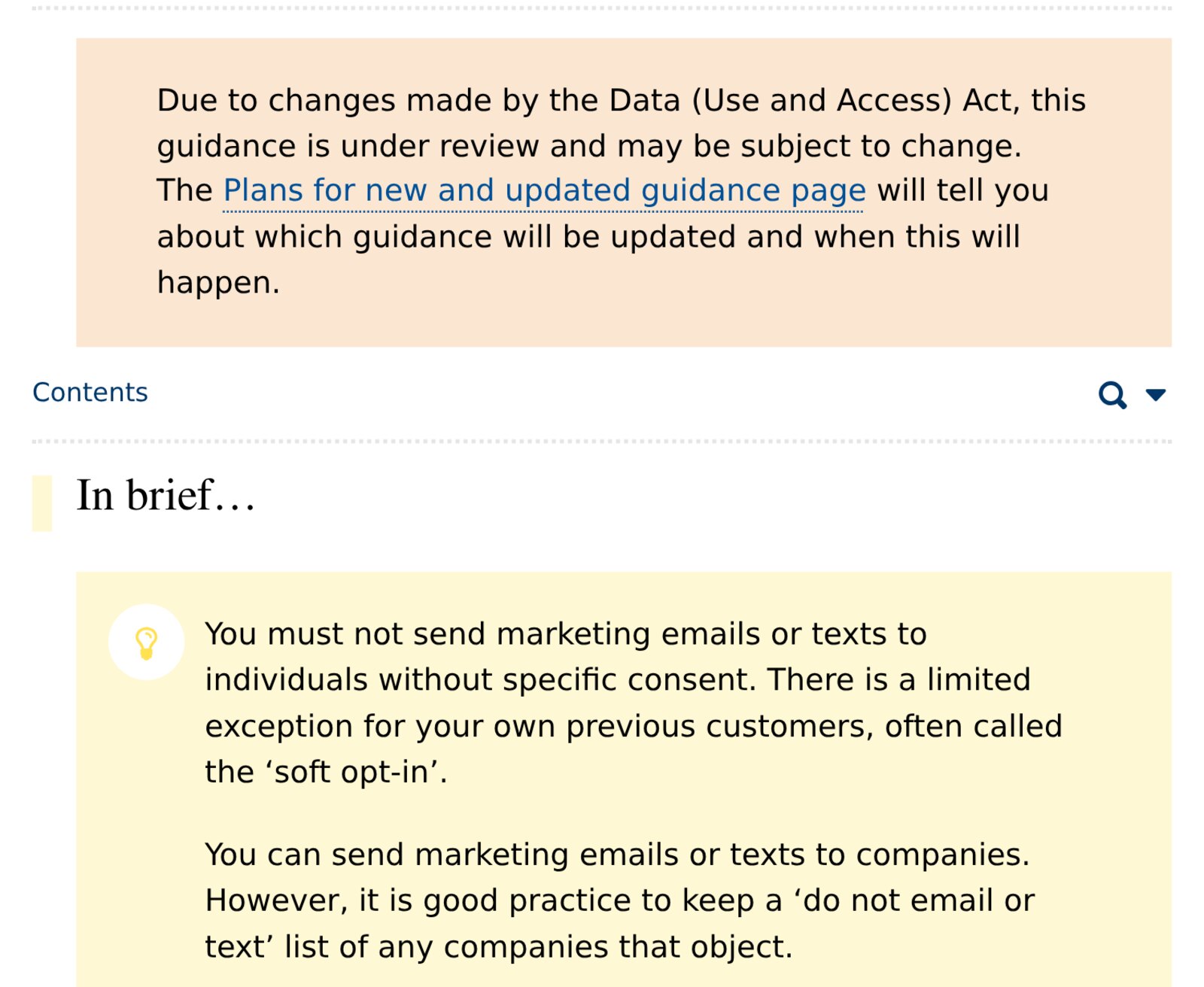
Image: Information Commissioner's Office, ico.org.uk, October 29, 2026
Canada is the strictest of the three. Its anti-spam law, often called CASL, generally requires consent before you send a commercial message. One form of implied consent covers addresses that the person has “conspicuously published” with no note saying they don’t want unsolicited messages, and only where the message “is relevant to the person’s business, role, functions or duties in a business or official capacity.” A producer whose email is on their company’s contact page, and who hires voices for a living, is a very different case from an address in a scraped list. Every message also has to say who you are, give a way to reach you, and include a way to unsubscribe, which the Act says must be honoured within 10 business days.
All three come down to the same thing: use your real name, say where you are, write to people your email is genuinely relevant to, and stop when they ask.
Follow up like a person, not a sequence
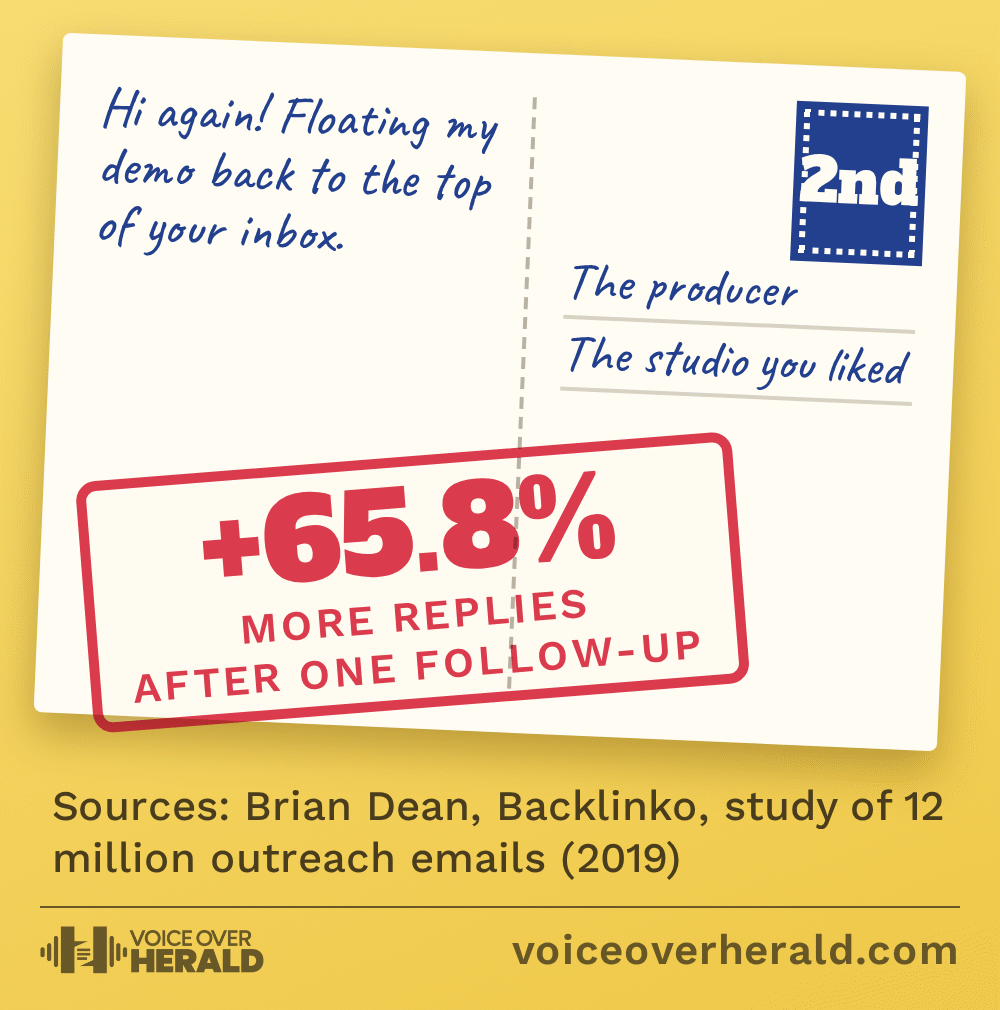
Most replies don’t come from the first email. The Backlinko study found that “sending 3 or more messages results in the best overall response rate.” Mazzoleni’s advice is the practical version of that: “Take note of when you send out each email and set a date to follow-up with the client if you don’t hear back.”
The trap is automating it into something that sounds like software. Redhead is blunt about paid tools that blast templated sequences on a voice actor’s behalf. Producers, Redhead argues, “have finely tuned radar for anything that feels impersonal, automated, or like it was sent to 500 other people at the same time.” The piece on email blasts goes further: “The delete rate on these emails isn’t just high. It’s probably doing active damage.”
A good follow-up adds something: a new demo that fits their work, or a short custom read of a line from one of their own videos. Give it a week or two, keep it to three or four lines, and reply in the same thread. If that meets silence too, try again in a few months, when they may be casting something new.
Before you hit send
Read it out loud: if it sounds stiff spoken, it’ll read stiff too. Check the name, the company and the job title. Click your own demo link. Make sure your signature has your real name, a postal address and a simple way to opt out. Then send it to one person, properly, and do the next one tomorrow.
A short, specific, honest pitch won’t land every time. But it’s far less likely to end up in the modern Dead Letter Office, and the clients it reaches will already have a fair idea of what you’re like to work with.
Sources: Astoria Redhead, “Blast,” The Actor’s Index (May 2026); Papy S, “4 Things to Include In an Email When Marketing Yourself For VO Work,” Papy On Air (March 2023); Paul Schmidt, “Marketing Outreach: Scale vs. Personalization,” Such A Voice (May 2021); Lauren Mazzoleni, “Break The Ice And Be G.R.E.A.T at Emailing Voice-Over Clients,” Such A Voice (October 2018); Brian Dean, “We Analyzed 12 Million Outreach Emails,” Backlinko (updated April 2019); Federal Trade Commission, “CAN-SPAM Act: A Compliance Guide for Business”; Information Commissioner’s Office, “Electronic mail marketing,” Guide to PECR; Canada’s anti-spam legislation, S.C. 2010, c. 23, sections 6, 10 and 11. Main image: “Dead letter office,” Bain News Service, Library of Congress, public domain.
Lee este artículo en español: El correo en frío es la audición: cómo los locutores en activo contactan a clientes que no los conocen
Know something about this story, or spotted an error? Tell the newsroom.