

Two AI Launches This Week Let One Voice Speak Dozens of Languages. Voice Actors Should Read the Consent Rules First
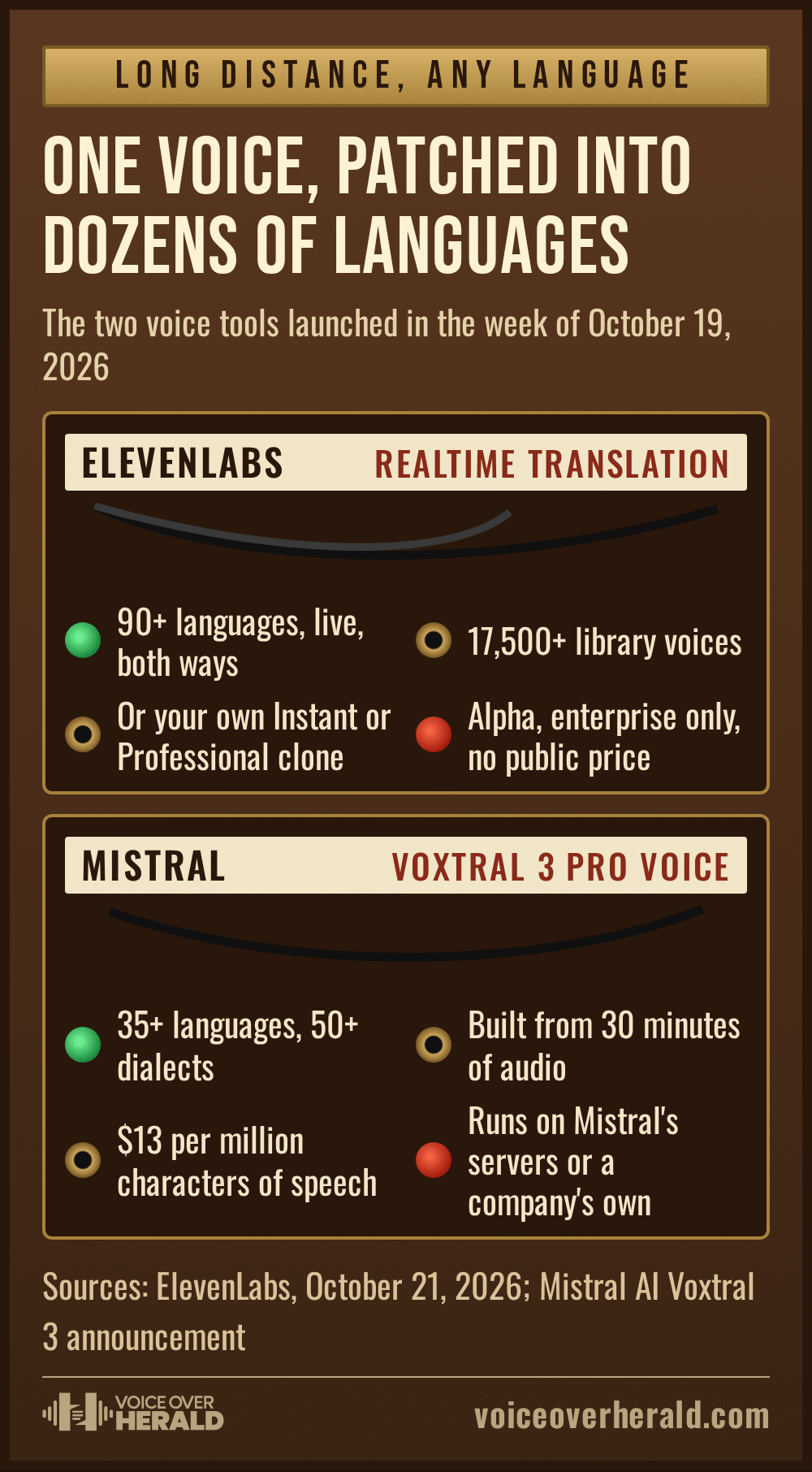
Two AI companies launched tools this week that make one voice speak languages its owner never recorded. ElevenLabs’ new live translation model works in more than 90 languages and can use a customer’s own voice clone. Mistral’s Voxtral 3 says it can carry a speaker’s “distinctive character” across 35 or more languages from 30 minutes of audio. For voice actors, the question is who gets to point those tools at a voice.
 VoiceEditSuiteLoudness NormalizerHit the broadcast spec first time.ACX, EBU R128, Spotify and podcast presets.See how it works
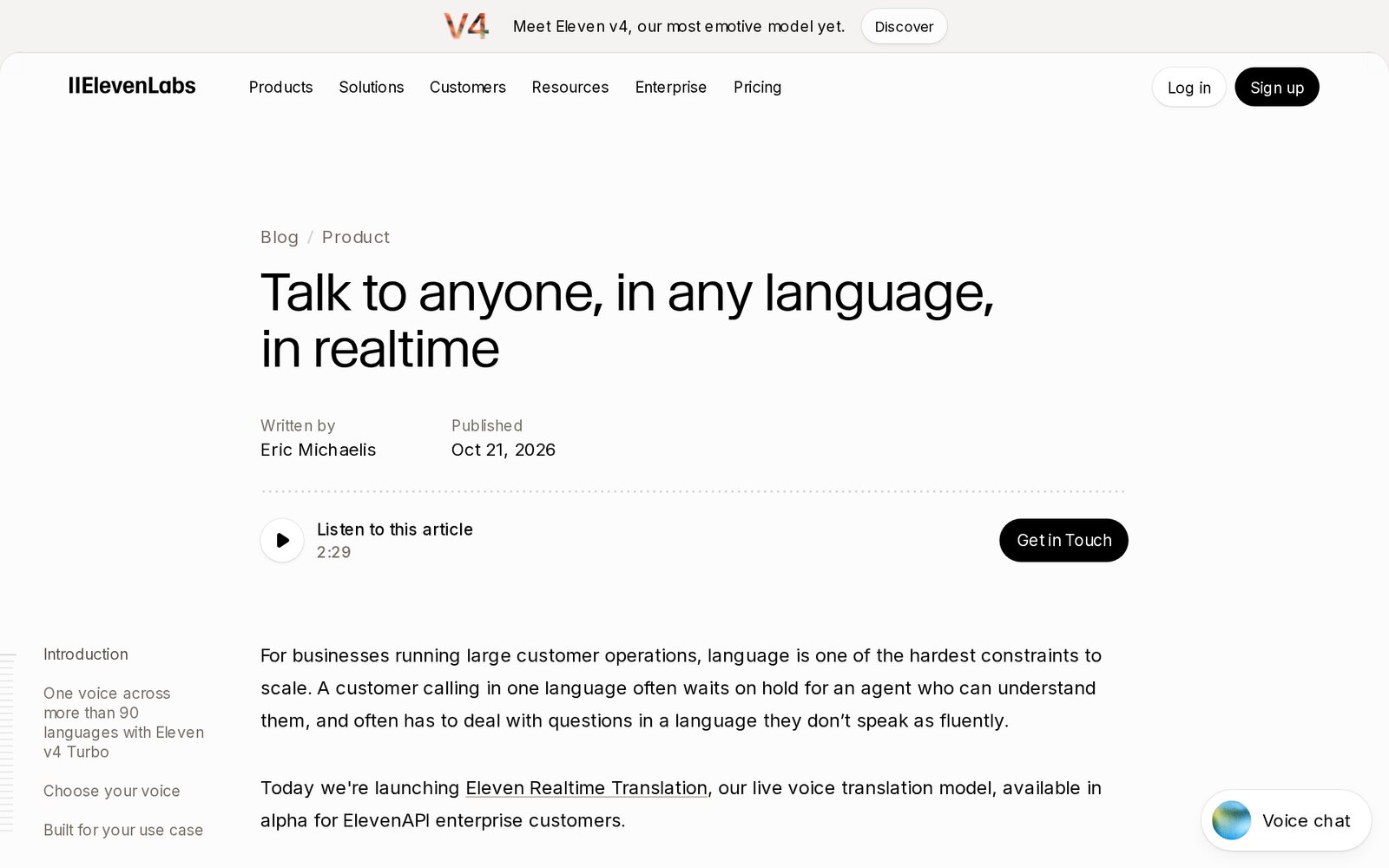
ElevenLabs announced Eleven Realtime Translation on October 21. It’s in alpha, for enterprise customers of its developer platform, and it does what the name says: each person on a call speaks their own language and hears the other side in theirs, while the conversation is happening. The company pitches it at phone networks, contact centres and live events, where one agent could help callers in many more languages “without bringing an interpreter onto the call.”
Mistral, the Paris AI company, released Voxtral 3 the same week. It’s a family of speech models covering transcription, voice agents and text to speech, with a feature called Pro Voice for what Mistral calls professional use cases “where basic voice cloning does not suffice.”
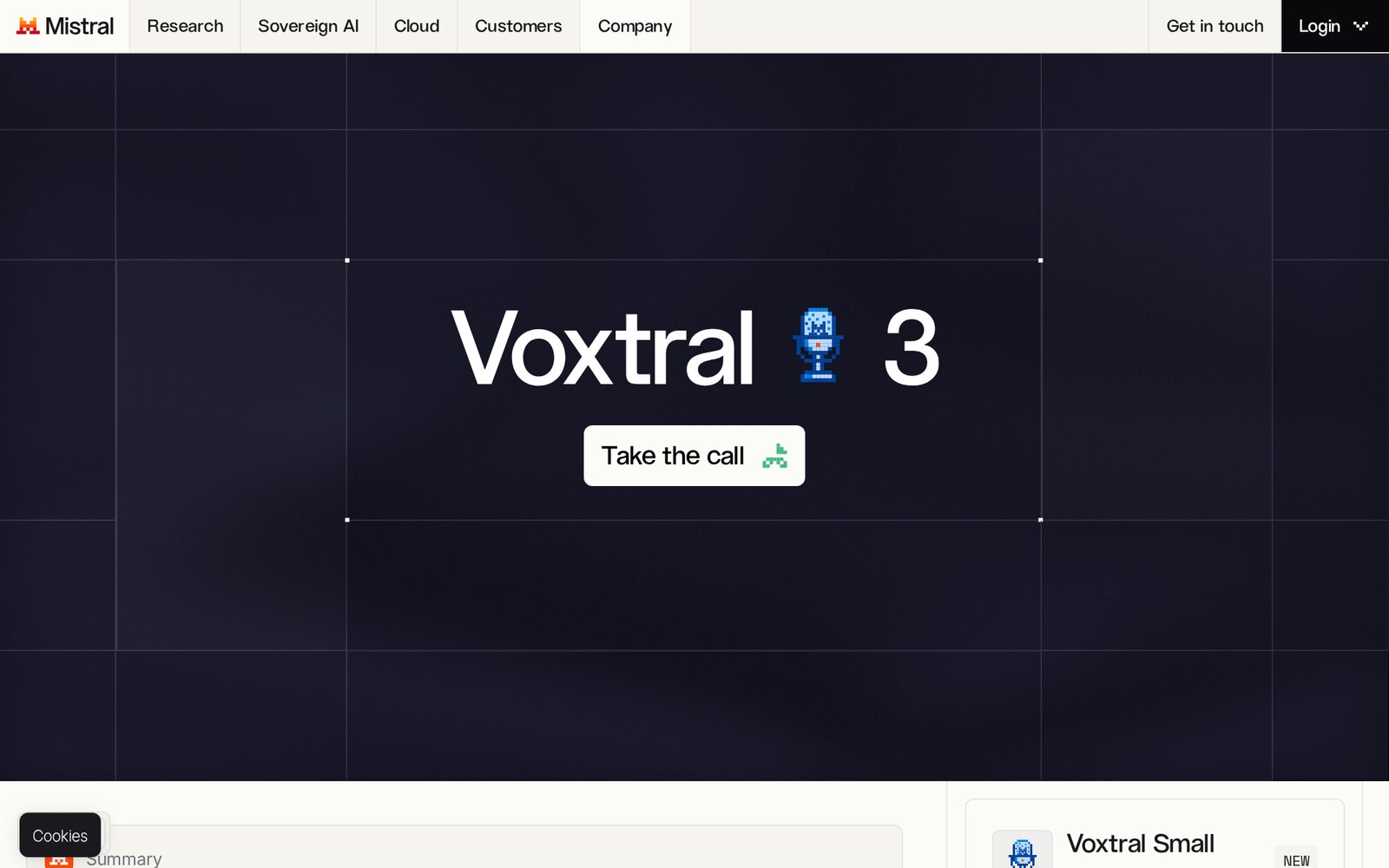
Mistral's Voxtral 3 page, as it appeared on October 24, 2026. Image: Mistral AI
Whose voice does the talking
ElevenLabs says the voice is the customer’s choice. “Choose any voice from more than 17,500 voices in our library, or build your own Instant or Professional Voice Clone,” its announcement says. “That voice will stay consistent for the entire session.” The model runs on Eleven v4 Turbo, the company’s low-latency speech model, which ElevenLabs says keeps a single voice more consistent across languages “so a brand or an agent sounds consistent in every market.”
That library matters to working voice actors. ElevenLabs’ Voice Library is where people share Professional Voice Clones of their own voices, set licensing terms and earn from usage. In a May post updated in September, the company said more than 10,400 creators were earning there. A narrator who has shared a clone could, in principle, now have that voice carrying a customer service call in a language the narrator doesn’t speak, under whatever terms the narrator set.
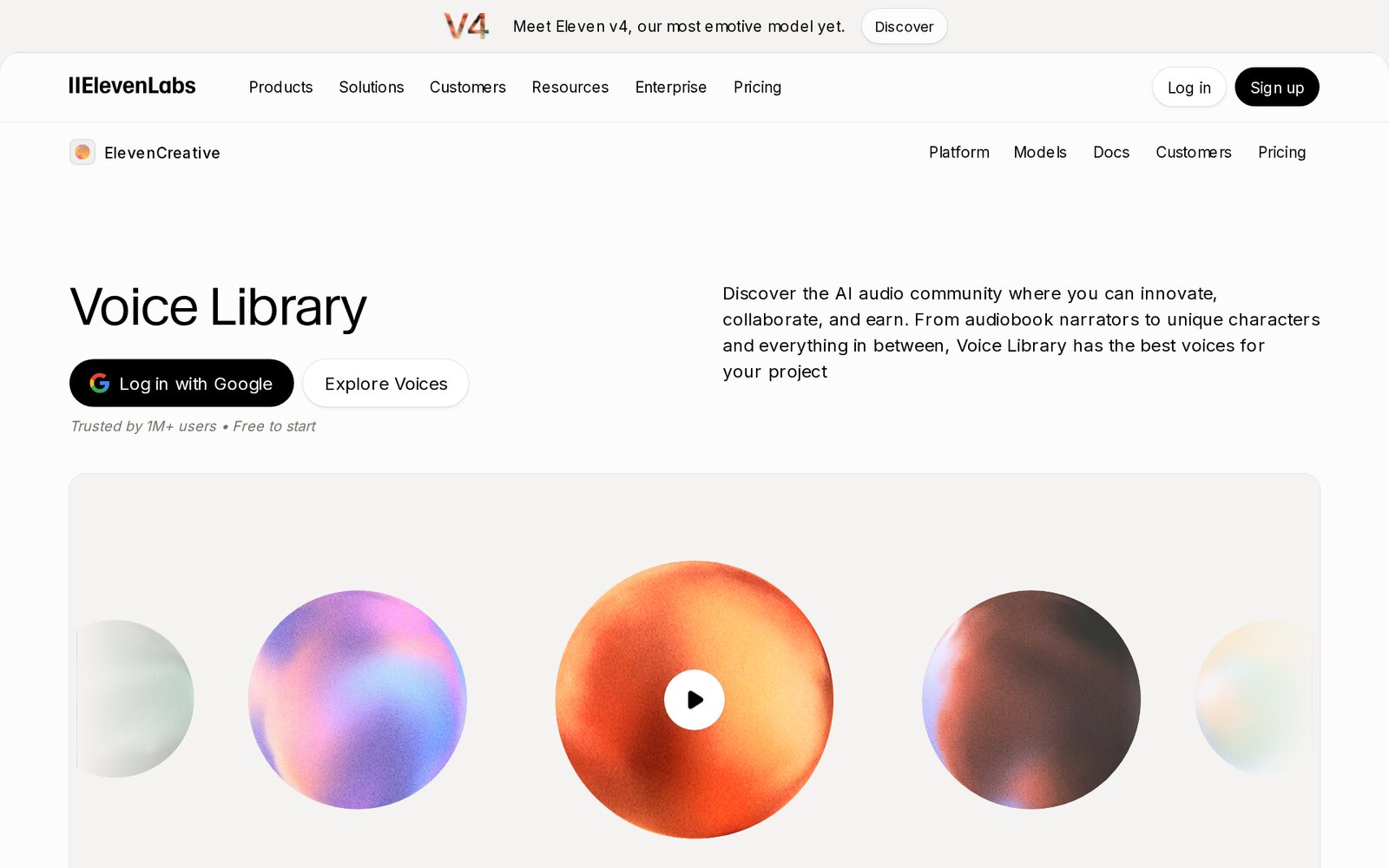
ElevenLabs' Voice Library page, October 24, 2026. Image: ElevenLabs
Deutsche Telekom is already building the translation model into its Magenta AI Call Assistant. “It’s really a complete new era of how voice can actually work and connect people, and also break down barriers,” Lena Drubel, the company’s vice president for consumer AI, said in ElevenLabs’ announcement.
Thirty minutes of audio
Mistral’s pitch is aimed at companies that want a voice of their own. “Voxtral’s Pro Voice adaptation is able to reproduce a speaker’s distinctive character, emotional range, and speaking style across languages, using just 30 minutes of audio,” its announcement says. The models can run through Mistral’s API, including EU-hosted endpoints, or be deployed on a company’s own infrastructure. Voice agents cost $0.04 to $0.08 a minute, depending on the reasoning model behind them.
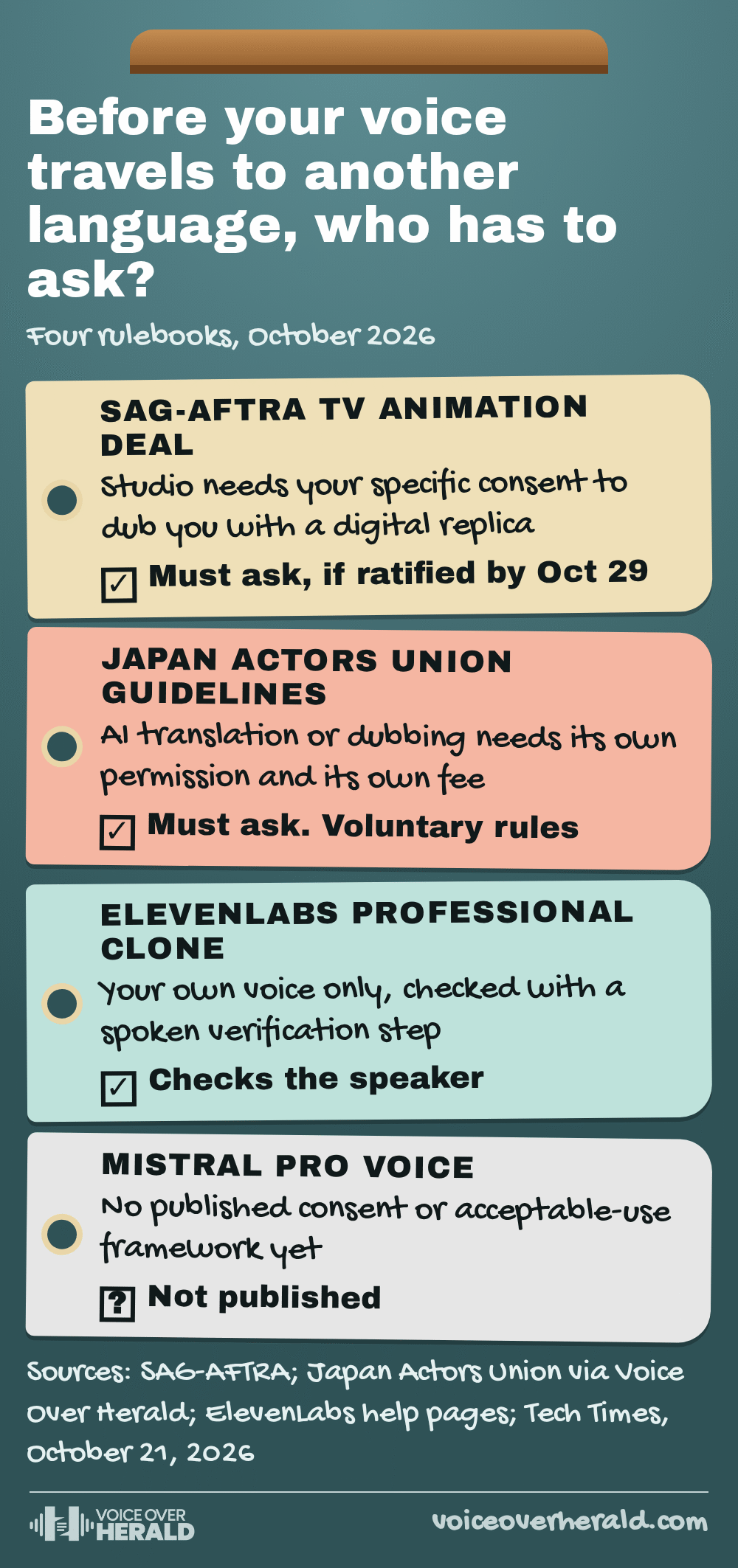
Plenty of working voice actors have more than 30 minutes of clean audio online between demos, audiobook samples and interviews. Tech Times made the same point about executives, noting that an earnings call or a public interview gives “substantially more than 30 minutes of clear-channel audio.” It also reported that Mistral “has not published a consent and acceptable-use framework for Pro Voice as of this writing.” Voice Over Herald found no such page on Mistral’s announcement either.
ElevenLabs, by contrast, spells out a check for its top tier. Its help pages say a Professional Voice Clone can only be made of your own voice, and that the account holder has to pass a spoken verification step, reading lines into the microphone “in a tone and delivery that is similar to those present in the samples.” Its quicker Instant clones are a separate product, and the Realtime Translation announcement lets customers use either.
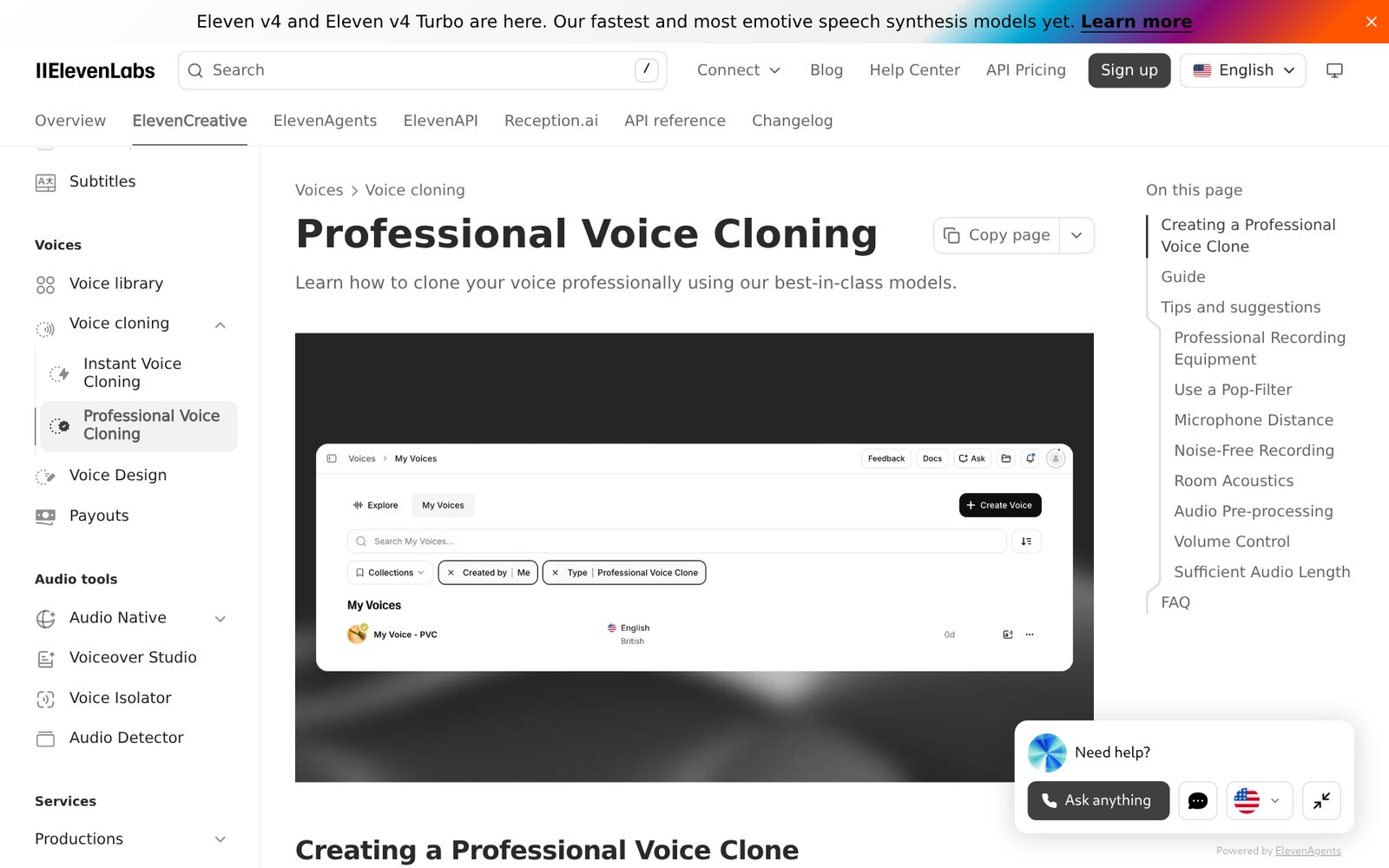
ElevenLabs' Professional Voice Cloning help page, October 24, 2026. Image: ElevenLabs
The contracts are moving the other way
Where voice actors have a union contract, the trend this year runs against using a replica in a new language without asking. SAG-AFTRA’s new television animation deal, which members are voting on until Thursday, makes studios get a voice actor’s specific consent before using a digital replica to dub a performance into another language. The last contract didn’t. Voice Over Herald has the details of that vote.
Japan’s Actors Union went further in its first AI guidelines this month. Using AI to translate or dub a performance into another language needs its own permission and its own fee, and the union says AI shouldn’t replace voice actors in dubbing for films or dramas. Those guidelines are voluntary, as Voice Over Herald reported when they came out.
None of that binds a contact centre or a software company that simply buys these tools. The tools launched this week are sold to businesses, and what protects a voice there is mostly the contract the voice was recorded under, plus the platform’s own rules about whose voice can be cloned.
What working voice actors can check now
Read the usage clause on anything you’ve recorded for a company’s AI, agent or brand voice, and look for the words “language,” “translation” and “localization.” A licence for an English assistant doesn’t automatically say what happens when the same voice answers in Turkish. If you’ve shared a clone on a voice marketplace, look at the use cases you allowed, because live translation for call centres is now one of them.
And if you’ve been asked to record 30 minutes of “natural speech” for a voice model, ask which languages it will speak, for how long, and what you’re paid each time it does. This week, that stopped being a hypothetical.
Sources: ElevenLabs, “Talk to anyone, in any language, in realtime,” October 21, 2026; ElevenLabs help pages on Professional Voice Cloning; ElevenLabs, “$22 million earned by voice creators on ElevenLabs,” May 22, 2026, updated September 22, 2026; Mistral AI, Voxtral 3 announcement; Tech Times, October 21, 2026; SAG-AFTRA TV Animation Agreements Informational Meeting, October 9, 2026; Voice Over Herald reporting on the Japan Actors Union guidelines. Hero image: screenshot of ElevenLabs’ announcement page, October 24, 2026.
Lee este artículo en español: Dos lanzamientos de IA esta semana hacen que una voz hable decenas de idiomas. Los actores de voz deberían leer primero las reglas de consentimiento
Know something about this story, or spotted an error? Tell the newsroom.