
Can a Voice Be a Trademark? Italy’s Prime Minister Filed Four Seconds of Hers
Italy’s prime minister has asked the EU trade mark office to register four seconds of her own voice as a sound mark, to fight AI fakes. In the same week, two companies showed tools that score a caller’s voice for signs it’s synthetic. For working voice actors, both stories ask the same thing: who owns a voice, and who can tell when it’s real?
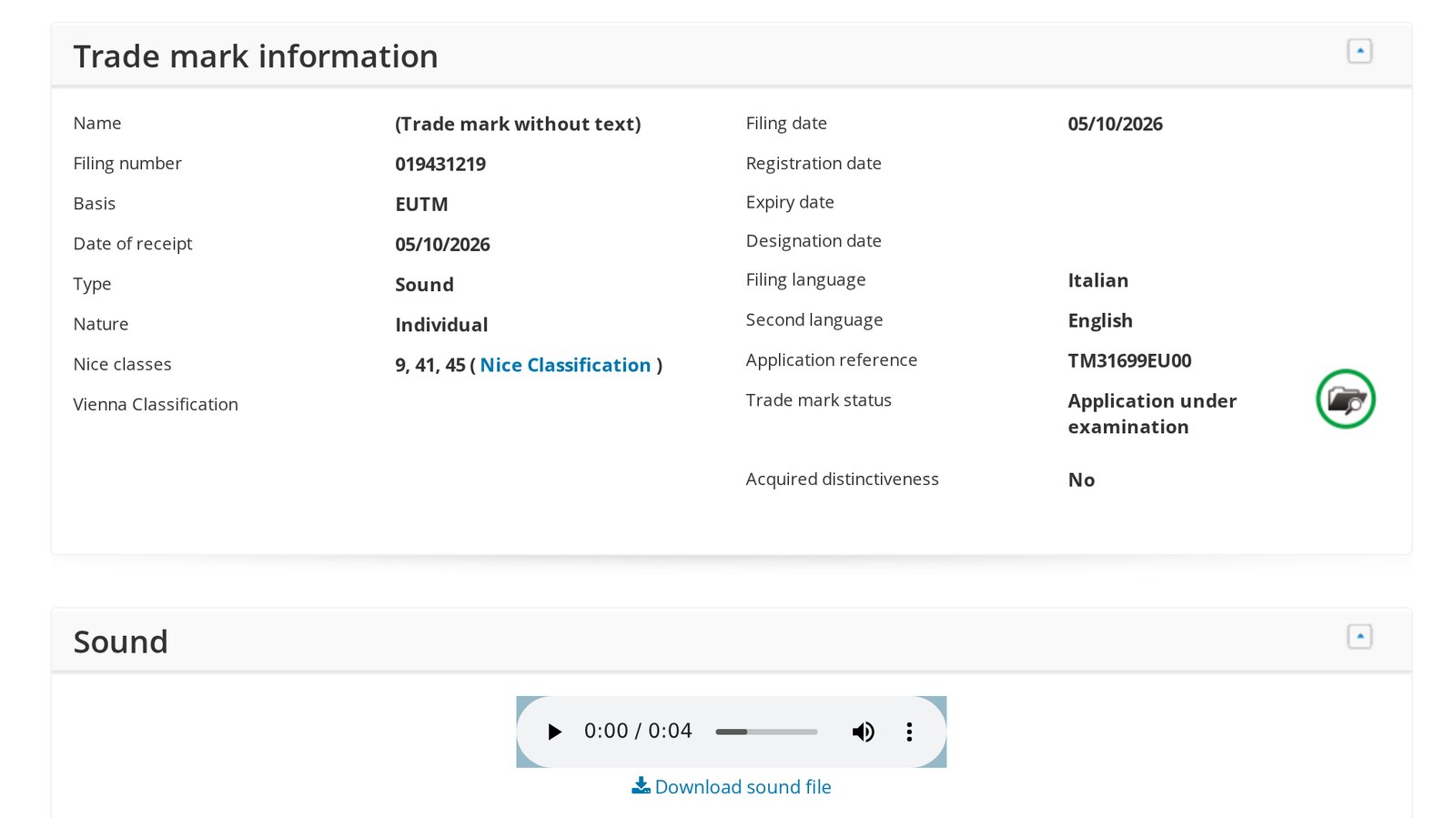
On October 5, 2026, Giorgia Meloni filed application 019431219 with the European Union Intellectual Property Office. The public register lists the mark as “(Trade mark without text)”, its type as Sound, and its status as “Application under examination”. A player on the record runs for exactly four seconds.
According to Reuters, as reported by PPC Land, the clip has Meloni saying in Italian that she is Giorgia Meloni, a sentence she says twice. Her office confirmed the filing and said its purpose is protection against AI-generated deepfakes. Nothing has been approved yet.
What the filing actually covers
The EUIPO record claims three classes: 9, 41 and 45. Class 9 covers things like downloadable media and multimedia recordings. Class 41 runs to 43 terms, from entertainment and training to a long list of publishing services. Class 45 adds two: “Organization of political meetings” and “Legal research in the field of public policy”. The description field reads “No data”.
The register also notes that “The application fulfilled Fast Track conditions”. Third-party guides cited by PPC Land put a Fast Track examination at roughly one month, followed by a three-month opposition window once the mark is published. The register itself shows no dates beyond the filing.
A voice actor got there first
Meloni isn’t the first Italian to try this. Luca Ward, the Italian dubbing voice of Russell Crowe and Keanu Reeves, filed a sound mark for his voice in February 2026. A September note from the Italian IP firm Bugnion, cited by PPC Land, says his mark is already registered. Singer Giusy Ferreri filed in April, and hers is still pending.
Ward explained why in a statement reported by Askanews and carried by Il Fatto Quotidiano: “Unfortunately the institutions don’t protect us. The individual feels that their own art is threatened by artificial intelligence. With no laws to protect us, the only way is to act on our own. That’s why I chose to patent my voice.”
His lawyer, Marco Mastracci, told Il Messaggero, as quoted by the same paper, that a sound mark makes it “possible to act more quickly and effectively against unauthorized uses, especially in the digital and technological sphere.”
What it costs, and what it buys
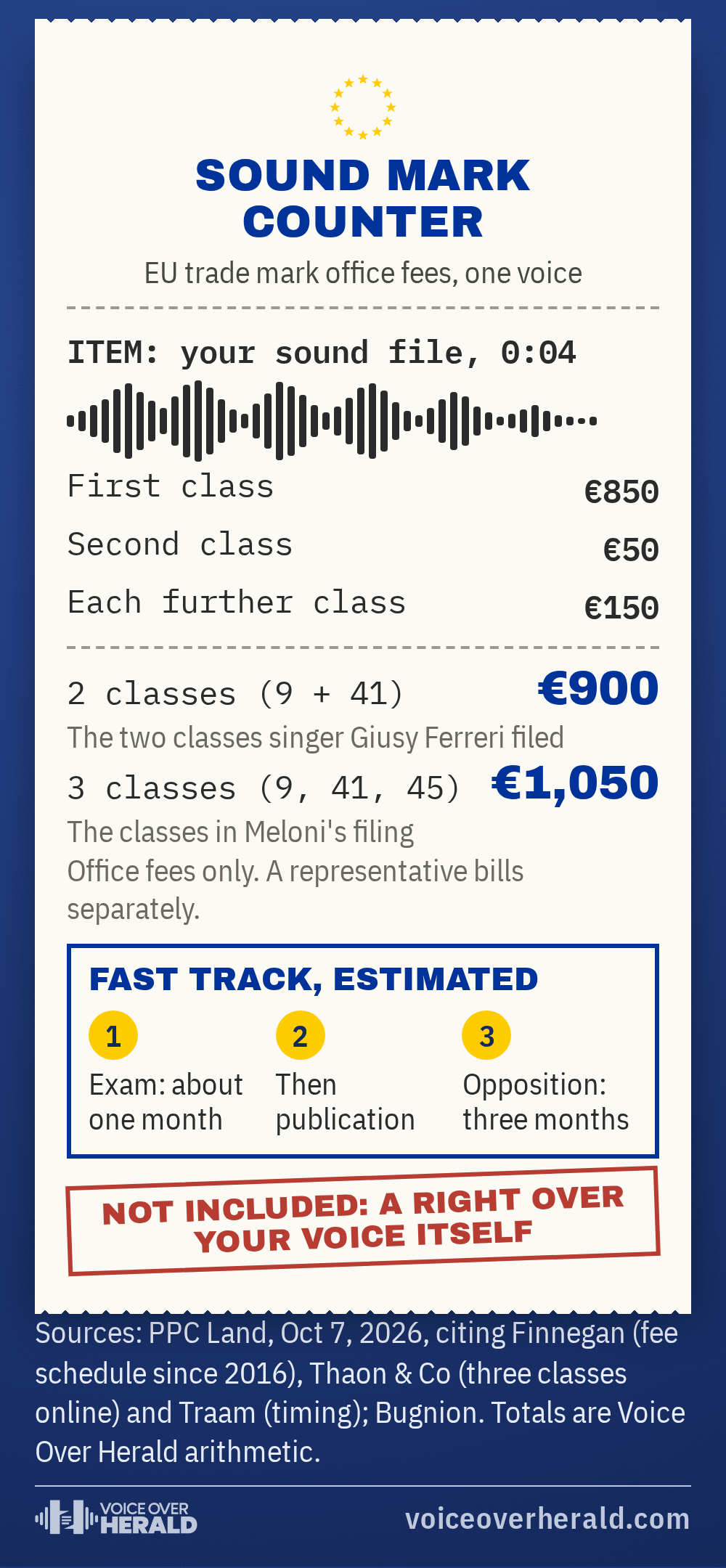
The office fees aren’t huge. According to PPC Land, citing the law firm Finnegan, the EU schedule hasn’t changed since 2016, and the first class carries most of the cost while each extra class adds far less. The receipt below works it out for two and three classes. A representative, like the firm Meloni used, is a separate bill.
The harder question is what you get. A registration protects a sign for the goods and services listed. Francesco Venturoli of Bugnion has argued that it gives no exclusive right over the voice as such. To stop an AI copy, a holder would still have to show similar signs, similar goods or services, and a likelihood of confusion. A deepfake may never count as trade mark use at all.
There’s also the question of whether a spoken name counts as distinctive. EU courts have upheld refusals for a can being opened and for a sound that resembled a banal ringtone. None of the sources PPC Land reviewed says how the office treats a spoken name.
A registered sign
Protection for one recording, used as a brand, across the listed goods and services, with EU-wide remedies against confusing copies.
Your voice itself
No general right over how you sound. A clone saying new words may not be trade mark use, and you’d still need to prove likely confusion.
Other routes already exist. In August 2025 a Berlin court ruled that AI voice cloning violated a voice actor’s personality rights in a dispute with a YouTuber, awarding €4,000 in damages. It held that imitating a recognisable voice with AI infringes even when no original recording is used. Italy’s Law 132/2025 also makes spreading harmful AI-falsified content without consent a crime, with one to five years in prison.

Meanwhile, the phones are learning to listen
On October 8, the AI agent company Sierra launched fleming-1, a model that “detects when the caller on a phone call is another agent.” In its announcement, Sierra says the model “analyzes callers’ speech in real time, scoring the audio for signs that it was generated by AI.”
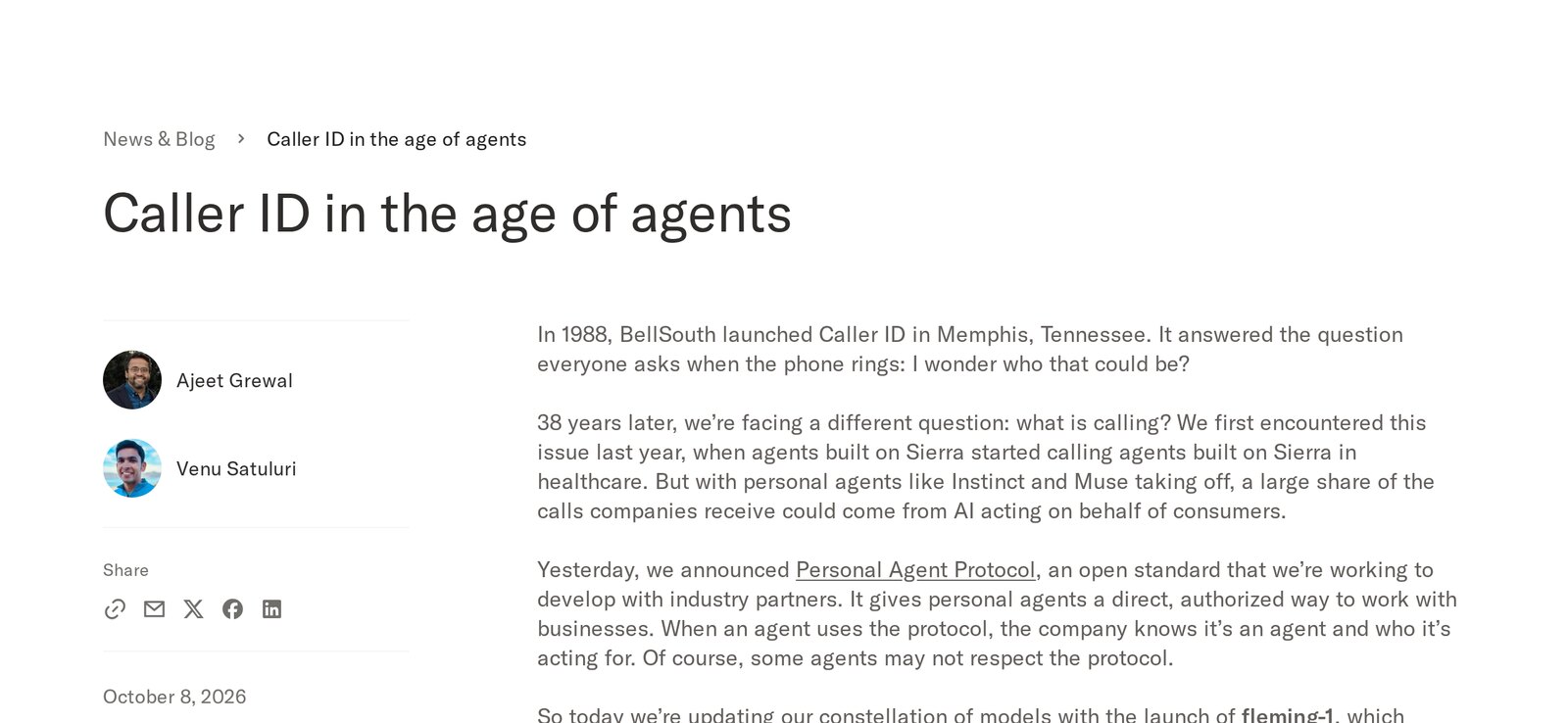
Image: Sierra
Sierra frames it as information, not a verdict: “Caller ID never told you whether to pick up.” The company says the model is “tuned to be conservative by default, so real people don’t inadvertently get flagged.” It hasn’t published accuracy figures.
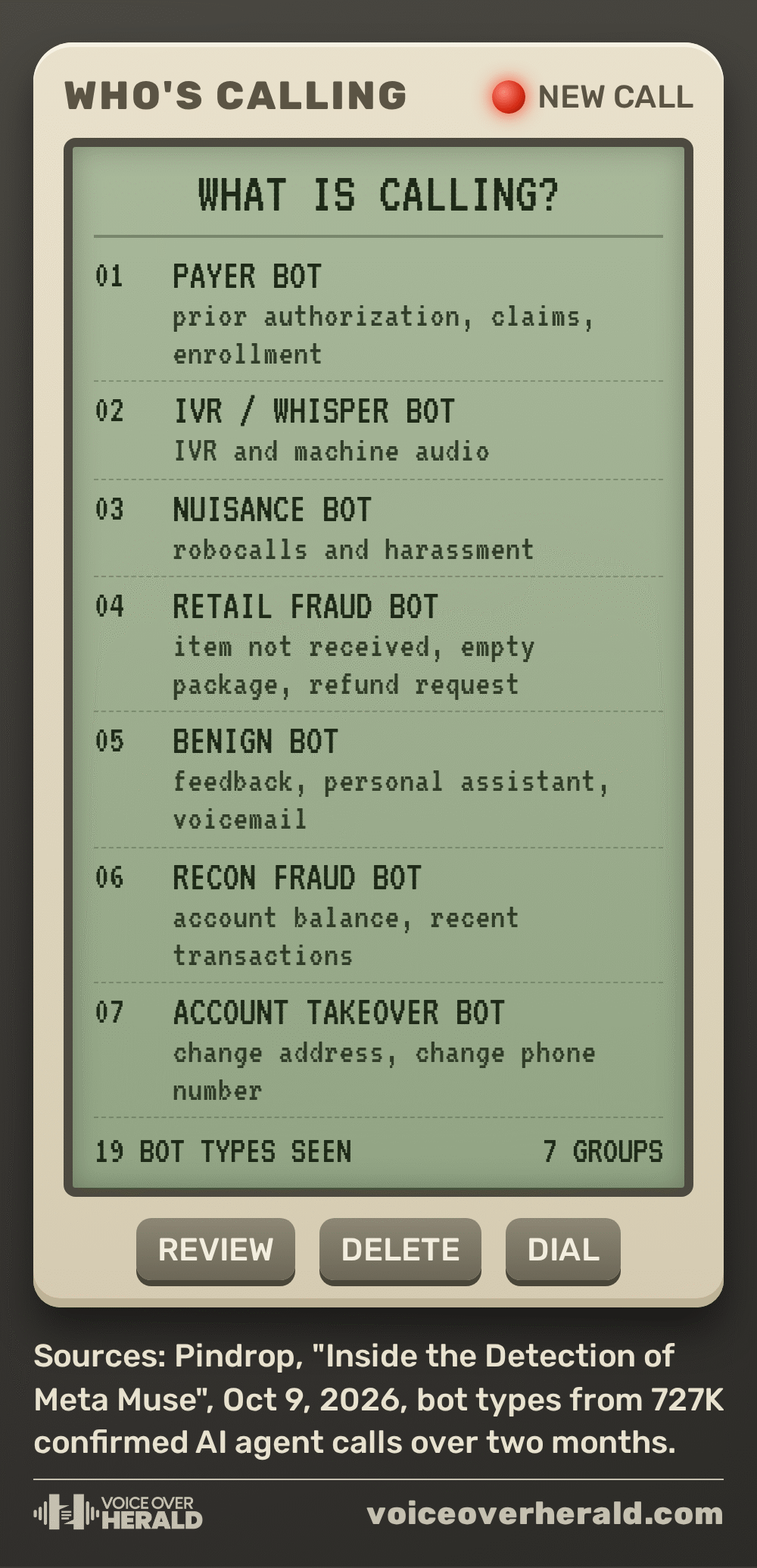
A day later, the voice security firm Pindrop said it identifies the two calling voices of Meta’s Muse personal AI agent, Brett and Hailey, by matching them against more than 5,000 AI voices in its AI Voice Consortium. In its analysis, research scientist Rodolfo Raimundo writes that “a contact center doesn’t just know a bot is on the line, it knows it’s Muse.”
Pindrop says the first Muse call it matched arrived on September 9, and that weekly volume by the fourth week was eight times the first week’s. Some of its customers flag those calls as fraud; others treat them as legitimate. Across two months it counted 727,000 confirmed AI agent interactions, 94% labelled good and 6% bad.
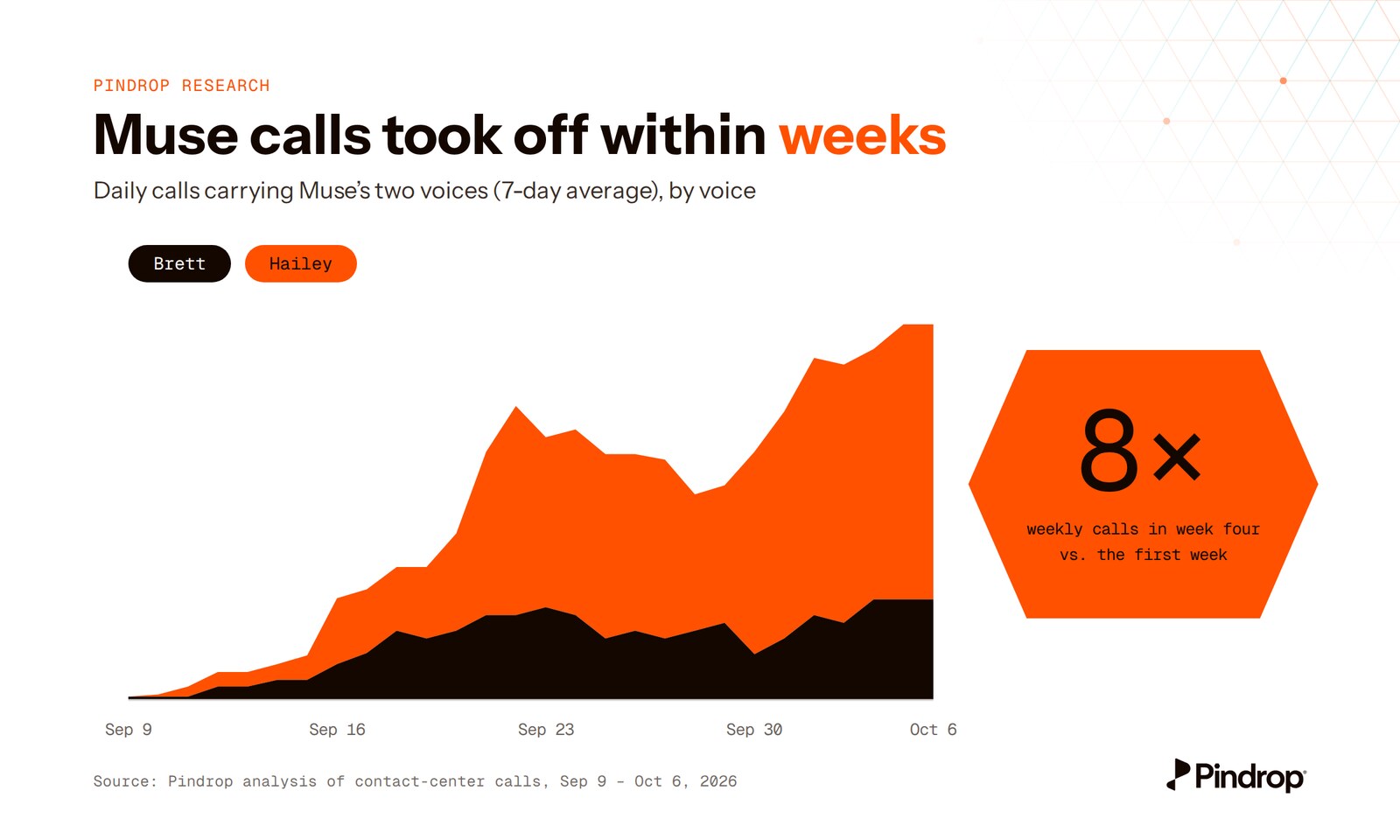
Image: Pindrop
What this means if you voice for a living
Detection tools look for signs that audio was generated, and Pindrop’s goes further, registering known AI voices by their own characteristics. That’s useful for the businesses taking calls. For a voice actor, it’s a reminder that a cloned voice can be catalogued and recognised, but only after it’s already out there making calls.
A sound mark sits at the other end. It’s a filing you make before anything goes wrong, and it suits a voice with a signature line that’s already used like a brand, the way Ward’s is. For most working actors, the stronger shields still look like personality rights, clear consent clauses in contracts, and laws like Italy’s. The EU AI Act’s transparency rules for synthetic content have applied since August 2, 2026.
 VoiceEditSuitePractise the skill that books work.The Cold Read hands you a fresh 30-second script and casting brief every take, then hides the timer so you build your own internal clock.See how it worksYour recordings are never used to train AI.
The first real test of Meloni’s four seconds comes when the office decides whether a spoken name can be registered at all. Would you file your own voice, and what line would you choose?
Sources: EUIPO eSearch record 019431219; PPC Land, October 7, 2026 (citing Reuters, Bugnion, Finnegan and others); Il Fatto Quotidiano, February 25, 2026 (citing Askanews and Il Messaggero); Sierra, “Caller ID in the age of agents”, October 8, 2026; Pindrop, “Inside the Detection of Meta Muse”, October 9, 2026. Quotations from Italian sources are translated by Voice Over Herald. Hero image: EUIPO.
Lee este artículo en español: ¿Una voz puede ser una marca? La primera ministra de Italia registró cuatro segundos de la suya
Know something about this story, or spotted an error? Tell the newsroom.