




The Corporate Read Is Leaving the Casting Brief. A Marketplace Analysis Says Acting Is What Clients Want Now
The corporate read is leaving the casting brief. That is the headline finding of a long analysis published this week by The Voice Realm, an online voice casting marketplace, which compared the wording of two years of client briefs and set the result against the research, the contracts and the laws that have reshaped voice work since 2024. Its conclusion for working voice actors is blunt: the clean, neutral narration that filled the industry’s order books for two decades is now the part synthetic voices do for free, and the work that remains is acting.
What the briefs say
The marketplace classified the free-text direction clients attach to castings, for the twelve months to August 2025 and the twelve months to August 2026, and reported the share of briefs using each kind of language. Briefs written in corporate-explainer terms (training, tutorial, phone system, “clear and professional”) fell from 13.5 percent of the total to 10.3 percent, a drop of roughly a quarter. Briefs asking for a conversational, natural or “not an announcer” read rose from 11.2 percent to 12.9 percent. Briefs asking for emotion, warmth or sincerity rose from 7.2 percent to 8.3 percent. The company publishes shares only, not volumes, and says the total number of briefs grew over the period.
Ron Atkins, the marketplace’s business development manager, who spent seventeen years in advertising and marketing before moving to the voice side, said the change is visible in the language clients use. “The brief used to say what the voice should sound like. Now it says what the listener should feel,” he said. “Clients didn’t stop needing voices. They stopped needing a certain kind of read, because they can generate that themselves now.”
The evidence around it
The analysis leans on three outside findings that will be familiar to anyone following the AI debate in voice work.
The first is a listening study from the University of Eastern Finland’s Computational Speech Group, published in December 2025, in which participants identified fully synthetic speech correctly 8.3 percent of the time, worse than chance, while spotting authentic speech 96.4 percent of the time. Listeners, the authors wrote, “rely on outdated acoustic cues such as robotic prosody or abnormal pausing and breathing, elements that modern synthesis systems no longer reliably produce.” The Voice Realm’s reading of that: sounding human is no longer a selling point, because it is no longer audible.
The second is the National Association of Voice Actors’ 2026 member survey, reported in May, in which 21 percent of voice actors said they had lost work directly to AI in the past year, up from 14 percent a year earlier. NAVA’s president, Tim Friedlander, said the numbers “tell a story that policymakers and communities need to hear.”
 VoiceEditSuiteClean a session in ninety seconds, not three hours.
The third points the other way. The Audio Publishers Association’s 2026 survey put US audiobook revenue at $2.43 billion in 2025, up 9 percent, with more than 750,000 active titles, and reported that “AI sales revenue amounted to .03% in 2025.” In the one market where listeners pay for a voice and nothing else, the analysis notes, they are still paying for people.
The law, in eighteen months
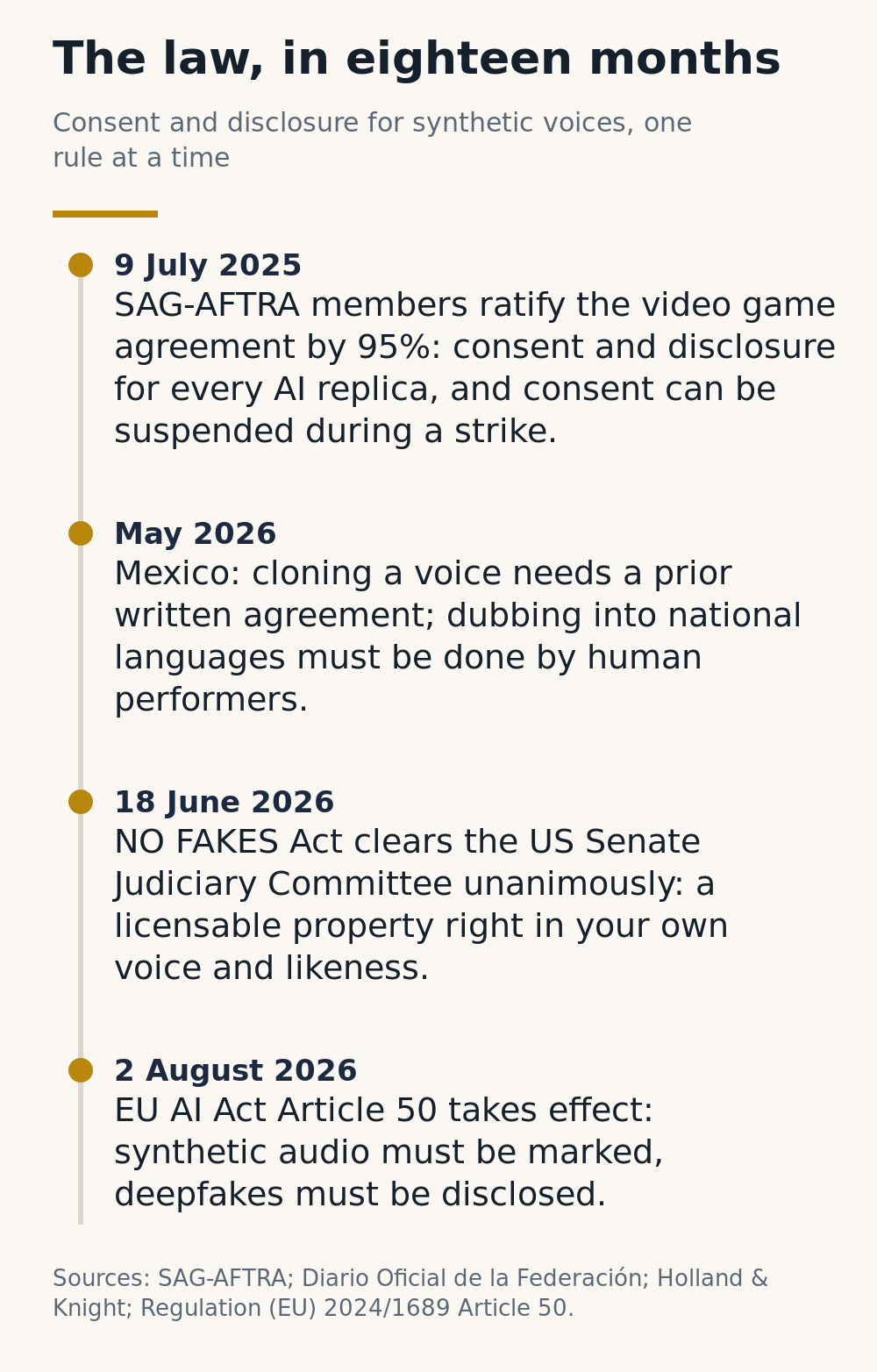
The piece also gathers the legal changes into one timeline. SAG-AFTRA’s video game agreement, ratified on July 9, 2025 by 95.04 percent of voting members, requires consent and disclosure for any AI replica of a performer and lets performers suspend that consent during a strike. Mexico’s copyright and labor reforms took effect in May 2026, requiring a prior written agreement before a voice can be cloned, and a new federal film law requires that dubbing into Mexico’s national languages be performed by human performers. The NO FAKES Act cleared the US Senate Judiciary Committee unanimously on June 18, 2026, creating what Holland & Knight describes as “a licensable property right in their own voice and visual likeness” for every person. Article 50 of the EU’s AI Act, in force since August 2, 2026, requires synthetic audio to be marked as such and deepfakes to be disclosed.
“Look at what all of these protect,” the analysis says. “They protect the identity of a voice. What none of them need to protect, because it can’t be taken, is the performance.”
What it asks actors to do
The practical half of the article lists seven things a synthetic voice does not do in a session, from taking direction on the next take to timing a joke, listening to a scene partner and improvising, and lays out a twelve-month retraining plan: scene study first, then improvisation and comedy, then deliberate range across genres, then a rebuilt profile and audition approach that leads with performance rather than sound.
Atkins put the advice in one line. “The mistake I hear from actors is ‘I need to sound more human than the AI.’ You already do. The job is to sound more like a specific human in a specific moment than a generic one. That’s acting, and it’s the only thing on the brief that has no shortcut.”
The full article, with the data, the sources and the plan, is on The Voice Realm’s blog: The Voice Over Industry in 2026: What AI Took, What It Can’t, and Why Acting Is the Job Now.
Disclosure: The Voice Realm and Voice Over Herald are under common ownership.
Sources: The Voice Realm (September 2026); L. Tomi and E. Kinnunen, University of Eastern Finland, arXiv (December 2025); National Association of Voice Actors survey as reported by Capitol Communicator (May 5, 2026); Audio Publishers Association (June 5, 2026); SAG-AFTRA 2025 Interactive Media Agreement; Holland & Knight (June 22, 2026); Regulation (EU) 2024/1689, Article 50; Diario Oficial de la Federación (May 2026).
Lee este artículo en español: La lectura corporativa está saliendo del brief de casting. Un análisis de marketplace dice que los clientes ahora quieren actuación
Know something about this story, or spotted an error? Tell the newsroom.