

 VoiceEditSuite


One Video, Ten Languages: Why Localization Is Reshaping Voice-Over Work
For much of the internet’s history, publishing a video internationally could mean little more than adding subtitles and hoping that viewers outside the original market would follow along. That approach is becoming increasingly difficult to reconcile with an online audience accustomed to content that feels as though it was made for them.
Companies, educators, entertainment producers and online creators can now distribute the same piece of content across numerous countries almost instantly. Yet reaching those audiences is not simply a matter of translating the script. The words have to sound natural when spoken, humor and cultural references may need adapting, names and terminology have to be pronounced correctly, and dialogue may need to fit an existing video.
That combination of linguistic, creative and technical demands is turning localization into an increasingly important part of modern voice production. Online platforms now make it possible for the same piece of content to carry multiple language versions, while increasingly sophisticated production workflows are making international distribution practical for organizations and creators of many different sizes. For voice actors, this means localization work is extending well beyond the traditional worlds of film and television dubbing.
Localization Is More Than Translation
The distinction between translation and localization can seem minor until a translated script reaches the recording booth. Translation is fundamentally concerned with transferring meaning from one language into another, while localization has a wider objective: making the resulting content appropriate for a particular audience, market and culture.
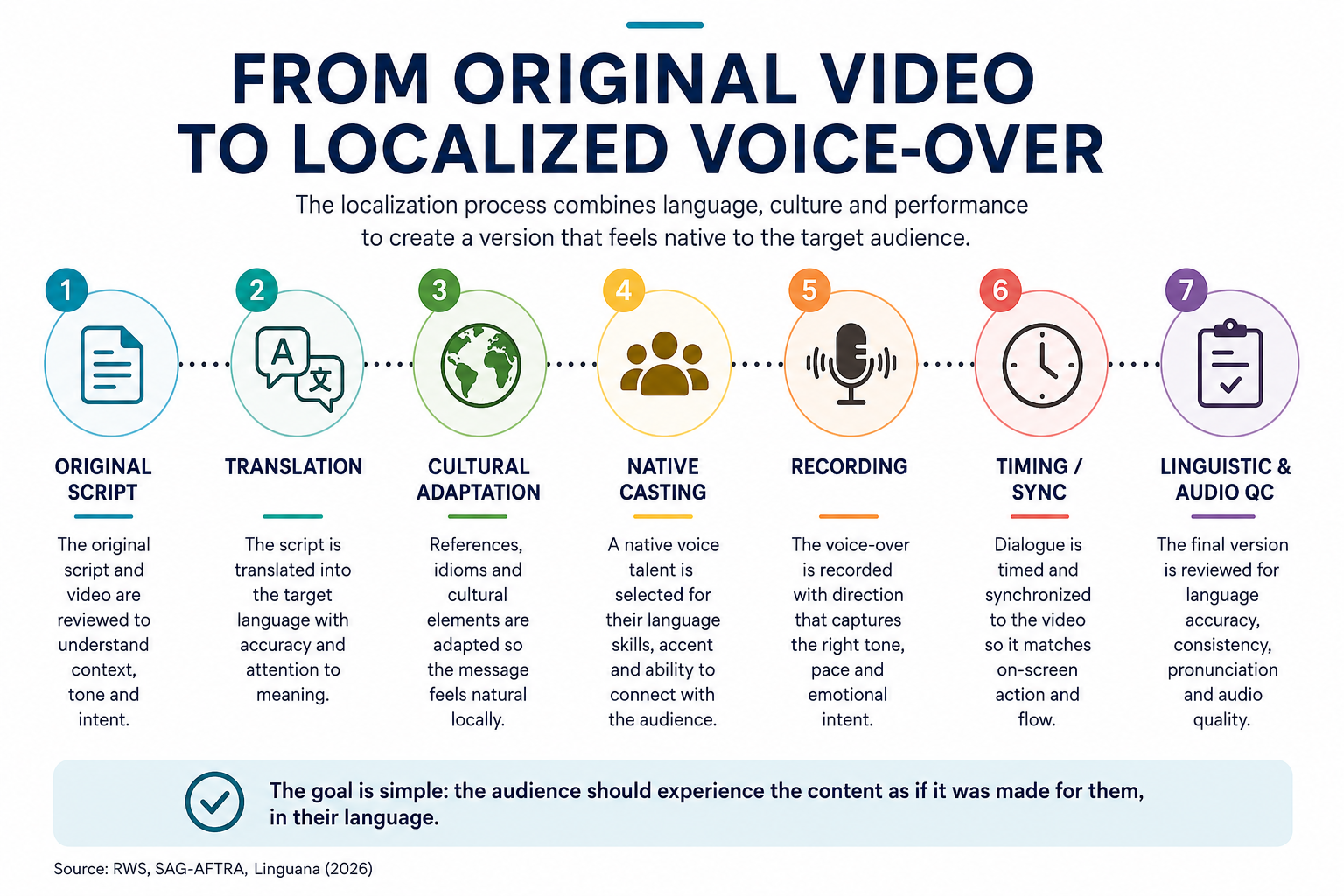
Video localization can involve several stages beyond translating a script. Depending on the project, the process may include adapting dialogue for the target audience, recording voice-over or dubbing, creating subtitles, adjusting on-screen text and synchronizing the finished audio with the original video. Linguistic review and quality control may also be required before the localized version is ready for release.
A sentence can therefore be technically accurate in translation and still be unsuitable for recording. It might sound overly formal to a native speaker, use terminology uncommon in the target country, contain an idiom that does not travel well, or simply take too long to say. For a voice actor standing at the microphone, those are no longer abstract linguistic problems. They become performance problems.
One Language Does Not Necessarily Mean One Market
Choosing “Spanish,” “French” or “English” on a project brief may not provide enough information to cast the right performer. Spanish spoken for an audience in Spain is not identical to Spanish intended for audiences in Mexico, Colombia or Argentina. French intended for France may require different vocabulary, pronunciation or delivery from French produced for a Canadian audience. English alone encompasses numerous recognizable national and regional varieties.
Not every project requires intensely local casting. Some clients deliberately seek a broadly understood or relatively neutral delivery because material will be distributed across several countries, while other projects depend heavily on local familiarity and cultural credibility. The important point is that language and market are not automatically the same thing.
A producer who waits until casting to answer that question may discover that the translated script, voice choice and intended audience are pulling in different directions. This is one reason native-language performers can contribute more to localization than pronunciation alone. A performer may immediately notice that a phrase is grammatically correct but unnatural, that a joke makes little sense locally, or that a particular word would rarely be used by the intended audience.
English Is Not a Universal Stopwatch
One of the least glamorous problems in localization is also one of the most persistent: time. A video originally produced around an English script already has a rhythm. Graphics appear and disappear, speakers pause, product demonstrations happen at particular moments, and animation moves according to an established timeline. A translated voice-over cannot simply ignore those boundaries.
Yet equivalent ideas do not occupy identical amounts of spoken time in every language. That does not mean one language can universally be described as a fixed percentage longer or shorter than another. Sentence construction, vocabulary, subject matter, translation choices and speaking style all affect duration, which means broad rules can become misleading very quickly.
What matters in production is simpler: a translation that is accurate on the page may not fit the time available on screen. When that happens, the script can sometimes be adapted while preserving its meaning, the actor may adjust pace within reasonable limits, pauses can be shortened, or visual timing may be changed when the production allows it. In tightly synchronized material, translators and dialogue adapters may have to find entirely different ways of expressing the same idea.
Simply instructing an actor to “speak faster” is rarely a complete solution. Push the pace too far and clarity disappears. A calm corporate narrator can suddenly sound hurried, an educational explanation becomes difficult to follow, and a character performance can lose its emotional rhythm. Localization therefore has to account for the spoken language, not just the written one.
Dubbing Creates an Even Tighter Constraint
Traditional voice-over and dubbing are related, but they are not interchangeable. In dubbing, the relationship between the new performance and the picture can become much more demanding.
SAG-AFTRA’s description of its dubbing agreements, for example, says performers working under its Modified Dubbing Agreement work “to picture,” synchronizing dialogue from the adapted script with on- and off-camera dialogue. The union separately describes non-dramatic or UN-style dubbing, where translated audio overlays the original foreign-language track and does not require the same synchronization to the dialogue.
That distinction illustrates why different localization projects require very different performances. A narrator working with a translated interview may have some flexibility in phrasing and timing, while an actor replacing the dialogue of an on-screen character may need to communicate the same emotional intention within much narrower timing constraints.
The localized actor is therefore not merely reproducing the original performance in another language. The actor is interpreting an adapted script while negotiating the creative boundaries established by the original picture.
The Best Translation May Not Be the Most Literal One
Literal accuracy can sometimes work against natural performance, particularly when idioms and humor are involved. A phrase that makes immediate sense in one language may sound bizarre when translated word for word, while jokes frequently depend on cultural knowledge, double meanings or sounds that simply do not exist in the target language.
The same challenge appears in less dramatic material. A corporate training video may refer to a workplace practice that differs between countries, while an educational program may use examples familiar to children in one market but not another. Measurements, dates, currencies and forms of address may need reconsideration, and even apparently simple marketing language can sound artificial if a slogan is translated without regard for how people actually speak.
Correct pronunciation is therefore essential, but authentic localization involves more than reading every translated word precisely as supplied. Sometimes one of the most useful contributions a native performer can make is identifying a phrase that may be grammatically correct but simply does not sound like something people in that market would naturally say.
When the Voice Actor Becomes a Linguistic Safety Net
That situation can put performers in an awkward position because a voice actor is generally hired to perform, not to rewrite a client’s translation. Yet native speakers are often among the final people in the production chain to encounter the script before the audience does, meaning they may be among the first to notice a phrase that sounds obviously wrong.
Making substantial alterations without permission creates its own problems. A client may have approved specific terminology for legal, technical or branding reasons, and a translated phrase that sounds unusual may have been chosen deliberately. Changing words during recording can also create inconsistencies with subtitles, graphics and other localized assets.
Ignoring an obvious problem is not necessarily ideal either. A more useful approach is communication: flagging a questionable phrase, explaining why it sounds unusual and allowing the client, translator or director to decide. This is particularly important in technical, medical, legal and educational content, where a seemingly minor linguistic adjustment can alter meaning.
The strongest localization workflows therefore treat the performer as one part of a larger linguistic process rather than the person expected to quietly repair every problem at the microphone. That allows a performer’s native-language knowledge to contribute to quality without placing responsibility for the entire translation on the actor.
A Native Voice Is About More Than Accent
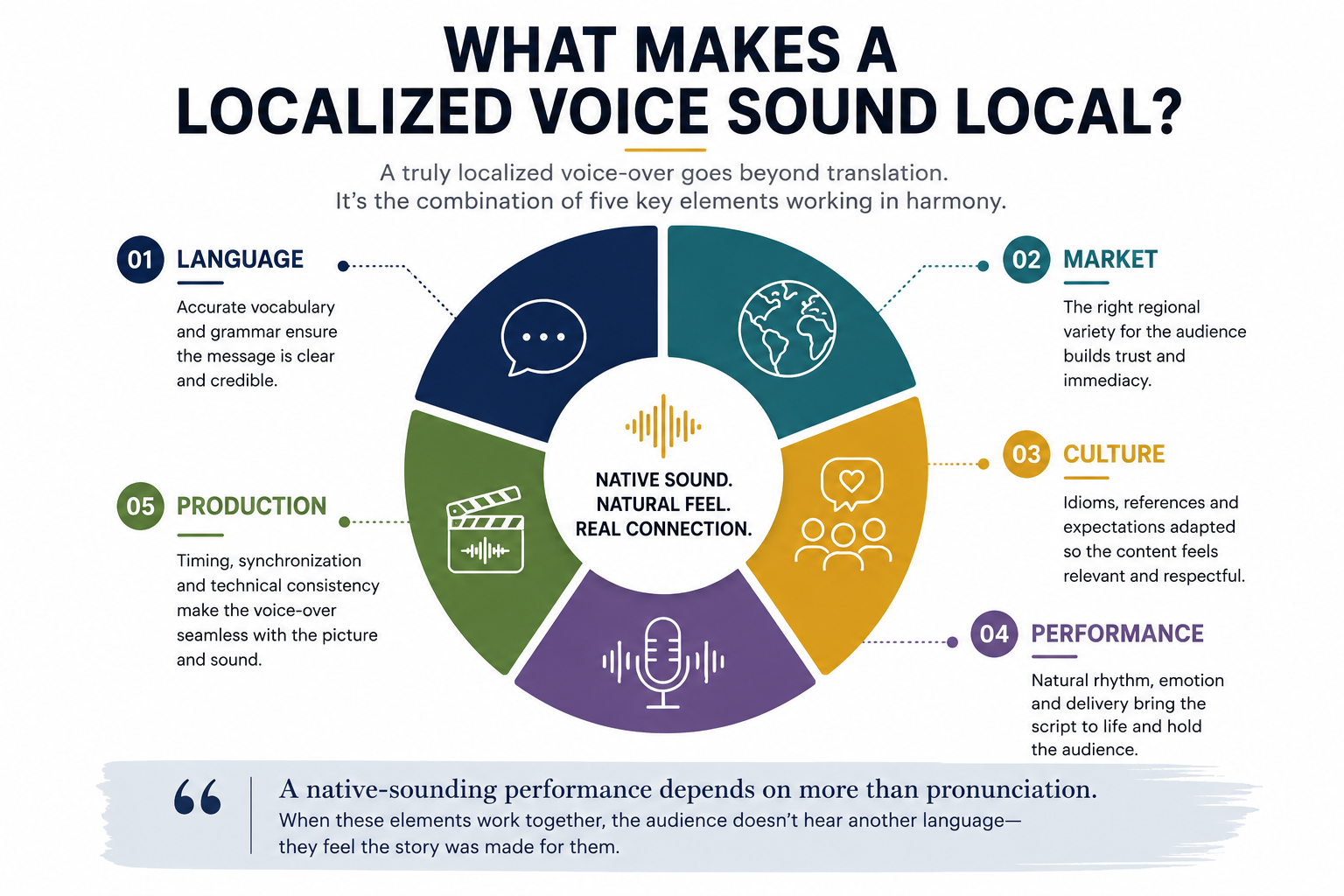
Casting for localized content also raises an interesting question about authenticity because clients sometimes describe their requirement simply as a “native accent.” Native delivery, however, encompasses much more than pronunciation.
Rhythm, emphasis, vocabulary, emotional expression and conversational convention can all differ between cultures. Even the way enthusiasm is communicated can vary. A performance that sounds engaging in one market may feel exaggerated in another, while a delivery considered appropriately restrained somewhere else may sound detached to a different audience.
That makes localized casting partly a question of cultural fluency. The performer needs to understand not only how words are pronounced but how the message would naturally be communicated to the people expected to hear it.
This becomes particularly important when the original voice is being used as a reference. Matching the original actor’s energy exactly may not always produce the most convincing localized performance, because the goal is often to recreate the intention of the original rather than mechanically reproduce every vocal characteristic.
Localization Is Expanding Beyond Film and Television
Dubbing may immediately suggest foreign-language films and television, but multilingual voice production now extends much further. Corporate training, e-learning, product demonstrations, social videos, online advertising, games, apps and creator content can all be distributed internationally, meaning a company does not need to operate a television network to find itself managing several language versions of the same video.
Online platforms have made multilingual publishing increasingly accessible to creators and organizations of all sizes. YouTube’s multi-language audio capabilities, for example, allow additional dubbed audio tracks to be attached to a single video, giving viewers the option to listen in their preferred language without requiring an entirely separate upload. As tools for international distribution become more accessible, multilingual production is no longer limited to major entertainment companies with dedicated localization departments.
The result is that localization is no longer solely the territory of major entertainment studios with dedicated dubbing departments. Smaller organizations and individual creators can increasingly contemplate multilingual distribution as part of an ordinary content strategy, potentially broadening the market for performers with genuine linguistic and regional expertise.
Technology Is Changing the Workflow, but Humans Have Not Disappeared
No discussion of localization in 2026 can completely avoid artificial intelligence, although it should not dominate every conversation about multilingual production. Automated transcription, machine translation, synthetic speech and AI-assisted dubbing are increasingly being incorporated into localization workflows, and the speed and economics of those tools can make it possible to produce language versions that might previously have been considered too expensive.
But the dividing line between automated and human localization is becoming less straightforward. Translation, transcription and speech technologies can now assist with parts of the production process, while human translators, performers, directors and reviewers may still be involved in decisions about meaning, pronunciation, cultural context, performance and quality control. The exact balance can vary considerably from one production to another.
These evolving workflows suggest that technology may change where human expertise enters the production chain rather than producing one universal replacement model. Some localization work will remain conventionally recorded, some may use technology as part of production, and some projects may become possible precisely because technology lowers the barriers to creating additional language versions.
For professional voice actors, translators and directors, that distinction matters. The long-term balance between conventional recording, hybrid workflows and fully synthetic production is still developing, which makes it difficult to treat localization as though it is moving toward one single production model.
Quality Control Becomes Harder With Every New Language
Producing one additional language version creates another set of opportunities for something to go wrong, and producing ten multiplies them. A name might be pronounced differently between sections, one script could contain an outdated product term, a voice file might be assigned to the wrong video, or the translated on-screen text could disagree with the spoken version.
Timing creates another potential source of inconsistency. Changes made after recording one language may never reach another, and unlike an obvious audio glitch, a linguistic error may be invisible to a production team that does not speak the language.
That is why multilingual production requires quality control at several levels. The audio must meet technical standards, the recording needs to match the approved script, pronunciations and terminology should remain consistent, and the language needs to be reviewed by somebody capable of identifying linguistic errors. When the project is synchronized to picture, the final version also needs to be checked in context rather than as an isolated audio file.
Scaling localization therefore means scaling review as well as recording. The more versions a production creates, the more important an organized process becomes for maintaining consistency between them.
The Original Production Can Make Localization Easier or Harder
Many localization problems are created before the translated script even exists. A source video packed with rapid narration leaves little flexibility for different phrasing, while on-screen graphics containing embedded English text create additional work. Unexplained abbreviations can confuse translators, and scripts that differ from the final recorded English audio make accurate adaptation unnecessarily difficult.
Organizations planning international distribution can reduce these problems by treating localization as part of production rather than an afterthought. That may mean keeping accurate final scripts, maintaining terminology lists, identifying names and brand pronunciations, leaving reasonable space in the edit and ensuring translators have enough context to understand what the audience is seeing.
It can also mean deciding early which markets actually matter. “One video, ten languages” sounds straightforward when written on a production schedule, but in reality each additional language represents another audience with its own linguistic and cultural expectations.
Planning for those audiences from the beginning does not eliminate every localization challenge. It can, however, prevent avoidable problems from reaching the recording stage, where correcting them may require new scripts, new sessions or changes to an already completed video.
For Multilingual Voice Actors, Expertise Is Becoming More Specific
The expansion of localization may create opportunities for performers, but it also makes accurate representation of language skills increasingly important. Speaking a language conversationally is not necessarily the same as being able to deliver a professional performance in it, just as being bilingual does not automatically mean a performer is equally suited to every regional market that uses those languages.
Clients may need to know where a performer acquired the language, which regional varieties they can authentically deliver, whether they can interpret culturally specific material and whether they are comfortable identifying translation issues during a session. Those details can become professional advantages rather than limitations.
A performer who clearly identifies themselves as a native Colombian Spanish speaker, for example, gives a producer more useful casting information than somebody who simply lists “Spanish.” The same principle applies across languages with significant national or regional variation.
Localization rewards specificity because the objective is not simply to find somebody capable of pronouncing the words. It is to find a performer whose linguistic and cultural knowledge fits the audience the production is trying to reach.
The Goal Is Not to Sound Translated
Ultimately, successful localization contains a small paradox: an enormous amount of work can go into producing something the audience should barely notice. Viewers should not have to mentally reconstruct the original English sentence to understand what the localized speaker means, nor should they be distracted by unnatural phrasing or wonder why an actor is racing through a line simply to reach the end before the picture changes.
Ideally, the content should feel as though it belongs in their language. Achieving that requires translators who understand context, writers and adapters willing to move beyond literal wording, directors who understand the intended audience, performers capable of delivering culturally credible performances, and production teams that recognize timing and synchronization as creative constraints rather than problems to be handed to the actor at the end.
Technology will undoubtedly continue altering how those tasks are performed, and the growing availability of automated and hybrid localization may mean that far more content becomes multilingual in the first place. But increasing the number of languages does not automatically increase the quality of communication.
The real challenge is making every version feel like more than a version. When localization succeeds, the audience should be able to concentrate on the story, information or message rather than the process that brought it into their language.
Join the Discussion
For voice actors working across languages, localization can create opportunities that extend far beyond conventional dubbing. It can also place performers closer to translation, adaptation and quality control than many traditional recording jobs do, making linguistic and cultural knowledge an increasingly important part of the work.
If you record voice-over in more than one language, what is the biggest localization problem you encounter: unnatural translations, regional differences, pronunciation, timing, direction or something else? Share your experience with Voice Over Herald readers in the comments below.
Know something about this story, or spotted an error? Tell the newsroom.