


Paid Now or Paid for Seven Years? How Audiobook Narrators Weigh an Offer Before They Say Yes
Two offers land in the same week. One pays a set fee for every finished hour. The other pays nothing now and half the royalties for seven years. Which one is better? It depends on the book, and you can work most of it out before you say yes. Here’s the arithmetic audiobook narrators use, with the numbers ACX and working narrators have published, and a deadline on December 31 that changes one side of the sum.
ACX, Audible’s platform for authors and narrators, offers three kinds of deal. Pay-for-Production is a flat fee based on the length of the finished book. Royalty Share swaps the fee for half the author’s royalties. Royalty Share Plus is a smaller fee and half the royalties. A flat fee per finished hour is the industry standard well beyond ACX, so the same first step works for almost any audiobook offer you’ll get.
Start with the hours, not the rate
Every quote in this business is per finished hour, meaning one hour of the audio a listener hears. It says nothing about how long you’ll be working. ACX tells new narrators to expect about two hours of recording, three of editing and 1.2 of checking for each finished hour. “Total estimated time: 6.2 hours per finished hour of audiobook,” its guide says.
Length comes from the word count. ACX divides by 9,300 words an hour, so an 80,000 word novel runs about 8.6 hours. At 6.2 hours each, that’s around 53 hours of work. A fee of $250 a finished hour comes to $2,150 for that book, or about $40 for each hour you actually put in. At $100 a finished hour it’s $16.
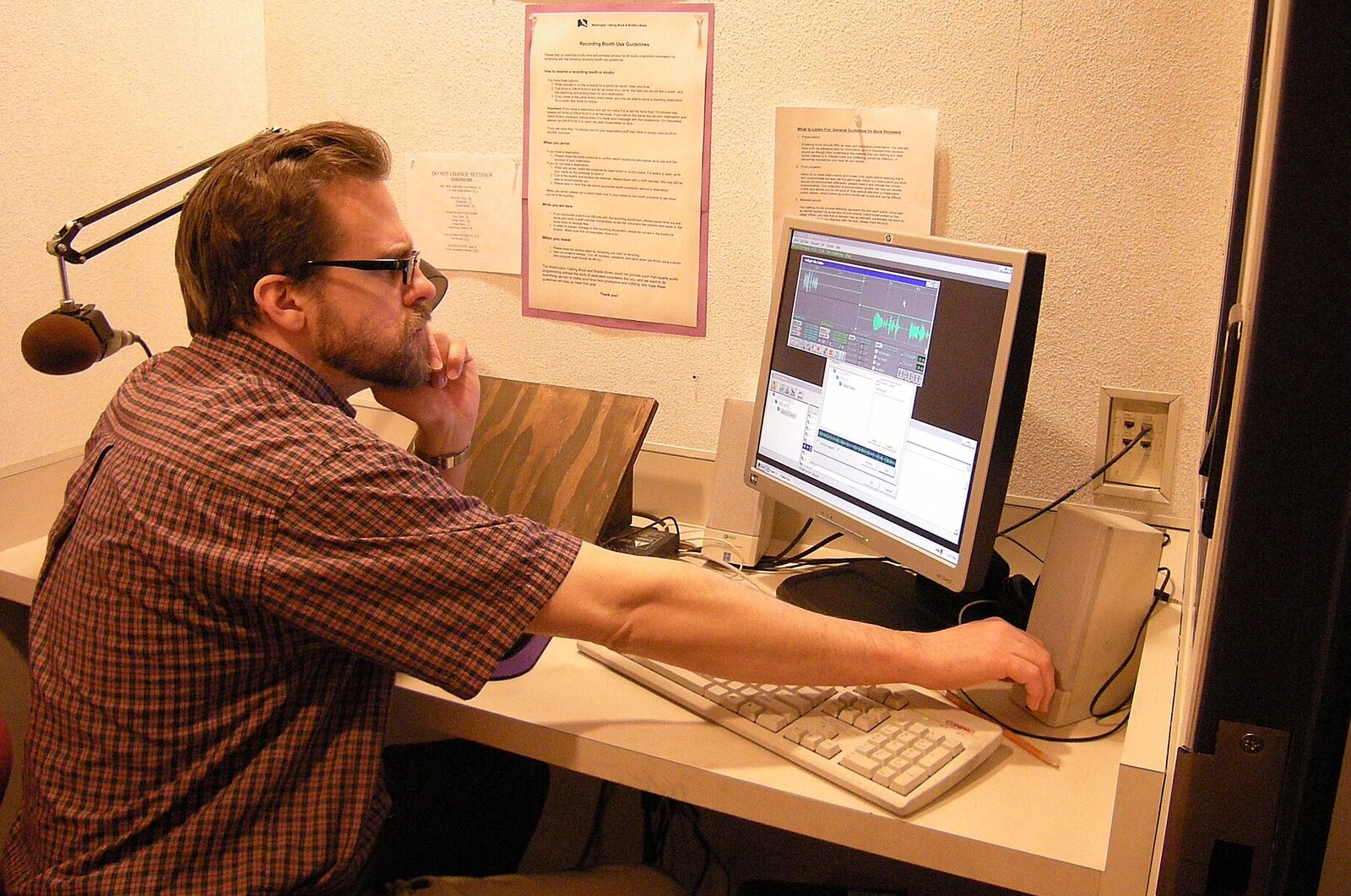
A recording booth at Seattle's Washington Talking Book & Braille Library, 2009. Photo: Joe Mabel, CC BY-SA 3.0, via Wikimedia Commons
Run that sum on every offer, whatever the currency. It turns a rate that sounds grand into a wage you can compare with the rest of your week. If you’re faster than 6.2, good. If the book has a dozen accents and a glossary, you won’t be, and our guide to prep and pickups explains where the extra time goes.
The flat fee is simple, until it’s late
A flat fee moves the risk to the author. Ten copies or ten thousand, you’re paid the same. The figure narrators measure against is $250, the lowest Pay-for-Production rate that qualifies for SAG-AFTRA health and retirement contributions on ACX. In Australia, MEAA’s card sets the same number in Australian dollars, as we found when we read four unions’ rate cards.
Plenty of nonunion work pays less. Narrator Brian Wiggins, in a rate guide written for indie authors, lists $85 to $100 for an inexperienced narrator and $150 to $250 or more for a very experienced one.
The catch is timing. On ACX the author pays you directly, after approving the whole book, and can ask for up to two sets of revisions first. The audiobook doesn’t go on sale until you confirm the money has arrived, so never press that button early.
Royalty share is a bet, so count it like one
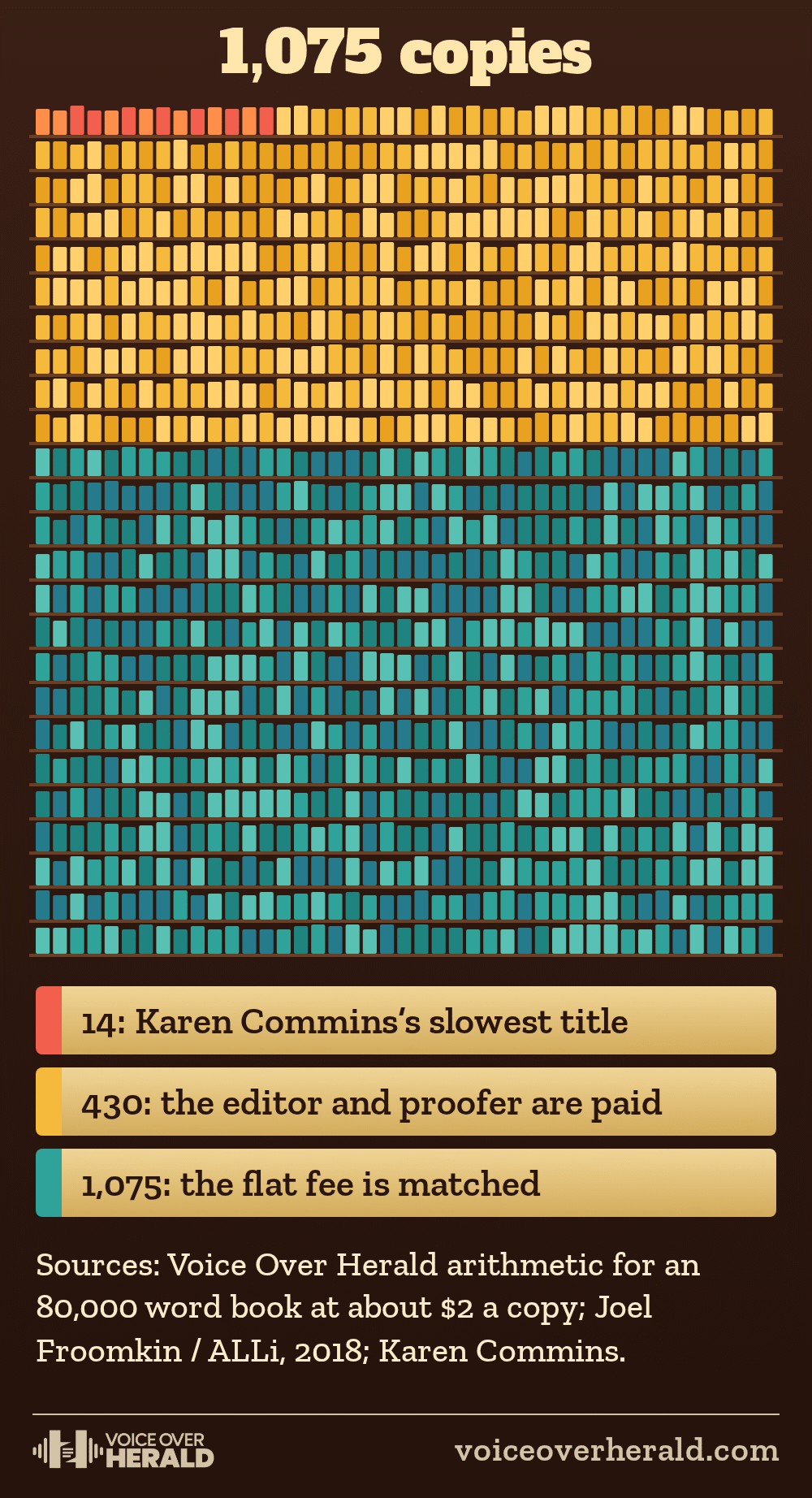
“Royalty share is a gamble,” narrator Joel Froomkin told author Anna Castle for the Alliance of Independent Authors in 2018. The method still holds. Take what a flat fee would have paid, divide it by what you expect to earn per copy, and you have the number of copies the book must sell before you’ve caught up.
Using a figure of about $2 a copy, Froomkin put an eight hour book at 1,000 sales to match the union minimum. It can also cost you money. Froomkin quoted $75 a finished hour for an editor and $25 for a proofer. “It is very easy with royalty share to LOSE money from the up-front expense.”
And the payoff? “We all have royalty share titles that have sold like twelve copies,” Froomkin said, “and we have per-finished-hour titles that we WISH had been royalty share!”
What narrators check before they bet
Karen Commins, an Atlanta narrator who runs the Narrators Roadmap site, keeps a primer on royalty share that was last updated in 2023. Its sales range from 14 copies of one title to thousands of another, at an average of $2.70 to $3.00 each, all under the old royalty rules. Commins warns that “past performance of a book is no indicator of future sales,” but a track record still beats a guess.
Froomkin looks first at the sales and review counts, especially paid ebook sales, then the author’s following, how they market, and how any earlier audiobooks sold. “Usually, if a project is a strong royalty share prospect, the author will want to pay you up front because they know it’s going to sell,” Froomkin said.
 VoiceEditSuiteNewAuto Clean Up now learns how you breathe.Learns from numbers, never your audio. Never used to train AI.See how it works
Rich Miller, who hosts The Audiobook Speakeasy podcast, told the writer Kristen Tsetsi in 2019 about reading the reviews for complaints that keep coming up, then asking for sales figures if the book has been out more than a few weeks. “I don’t do many royalty share projects these days, because the number that I think will earn out over time is very small,” Miller said.
Commins adds a check that sounds backwards. On Narrators Roadmap, a brilliant sales rank with 50 or more reviews can be a red flag on a royalty share listing, because authors of books that sell usually prefer to pay. Some listings are posted by people who don’t own the book at all. We’ve covered the other signs in our guide to fake voice jobs.
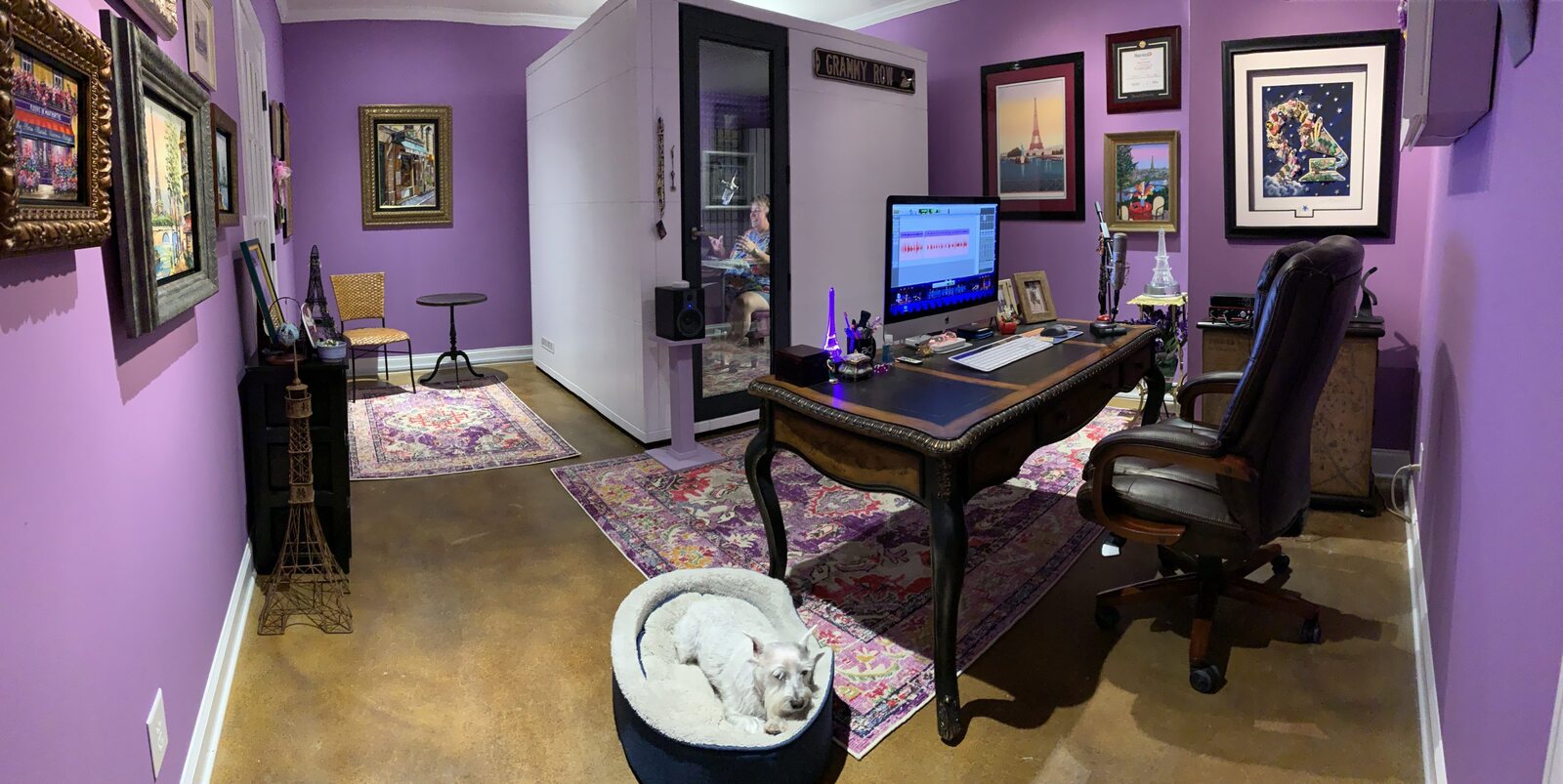
Karen Commins's studio. Image: Karen Commins, karencommins.com
So why would anyone say yes? Because a new narrator needs credits, and a book that keeps selling keeps paying. Commins uses royalty share to fill holes in the calendar and asks for two to four months to deliver. “Royalty share work should not come ahead of paying work,” the primer says. “The rights holder can have it Fast. Good. Cheap. Pick any two.”
The middle deal comes with fine print
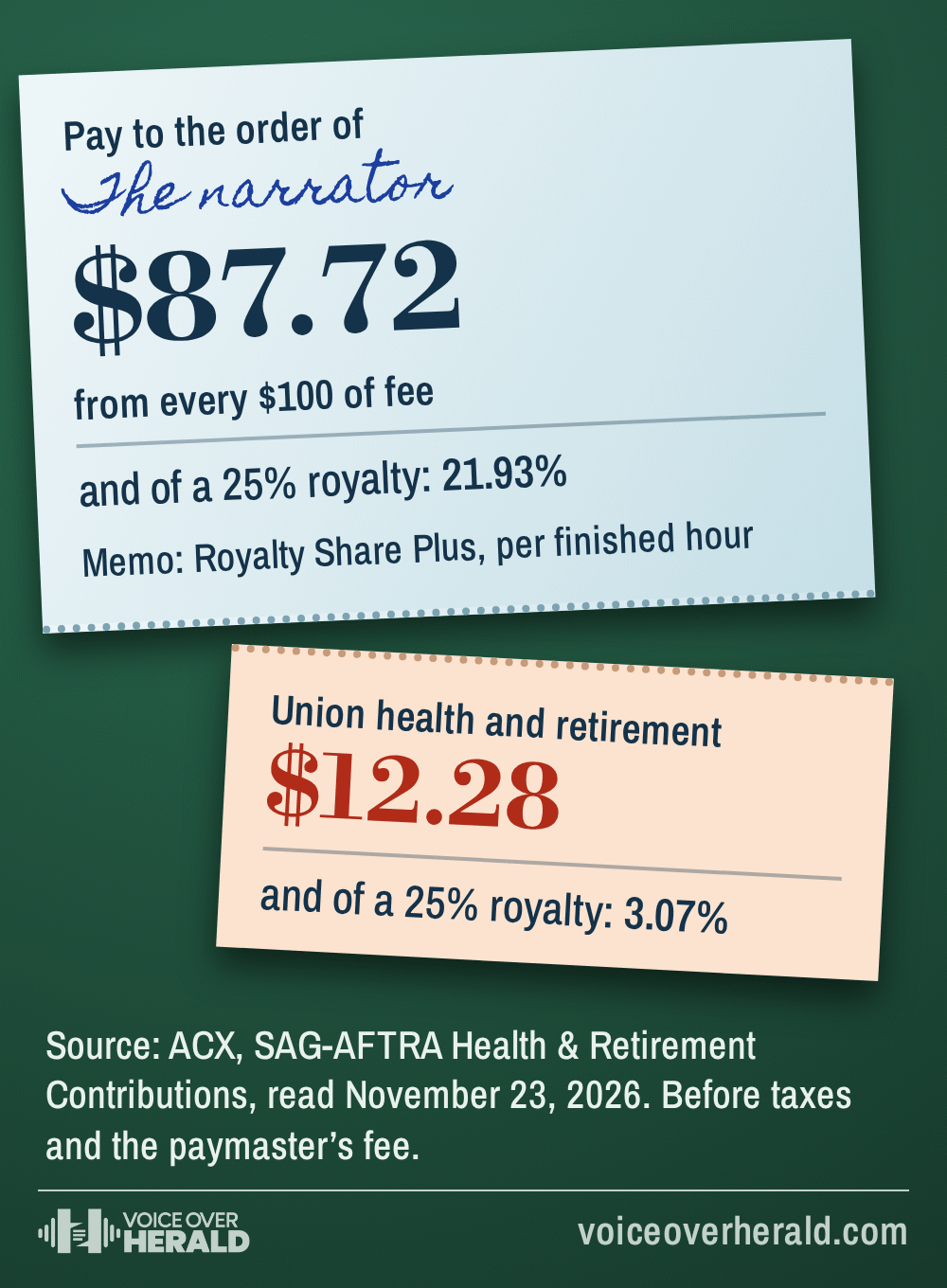
Royalty Share Plus is the one to ask for when an author has some money but not enough. The fee covers your editor, and the royalty keeps you in the game. At $100 a finished hour or more it can be accepted with union contributions, and you don’t have to be a SAG-AFTRA member to take it that way. You do need to narrate it yourself and be paid through a paymaster.
Know where those contributions come from, though. They aren’t added on top, the way they are on a commercial. On ACX they’re taken out of your fee and out of your royalties, so that hiring a union narrator costs the author no more than hiring anyone else.
The per-copy figure has changed
Everything above leans on a number per copy, and that number is moving. Under the royalty model that opened to all ACX creators in May, a Royalty Share narrator on an exclusive title gets 25% instead of 20%. For members’ listening, though, it’s 25% of a share of each member’s monthly payment, split among everything that member engaged with. The old $2 or $3 is a guide, not a promise.
- Hours. Word count divided by 9,300, times your real working ratio.
- Cash out. Editor and proofer, paid by you, whether it sells or not.
- Break-even. The flat fee you’d have earned, divided by a cautious figure per copy.
- Proof. Ask for sales figures. A serious author will have them.
- Date. When the money lands, or which day the book has to be enrolled by.
ACX’s own early report card, published on November 5, says the same titles “collectively earned over 26% more in total royalties in their first one to two months, and 64% of those ACX creators earned more overall.” Read that the other way and 36% didn’t. ACX notes that individual results vary, and it doesn’t break out narrators.
If you already have royalty share books, the calendar matters more than the percentage. When we first wrote about the switch, ACX hadn’t said what happens to a title that never moves. Now it has. “Titles that were not enrolled in Audible’s new royalty model by December 31, 2026 will be removed from distribution,” its help page says.
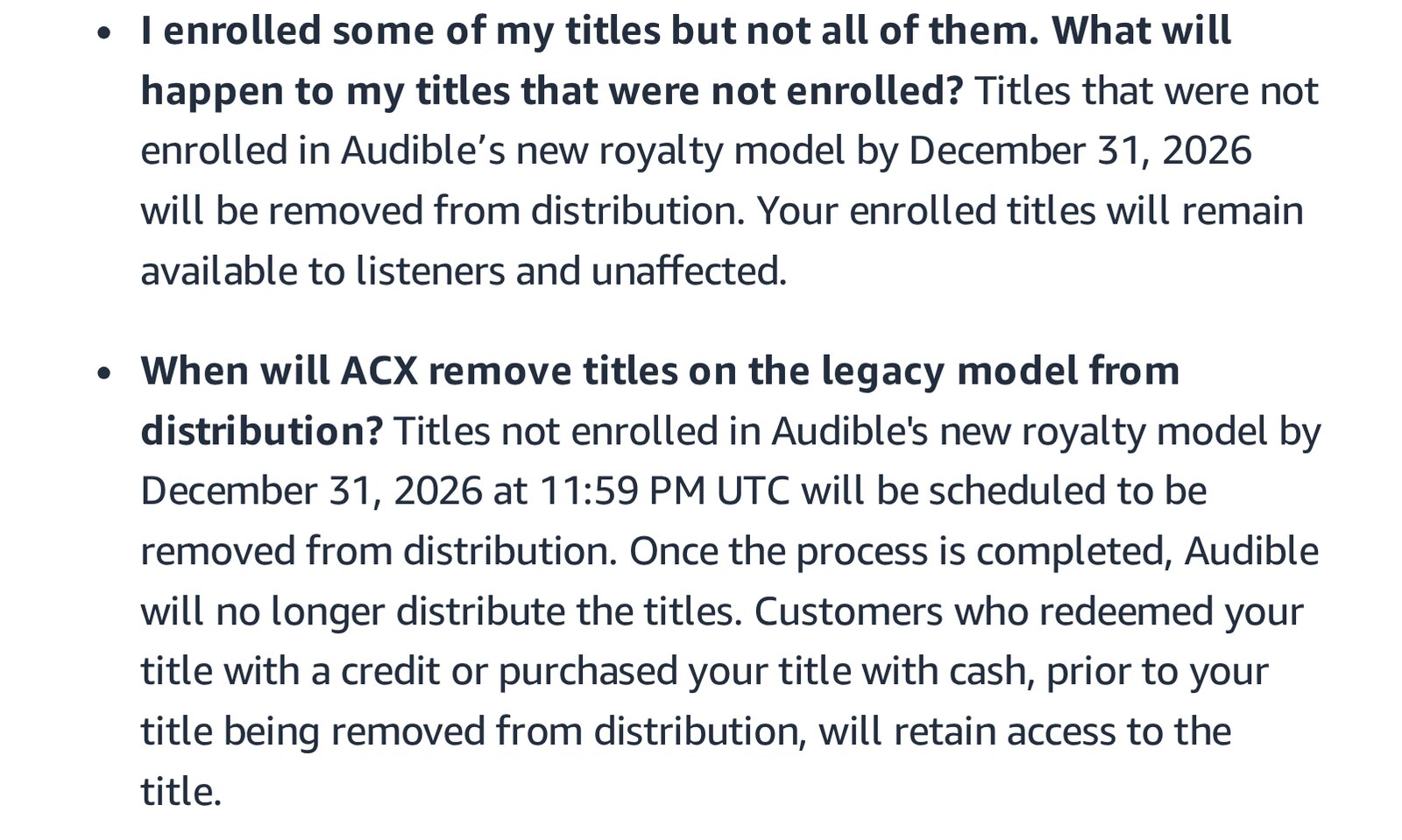
ACX help page, screenshot taken November 23, 2026. Image: ACX
The cutoff is 11:59 PM UTC, which is 6:59 PM in New York and already New Year’s morning in Sydney. A book that’s off sale earns nobody a royalty, and it’s the author who has to enroll it. ACX’s advice to a worried narrator is to contact the rights holder “as soon as possible.” Authors can schedule the change now to start on January 1.
None of this tells you to turn down a book you love. It tells you what loving it might cost. If the break-even number makes you wince, ask for a fee, ask for the middle deal, or keep the evening free for the offer that pays on delivery.
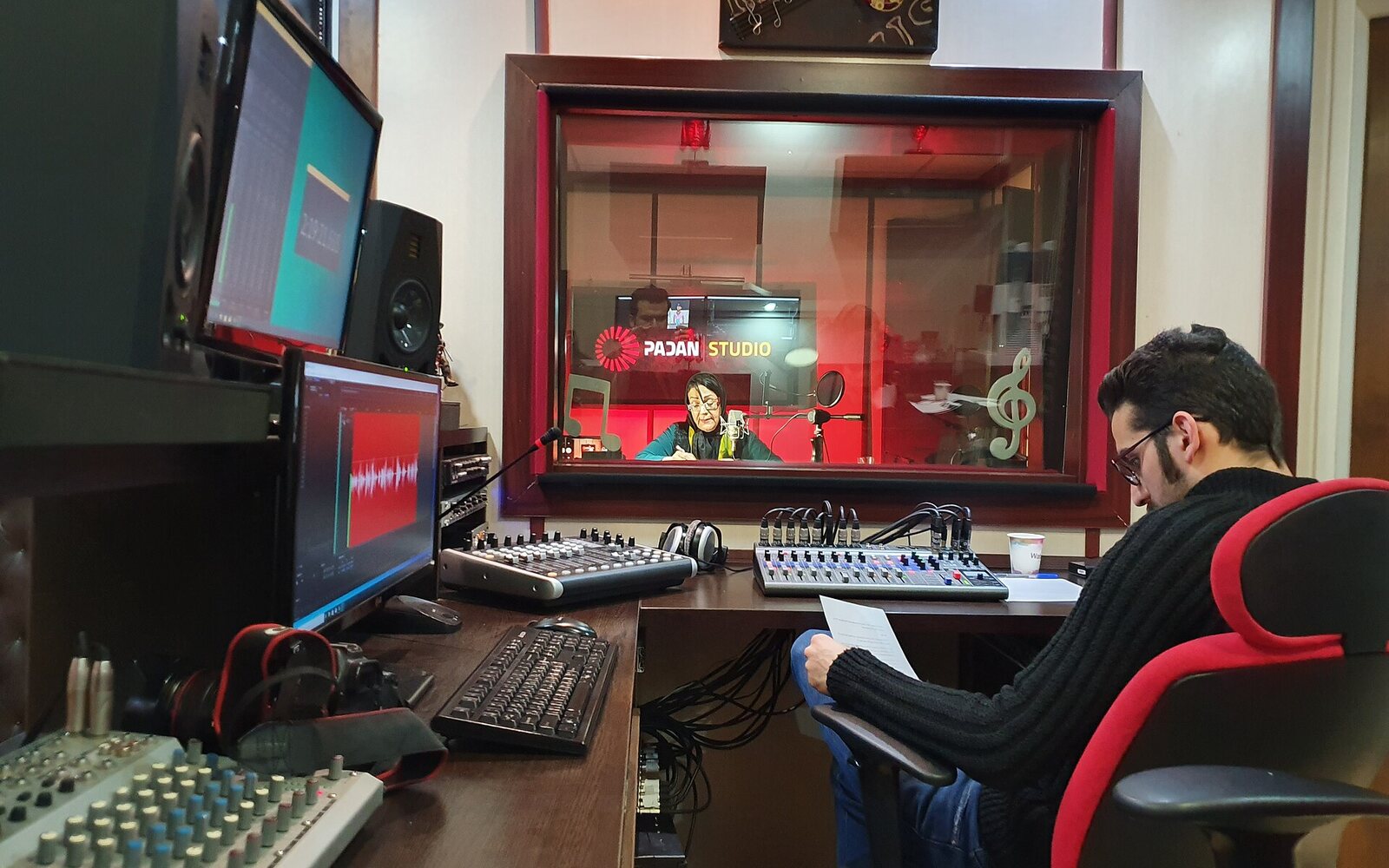
Sources: ACX, How royalties work; Narrate an audiobook; Audible’s New Royalty Model; SAG-AFTRA Health & Retirement Contributions; and Audible’s new royalty model: results by the numbers (November 5, 2026), all read on November 23, 2026; Alliance of Independent Authors, Joel Froomkin interviewed by Anna Castle (April 19, 2018); Karen Commins, Karen’s Primer on Narrating Royalty Share Audiobooks (2013, updated January 2023) and narratorsroadmap.com; Jane Friedman’s blog, Rich Miller interviewed by Kristen Tsetsi (February 12, 2019); Brian Wiggins, Audiobook Narrator Rate Guide (2025); MEAA Voiceover Industry Rate Card. Worked examples are Voice Over Herald’s own arithmetic, in US dollars unless stated. Main photo: Padan Art Studio, CC BY-SA 4.0, via Wikimedia Commons.
Lee este artículo en español: ¿Cobrar ahora o durante siete años? Cómo evalúan una oferta los narradores de audiolibros antes de decir que sí
Know something about this story, or spotted an error? Tell the newsroom.