
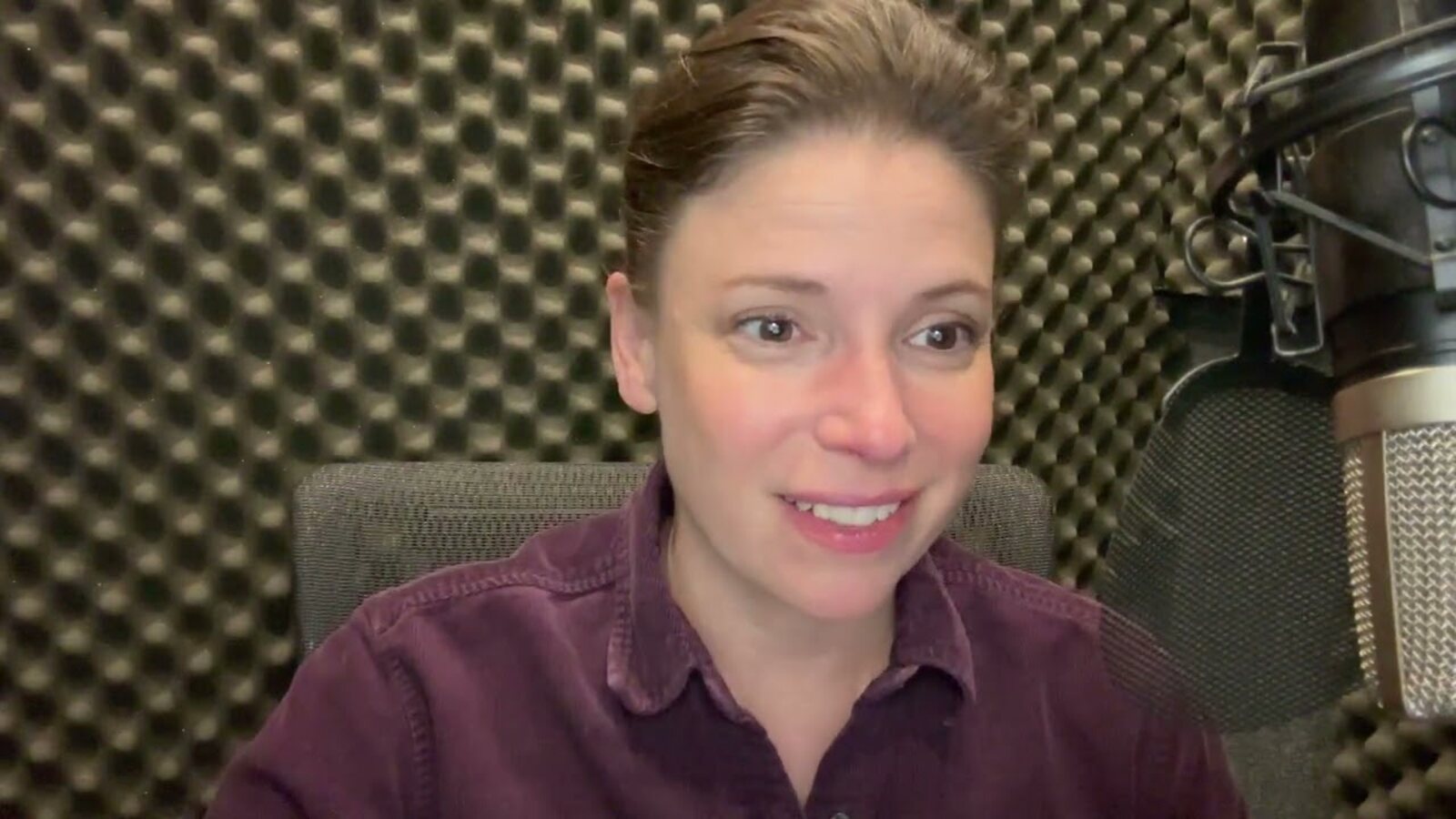
Seven Hundred Audiobooks In, Julia Whelan Still Starts Every One With a Map of Who Talks to Whom
Julia Whelan has narrated more than 700 audiobooks, from Gone Girl to Educated, picked up an Audie for Best Female Narrator, and set up her own audiobook company because narrators don’t get royalties. Read side by side, her interviews are a working manual for anyone behind a microphone at home: map the cast, guard the voice, and know exactly what the job pays.
If you listen to audiobooks, you’ve probably spent days of your life with her. She read Gillian Flynn’s Gone Girl alongside Kirby Heyborne, Tara Westover’s memoir Educated and a long run of Emily Henry romances. Audible named her its Narrator of the Year in 2014, AudioFile magazine gave her its lifetime Golden Voice award in 2020, and she has a shelf of Earphones awards on top of her Audies.
She’s also a novelist, a former child actor and, since 2024, a publisher. But the parts of her story that matter most to working voice actors are the unglamorous ones: how the jobs arrive, how she preps, what a cold does to her calendar, and why she thinks the pay model is broken.
Hear the voice: Julia Whelan reads from the novel The Night We Lost Him. Video: Simon & Schuster Audio, on YouTube
From a TV family drama to the booth
Whelan was born in Oregon in 1984 and was acting on television by the age of 11. Her best known role was Grace Manning, the anxious teenage daughter in the ABC drama Once and Again, which ran from 1999 to 2002. A year studying at Oxford later became her first novel, My Oxford Year, now a Netflix film.
Narration came after the camera, and she’s never looked back. “I feel like I was born to do it,” she told the Associated Press in 2025. “It’s everything that I love and that I’m good at and everything I want to be doing.”
That doesn’t mean it came easily. “This job takes a while to figure out how to do,” she said on the Libro.fm podcast in 2022. Enjoying it was instant, she explained, “but actually feeling like I was capable at it took a really long time.” The biggest change from screen acting is simple and brutal. Without a face or hands to help, she told TV Insider’s Swooon, “More has to go into the voice to make [a line] land.”
How the work actually arrives
Indie authors post projects and narrators audition for them, she explained, but almost all of her work now comes from traditional publishers. “On traditional publishing, which is where I do 99% of my work at this point, I open my inbox, and I get an email from any of the publishers or audio producers that I work with.”
 VoiceEditSuiteIt edits like you would, and it gets better every file.Every fix you make in the editor teaches Auto Clean Up more, so each file comes back sounding like you edited it yourself.See how it worksLearns from numbers, never your audio. Never used to train AI.
She puts that at about 15 to 20 regular clients. The email is short: “here’s the author, here’s the synopsis, here’s when we would need it done. What are your thoughts?” Her answer usually depends on the diary. “Most of the time, for me, it comes down to scheduling,” she said. She tracks her favourite authors’ release dates so closely that she knows Emily Henry’s publishing schedule “probably before Emily does.”
There’s no contract tying her to a series, either. “We are independent contractors. They can’t make us do anything,” she said. That cuts both ways. Listeners hate a change of narrator halfway through a series, and she learned that the hard way: “I took over a series from someone once, and I swore I would never do it again, because the reviews were so bad because I wasn’t the original narrator.”
Prep: a list, a map and a folder of clips
Her prep starts on paper. “I create character lists. I create pronunciation lists, and I do the necessary research for that,” she told the AP, adding that prep time “can vary book to book significantly, depending on how complicated the book is.”
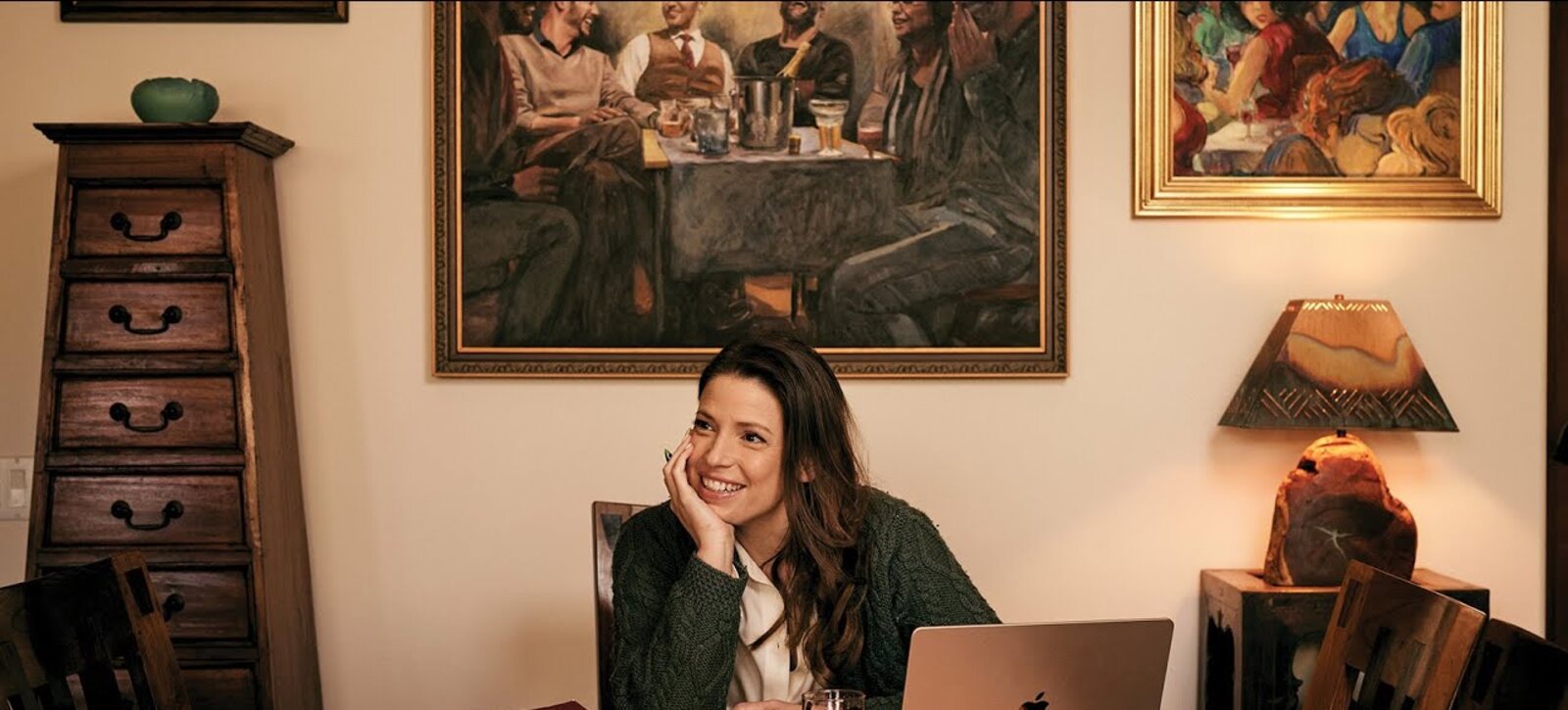
Image: Palm Springs Life
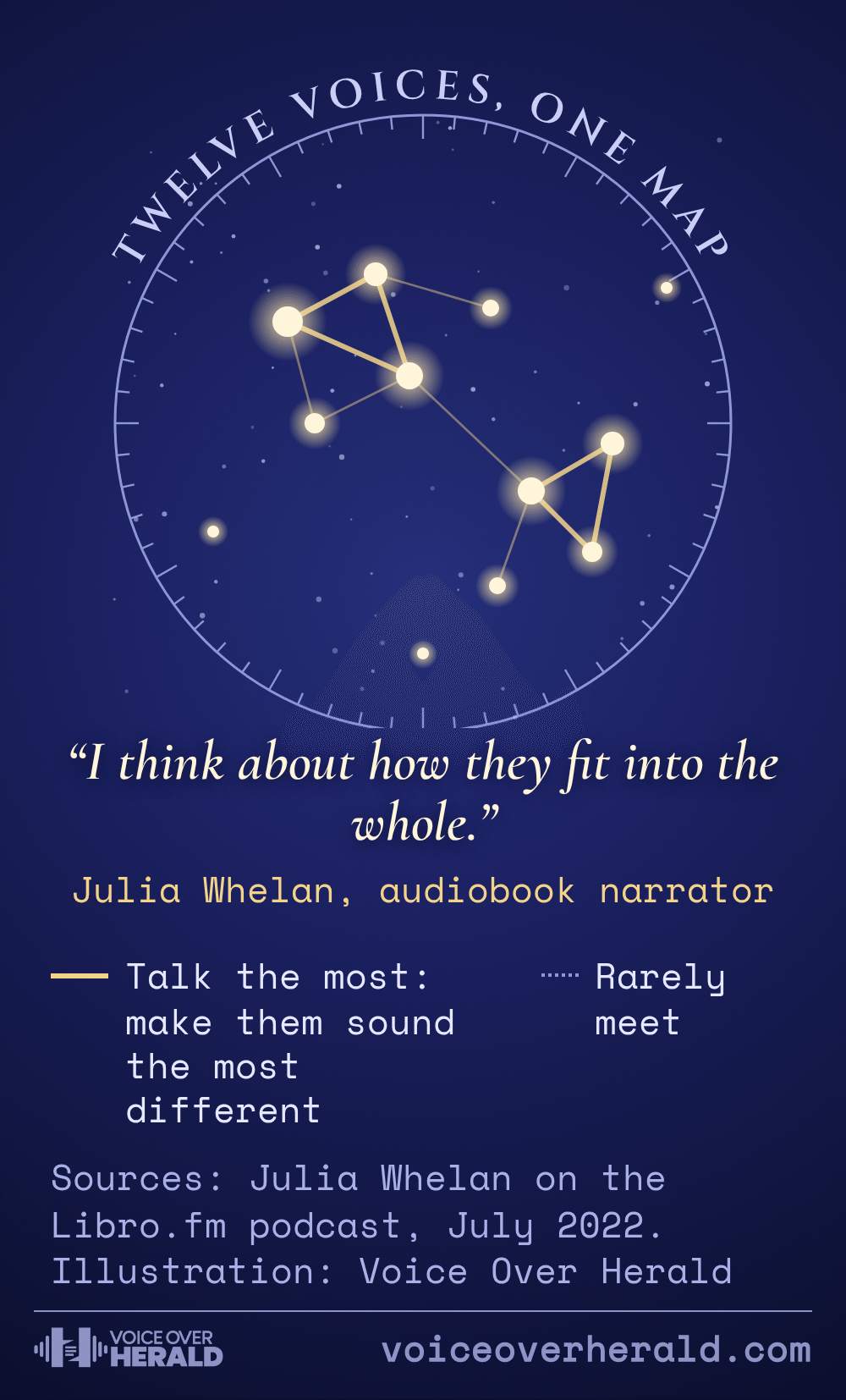
The clever part is what she does with the list. She writes down every speaking role and “any vocal traits that the author gives them,” then looks at who keeps ending up in scenes together. “So what are those constellations?” she asked on the Libro.fm podcast. The characters who talk to each other most are the ones whose voices have to be furthest apart, so she builds them as a group rather than one at a time. The nightmare version, she said, is a young adult novel set in a boarding school with a dozen teenage girls, where the whole job is to make each one clear to a listener.
Then there’s her series habit, which is worth copying by anyone who voices recurring characters in e-learning, games or long-running brand work. “If I am recording a book and a character opens its mouth, I am clipping that audio and putting it in a file in a folder for that series, because I don’t know if the author is going to bring that character back. Five books later.”
When a book has several narrators, the same files travel between them. “If you respect your fellow narrators, you’re doing that,” she said of swapping voice clips, while being realistic about the result: “we’re never going to sound like the other narrator.”
The instrument doesn’t get sick days
Ask her about a sore throat and the answer is instant. “It ruins everything,” she told the AP. “I’m probably the only person left who wears a mask on a plane at this point, but everything falls apart if I get sick. You’re messed up for three or four months.” In the years she was recording 70 books, she said, there was “no room for error.”
Some books are harder on the voice than others. War epics are the toughest, with a crowd of accents, action and shouting, and “the toll it takes on the actual instrument is a lot.”
She is blunt about what the job asks of the people who do it full time. “It’s demanding. It’s isolating, like you have to love it,” she said. When newcomers ask how to start, she points them to Narrators Roadmap, the free resource site built by fellow narrator Karen Commins. On a less patient day, she admitted, her advice is shorter: “Go read for eight hours in a closet.”
The money: no slice of the success
Here’s where Whelan stops being polite. “The only reason I was doing 70 books a year was because that’s how many books you have to do when you’re first starting out to keep your head above water because the rates are low,” she told the Associated Press. “It would be OK if there were a kickback for success, but narrators don’t get royalties.” Her summary of the economics: “the financial aspect makes zero sense.”
The comparison that stings comes from her own past. As a member of SAG and AFTRA, she still gets paid when her old screen work airs again. “I still get residual checks for things I did when I was 12. Yet, somehow, we did not benefit from either one of those systems,” she told Splash Magazines in 2024, meaning publishing royalties on one side and performers’ residuals on the other.
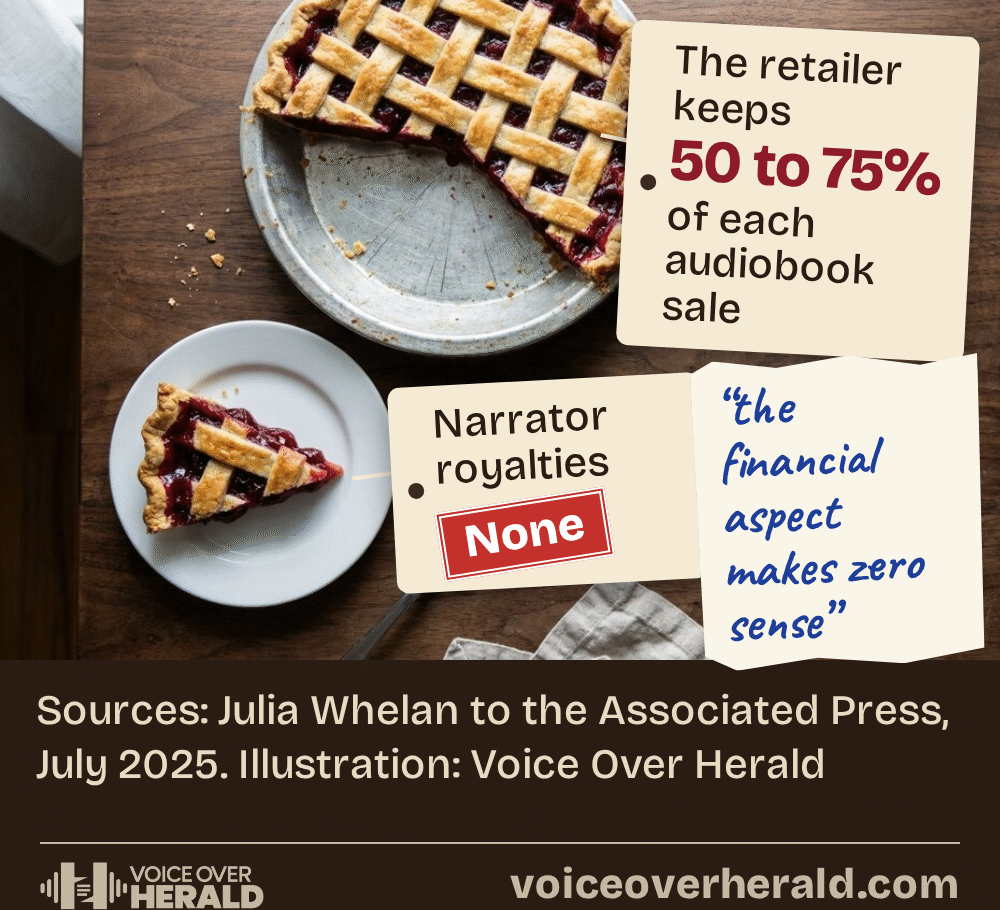
So she built her own company. Audiobrary, launched in 2024, describes itself as “a publishing and distribution platform devoted exclusively to human storytelling.” It sells straight to listeners, so a retailer doesn’t take its cut, and it shares the proceeds. “Audiobrary does a profit-share model with writers, who I also feel don’t get enough percentage of the pie, and a royalty share for narrators,” she said.
Audiobrary.com home page, screenshot taken 10 November 2026
On AI: candles, not panic
Whelan doesn’t pretend synthetic narration is going away. She sees the appeal plainly: a machine “can produce your audiobook much cheaper, and much faster. But it does not know what it’s saying.”
Her line on voice licensing is one every voice actor should pin above the desk. “I’m not someone who’s going to stand there and say, like, you should never license your voice or something. But you have to be able to protect where that goes,” she said, pointing to cases where voices licensed to one company ended up sold on to third parties.
By 2025 she sounded steady rather than scared. “I don’t lie awake at night worried, but everyone’s threatened right now,” she told the AP. Her bet is that human storytelling becomes the special thing, not the extinct one. “When electricity came about, candles didn’t go away. Now, candles are gifts we give people. They are specialized.”
What to take into your own booth
You don’t need 700 titles for her methods to pay off. Build your cast as a map, keep a clip of every recurring voice, and treat your health as the business asset it is. Then read every contract with her two questions in mind: does it pay you again when the work keeps earning, and where can your voice end up?
Or, as she put it while explaining why no two books get the same treatment: “Every book is different, everything requires a different approach.”
Sources: Associated Press interview by Alicia Rancilio (July 2025); Libro.fm podcast, episode 4 (July 2022); Splash Magazines, “Introducing Audiobrary” by Andrew DeCanniere (February 2024); Swooon at TV Insider (May 2026); Audiobrary.com; Wikipedia biography. Video and main image: Simon & Schuster Audio. Photo at her desk: Palm Springs Life.
Lee este artículo en español: Con 700 audiolibros narrados, Julia Whelan sigue empezando cada uno con un mapa de quién habla con quién
Know something about this story, or spotted an error? Tell the newsroom.